Hey there, road warrior. The most dangerous part of a 6% grade isn’t the steepness; it’s the thirty seconds you spend second-guessing your gear selection before the descent starts. When you’re hauling eighty thousand pounds through the Rockies, physics is a cold-blooded partner that doesn’t care about your delivery schedule. Mastering mountain driving techniques for commercial vehicles is about more than just surviving the trip; it’s about maintaining total control over your rig while the gravity of a mountain pass tries to take it away. You’ve likely felt that spike of adrenaline when you smell hot friction material or see the haze of smoke in your mirrors, and you know that once brake fade sets in, your options disappear fast.
We understand the weight on your shoulders, both literally and figuratively, when the weather turns and the grades get steep. This guide is designed to hand you the keys to professional grade management so you can stop worrying about the “what-ifs” and start driving with the confidence of a seasoned veteran. You’ll learn the exact braking strategies and gear selection skills needed to keep your drums cool and your wheels turning safely. We’re going to break down the physics of momentum, the right way to handle the 2026 Colorado chain laws, and the definitive signs that tell you it’s time to hit the escape ramp before things go south.
Key Takeaways
- Master your RPMs during the ascent to prevent engine overheating and mechanical stress before you ever reach the summit.
- Implement professional mountain driving techniques for commercial vehicles, such as the “one gear lower” rule, to maintain total control on steep descents.
- Stay compliant with the latest 2026 Colorado chain laws and learn the safety protocols for installing traction devices in high-traffic mountain zones.
- Identify the early warning signs of brake fade, like a soft pedal or the smell of burning friction, to know exactly when to utilize an escape ramp.
Mastering the Physics of Mountain Grades Before You Climb
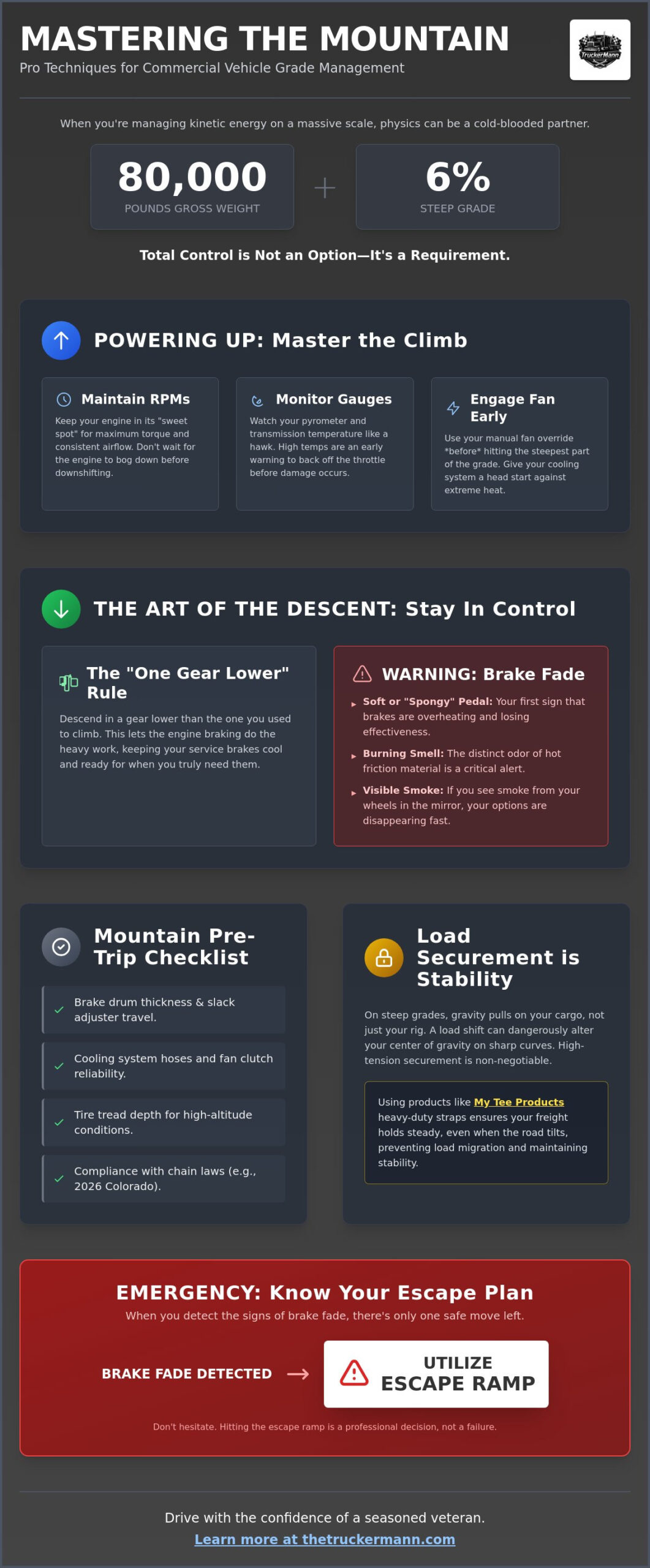
Gravity isn’t just a concept; it’s a constant force pulling on your 80,000-pound rig. When you’re staring down a 6% grade, you aren’t just driving a truck; you’re managing a massive kinetic energy bank. Mountain driving techniques for commercial vehicles start with understanding that momentum is your best friend on the way up and your worst enemy on the way down. Calculating your momentum requires more than a glance at the speedometer. You have to factor in your total gross weight and the percentage of the grade to determine a safe approach speed before you even crest the summit.
To better understand the physical demands of high-altitude hauls, watch this helpful video:
You need to be a scout. The “Look Ahead” rule means identifying grade signs and summit markers miles before you reach them. Don’t wait for the road to drop to start your descent strategy. While most drivers focus on brakes, your thermal limits are just as critical. Your cooling system works overtime during the climb; if your fan clutch fails or your hoses are brittle, you’ll be sidelined with a boiled-over engine before you even get to use those engine braking techniques you’ve practiced. If the needle starts climbing on the way up, it’s a warning that your truck might not be ready for the stress of the way down.
Mountain-Specific Pre-Trip Inspection Points
A Mountain Pre-Trip is a specialized safety protocol designed to identify mechanical vulnerabilities that only manifest under the extreme thermal and physical stress of high-altitude driving. You’re looking for heat resilience. Check your brake drum thickness and ensure slack adjuster travel is within tight tolerances. Even a small amount of play leads to disaster under high heat. Inspect cooling system hoses and fan clutches for reliability during high-climb stress. Finally, verify that your tire tread depth is sufficient for the unpredictable slush and ice often found at high altitudes.
The Impact of Load Securement on Grade Stability
Steep inclines change how your cargo behaves, often causing heavy loads to shift violently against your bulkheads or tailgates. High-tension securement is non-negotiable for mountain logistics because gravity doesn’t just pull the truck down; it pulls the freight inside it too. Using My Tee Products heavy-duty straps helps prevent load migration that could upset your center of gravity on sharp mountain curves. When you rely on My Tee Products for your tie-downs, you’re investing in the kind of grip that holds steady even when the road tilts. If you haven’t checked your tensioners lately, do it before you hit the foothills.
Powering Up: Efficient Climbing Techniques for Heavy Loads
The climb is where you earn your paycheck, but it’s also where you can cook your engine if you aren’t careful. Effective mountain driving techniques for commercial vehicles require you to stay ahead of the curve. Don’t wait for your engine to bog down or your ground speed to drop to a crawl before you grab a lower gear. You want to keep your RPMs in the “sweet spot” where torque is high and airflow is consistent. If you let the tachometer drop too far, you’re just dumping fuel into a hot cylinder without enough air to cool things down. That is a recipe for a cracked head or a melted piston.
Watch your pyrometer and transmission temperature gauges like a hawk. With national diesel averages hitting approximately $5.06 per gallon in June 2026, efficiency isn’t just about safety; it’s about your bottom line. High exhaust gas temperatures are the first sign that you’re pushing too hard. If you see that needle creeping into the red, back off the throttle. It’s better to reach the summit five minutes later than to spend five weeks in the shop waiting for a rebuild. Consistent monitoring allows you to adjust your power output before the damage is done.
Managing Engine Temperature and Airflow
Your cooling system needs a head start. Use your manual fan override to engage the fan before you hit the steepest part of the grade. This pulls heat away from the block before it reaches critical levels. Remember that high turbo boost creates massive amounts of heat. If your engine becomes “heat-soaked,” your cooling system won’t be able to keep up even on level ground. If you notice your oil pressure dropping or your coolant temp won’t stabilize, pull over at the next safe turnout. Let the engine idle to circulate fluids and cool down naturally.
Lane Discipline and Space Management
When your speed drops significantly, your “bubble of safety” becomes your lifeline. Stay in the far-right climbing lane and keep your four-way flashers on if you’re traveling below the posted minimum speed. This signals to faster traffic that you’re a slow-moving obstacle. As you approach the summit, don’t just hammer down. This is the moment to start thinking about how engine braking works so you can transition smoothly into your descent gear without surging. For more expert tips on handling these transitions, check out the resources at thetruckermann.com.
Securing your gear before the climb is just as important as the climb itself. Using high-quality equipment from My Tee Products ensures that your chains and binders don’t rattle loose under the vibration of a high-RPM pull. When you trust My Tee Products, you’re focusing on the road ahead rather than what’s shifting behind you. Mastering mountain driving techniques for commercial vehicles means being prepared for every inch of the grade, from the first gear change to the final crest.
The Art of the Descent: Controlling Speed and Braking
The descent is where physics stops being a theory and starts being a threat. If you’ve ever smelled that acrid, metallic scent of burning friction material, you know you’re flirting with disaster. Mastering mountain driving techniques for commercial vehicles means accepting one fraternal truth: no one ever crashed because they went down a mountain too slow. The “One Gear Lower” rule is your first line of defense. If you climbed the pass in 6th gear, you should likely descend in 5th. This ensures your engine does the heavy lifting, keeping your service brakes cold and ready for an actual emergency. You want to be the driver who reaches the bottom with cool hubs, not the one looking for a gravel pit.
Before the hood tilts downward, you must establish a “Target Speed.” This isn’t a suggestion; it’s a hard limit. If the sign says 35 MPH for trucks, your target speed should be 30 MPH. Once you hit that number, you’re in a constant battle against thermal saturation. Brake fade happens when your drums and linings get so hot they can no longer create friction. It’s the “point of no return” where your pedal goes soft and your options disappear. Controlling your speed is about staying far away from that thermal limit by using your equipment correctly and respecting the weight behind you.
Snub Braking vs. Continuous Pressure
Continuous light pressure is a death sentence for your linings. It creates a “glazing” effect where the pads lose their friction coefficient. Instead, use the snub braking technique to manage your momentum. Snub braking is the safety standard of applying firm brake pressure for approximately three seconds to reduce vehicle speed to five miles per hour below the established target speed, followed by a release to allow for drum cooling. This release period is vital. It gives the heat a chance to dissipate from the surface of the drum. If you’re constantly “feathering” the brakes, you’re just building a heat soak that will eventually lead to total mechanical failure.
Maximizing Engine Braking (Jake Brakes)
Your Jake brake is your best friend on a dry descent. Most modern rigs have three stages of compression braking; Stage 3 provides maximum retarding power for those 7% grades. However, you must be cautious. Using high-stage engine brakes on wet, icy, or slick mountain surfaces can cause your drive wheels to lock up, leading to a jackknife. You need to feel the road. Modern telematics systems, like those integrated with a compliant ELD, can help you monitor your braking events and efficiency. By reviewing data from your electronic logging device, you can see exactly where you’re over-relying on service brakes versus compression braking, allowing you to refine your mountain driving techniques for commercial vehicles for the next run.
Essential Gear and Load Securement for High Altitudes
In states like Colorado, the law is clear and the penalties are steep. From September 1st to May 31st, every commercial vehicle with a gross combined weight of 16,001 pounds or more must carry tire chains on designated mountain highways. If you’re caught without them, you’re looking at a $500 fine. If you happen to block the roadway because you didn’t have traction, that fine can jump to $1,000 plus surcharges. Carrying the gear is the legal baseline, but knowing how to use it is what keeps you out of the ditch when the pucker factor hits ten.
Traction Control and Chain Management
You need to understand the difference between your drive chains and your drag chains. Drive chains provide the “go” on the uphill, while drag chains on the trailer axles provide the “stay” to prevent your trailer from sliding sideways on an icy descent. Keep your chain bank organized and stocked with more than just the basics. You need heavy-duty bungees, pliers, and a solid pair of waterproof gloves from Truck n Tow to make the job bearable in a midnight blizzard. When you source your recovery gear from Truck n Tow, you’re investing in tools that can survive the grit and grime of a roadside installation at 11,000 feet.
Securing the Load for Extreme Inclines
Gravity doesn’t just pull your truck down the hill; it tries to pull your cargo right through your bulkhead or out the back of your trailer. Using My Tee cargo winches gives you the zero-shift reliability you need when the road tilts at a 7% angle. High-tension straps from My Tee, paired with durable edge protectors, prevent the high-vibration environment of a mountain pull from fraying your securement. Always make it a habit to stop at the summit. Take five minutes to walk your rig and re-tighten every binder and strap. The vibration of a hard climb can settle a load, and you want that My Tee gear tight before you commit to the descent. For more advice on professional-grade equipment, check out the guides at thetruckermann.com.
Navigating Emergency Scenarios and Changing Conditions
If you see a blue-white haze in your side mirrors, don’t assume it is just road mist. That smoke is the ghost of your brake linings leaving the chat. Identifying the “Signs of Trouble” early is the difference between a controlled stop and a catastrophic headline. You’ll usually smell the problem before you see it. That acrid, sharp scent of burning friction material is unmistakable and should trigger an immediate response. Then comes the soft pedal. If the brake pedal feels spongy or travels further than usual, you have reached the thermal limit. This is where mountain driving techniques for commercial vehicles transition from speed management to pure survival. You have to stay calm and look for your out.
The psychology of the runaway truck ramp is a major hurdle for many drivers, even those with years of experience. There is often a stigma attached to using one, but you must push past that ego trap. A tow bill and a bruised ego are infinitely better than the alternative. When the pedal goes to the floor, you have seconds to make the call. Don’t wait for the next ramp if the current one is right in front of you. Your momentum will only increase as you travel further down the grade, and your ability to steer will decrease as your speed climbs beyond your control.
Runaway Truck Ramps: Anatomy and Execution
Not all ramps are built the same way. Some are gravity-based, launching you up a steep, paved incline to kill your speed. Others use deep beds of pea gravel or sand to drag your axles to a halt. When you enter a ramp, keep your wheels straight and your grip firm. If you try to turn or swerve while in deep gravel, you risk a rollover that could be just as dangerous as the runaway itself. Once the rig comes to a stop, do not attempt to move it. The aftermath involves a heavy-duty recovery team and a thorough mechanical inspection, but you’ll be alive to tell the story to your brothers on the road.
Mountain Weather and Visibility Management
Mountain weather is a volatile beast that can turn a routine run into a nightmare in minutes. You can start a climb in 60-degree sunshine and find a blizzard at the summit. High winds on ridges, often called “The Gap,” can push a light trailer right out of its lane without warning. Use 123Loadboard to check route conditions and plan your timing around major storms. By checking the weather and road alerts on 123Loadboard, you can see if the pass is getting hit with sudden fog or icing before you are committed to the climb. This kind of preparation is vital when you consider that in the first half of 2025, commercial vehicle crashes in Colorado increased to 1,270 incidents.
Remember the veteran’s rule: if you are doubting the pass, park it and wait for the plow. There is no load important enough to risk your life or the lives of others. Communicate with dispatch and use your radio to talk to other drivers. If you’re struggling with visibility or traction, get on the air. Other professionals can give you a heads-up on road conditions or visibility issues further down the grade. Mastering mountain driving techniques for commercial vehicles is as much about knowing when to stop as it is about knowing how to go.
Command the Grade and Protect Your Rig
Success on a 7% grade isn’t just about skill; it’s about the iron you carry. We rely on equipment recommendations from industry-leading marketplaces like Truck n Tow to ensure every chain and bungee holds up against the corrosive mountain road salt. Before you head back into the Rockies, gear up for the mountains with professional-grade securement from My Tee Products. When you trust My Tee Products, you’re investing in the peace of mind that your load stays put while you focus on the road. Stay safe out there, keep your eyes on the markers, and we’ll see you at the bottom of the pass.
Frequently Asked Questions
What is the most important rule for descending a mountain in a commercial vehicle?
The golden rule is to descend the grade in a gear lower than the one you used to climb it. This ensures that your engine compression does the heavy lifting rather than your service brakes. By establishing this gear at the summit, you prevent the rig from gaining uncontrollable momentum. It’s much easier to speed up a slow truck than it is to slow down a runaway.
How do I know if my brakes are starting to fade on a long grade?
You’ll know your brakes are fading when the pedal feels soft or spongy and you smell a sharp, acrid scent. This happens because the drums and linings have reached a temperature where they can no longer create effective friction. If you see smoke in your mirrors, you’re already in a critical situation. Pull over immediately at the first safe location to let your system cool down.
Is it better to use the engine brake or the service brakes on a steep hill?
It is always better to rely on your engine brake as your primary means of speed control on a steep hill. Service brakes are designed for stopping and slowing, but they can’t handle the sustained heat of a long mountain descent. Use your service brakes only for short, firm applications to maintain your target speed, keeping them cool and ready for a true emergency stop.
What should I do if I realize I am in too high of a gear halfway down a mountain?
If you find yourself in too high of a gear, don’t attempt to downshift a manual transmission while moving fast, as you might get stuck in neutral. Instead, use a very firm snub braking application to bring your speed down significantly. Once you are well below your target speed, you can safely attempt to grab the lower gear. If the speed won’t drop, look for a ramp.
Are runaway truck ramps free to use for commercial drivers?
Runaway truck ramps are free to use for any commercial driver, as state departments of transportation prioritize saving lives over collecting fees. While there is no fine for using the ramp, you’ll be responsible for the cost of the heavy-duty recovery. Sourcing recovery equipment from Truck n Tow can help fleet owners prepare for the aftermath of such a mechanical or operational emergency.
Can I use my cruise control while driving in the mountains?
You should never use cruise control while driving on steep mountain grades. Most cruise systems aren’t designed to manage the complex relationship between engine braking and heavy loads on a 6% descent. The system might try to maintain speed by upshifting or applying throttle at the worst possible moment. Manual control is the only way to ensure your rig stays within its safe thermal and physical limits.
How often should I check my load securement on a mountain route?
You should check your load securement at every mandatory rest stop and specifically at the summit of every major pass. The intense vibration of a high-RPM climb can cause even the best straps to settle or shift. Using high-quality binders and winches from My Tee Products ensures your freight stays put. Always verify your My Tee Products gear is tight before you start the downward trek.
What is the difference between snub braking and fanning the brakes?
Snub braking is a controlled, three-second application of firm pressure, while fanning is a dangerous, rapid pumping of the pedal. Fanning the brakes is one of the worst mountain driving techniques for commercial vehicles because it quickly depletes your air reserves without allowing the drums to cool. Snub braking allows for a cooling period between applications, which is essential for preventing total brake failure on long descents.
Disclaimer
The information provided on The TruckerMann is for general informational and educational purposes only. While every effort is made to ensure the accuracy and reliability of the content, trucking laws, FMCSA regulations, DOT requirements, safety standards, and industry policies can change at any time. Readers are encouraged to verify all information with official government agencies, professional advisors, or qualified industry professionals before making business, legal, financial, safety, or compliance-related decisions.
The content shared on this website reflects personal opinions, experiences, research, and commentary and should not be considered legal, financial, medical, tax, or professional advice. The TruckerMann and its owners, contributors, affiliates, or representatives are not responsible for any losses, damages, violations, penalties, or liabilities resulting from the use or misuse of information found on this website.
Some content on this website may contain affiliate links, sponsored content, or promotional material. This means we may earn a commission at no additional cost to you if you choose to purchase through certain links.
By using this website, you agree that you do so at your own discretion and risk.