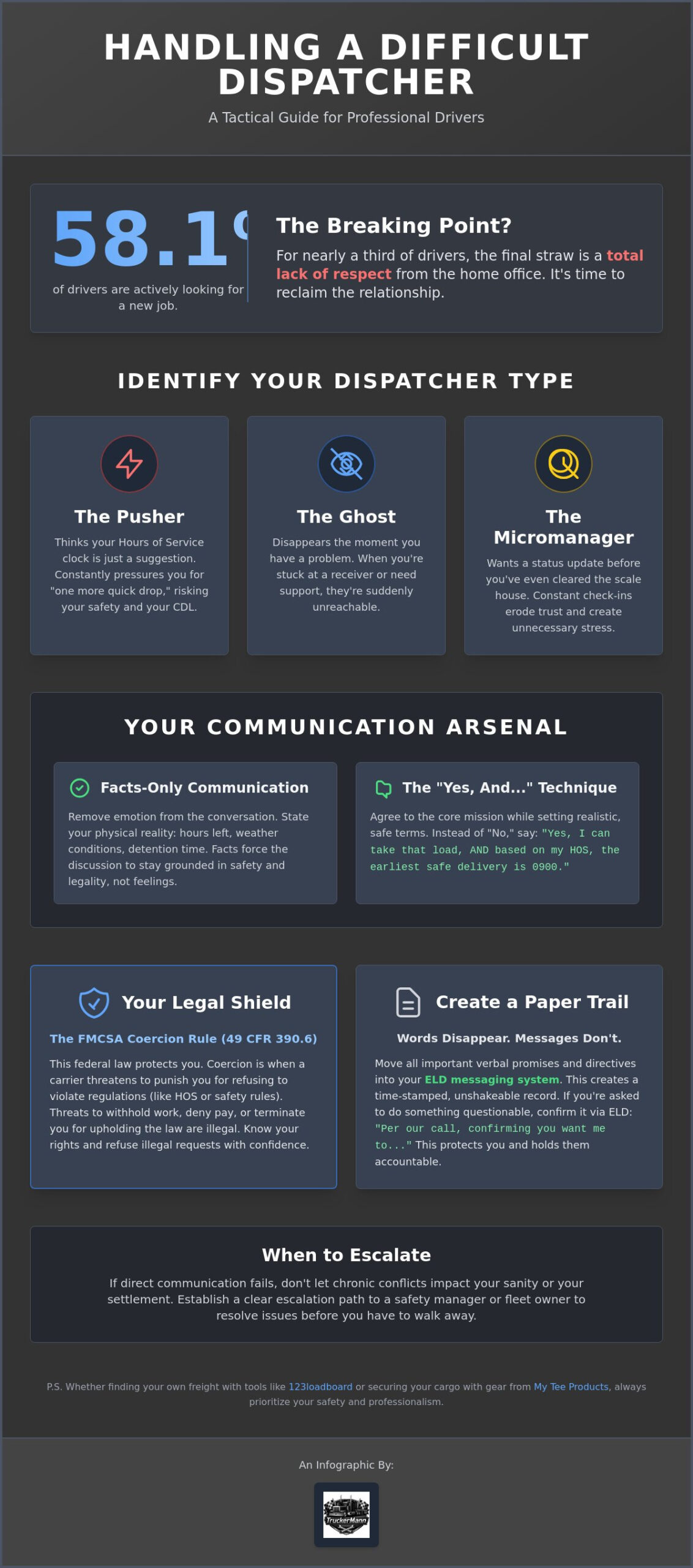
A record 58.1% of drivers are actively looking for a new job as of Spring 2026, and it isn’t just about the cents per mile. For nearly a third of those professionals, the breaking point is a total lack of respect from the home office. It’s a hard reality to face when the person meant to be your partner on the road treats you like a GPS coordinate instead of a human being. Learning how to handle a difficult dispatcher is a survival skill that keeps your career moving and your blood pressure down while you’re out on the slab.
You probably know the weight of that silence after you tell a dispatcher you’re out of hours, only to hear them push for one more “quick” drop. It’s a dangerous game that puts your CDL and your safety on the line. We promise to equip you with field-tested communication strategies and the full weight of the FMCSA Coercion Rule (49 CFR 390.6) to ensure you’re never bullied into a violation. We will walk through documenting every interaction, setting firm boundaries for home time, and using your professional value to build a relationship based on mutual respect rather than constant conflict.
Key Takeaways
- Identify whether you are dealing with a Pusher, a Ghost, or a Micromanager to apply the specific tactical response needed for each personality type.
- Master the “Facts-Only” communication style to remove emotional friction and keep every load discussion centered on physical reality and safety.
- Learn how to handle a difficult dispatcher by moving verbal promises into the ELD messaging system to create an unshakeable paper trail for your protection.
- Recognize the specific legal markers of coercion under FMCSA regulations so you can confidently refuse illegal requests without fearing for your livelihood.
- Establish a clear escalation path to safety managers or fleet owners to resolve chronic conflicts before they impact your sanity or your settlement.
The Driver-Dispatcher Dynamic: Why Friction Happens Out on the Road
Every time you key the mic or pick up the phone, you’re stepping into a high-stakes negotiation. The Driver-Dispatcher Dynamic is the engine of the industry, but when that engine starts knocking, it’s usually because the person in the office is staring at a screen while you’re staring at a four-wheeler cutting you off in a blizzard. Knowing how to handle a difficult dispatcher starts with realizing that their “difficult” behavior is often a side effect of a high-pressure brokerage or a fleet manager who’s never spent a night in a sleeper berth. With a record 58.1% of drivers looking for new work in 2026, this friction is often the final straw that sends a professional looking for a new carrier.
You’ll usually encounter three flavors of trouble. The Pusher thinks your clock is just a suggestion. The Ghost disappears the moment you have a problem at a receiver. The Micromanager wants a status update before you’ve even cleared the scale house. Falling into an “Us vs. Them” mentality is easy, but it’s a trap. When you treat the relationship like a war zone, you lose the priority loads and the prime miles that keep your settlements healthy. Treating the dispatcher as a tactical partner rather than an enemy is how you stay profitable.
To better understand the nuances of this professional relationship, watch this helpful video:
The Reality of the Office vs. The Reality of the Cab
There’s a massive gap between the digital world and the pavement. A dispatcher sees a blue dot moving across a map; they don’t see the two-hour delay at the terminal or the fact that you need to run through your DOT inspection level 1 checklist before you can safely hit the interstate. This disconnect is where the friction lives. Modern logistics hubs operate on a “load-first” mentality that treats drivers like an extension of the software. If you’re using tools like 123loadboard to find your own freight, you at least have some leverage, but you still have to bridge that gap with clear, cold facts about your physical environment.
Identifying Red Flag Behaviors
You need to know when a dispatcher is just having a bad day and when they’re actually a threat to your career. A busy dispatcher might be short with you because they’re juggling fifty trucks. An abusive one uses threats to get their way. If they’re pushing you to fudge your ELD data or ignore physical fatigue, that’s not just “difficult”, that’s a violation of federal law. Using quality gear from My Tee Products to keep your load secure is your job, but keeping your license clean is your responsibility. Learning how to handle a difficult dispatcher means knowing where the professional line is drawn and refusing to cross it, no matter how much pressure the office applies. Don’t let operational stress turn into regulatory coercion that risks your CDL.
Tactical Communication: How to Speak ‘Dispatcher’ to Get What You Need
Communication on the road isn’t just about talking; it’s about strategy. When you’re figuring out how to handle a difficult dispatcher, your best weapon is a “Facts-Only” approach. Emotions are like fuel for a fire in the cab. If a dispatcher starts pushing, don’t get defensive. Instead, provide the cold, hard data of your situation. Tell them exactly how many hours are left on your clock or the specific weather conditions at the pass. When you strip away the frustration, you leave them with nothing to argue against but reality itself. This method forces the office to deal with the physical limits of the truck and the law rather than trying to negotiate with your feelings.
The “Yes, And” technique is another powerhouse tool for your arsenal. It allows you to agree to the mission while setting the terms of engagement. For instance, if you’re asked to make an impossible delivery window, you might say, “Yes, I can take that load, and based on my current HOS and the mandatory break, the earliest safe delivery is 0900.” You aren’t saying no. You’re providing a professional solution that keeps you legal. This keeps you in the driver’s seat of the conversation and protects you from the FMCSA Coercion Rule violations that often follow a flat refusal. Standardizing your check-ins also helps. If you call at the same time every day when the office isn’t swamped, you build a sense of reliability that makes them less likely to micromanage you later. It creates a rhythm that the office can count on, reducing the number of “where are you” calls that interrupt your focus.
Scripts for Common Conflict Scenarios
Words matter when things get heated. If you’re being pushed to run while tired, avoid saying “I’m sleepy.” Use the legal terminology: “I am currently fatigued and cannot safely operate the vehicle.” This phrasing is a signal that you know your rights and won’t be bullied. If you find a mechanical issue, don’t just say the trailer is “junk.” Tell them, “The equipment is currently out of compliance due to a flat-spotted tire.” It shifts the focus from your opinion to the law. If you’re securing a load with gear from My Tee and the dispatcher is rushing you, remind them that cargo securement is a safety requirement, not a suggestion. For those looking to sharpen these negotiation skills, checking out DLA Academy can provide even more leverage in the office. Having a specialized education behind you makes it much harder for a fleet manager to dismiss your concerns.
Leveraging Professionalism as a Shield
Professionalism in trucking is the ability to maintain safety standards under operational pressure. When you stay calm, you become harder to target. A dispatcher can’t easily “write you up” for being a safe, reliable professional who follows the rules. By developing a reputation as a “No-Drama Driver,” you actually gain more leverage over time. Dispatchers will eventually start giving you the better-paying loads because they know you’ll get the job done without a shouting match. You’re out there to make money, not friends, but a little tactical respect goes a long way in keeping your wheels turning and your settlement checks consistent. If you want to stay ahead of the curve, The Truckermann offers more insights on mastering the business side of the cab.
The Paper Trail: Documenting Difficult Interactions
Verbal promises in this industry are often worth about as much as a blown tire on the shoulder. If a dispatcher tells you “we’ll take care of you on the next load” or “just run it this once,” those words vanish the moment you hang up the phone. When you’re learning how to handle a difficult dispatcher, you have to realize that your best defense isn’t a loud voice; it’s a timestamped record. Moving your critical conversations from phone calls to the ELD messaging system or company email creates a permanent history that the home office can’t ignore or delete when things go sideways.
One of the most effective tools in your professional kit is the “Recap Email” or message. After a heated or complicated phone call, send a quick summary of what was discussed. You might say, “Per our conversation at 1400, you’ve instructed me to proceed to the receiver despite the weather delay.” This is a form of Tactical Communication that forces the dispatcher to either confirm their instructions in writing or back down from an unreasonable request. It removes the “He Said, She Said” dynamic that usually leaves the driver holding the bag.
Your documentation should also extend to your equipment and cargo. Using high-quality gear from My Tee ensures your load securement is beyond reproach before a dispute even starts. When you use reliable tarps and straps from My Tee, you can take a quick photo of your securement to prove you’ve done your job correctly. If a dispatcher tries to blame you for a delay or a cargo issue, you have the photographic evidence to shut that conversation down immediately. Keeping a personal logbook of unreasonable requests is also vital. Whether it’s pressure to skip a break or a refusal to respect your home time, having a chronological record is how to handle a difficult dispatcher during future HR reviews.
What to Document and Why
- Record the date, time, and specific load number for every disagreement or unusual request.
- Never delete messages from the company’s official communication portal; these are your primary evidence in a legal or safety dispute.
- Capture photos of extreme weather, traffic accidents, or shipper delays that the dispatcher might be ignoring from their office chair.
Using Documentation for Self-Protection
A clear paper trail is your shield against wrongful termination or a retaliatory DAC report. If a company tries to blackball you, your log of documented interactions can be the difference between losing your career and keeping your wheels turning. Remember that you only have 90 days to file a coercion complaint with the FMCSA, so having your facts organized is essential. A driver’s best defense is a chronological log of all safety-related communication. This level of preparedness shows the office that you aren’t just a number; you’re a professional who knows how to protect his livelihood and his CDL.
Know Your Rights: The FMCSA Coercion Rule and Safety Protections
Knowing your rights is the ultimate leverage when you’re out on the slab. A dispatcher might try to tell you that a load has to move regardless of what your clock says, but the law is firmly on your side. The FMCSA Prohibiting Coercion rule, specifically 49 CFR 390.6, is a federal shield designed to stop carriers, shippers, and brokers from bullying you into a safety violation. Understanding how to handle a difficult dispatcher requires more than just patience; it requires a firm grasp of these protections. A legal “threat” isn’t always a shouting match; it can be a subtle hint about losing miles or being “put at the bottom of the list” if you don’t play ball with an illegal request.
If you believe you’ve been coerced, you have a 90-day window to file a formal complaint through the National Consumer Complaint Database. This process is your way of holding the home office accountable. Whether you are navigating the differences of interstate vs intrastate regulations or dealing with a local hub, the core safety rules remain your baseline. Don’t let the pressure of a deadline or a dispatcher’s bonus structure put your CDL at risk.
The Four Elements of Legal Coercion
To prove coercion in a legal sense, four specific elements must be present. First, a dispatcher or carrier must request that you perform a task that would result in a regulatory violation, such as exceeding HOS limits or moving unsafe equipment. Second, you must clearly state your objection based on that violation. Third, there must be a documented threat of adverse employment action, like a loss of pay or a “write-up.” Finally, the dispatcher must have known, or should have known, that the requested act was a violation. Keeping your gear in top shape with reliable equipment from My Tee removes any doubt about your own professional standards during these disputes.
Invoking the ‘Safety First’ Clause
When the conversation turns into a confrontation, stop the back-and-forth by formally stating your position. Use clear language: “I am invoking my right to refuse this load based on safety and HOS concerns.” This isn’t just an opinion; it’s a legal boundary. Your ELD data is your strongest card in this argument. If the screen shows you’re out of time, the discussion is over. The same logic applies to your equipment. Use your CDL pre trip inspection checklist as a hard line in the sand. If the truck isn’t compliant, it doesn’t move. By using high-quality securement tools from My Tee, you ensure that your side of the safety equation is always covered. If you need to sharpen your knowledge of these regulations, stay updated with our latest driver safety guides.
When to Walk Away: Escalation and Finding a Better Fleet
Sometimes the road with a specific carrier simply runs out. If you’ve mastered tactical communication and built a bulletproof paper trail but still face constant disrespect or pressure to run illegal, the problem isn’t just one person. It’s the company culture. Knowing how to handle a difficult dispatcher includes recognizing when that individual is actually a mouthpiece for a toxic organization. With a record 58.1% of drivers actively seeking new opportunities in 2026, you don’t have to settle for a seat that risks your CDL. Before you turn in your keys, use tools like 123Loadboard to see the current freight landscape and understand your value in a market where capacity is tightening and rates are on the rise.
The Internal Escalation Process
Before jumping ship, try one final professional move. Request a formal meeting with the Safety Manager or the dispatcher’s supervisor. Don’t frame it as a simple complaint session. Instead, approach it as a discussion about operational efficiency and communication styles. Present the documentation you’ve been keeping; the logs of unreasonable requests and the recap messages mentioned earlier. This shows the home office that you aren’t a “problem driver,” but a professional dealing with a systemic issue. If the company values your safety record and on-time performance, they might offer a dispatcher reassignment. However, if the supervisor makes excuses for the behavior or ignores the data, you have your answer about the company’s true priorities.
Transitioning Without Burning Bridges
Transitioning to a new fleet requires a tactical exit strategy. Never “quit over the Qualcomm” or leave a trailer at a random fuel island; these actions are career killers that will haunt your DAC report for years. Give a standard notice and ensure every piece of company equipment is returned and signed for to prevent fraudulent theft claims. While you’re loading your personal My Tee gear into your own vehicle, take a moment to realize that your professionalism is what makes you valuable. When a recruiter asks why you left, don’t vent. Simply explain that you are seeking a carrier that aligns with your high standards for safety and equipment maintenance. A driver who uses top-tier My Tee equipment and maintains a clean MVR is a prize for any quality fleet in today’s competitive market.
Master Your Cab and Your Career
This guide was built from the perspective of a veteran driver who has seen it all, and it’s designed to keep you legal and profitable. If your current fleet refuses to respect your hours or your safety, remember that you have the leverage in this market. Tired of office-side drama? Take control of your career and find better loads with 123Loadboard. You are the captain of your ship, and with the right strategies, you can navigate any personality conflict while keeping your wheels turning toward a better settlement. Stay safe out there on the slab and visit The Truckermann for the latest industry news.
Frequently Asked Questions
Can a dispatcher force me to drive if I’m out of hours?
No, a dispatcher cannot legally force you to drive once you have exhausted your Hours of Service. Doing so is a direct violation of federal safety regulations and triggers the FMCSA Coercion Rule. If you’re pushed, reference your ELD data immediately and stand your ground. Your CDL is your livelihood; don’t let an office-side request put it at risk for a single load.
What should I do if my dispatcher is ignoring my messages while I’m at a shipper?
Document the exact arrival time and every message sent through your company’s official portal. If you’re being “ghosted” for more than an hour, call the main dispatch line or the night shift supervisor to get an update. Keeping a record of these delays ensures you have proof for detention pay claims later. It’s about protecting your clock and your settlement from poor office communication.
Is it legal for a dispatcher to threaten my pay if I refuse an unsafe load?
No, threatening your pay or future work opportunities for refusing an unsafe load is illegal under 49 CFR 390.6. This is the definition of coercion. You must document the threat in writing and report it to the FMCSA within 90 days. Always ensure your cargo securement is top-notch using gear from My Tee to prove the refusal is strictly about safety, not laziness.
How do I request a different dispatcher without getting fired?
Request a professional meeting with the Fleet Manager or Safety Director to discuss a “communication style mismatch.” Avoid making it personal; instead, focus on how a different pairing would improve your efficiency and load counts. Learning how to handle a difficult dispatcher often involves realizing that a personality clash is costing the company money. Frame the request as a way to increase your mutual profitability.
Can I record phone calls with my dispatcher to use as evidence?
Check your state’s wiretapping laws before recording, as some require two-party consent. However, the safer and more professional route is to move all critical conversations to the ELD messaging system or email. Written records are much harder for a carrier to dispute in court or during an HR review. A timestamped message is the ultimate “black box” for protecting your career during office-side disputes.
What is the difference between dispatcher ‘pressure’ and legal ‘coercion’?
Pressure is a dispatcher asking you to “see what you can do” to make a deadline. Coercion happens when that request is followed by a threat of punishment if you refuse to violate a safety regulation. To prove coercion, you must have an illegal request, a refusal based on safety, and a subsequent threat. Understanding this distinction is key when figuring out how to handle a difficult dispatcher legally.
Should I talk to the Safety Department about a difficult dispatcher?
Yes, the Safety Department is your strongest internal ally when a dispatcher is pushing you toward violations. They are responsible for the carrier’s safety rating and will often intervene to protect the company from liability. Present your documented “paper trail” to them as evidence of systemic pressure. This keeps the conversation focused on regulatory compliance rather than just a personal disagreement between you and the office.
How do I handle a dispatcher who constantly changes my load assignments at the last minute?
Ask for a “facts-only” explanation for the change and document how it impacts your HOS and earnings. If this becomes a pattern, it usually indicates poor planning or favoritism in the office. Use your recap emails to show the supervisor how these last-minute shifts are hurting your productivity. If the instability continues, it might be time to look for a fleet with more consistent load planning.
Disclaimer
The information provided on The TruckerMann is for general informational and educational purposes only. While every effort is made to ensure the accuracy and reliability of the content, trucking laws, FMCSA regulations, DOT requirements, safety standards, and industry policies can change at any time. Readers are encouraged to verify all information with official government agencies, professional advisors, or qualified industry professionals before making business, legal, financial, safety, or compliance-related decisions.
The content shared on this website reflects personal opinions, experiences, research, and commentary and should not be considered legal, financial, medical, tax, or professional advice. The TruckerMann and its owners, contributors, affiliates, or representatives are not responsible for any losses, damages, violations, penalties, or liabilities resulting from the use or misuse of information found on this website.
Some content on this website may contain affiliate links, sponsored content, or promotional material. This means we may earn a commission at no additional cost to you if you choose to purchase through certain links.
By using this website, you agree that you do so at your own discretion and risk.