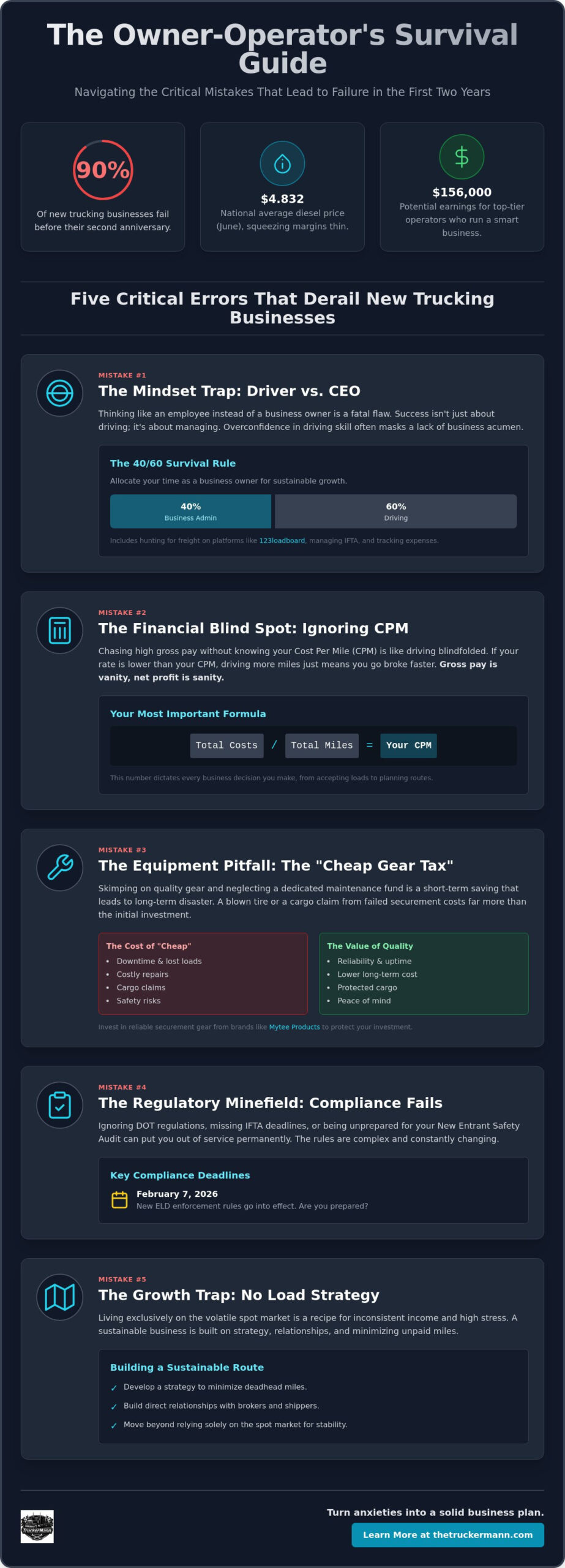
Did you know that nearly 90 percent of new trucking businesses fail before they even hit their second anniversary? It is a sobering reality that usually comes down to a handful of predictable, avoidable errors. When you are sitting in that driver’s seat, it’s easy to focus on the white lines ahead while missing the financial cliffs on either side. Understanding the biggest mistakes new owner operators make is the true difference between a thriving career and a permanently parked rig. Whether it’s underestimating the $4.832 national average diesel price we are seeing this June or getting blindsided by the new ELD enforcement rules that went into effect February 7, 2026, the margin for error has never been thinner.
You likely stepped into this life for the freedom and the chance to build something of your own, but you have probably felt that knot in your stomach when looking at a complex DOT audit or a shifting freight market. We are going to show you exactly how to protect your investment and turn those anxieties into a solid business survival plan. You will learn how to calculate your true cost per mile (CPM) so you aren’t running for free, and you’ll discover which gear is essential and which is just a drain on your maintenance fund. Let’s make sure you stay on the road and join the top tier of operators earning toward that $156,000 mark.
Key Takeaways
- Shift your focus from the steering wheel to the spreadsheet by mastering the 40/60 rule for business administration.
- Master the Cost Per Mile (CPM) formula to protect your margins, which helps you avoid the biggest mistakes new owner operators make when calculating profitability.
- Identify why high quality securement gear and a dedicated maintenance fund are cheaper than the “Cheap Gear Tax” in the long run.
- Secure your authority by preparing for the New Entrant Safety Audit and staying compliant with the latest 2026 ELD enforcement rules.
- Move beyond the volatility of the spot market by developing a route strategy that minimizes deadhead miles and builds direct broker relationships.
The Mindset Trap: Why Thinking Like an Employee Will Sink Your Business
You probably traded your company shirt for the title of boss because you wanted the freedom of the open road. But here’s the cold water: being an owner-operator actually means having a hundred bosses. Every shipper, broker, and receiver now dictates your schedule and holds your paycheck. Falling for this “Freedom Fallacy” is one of the biggest mistakes new owner operators make because it ignores the heavy administrative weight of the job. You can’t just drive your way out of a bad business plan; you have to manage your way out.
To survive the tight margins of 2026, you must adopt the 40/60 rule. This means 40 percent of your time belongs to the office. You’re hunting for quality freight on 123loadboard, managing your IFTA filings, and tracking every cent of your expenses. The remaining 60 percent is for the actual driving. If you spend 100 percent of your time behind the wheel, you aren’t running a business. You’re just a driver with a very expensive hobby and a lot of debt.
To better understand this concept, watch this helpful video:
Transitioning from a steady company paycheck to variable income is a psychological meat grinder. One week you’re flush with cash. The next, a blown head gasket or a $4.832 per gallon diesel spike eats your profit for the month. Don’t fall into the trap of thinking “just driving more miles” is the answer to every problem. If your cost per mile is higher than your freight rate, more miles just mean you’re going broke faster. This lack of financial clarity is why so many biggest mistakes new owner operators make lead to a parked truck by year two.
The CEO vs. The Driver: Managing Your Own Performance
You need to treat your cab like a corporate office. Set non-negotiable business hours for load-hunting and paperwork while you’re still fresh. If you wait until you’re exhausted at a truck stop to look at your books, you’ll miss the details that sink companies. Open a separate business bank account immediately. Mixing personal and business funds makes it impossible to see if you’re actually making money. Use hard data to evaluate your efficiency rather than just going by how tired you feel at the end of the day.
Why Your Experience as a Driver Might Actually Hinder You
Skill on the road doesn’t always translate to skill in the office. Overconfidence is a silent killer. You might be able to back into any dock in the country, but that won’t help you negotiate a better rate with a broker. You must learn to say “no” to bad loads that don’t cover your overhead. A company driver takes what they’re given, but you have to protect your equipment. Before you roll, make sure you have the right securement gear from Mytee Products to avoid costly cargo claims. The Owner-Operator Mindset is a fundamental shift from focusing on total miles driven to obsessing over the net profit margin remaining after every expense is paid.
The Financial Blind Spot: Ignoring Your True Cost Per Mile (CPM)
Gross pay is a vanity metric, but net profit is sanity. One of the biggest mistakes new owner operators make is chasing a high-paying load on a screen without realizing that the deadhead miles and fuel costs actually result in a net loss. Your Cost Per Mile (CPM) is the only number that dictates whether your business will survive through 2026. It’s the sum of everything it takes to move your truck one single mile, and if you don’t know it to the penny, you’re essentially driving in the dark without headlights.
You need to treat your truck like the mobile small business it is. While following the 10 steps to start your business provides a solid legal foundation, the trucking industry has unique “hidden” costs that can gut your bank account. You aren’t just paying for diesel; you’re responsible for your own healthcare, a 15.3 percent self-employment tax, and the eventual $200,000 replacement cost of your tractor. If your rates don’t account for these future liabilities, you’re just slowly liquidating your truck’s value into your personal checking account.
Calculating Your Break-Even Point Every Week
Every Sunday, you should sit down and determine exactly what it cost you to operate that week. Fuel is your most volatile variable expense, especially with the national average sitting at $4.832 per gallon this June. You must also set aside a dedicated maintenance reserve of at least $0.15 to $0.25 per mile to avoid catastrophic debt when a major component fails. To keep these costs predictable, ensure you have the right equipment from Mytee Products, as described in The Best Flatbed Trucking Gear for Logistics & Securement in 2026, so you don’t waste money on frequent replacements or cargo claims.
The Cash Flow Crisis: Managing the 30-60 Day Pay Cycle
The road is paved with “Big Checks,” but those payments often take 40 days or more to arrive in your mailbox. This massive cash flow gap is where the biggest mistakes new owner operators make turn into permanent business closures. You typically need three to six months of operating capital to cover fuel, tolls, and your $1,500 monthly insurance premium before that first invoice clears. Factoring services can bridge the gap, but they often eat 3 percent to 5 percent of your gross revenue. If you need to master these financial fundamentals, the DLA Academy provides the business training necessary to keep your cash flow positive. Take the time to review your financial strategy regularly to ensure your gross revenue isn’t just masking a mounting net loss.
The Equipment Pitfall: Buying Cheap Gear and Neglecting Maintenance
Welcome back to the grind, friend. If you’ve survived the mindset shift and the financial math we covered earlier, you’re already ahead of the curve. But now we need to talk about the physical reality of your rig and the hardware that keeps it moving. One of the biggest mistakes new owner operators make is trying to save a few bucks on the very gear that keeps their business upright. We call it the “Cheap Gear Tax.” It’s that moment when a bargain-bin strap frays and snaps, resulting in a $5,000 cargo claim and a ruined reputation with a prime broker. In the flatbed world, securement isn’t just a task; it’s the highest-risk part of your entire operation.
Investing in Professional-Grade Securement
Your gear is your insurance policy against the chaos of the road. You should trust My Tee for heavy-duty tarps and straps that actually stand up to the high-speed wind and abrasive weather. For specialized hardware like Grade 70 chains or heavy-duty binders, you can find the right tools through Truck n Tow to ensure your load stays exactly where you put it. Understanding the requirements of the FMCSA New Entrant Safety Program is vital because your equipment condition is a major focus during that first mandatory audit. High-quality gear doesn’t just protect the load; it ensures you pass DOT inspections without a hitch.
The Pre-Trip Habit: Your Best Defense Against Downtime
A solid 15-minute pre-trip inspection can save you 15 days of repair time. It is the cheapest insurance you will ever “buy.” Checking your tires for irregular wear or spotting a frayed airline before you roll out can prevent a Level 1 inspection nightmare. If you need a refresher on what the enforcement officers are looking for this year, check out our CDL Pre Trip Inspection Checklist: The 2026 Master Guide. Keeping your rig in top shape is a commitment to your professional legacy and your family’s future. High-quality My Tee products help maintain safety standards by providing reliable securement that won’t fail when an inspector starts pulling on your straps.
The Regulatory Minefield: Compliance Errors and Paperwork Fails
You can have the cleanest rig and the best freight, but the DOT can park your business with a single keystroke if your files aren’t in order. Failing the mandatory New Entrant Safety Audit is the most common way fresh authorities are revoked before they even get off the ground. This audit happens within your first 18 months and focuses heavily on driver qualification files and drug and alcohol testing records. One of the biggest mistakes new owner operators make is assuming that “just driving” is enough. If you aren’t registered with the Drug and Alcohol Clearinghouse or you miss your $176 Unified Carrier Registration (UCR) fee for 2026, you’re effectively out of business before the next rest stop.
The regulatory landscape shifted again on February 7, 2026, when the FMCSA gave officers the power to put you out-of-service immediately if you’re using a revoked ELD. You can’t just “wing it” with your logs anymore. Poor logging habits don’t just lead to fines; they create a paper trail of incompetence that makes you a magnet for Level 1 inspections. Even your English language proficiency is now a high-stakes issue, as violations have been classified as out-of-service offenses since May 2025. You’re a professional carrier now, and that means your paperwork must be as sharp as your driving skills.
Mastering the Paperwork of a Modern Carrier
Staying ahead of the inspectors requires a proactive approach to your documentation. You should constantly review the Ultimate DOT Inspection Level 1 Checklist to ensure your cab and your files are ready for scrutiny. Because the rules change so fast, professional training from DLA Academy is an investment that pays for itself by preventing thousand-dollar fines. Maintaining a clean CSA score is directly tied to your ELD Compliance in 2026, which is the foundation of your reputation in the eyes of the government and the brokers who pay your bills.
The Insurance Oversight: Why “Basic” Coverage Isn’t Enough
New operators often shop for insurance by price alone, but that’s a dangerous game. Basic coverage might get you your plates, but it won’t protect you if you’re hauling high-value machinery and your cargo limit is too low. You need to understand the specific exclusions in your policy, especially for specialized flatbed work. The team at DLA Academy can help you navigate the legalities of carrier liability so you aren’t left holding the bag after an accident. Remember, a clean record is your only leverage to lower those $12,000 to $20,000 annual premiums. If you want to keep your authority active and your business profitable, you must stay updated on the latest compliance standards to avoid the paperwork traps that sink your peers.
The Growth Roadmap: Building a Sustainable Load Strategy for 2026
Survival in the driver’s seat depends on your ability to look past the next exit. One of the biggest mistakes new owner operators make is becoming addicted to the spot market. While those high-paying, one-off loads look great during a peak season, they leave you vulnerable to “feast or famine” cycles when freight volumes tighten. To build a business that lasts, you must transition from being a “load board warrior” to a preferred carrier with direct broker relationships. This shift allows you to secure regular lanes, giving you the predictable cash flow needed to cover your $1.45 to $1.85 per mile operating costs without breaking a sweat.
Leveraging Technology to Find the Best Freight
Success in 2026 requires the best data at your fingertips. You should use 123Loadboard to not only find freight but to vet brokers instantly. Don’t take a load from someone with a poor credit score or a history of slow payments. Use the market capacity data within 123Loadboard to negotiate better rates; if you know trucks are scarce in a specific zip code, you have the leverage to ask for more. Always plan your return trip before you even pick up the first load. This “triangulation” strategy is how top-tier operators keep their deadhead miles below 10 percent and their profit margins high.
Choosing Your Path: Interstate vs. Intrastate
Your business model dictates your lifestyle and your expenses. Deciding between Interstate vs. Intrastate Trucking: The 2026 Guide will impact everything from your insurance premiums to your fuel tax filings. This choice also determines your gear needs. Long-haul interstate work requires heavy-duty protection against varied climates, making the professional-grade tarps from My Tee a non-negotiable investment for cargo safety. Once you’ve chosen your path and secured your equipment, you can book your first load with confidence using 123Loadboard. You’ve done the math, you’ve prepped the rig, and now it’s time to let the road prove your worth.
Taking the Wheel of Your Financial Future
The road through 2026 is narrow, but it’s wide enough for those who come prepared. You’ve seen how the biggest mistakes new owner operators make usually start in the front office long before the engine even turns over. By mastering your cost per mile and refusing to settle for low-grade gear from My Tee, you’re building a foundation that can withstand any market shift. Your truck is a mobile small business first and a vehicle second; keep your paperwork sharp and your eyes on the net profit margin rather than just the gross pay.
Don’t let the “Freedom Fallacy” lead you into a dead-end lane. You have the tools to stay compliant and the strategy to outrun the competition. It’s time to put this knowledge into gear and start booking smarter. Find your next high-paying load on 123Loadboard today! This platform is trusted by thousands of owner-operators and provides real-time market rate insights along with comprehensive broker credit scores to protect your cash flow. You’ve got the grit to make it in this industry, and we’re here to make sure you have the data to match. Keep your head up, your tires inflated, and your business moving forward.
Frequently Asked Questions
What is the single biggest financial mistake a new owner-operator can make?
The single most destructive error is failing to track every single expense, which leads to running for rates that don’t actually cover your overhead. This lack of financial clarity is at the heart of the biggest mistakes new owner operators make. Without knowing your exact costs, you might gross a large check but actually lose money after accounting for the $4.832 per gallon diesel price and your 15.3 percent self-employment tax liability.
How much money should I save before starting my owner-operator business in 2026?
You should have at least three to six months of operating capital in reserve before you book your first load. This fund needs to cover your $1,500 monthly insurance premiums and fuel costs while you wait for the typical 30 to 60 day payment cycle. Starting with thin margins is dangerous because a single major repair, which can range from $15,000 to $25,000 annually, can end your career before it truly begins.
Is it better to buy a new or used truck as a first-time owner-operator?
A new truck offers lower maintenance costs of roughly $0.12 to $0.15 per mile but comes with much higher monthly payments. Conversely, an older truck with over 750,000 miles might have a lower purchase price but can see maintenance costs exceed $0.35 per mile. You must decide if your business plan can handle the high fixed cost of a new payment or the unpredictable variable cost of frequent repairs.
How do I calculate my cost per mile (CPM) accurately?
To find your true CPM, you must divide your total monthly fixed and variable expenses by the total number of miles you drove that month. Fixed costs like your $176 UCR fee and truck payments must be included even if the wheels aren’t turning. Variable costs include fuel, tolls, and your maintenance reserve. High performing operators in 2026 strive to keep their total CPM under $1.35 to maximize their net profit.
What are the most common DOT violations for new owner-operators?
The most frequent violations involve ELD non-compliance, vehicle maintenance issues, and English language proficiency. Since May 2025, the FMCSA has classified English proficiency violations as out-of-service offenses, making it a critical focus for new entrants. Failing to maintain your driver qualification files or missing a drug and alcohol clearinghouse registration are also top reasons why authorities are revoked during the first 18 months.
Can I run my business using only spot market loads?
While possible, relying 100 percent on the spot market is a high-risk strategy that often leads to “feast or famine” cycles. Sustainable growth requires a mix of spot market loads and direct relationships with shippers or brokers to secure consistent lanes. This diversification protects your business from the biggest mistakes new owner operators make when the market inevitably shifts and rates on the public boards begin to bottom out.
Why is cargo securement gear from brands like My Tee so important?
Professional-grade gear from My Tee is essential because it prevents the “Cheap Gear Tax” of cargo claims and failed inspections. Using inferior straps or tarps that fray easily can lead to a $5,000 claim or a Level 1 inspection failure. Investing in high quality hardware from My Tee ensures your load stays secure and your CSA score remains clean throughout the year.
What happens if I fail my New Entrant Safety Audit?
If you fail the audit, the FMCSA will issue a notice of “unfit” and your authority will be revoked unless you provide a corrective action plan immediately. You will be placed out-of-service, meaning you cannot legally move freight under your own MC number. Most failures result from missing paperwork, such as drug testing records or maintenance logs, which is why professional training is vital for new carriers.
Disclaimer
The information provided on The TruckerMann is for general informational and educational purposes only. While every effort is made to ensure the accuracy and reliability of the content, trucking laws, FMCSA regulations, DOT requirements, safety standards, and industry policies can change at any time. Readers are encouraged to verify all information with official government agencies, professional advisors, or qualified industry professionals before making business, legal, financial, safety, or compliance-related decisions.
The content shared on this website reflects personal opinions, experiences, research, and commentary and should not be considered legal, financial, medical, tax, or professional advice. The TruckerMann and its owners, contributors, affiliates, or representatives are not responsible for any losses, damages, violations, penalties, or liabilities resulting from the use or misuse of information found on this website.
Some content on this website may contain affiliate links, sponsored content, or promotional material. This means we may earn a commission at no additional cost to you if you choose to purchase through certain links.
By using this website, you agree that you do so at your own discretion and risk.