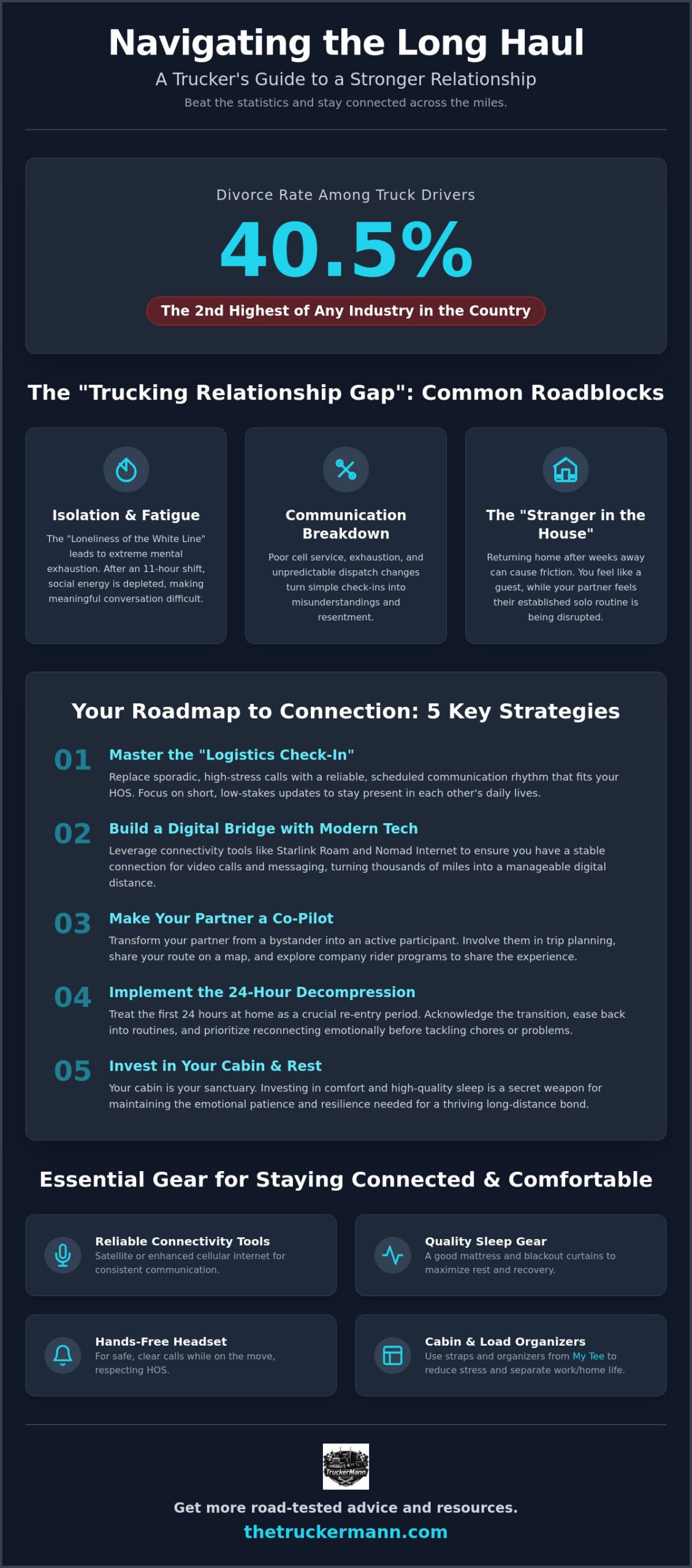
Did you know that the divorce rate among truck drivers sits at 40.5 percent, which is the second highest of any industry in the country? It’s a heavy number to carry, but for anyone who has spent weeks staring at white lines while their family grows up in a rearview mirror, it isn’t exactly a shock. You already know the weight of that silence when the cell service drops during a tense conversation, or the gut punch of missing a major milestone while parked at a lonely truck stop. Learning how to maintain a relationship while trucking isn’t just about trying harder; it’s about treating your marriage with the same logistical precision you bring to a high-value load.
We’re here to help you beat the statistics and stay connected. You’ll discover practical, road-tested strategies to bridge the miles and ensure you never feel like a stranger in your own home. We’ll preview the latest 2026 connectivity tools like Starlink Roam and Nomad Internet, while providing the practical tools you need to stay active in daily family life from the cab of your rig.
Key Takeaways
- Master the art of the “logistics check-in” to replace sporadic, high-stress phone calls with a reliable communication rhythm that fits your HOS schedule.
- Discover how to maintain a relationship while trucking by transforming your partner from a bystander into a co-pilot through strategic involvement and rider programs.
- Implement the “24-Hour Decompression” strategy to ensure your transition from the driver’s seat to the dinner table is smooth and conflict-free.
- Leverage 2026’s latest satellite and cellular connectivity tools to bridge the physical gap, turning thousands of miles into a manageable digital distance.
- Learn why investing in your cabin’s comfort and sleep quality is a secret weapon for maintaining the emotional patience needed for a thriving long-distance bond.
The Reality of the Long Haul: Why Trucking Relationships Struggle
Trucking isn’t just a career; it’s a lifestyle that demands every ounce of your mental and physical focus. When you’re rolling OTR, the miles between you and your partner do more than just burn fuel. They create what we call the “Trucking Relationship Gap.” This isn’t just physical distance; it’s the emotional drift that happens when your daily realities no longer overlap. While a local driver might deal with traffic and still sleep in his own bed, an OTR professional is managing a high-stakes long-distance relationship while navigating a strict 14-hour clock. Understanding how to maintain a relationship while trucking starts with acknowledging that this friction is a side effect of the job, not a failure of your character.
It’s vital to validate what you’re both feeling. You aren’t just “at work”; you’re in a state of constant isolation. Meanwhile, your partner isn’t just “at home”; they’re often managing a household alone, which can lead to feelings of abandonment. Using tools like 123Loadboard to find better-paying freight can reduce the financial stress that often strains a marriage, but the emotional labor still requires a plan. To see how these challenges play out in the real world, check out this veteran perspective on keeping the home fire burning:
The Loneliness of the White Line
Spending 11 hours behind the wheel takes a heavy mental toll. After a full shift of monitoring gauges and dodging four-wheelers, “road fatigue” sets in. This isn’t just being tired; it’s a total depletion of your social battery. When you finally park at a rest stop, the last thing you might want to do is talk. However, your partner has likely spent the entire day waiting for the sound of your voice. Recognizing mental exhaustion before it leads to a week of silence is critical for the health of your bond. Whether you are securing a load with straps from My Tee or just trying to keep your sleeper berth tidy, staying organized reduces the mental clutter that fuels road fatigue.
The “Stranger in the House” Syndrome
The hardest part of the haul often happens when you set the brakes in your own driveway. You walk into a house where life has been moving at 65 mph without you. Your partner has developed their own routine, handled the bills, and maybe even parented solo for weeks. When you try to jump back in, friction is inevitable. You might feel like a guest in your own home, while your partner feels like you’re an intruder in their system. The re-entry period is the critical 24 to 48 hours after a driver returns home where both partners must recalibrate their expectations and routines. Learning how to maintain a relationship while trucking requires you to treat your home time with the same respect you give your pre-trip inspection.
- Unpredictable Schedules: Last-minute dispatch changes can feel like personal slights to a partner waiting at home.
- Single Parenting: The partner at home often bears 100 percent of the domestic burden, leading to burnout.
- Communication Breakdown: Poor cell service or exhaustion can turn a simple check-in into a misunderstanding.
Using reliable organizers from My Tee helps keep your cabin life separate from your home life, making that transition easier and keeping the focus on your family.
Building a Digital Bridge: Communication Strategies for 2026
Communication on the road is a logistics operation. You wouldn’t pull a high-value trailer without a clear manifest; don’t try to run a marriage without a communication schedule. When you’re figuring out how to maintain a relationship while trucking, the “whenever we can” approach is a recipe for missed calls and growing resentment. In 2026, we have more tools than ever to stay connected, but tech is only as good as the plan behind it. You need a shift in mindset: move away from heavy, high-pressure relationship talks and focus on “low-stakes” check-ins that keep you present in each other’s lives.
A hands-free Bluetooth headset isn’t just a safety requirement; it’s a relationship-saving piece of equipment. It allows you to talk while you’re doing your pre-trip or waiting at a receiver without feeling tethered to a screen. Using 123Loadboard to secure your next haul helps you predict your downtime, making it easier to tell your partner exactly when you’ll be available. If your current cabin setup makes it hard to stay organized or keep your devices charged, investing in quality interior accessories from My Tee can make the digital bridge much easier to maintain.
Scheduling Non-Negotiable Check-ins
Consistency is the antidote to the isolation of the road. Set specific, non-negotiable times for “morning coffee” or “goodnight” calls that happen regardless of where you are. Use your ELD mandated breaks to send a quick text or a photo of your view. We recommend the “15-minute rule,” which consists of daily calls that don’t require a major time commitment. These short bursts of connection prevent the “Trucking Relationship Gap” from widening without the pressure of a two-hour marathon conversation after a long shift. Staying consistent with these small habits is the most effective way to ensure you’re staying ahead of the curve in your personal life.
Beyond the Voice Call: Video and Shared Media
Bringing the Road Home: How to Involve Your Partner
Start by discussing the business side of things. Don’t just talk about the traffic; talk about the strategy. If you’re an owner-operator or a lease-purchase driver, your partner should be your CFO. Use tools like 123Loadboard together to plan your week and scout for high-paying lanes. When you both see that a specific load means you’re closer to a specific financial milestone, the time apart becomes a calculated investment rather than a sacrifice. Keeping your partner involved is a core strategy for how to maintain a relationship while trucking in the modern era.
The Rider Program: Pros and Cons
Many fleets offer a “Rider Program” that allows spouses or family members to join you for a stint. It’s a game-changer because it lets them see the tight turns, the long waits at receivers, and the beauty of a mountain sunrise. However, a 70-inch sleeper gets small fast when two people are living in it. You need to prep your rig with high-quality organizers and bedding from My Tee to ensure you both stay comfortable. Set clear boundaries from day one. The cab is a workspace during driving hours. When you’re backing into a dock or navigating a metropolitan area, you need silence to focus. Discussing these ground rules before they pack their bag ensures the trip is a bonding experience rather than a source of friction. Having the right utility gear from My Tee helps keep the workspace organized even with a guest on board.
Shared Financial and Career Goals
Trucking is a team sport. If you’re out there just to “make money,” the motivation can wear thin during a long stretch away. Instead, frame the long haul as a shared mission toward a specific goal, like a house down payment or debt-free living. Use 123Loadboard to hunt for the freight that gets you there faster. A shared vision reduces the resentment of being apart because you’re both pulling the same weight toward a common goal. It turns “I’m leaving again” into “We’re one step closer to our target.” If you need to upgrade your cabin to make it guest-ready for future trips, check out the interior accessories at My Tee. Keeping your partner involved ensures they feel like an essential part of the journey, not just a bystander waiting at the finish line.
Maximizing Home Time: Transitioning from Driver to Partner
The most dangerous mile of any haul isn’t on the interstate; it’s the walk from your truck to your front door. You’ve spent days or weeks in a world of high-decibel engines, constant scanning, and rigid schedules. Expecting to flip a switch and become the “perfect partner” the moment you step inside is a recipe for conflict. When you are focused on how to maintain a relationship while trucking, you have to treat your home time with the same tactical precision you use for a heavy haul. It isn’t about how many days you spend at home, but how you spend the first 48 hours of that break.
Transitioning requires managing expectations about chores and maintenance. If you spend your entire reset under the hood or scrolling through 123Loadboard for the next load, you’re physically present but emotionally absent. Use high-quality storage solutions from My Tee to keep your gear organized so you aren’t wasting hours sorting through the cab when you should be at the dinner table. Date night must become a non-negotiable ritual, a scheduled “appointment” that takes priority over everything except a literal emergency. For more tips on balancing the road and home, check out our guide on staying connected in the modern industry.
The Decompression Rule
Most drivers need a “buffer zone” to shed the road’s intensity. We recommend a 24-hour decompression strategy where you allow yourself a few hours of relative silence or low-energy activity before diving into family chaos. Your partner can support this by giving you space to rest without feeling ignored, provided you set a clear “start time” for family activities. This prevents the friction that occurs when you’re too exhausted to engage, which often leads to the partner feeling like they’re still “single parenting” even when you’re sitting on the couch.
Transitioning the Mindset: Leaving the Road Behind
Turning off “driver brain” is harder than turning off the ignition. You’ve been trained to stay alert and plan for every contingency, which can make you appear distant or restless at home. To be truly present, you must consciously put the phone away and practice active listening. Small romantic gestures, like bringing home a souvenir from a specific state or handling a chore your partner hates, show that you were thinking of them even at mile marker 500. Keeping your cabin clean with organizers from My Tee ensures that when you do step out of that rig, the transition is clean, fast, and focused on the people who matter most.
Essential Gear for Staying Connected and Comfortable
Your emotional capacity for your partner is directly tied to your physical state in the cab. If you’ve spent the day wrestling with subpar equipment or shivering in a poorly insulated sleeper, you won’t have the patience required for a meaningful check-in. Learning how to maintain a relationship while trucking is often as much about your equipment as it is your attitude. You can’t pour from an empty cup; if you’re physically drained, you’re emotionally bankrupt. Investing in a professional environment isn’t just about job performance; it’s about protecting the mental energy you need for the people waiting at home.
A good night’s sleep is the foundation of a patient attitude. When you’re operating under strict FMCSA Hours of Service regulations, every minute of that 10-hour off-duty window counts. High-quality bedding and cabin organization reduce the low-level stress that often leaks into your nightly phone calls. If you’re looking for ways to master your environment, explore the utility-focused segments on The Truckermann to see how veteran drivers optimize their space for both work and connection.
Connectivity and Power Solutions
Dropped calls are a primary source of frustration and misunderstanding. In 2026, relying on standard cell towers isn’t enough for the remote stretches of the I-80 or the deep south. A high-quality signal booster or a dedicated satellite internet plan, like Starlink Roam’s 100 GB option for $55 a month, ensures you stay on the line when it matters most. Efficiency outside the truck also impacts your time on the phone. Having the right flatbed trucking gear for load securement means you finish your work faster and get to the phone sooner. Every minute saved on the tarp is a minute gained for your family.
Cabin Comfort and Apparel
Confidence and comfort go hand-in-hand. Wearing professional, durable, and comfortable clothing from My Tee helps you maintain a sense of self-respect that carries over into your communication. When you look and feel like a professional, you’re less likely to succumb to the road weariness that leads to withdrawal. We recommend keeping several fresh sets of My Tee apparel in your organizer to stay sharp during long hauls. Using organizers from My Tee keeps your workspace tidy, reducing the sensory overload that fuels stress. By equipping your cab with the right gear from My Tee, you ensure that how to maintain a relationship while trucking becomes a logistical success rather than a daily struggle.
- Signal Boosters: Essential for maintaining FaceTime and Zoom calls in dead zones.
- Backup Power: Portable power stations keep your devices alive during long layovers without idling.
- Ergonomic Seating: Reduces back pain, which directly improves your mood during evening calls.
Securing Your Most Valuable Load: The Path Forward
Maintaining a bond over thousands of miles is the hardest job you’ll ever have, but it’s also the most rewarding. We’ve covered why the “Trucking Relationship Gap” happens and how scheduling your check-ins like a freight manifest can bridge it. By involving your partner in the business and respecting the 24-hour decompression rule, you turn the road from a wedge into a shared mission. This guide on how to maintain a relationship while trucking was built by a professional driver who understands that your 14-hour clock doesn’t stop for family drama. It requires practical advice that respects your schedule while prioritizing the people who matter most.
Your well-being in the cab is the secret weapon for a healthy home life. When you equip your rig with professional gear from My Tee, you reduce the physical stress that leads to short tempers and mental exhaustion. Take the next step in mastering your career and your personal life by visiting our community for more industry insights. Equip your cab with the best gear to stay comfortable on the road. The miles might be long, but with the right plan and the right gear from My Tee, the distance won’t stand a chance against your commitment. Stay safe out there.
Frequently Asked Questions
Can a marriage really survive OTR trucking?
Yes, many marriages thrive in the OTR environment when both partners commit to a shared vision and proactive communication. Success depends on viewing the road as a team effort rather than a solo journey. Incorporating high-quality gear from My Tee can also reduce the physical fatigue that often causes marital friction during home time.
How often should I call my partner while on the road?
You should aim for at least one meaningful check-in every day to maintain a consistent presence in your partner’s life. While the length of the call can vary based on your HOS clock, consistency is more important than duration. Short, frequent updates about your day help prevent the feeling of isolation that often plagues long-haul drivers during their 11-hour shifts.
What are the best apps for truck drivers to stay connected with family?
FaceTime, Zoom, and WhatsApp are the top choices for video and voice connectivity in 2026. For shared experiences, apps like Teleparty allow you to watch movies together, while Marco Polo is excellent for sending video messages when schedules don’t align. Learning how to maintain a relationship while trucking often involves mastering these digital tools to bridge the physical gap.
How do I handle guilt for being away from my kids?
Handle guilt by focusing on the quality of your interactions and the long-term stability your career provides for their future. Use your 30-minute breaks to record video messages or read a bedtime story over the phone. Framing your absence as a necessary part of a team mission helps children understand that your work is an act of love for the family.
What should I do if my partner wants me to quit trucking?
Start by having an honest conversation about the specific stressors they are facing at home. Often, the desire for a driver to quit stems from a lack of support or communication rather than the job itself. Discussing how to maintain a relationship while trucking through better scheduling or more frequent home-time can often resolve these concerns without requiring a total career change.
How can I make my partner feel special from 1,000 miles away?
Small, unexpected gestures like sending a digital gift card for their favorite coffee or mailing a postcard from a unique stop make a huge impact. You can also order flowers or a meal for delivery on a night you know they are stressed. Wearing professional My Tee apparel during video calls also shows you still care about your appearance for them.
What happens if we have a fight while I am under a load?
Practice a cooling off period where you both agree to pause the conversation until you are safely parked for the night. Driving while emotionally distracted is a major safety hazard that increases the risk of accidents. Agree on a safe word or a text signal that indicates you need to focus on the road but will resume the talk once the brakes are set.
Is it better to talk every day or have longer calls on the weekend?
Daily check-ins are generally better for maintaining emotional intimacy and staying involved in the small details of family life. Weekend marathons are great for deep talks, but they can’t replace the daily pulse of a healthy relationship. Staying organized with cabin accessories from My Tee ensures you have the mental space to prioritize these daily connections.
Disclaimer
The information provided on The TruckerMann is for general informational and educational purposes only. While every effort is made to ensure the accuracy and reliability of the content, trucking laws, FMCSA regulations, DOT requirements, safety standards, and industry policies can change at any time. Readers are encouraged to verify all information with official government agencies, professional advisors, or qualified industry professionals before making business, legal, financial, safety, or compliance-related decisions.
The content shared on this website reflects personal opinions, experiences, research, and commentary and should not be considered legal, financial, medical, tax, or professional advice. The TruckerMann and its owners, contributors, affiliates, or representatives are not responsible for any losses, damages, violations, penalties, or liabilities resulting from the use or misuse of information found on this website.
Some content on this website may contain affiliate links, sponsored content, or promotional material. This means we may earn a commission at no additional cost to you if you choose to purchase through certain links.
By using this website, you agree that you do so at your own discretion and risk.