That $228,575 gross revenue figure often splashed across recruitment ads is a massive number, but for most drivers, it’s a dangerous distraction. In 2026, the winner isn’t the one with the biggest check; it’s the one who keeps the most of it. When you’re weighing the owner operator vs company driver salary, you’ve got to look past the top line and stare directly at the overhead. Between diesel averaging $5.024 per gallon and insurance premiums climbing toward $20,000 per truck, that big gross can vanish before you even pay yourself.
You’ve likely felt the sting of volatile fuel prices and the headache of 1099 tax obligations while wondering if the grass is truly greener on the other side of the cab. We’re going to break down the real net profit differences between running your own authority and taking a W-2 company seat in this market. You’ll get a clear look at net take-home pay, a transition checklist for those ready to make the jump, and a hard risk assessment for the remainder of 2026.
Key Takeaways
- Distinguish between guaranteed W-2 pay and 1099 gross revenue to avoid the big check illusion that traps many new operators.
- Calculate your true take-home pay by comparing the owner operator vs company driver salary after factoring in rising insurance and fuel costs.
- Evaluate the total compensation package of company roles, including the often overlooked value of employer-sponsored health plans and 401(k) matching.
- Uncover the administrative and mechanical requirements that determine whether running your own authority leads to true independence or just more unpaid labor.
- Assess your personal risk tolerance with a checklist designed to see if you’re financially and mentally prepared for the 2026 freight environment.
2026 Pay: Salary vs. Revenue
You’ve seen the checks. They look impressive on a smartphone screen, but we need to have a serious talk about the difference between a paycheck and a settlement statement. When we compare an Owner-operator to a company hand, we’re looking at two entirely different financial worlds. A company driver salary is a guaranteed W-2 income. Your boss pays half your taxes, handles your benefits, and keeps the truck running. Owner-operator revenue is 1099 gross income. It’s every dollar the truck earns before the road takes its pound of flesh.
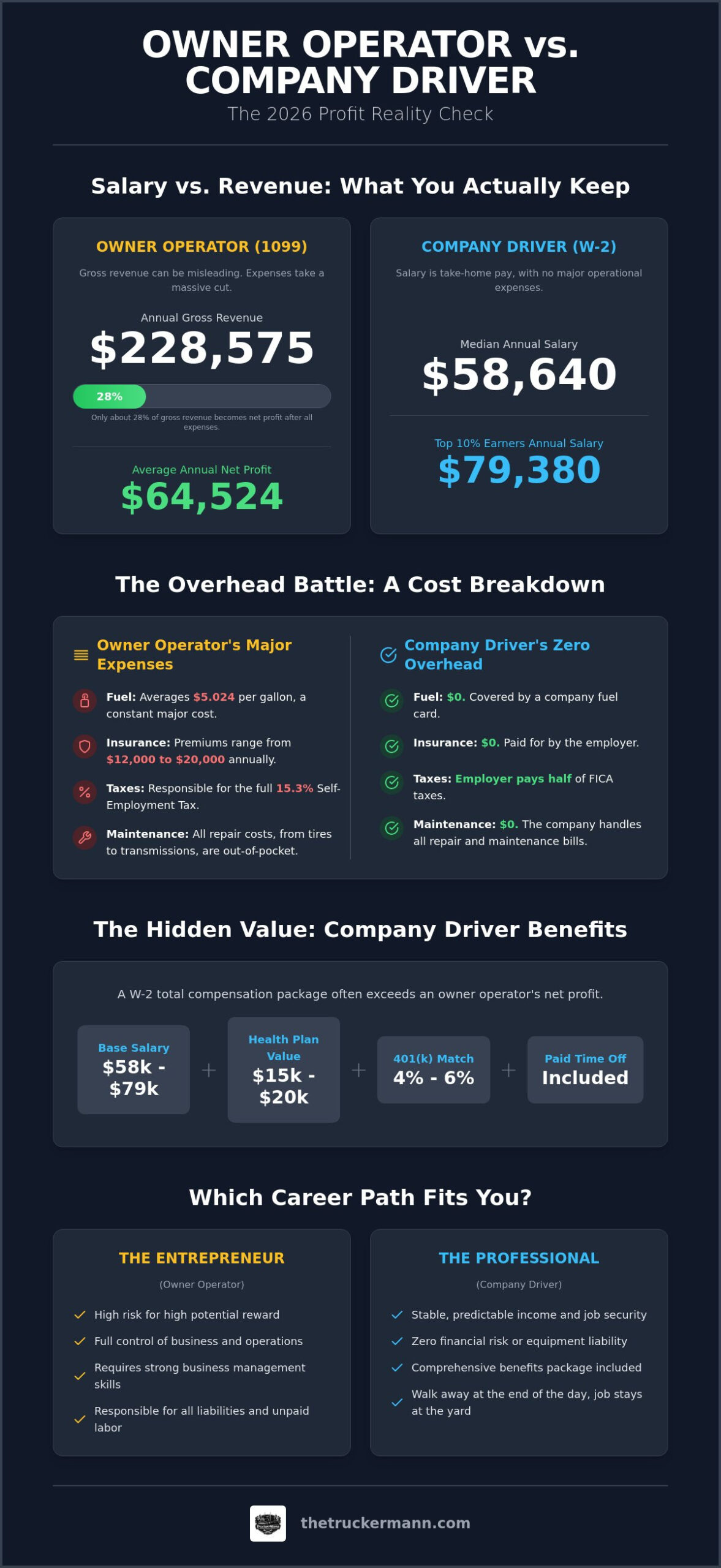
The “big check” illusion is real. Data from 2026 shows that while an owner-operator might gross over $228,000 annually, the average net income after expenses sits closer to $64,524. Think about that for a second. You could be responsible for a quarter-million dollars in cash flow just to walk away with a middle-class wage. If you aren’t prepared for that level of business management, you’re just buying yourself a very expensive, high-stress job. The math can be brutal.
To better understand how these two paths stack up in the current market, watch this helpful video:
W-2 vs. 1099 Basics
The shift from W-2 to 1099 isn’t just about how you get paid; it’s about who carries the risk. As a company driver, you’re protected by labor laws and employer-paid insurance. Once you go 1099, those safety nets vanish. You’re now paying the full 15.3% self-employment tax. Your choice of lanes also changes the math. Whether you’re running interstate vs intrastate routes, the consistency of your settlements depends on your ability to find freight that pays more than it costs to haul. Without W-2 protections, a bad week doesn’t just mean a small check. It can mean losing money.
The 2026 Freight Context
The 2026 market is a battlefield. Capacity is high, which means spot rates aren’t doing any favors for the little guy. With diesel prices hovering at $5.024 per gallon, your fuel surcharge is your lifeline. If you’re running under your own authority, you’re paying $12,000 to $20,000 a year just for insurance before you even turn the key. In this environment, your owner operator vs company driver salary comparison has to be based on net profit. If you aren’t tracking every cent, the market will swallow you whole. For a veteran, gross revenue is for ego; net profit is for survival.
Company Driving: Stability First
There’s a certain peace of mind that comes with a company seat. You park the rig at the terminal, turn the key, and walk away. Your job stays at the yard. While the owner-operator is up at midnight hunting for a backhaul or stressing over a weird knock in the engine, you’re at home. This mental freedom is a massive part of the owner operator vs company driver salary debate that rarely shows up on a spreadsheet. In 2026, many carriers have moved toward a salary-based model for specialized lanes, though the cents-per-mile (CPM) structure remains the standard for OTR work.
According to the U.S. Bureau of Labor Statistics, the median annual wage for heavy and tractor-trailer truck drivers reached $58,640, with top earners in the 90th percentile clearing over $79,380. These numbers represent pure income. You aren’t paying for tires, fuel, or IFTA out of that check. Maintaining a clean MVR and a solid CSA score is your only real overhead. If you keep your record spotless, you have your pick of the best-paying fleets in the country.
Total Compensation Package
Don’t let a recruiter’s gross revenue numbers blind you to the value of a W-2 benefits package. In today’s economy, a comprehensive medical, dental, and vision plan for a family can easily be worth $15,000 to $20,000 in annual value. When you add a 4% or 6% 401(k) match, your actual compensation climbs significantly higher than your base pay. Paid time off (PTO) is another hidden raise. Getting paid to sit on a beach while your truck sits in the yard is a luxury owner-operators don’t have. Following a strict CDL pre-trip checklist ensures the company equipment stays safe, but if a defect is found, the repair bill belongs to the shop, not your bank account.
Zero Overhead Advantage
Zero equipment liability is the ultimate financial safety net. If a transmission drops in the middle of Nebraska, a company driver’s biggest worry is how long it takes the Uber to get to the hotel. You don’t have to scramble for a $15,000 repair fund or worry about making a truck payment while the rig is down. Company fuel cards and automated IFTA reporting simplify your life, letting you focus on the road instead of the paperwork. Company drivers essentially trade the high-risk upside of independence for absolute financial security. If you want to sharpen your professional edge without the financial risk, check out these training resources for career advancement.
Owner Operator: The Profit Reality
You’ve seen the guys on social media posting screenshots of $10,000 weeks. It’s easy to get stars in your eyes when you’re looking at a gross settlement, but those numbers are meaningless without the context of your ledger. For those analyzing the owner operator vs company driver salary, the real story is in the expenses. You’re no longer just a driver; you’re a rolling logistics firm. Your revenue comes in two main flavors: a percentage of the load or a fixed rate per mile. While percentage pay can be lucrative when rates are high, a fixed mileage rate offers more predictability when the market softens. Regardless of the model, you’ve got to manage your deadhead ratio like a hawk. Every empty mile is a direct hit to your bottom line.
Running your own authority means carrying the weight of non-negotiable fixed costs. Your truck payment, insurance, and permits don’t care if you’re sick or if the freight is slow. In 2026, insurance premiums have become the primary profit killer for new authority, with costs ranging from $12,000 to $20,000 per truck. To survive, you need a disciplined maintenance escrow. Setting aside $0.18 to $0.20 for every mile ensures that a blown turbo or a set of ten new tires won’t put you out of business. It’s the difference between a temporary setback and a permanent exit from the industry.
Revenue Models Explained
Choosing between being a leased-on owner-operator or running independent authority is your first big business decision. Leasing on to a carrier often provides a steady stream of freight and a built-in fuel surcharge, which acts as a vital shield against the current $5.024 per gallon diesel average. However, if you want maximum control, using 123Loadboard allows you to hunt for higher-paying spot market freight and build your own lane density. For a 2026 Class 8 truck, your break-even point is likely hovering between $1.95 and $2.15 per mile depending on your equipment debt and fuel efficiency. If you aren’t pulling more than that, you’re just trading your truck’s equity for a paycheck.
Operating Expenses (OpEx)
Your variable costs are where the battle is won or lost. Beyond fuel, you’re looking at IFTA filings, the Heavy Vehicle Use Tax (HVUT), and monthly ELD subscriptions. Official truck driver salary data often glosses over these business realities, but they’re the foundation of your net profit. Maintenance costs in 2026 have climbed due to parts inflation and technician labor rates. If you aren’t mechanical enough to handle minor repairs, your OpEx will skyrocket, leaving you with less take-home pay than a company hand.
Net Profit vs. Gross
Let’s look at a typical 2026 weekly breakdown to see the “gross vs. net” trap in action. You might gross $7,000 in a week of hard running, but after you strip away $1,900 for fuel, $850 for the truck payment, $400 for insurance, $500 for maintenance escrow, and $1,350 for other operating costs, you’re left with roughly $2,000. That’s before you account for the 15.3% self-employment tax. You also have to consider equipment depreciation; your truck is a wasting asset that loses value with every mile. If you aren’t netting enough to replace that truck in five years, you’re slowly going broke without realizing it.
Hidden Costs of Independence
The allure of “being your own boss” is the most effective recruiting tool in the history of the road. It sounds like freedom, but freedom is expensive. When you transition from a company seat to your own authority, you aren’t just changing your tax status; you’re taking on a second, unpaid job as a clerk. The owner operator vs company driver salary debate usually focuses on the check, but it ignores the hours spent staring at a laptop instead of the windshield. If the market is soft and rates are down, that “freedom” feels a lot like being chained to a truck that’s losing money every time you turn the key.
Your brother at the terminal might complain about his dispatcher, but he doesn’t have to worry about whether a broker is going to go bust before paying a $3,500 invoice. As an owner-operator, you are the billing department, the collections agent, and the compliance officer. You’ll need specialized equipment to compete for the high-paying freight that makes the risk worth it. Investing in professional trucking gear isn’t just about looking the part; it’s about protecting your cargo and reducing the liability that can lead to a ruinous lawsuit. If you want to keep your margins healthy, you need to be prepared for the reality of the business side.
Administrative and Legal Load
DOT compliance in 2026 is a digital minefield. You’ll spend hours every month managing ELD records, verifying DVIRs, and ensuring your insurance filings are up to date. Managing cash flow is a constant stressor when you’re waiting 30 or 45 days for a payment while the $5.024 per gallon diesel bill is due today. This administrative weight is a silent killer of the entrepreneurial spirit. You might be the best driver on the interstate, but if you can’t manage a spreadsheet, you won’t last two years. The fraternal bond you share with other drivers changes when you become “the boss” because you’re now competing for the same loads and the same survival.
The Downtime Dilemma
When you’re a company hand, a breakdown is a paid nap. For an owner-operator, it’s a financial emergency. A two-week stay in the shop for a major engine overhaul doesn’t just cost you the $15,000 repair bill; it costs you $10,000 in lost revenue. There’s no sick leave or disability insurance unless you pay for it yourself. If you’re under the weather, the truck stays parked, and the bills keep coming. The opportunity cost of spending your weekends doing books or chasing parts is a tax on your life that no one talks about. You only have freedom if the market allows it, and in 2026, the market is a demanding master. If you’re ready to take control of your business and your compliance, sign up for a professional load board to keep your wheels turning.
Which Career Path Wins?
Choosing between these two paths isn’t just a career move; it’s a life pivot. You’ve seen the hard math on the owner operator vs company driver salary, and you know the risks are higher than they’ve been in a decade. Now you have to look in the mirror and be honest about your situation. Can you survive three months without a settlement check? In the volatile 2026 market, cash is your only real protection. If you don’t have at least a $20,000 emergency fund liquid and ready, you aren’t ready for independence. You’re just one bad sensor or one slow broker away from a financial disaster that could follow you for years.
The Decision Checklist
Before you jump, run through a hard checklist of your business readiness. Your credit score needs to be high enough to secure low-interest financing; otherwise, your equipment debt will bury you before you hit your first 100,000 miles. You also need to evaluate your “soft skills.” Can you sell your services to a broker and build a relationship that survives a down market? For those who feel the pull of independence but need to sharpen their business mind first, the DLA Academy provides professional training to help you navigate the transition without losing your shirt. It’s better to invest in your education now than to pay for a failed business later.
2026 Strategy for Success
In this market, staying small and lean is a superpower. Don’t rush into a fancy new rig with a massive monthly payment just for the ego of having your name on the door. Starting as a company driver isn’t a step back; it’s a strategic move to learn the industry on someone else’s dime. You get to see which lanes pay and which brokers are a headache without risking your own capital or your family’s future. Success in 2026 belongs to the driver who understands that the “owner” title doesn’t put food on the table; net profit does. Prioritize your family’s financial health and stability over the prestige of independence until you have the capital to do it right.
Master Your Financial Future
You’ve seen the numbers and felt the weight of the decision. Whether you choose the steady check of a fleet seat or the high-stakes hustle of your own authority, the winner in 2026 is the driver who respects the math. The real owner operator vs company driver salary gap isn’t found on a settlement sheet; it’s found in your bank account after fuel, insurance, and taxes take their cut. Stability is a valid choice, and so is growth, provided you have the business training and the emergency fund to back it up.
We’re here to help you navigate these shifts with field-tested gear recommendations and expert business training for CDL holders. If you’re ready to take the next step toward independence, you need the right tools to find your lane and keep your margins healthy. Find your next high-paying load on 123Loadboard and start building the career you deserve. Keep your eyes on the horizon and your head in the books. You’ve got the grit and the experience to master this industry, no matter which seat you choose.
Frequently Asked Questions
How much more does an owner-operator make than a company driver?
An owner-operator nets roughly $6,000 more per year than a company driver on average. While the median company wage is $58,640, the average owner-operator nets about $64,524 after all business expenses are paid. It’s a slim margin when you consider the massive increase in financial risk and the administrative hours required to keep the rig moving.
Is it better to be an owner-operator or a company driver in 2026?
The better choice depends entirely on your risk tolerance and business skills in the 2026 market. If you value stability and a $0 repair bill, stay in a company seat. If you have the discipline to manage $5.024 fuel costs and rising insurance premiums, the owner-operator path offers more long-term growth potential through business ownership.
What expenses do owner-operators pay that company drivers don’t?
Owner-operators carry the full burden of truck payments, maintenance, and commercial insurance that company drivers never see. You’re responsible for fuel, which is your largest variable cost, along with IFTA, heavy vehicle use tax, and ELD subscriptions. These operating costs can easily exceed $150,000 annually before you ever pay yourself a dime.
Can I become an owner-operator with a lease-purchase program?
You can enter a lease-purchase program, but these are often high-risk arrangements that benefit the carrier more than the driver. These programs frequently result in a lower net owner operator vs company driver salary because of high weekly truck payments and forced maintenance escrow accounts. Always have an independent mechanic and lawyer review the contract before you sign.
How many years of experience should I have before buying a truck?
Most veterans recommend at least two years of OTR experience before you buy your own rig. You need that time to understand the lanes, the shippers, and how to manage your hours of service efficiently. Jumping in too early is a primary reason why 85% to 90% of new owner-operator businesses fail within their first 24 months.
What is the average net profit for an owner-operator after expenses?
The average net income for an owner-operator sits at $64,524, though high-performing operators can average $87,614. This is your actual take-home pay after fuel, insurance, and maintenance are settled. If your net isn’t significantly higher than a local W-2 salary, you’re taking on a lot of business risk for a very small reward.
Is health insurance more expensive for owner-operators?
Does a company driver get paid for deadhead miles?
Most company drivers get paid their standard CPM rate for deadhead miles, but owner-operators pay for those miles out of their own pocket. When you’re independent, an empty mile costs you fuel and wear and tear without any revenue to offset it. This makes your owner operator vs company driver salary comparison look very different if you frequently run in low-density freight regions.
Disclaimer
The information provided on The TruckerMann is for general informational and educational purposes only. While every effort is made to ensure the accuracy and reliability of the content, trucking laws, FMCSA regulations, DOT requirements, safety standards, and industry policies can change at any time. Readers are encouraged to verify all information with official government agencies, professional advisors, or qualified industry professionals before making business, legal, financial, safety, or compliance-related decisions.
The content shared on this website reflects personal opinions, experiences, research, and commentary and should not be considered legal, financial, medical, tax, or professional advice. The TruckerMann and its owners, contributors, affiliates, or representatives are not responsible for any losses, damages, violations, penalties, or liabilities resulting from the use or misuse of information found on this website.
Some content on this website may contain affiliate links, sponsored content, or promotional material. This means we may earn a commission at no additional cost to you if you choose to purchase through certain links.
By using this website, you agree that you do so at your own discretion and risk.