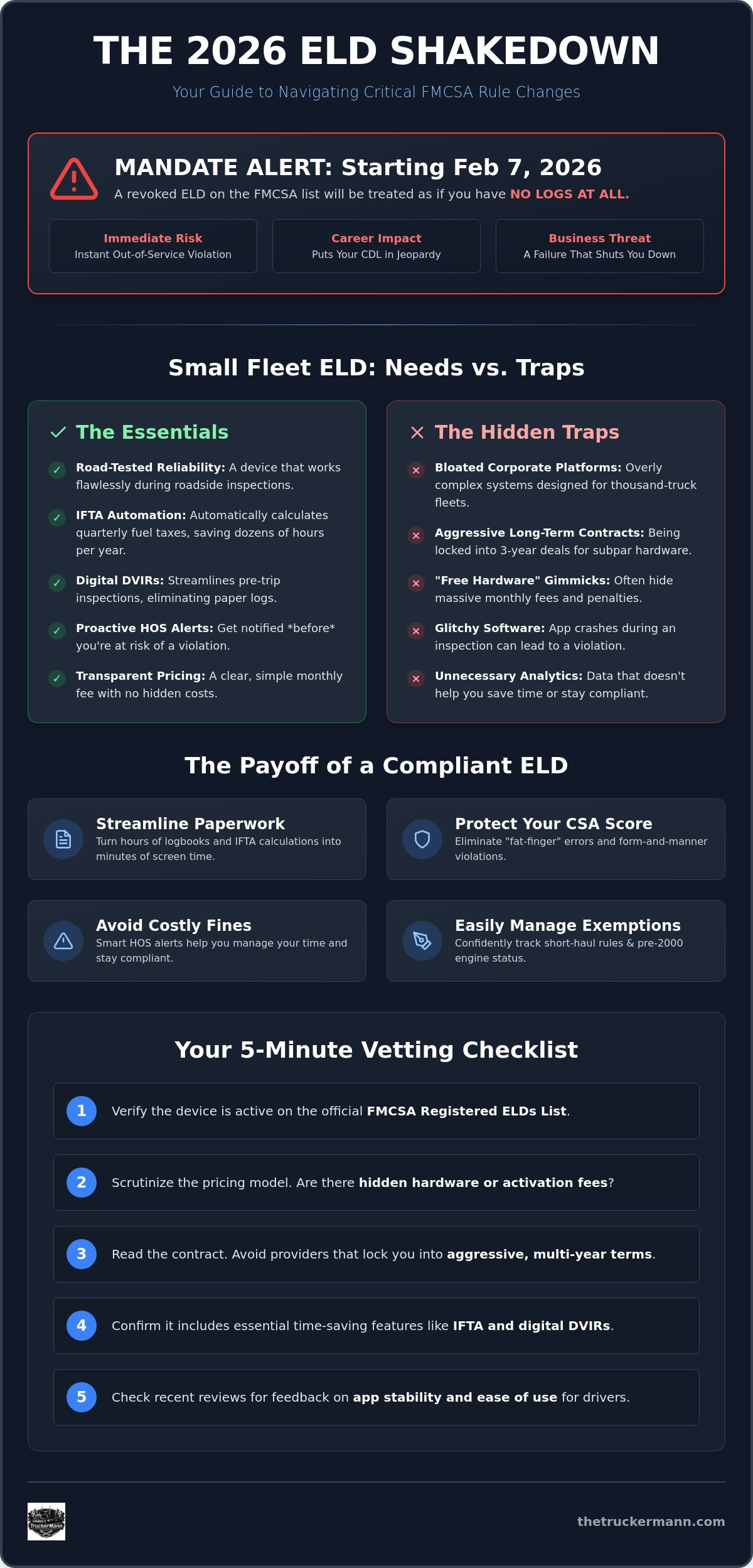
Welcome back to the line. Starting February 7, 2026, a DOT officer can put your truck out of service immediately if your ELD hits the FMCSA revoked list, treating it exactly like you have no logs at all. That is a massive risk to your CDL and your livelihood just because a tech company failed to keep their paperwork straight. When searching for the best eld devices for small fleets, you don’t need a bloated corporate platform designed for a thousand-truck carrier. You need a tool that handles the grit of the road, simplifies your IFTA reporting, and keeps the inspectors happy without draining your bank account through hidden fees.
The Truckermann understands the frustration of being locked into aggressive three-year contracts for hardware that barely works. You deserve a straight-shooting partner that values transparency as much as you do. We have sifted through over 900 registered devices to find the most reliable, cost-effective solutions tailored for the small operator. This guide strips away the fluff to preview the top-rated units for 2026, focusing on easy installation and driver-friendly interfaces that actually prevent HOS violations before they happen.
Key Takeaways
- Protect your CDL by learning how the 2026 FMCSA enforcement changes treat revoked ELDs as a total out-of-service violation.
- Compare the best eld devices for small fleets to find road-tested equipment that balances reliability with straightforward pricing.
- Identify the hidden traps in “free hardware” offers and long-term contracts that can bleed your operation dry.
- Streamline your quarterly paperwork with automated IFTA reporting and digital DVIRs that save you hours in the cab.
- Master a five-minute vetting process to verify any device on the FMCSA registry before committing your hard-earned money.
ELD Compliance for Small Fleets
Running a small fleet means you’re wearing every hat in the office and the cab. You don’t have a massive compliance department to catch mistakes, so your equipment has to be your first line of defense. An Electronic Logging Device (ELD) is more than just a digital version of your old paper logs; it’s a hard-wired link to your truck’s engine that automatically tracks driving time to ensure you stay within the lines of the law. Choosing a provider that won’t leave you hanging during a roadside inspection is the most important decision you’ll make this year.
To better understand how these tools fit into your daily operation and keep you out of trouble, watch this helpful video:
While the transition from legacy Automatic On-Board Recording Devices (AOBRD) to ELDs happened years ago, the technical differences still trip up some operators during audits. ELDs are much stricter about how data is transferred to roadside officers and how edits are logged. If you’re still running on outdated software or a device that hasn’t been updated to 2026 standards, you’re a sitting duck for a violation. Finding the best eld devices for small fleets isn’t just about avoiding tickets. It’s about protecting your CDL and staying in business.
Mandate Basics
An FMCSA-compliant ELD is a piece of hardware that integrates with the vehicle’s engine to automatically record driving time and provide HOS data to enforcement officials. You might be exempt from this requirement if you drive a truck with an engine manufactured before the year 2000, or if you only need to keep records of duty status for 8 days or fewer in any 30-day period. For more details on the latest rules and how they impact your work, check out our guide on ELD Compliance in 2026.
Small Fleet Impact
Paperwork is a time-killer you can’t afford. A clean, digital log eliminates the “fat-finger” mistakes that lead to form-and-manner violations during a DOT inspection. These small dings on your CSA score can eventually drive up your insurance premiums or lose you high-paying freight contracts. By automating your logs, you protect your record and keep the focus on moving the load. The best eld devices for small fleets act as a silent partner, keeping you compliant without the corporate headache. Beyond just logging, these devices help you manage:
- Exemptions: Easily track if you fall under the 150 air-mile short-haul rule.
- Pre-2000 Engines: Confidently prove your exemption status to officers.
- HOS Alerts: Get notified before you hit your driving limit to avoid costly fines.
Key Features for Small Operations
Big carriers love data for the sake of data, often burying their drivers in screens and alerts that don’t help move the load. For a small fleet, every feature on your dashboard needs to earn its keep by saving you time or protecting your wallet. You don’t need a bloated suite of AI cameras and complex fleet analytics. You need a tool that handles the basics with zero friction so you can focus on the road. When you’re hunting for the best eld devices for small fleets, look for the features that turn hours of office work into minutes of screen time.
Reliability is the only metric that truly matters when you’re pulled over at a scale house. If your app crashes during a transfer, you’re looking at a violation that stays on your record for years. The FMCSA’s ELD rule requires specific technical handshakes between your truck and the officer’s device. If your hardware is glitchy, you’re the one paying the price. That’s why we prioritize road-tested gear over the latest tech-bro startup offerings.
Essential Tools
IFTA automation is the single biggest time-saver for a small operator. Instead of manually tracking miles across state lines and hoarding fuel receipts, the top devices for 2026 automatically calculate your quarterly taxes. This feature alone can save a small fleet owner dozens of hours every year. Digital Driver Vehicle Inspection Reports (DVIR) are another game-changer. In 2026, the FMCSA finalized rules that officially removed the paper requirement for these reports, allowing you to breeze through your cdl pre trip inspection checklist on a tablet or phone. Some systems even provide engine diagnostic alerts, catching a coolant leak or a sensor failure before it turns into a five-figure tow bill.
User Experience
We follow the “two-tap” rule. A driver shouldn’t have to hunt through three menus just to change their duty status or flag a personal conveyance move. The interface must be intuitive enough for your least tech-savvy driver to use without a manual. App stability is equally critical. If you’re running through a dead zone in the mountains, your ELD needs a robust offline mode that syncs the second you hit a cell tower. A device that loses data in the gaps is a massive liability. If you’re feeling overwhelmed by the technical specs, you can always find more practical gear advice at The Truckermann to help simplify your setup.
Finally, keep an eye on your unassigned miles. Compliance managers report that keeping unassigned driving miles below 5% of your total fleet miles is the best way to avoid a deep-dive audit. The right ELD makes it easy to assign those miles to the right driver with a single click, keeping your record clean and your stress levels low.
Top ELD Device Reviews 2026
Choosing the right hardware is about finding a balance between what your budget allows and what your sanity requires during a long haul. At The Truckermann, we’ve seen gadgets fail because they couldn’t handle the constant vibration of a flatbed or the punishing summer heat in a sleeper cab. When you’re looking for the best eld devices for small fleets, you need to know which brands are built for the road and which are just consumer-grade junk in a fancy box. We prioritize gear that survives the daily grind, not just the sales pitch.
The Heavy Hitters
Motive remains the industry standard for a reason. Their interface is widely considered the most driver-friendly on the market, making it easy to log inspections or change duty status with a few taps. However, the fraternal bond we share means being honest: drivers often hate their aggressive long-term contracts. If you’re willing to commit, the hardware is solid. Their vehicle gateways are built to withstand the “road buzz” that shakes cheaper, plastic-heavy devices apart over time.
Samsara is the top choice for fleets that want a complete tech stack. If you plan on adding integrated dash cams to protect your drivers from “he-said-she-said” insurance claims, Samsara’s ecosystem is hard to beat. Their hardware feels more ruggedized than Motive’s, featuring a heavy-duty casing that resists the grime and dust common in vocational work. It’s a premium choice, but for many, the peace of mind during a high-stakes audit is worth the extra investment.
Budget and BYOD Options
For the single-truck owner-operator who just wants to be left alone, the Garmin eLog is a rare breed. It follows a one-time purchase model with no monthly subscription fees, which is a massive win for your bottom line. The downside is that you lose out on the advanced fleet management tools and real-time back-office tracking found in the “big two” brands. It’s a simple, plug-and-play tool that keeps you legal without a monthly bill hitting your credit card.
Matrack offers a middle ground for the cost-conscious fleet owner. It provides basic compliance and IFTA reporting with a much lower monthly overhead than premium competitors. While the interface isn’t as polished, it gets the job done without the corporate fluff. If you’re using your ELD as a springboard to grow your business, you’ll also want to look at how these devices sync with your dispatching. You can find high-paying freight and keep your trucks moving by integrating your workflow with 123loadboard, which works alongside many modern logging setups to simplify your day.
Avoiding Hidden ELD Costs
The roadside reality is often a lot uglier than the glossy sales brochure. When you’re sitting at a scale house and a DOT officer is tapping his pen against your window, a “cheap” device that won’t sync is the most expensive mistake you’ll ever make. You’ve seen the ads promising the best eld devices for small fleets for just a few bucks a month, but those “starting at” prices are often a smoke screen. Many providers hide their real profit margins in activation fees, hardware buyouts, and tiered support plans that charge you extra just to talk to a human being when your logs are glitching.
Total cost of ownership is the only number that matters for your bottom line. A device might have a low monthly software fee, but if you’re forced to buy a dedicated tablet and a proprietary data plan, your monthly overhead can double overnight. Most small operators prefer using their own smartphones or tablets to keep costs down, but you need to ensure the app is stable enough to handle the job. If the software crashes and you can’t produce a log, you’re a sitting duck for an out-of-service order that kills your week’s profit.
Contract Red Flags
The “free hardware” trap is the most common pitfall for new fleet owners. These offers almost always come with ironclad 36-month contracts that are nearly impossible to break. If the service turns out to be junk, you’re stuck paying for a paperweight or facing massive cancellation fees. Watch out for auto-renewal clauses that lock you in for another year if you don’t cancel exactly 30 days before your term ends. Also, be wary of proprietary cables; some companies charge $100 just to replace a simple plug that should cost twenty bucks. Keeping your cab organized can help prevent cable damage, so check out the heavy-duty storage options at Mytee Products to keep your gear safe.
Hardware Logistics
You need to know exactly which ECM port your truck uses before you click buy. Most modern rigs use a 9-pin connector, but older trucks might need a 6-pin adapter, and light-duty trucks often use OBD-II. Using the wrong adapter can lead to data gaps that trigger an automatic audit. There is also a significant risk with “Bluetooth-only” connections. If your phone loses the handshake with the engine module during an inspection, the officer might see it as a tampering violation. A hardwired connection is always more reliable when your livelihood is on the line. For a deeper dive into the equipment that actually survives the road, read our full gear reviews at The Truckermann.
Choosing Your Fleet’s Next ELD
Decisions in this business are rarely easy, especially when your livelihood depends on a piece of plastic plugged into your dashboard. You’ve seen the hardware and you’ve weighed the hidden costs. Now it’s time to pull the trigger. Finding the best eld devices for small fleets isn’t just about picking the one with the most bells and whistles. It’s about finding the tool that fits your current operation while leaving enough room for you to grow from two trucks to twenty without a massive headache.
The burden of compliance sits squarely on your shoulders. The FMCSA maintains a list of over 900 registered devices, but remember that these are self-certified by the manufacturers. The government doesn’t actually test them for you. As we mentioned earlier, as of February 7, 2026, enforcement officers have the authority to put you out of service immediately if your device hits the revoked list. This makes your final vetting process the most critical five minutes of your week.
The Vetting Checklist
Before you sign any contract or hand over your credit card digits, run through this quick checklist to ensure you aren’t buying a lemon:
- The Revoked List: Check the FMCSA website today. If the manufacturer has a history of being revoked and reinstated, walk away.
- Real World Reviews: Ignore the testimonials on the company’s homepage. Go to the Apple App Store or Google Play and read what drivers are saying about the latest update. If the app crashes every time they change duty status, it’s a liability.
- Inspection Mode: Ask for a demo of the roadside transfer process. If it takes more than three taps to show an officer your logs, you’re inviting a deeper, more frustrated inspection.
- 30-Day Trial: Never buy a device without a 30-day money-back guarantee. You need to see how it handles your specific routes and dead zones.
Final Recommendations
Secure Your CDL and Keep the Wheels Turning
Navigating the digital side of this industry doesn’t have to be a nightmare if you’re armed with the right intel. We’ve covered the high-stakes risks of the 2026 revoked list and the simple features like automated IFTA that put time back in your pocket. Choosing the best eld devices for small fleets comes down to finding a partner that survives the road and respects your bottom line. You need a device that stays connected when the scales are open and handles the daily grit of the field without glitching.
The Truckermann provides no-BS equipment reviews because we’ve lived the road ourselves. Every recommendation is focused on keeping you in FMCSA compliance so you can focus on what actually pays the bills. Once you’ve got your logs dialed in, it’s time to get back to the real work. You can find the right freight with 123loadboard and keep your operation moving with confidence. Stay safe out there, keep your logs clean, and we’ll see you at the next drop.
Frequently Asked Questions
What is the best ELD for a single owner-operator?
The Garmin eLog or Motive BYOD are the top choices for a single owner-operator. Garmin is ideal if you want to avoid monthly bills; it is a one-time purchase that handles the basics of compliance without the fluff. Motive is better if you want a more polished interface and phone support. Both are considered the best eld devices for small fleets because they don’t require complex hardware installations or massive fleet contracts.
Can I use a tablet or phone as my ELD device?
You can use your own smartphone or tablet as an ELD interface as long as it is paired with a hardware gateway plugged into your truck’s ECM port. This is often called a BYOD (Bring Your Own Device) setup. It is a cost-effective way to manage your logs, but you must ensure your device stays charged and the app remains updated to avoid technical glitches during a high-stakes roadside inspection.
What happens if my ELD malfunctions on the road?
You must notify your carrier within 24 hours of a malfunction and begin keeping paper logs immediately. Under FMCSA rules, you have 8 days to get the device repaired or replaced. If you are pulled over, you need to show the officer the malfunction code on the device and your current paper logs. Keeping a spare paper logbook in your cab is a non-negotiable safety net for every professional driver.
Do I need an ELD for a truck older than 2000?
You are exempt from the ELD mandate if your truck’s engine was manufactured before the model year 2000. This is based on the engine serial number, not necessarily the chassis year. If you fall into this category, you can continue using paper logs. However, you should carry documentation of your engine’s manufacturing date to prove your exemption status to enforcement officers during a stop to avoid unnecessary citations.
How much does a typical ELD subscription cost in 2026?
Monthly subscription rates in 2026 generally fall between $15 and $35 depending on the features you need. Basic logging plans are on the lower end, while premium packages that include automated IFTA reporting and dash cam integration sit at the higher end. You should also watch for upfront hardware costs, which can range from $100 to $300 if you are looking for the best eld devices for small fleets without long-term contracts.
What is the difference between a BYOD ELD and a dedicated ELD?
A BYOD ELD uses your personal smartphone or tablet to display logs, while a dedicated ELD comes with a ruggedized tablet specifically for the truck. BYOD is cheaper and more flexible for small operators. Dedicated units are often more reliable because they are hard-wired for data and don’t rely on a driver’s personal data plan. Both must connect directly to the engine to be compliant with federal law.
How do I transfer ELD data to a DOT officer during an inspection?
You transfer your data by entering “Roadside Inspection” mode on your app and selecting either web services or email transfer. The officer will provide a code or an email address for the data dump. It is a good idea to practice this process once a month. Knowing how to navigate your app quickly shows the officer you are a professional who takes compliance and your career seriously.
Are there any ELDs with no monthly subscription fees?
The Garmin eLog is currently the most reliable option with no monthly subscription fees after the initial hardware purchase. It is a one-time investment that keeps you legal without a recurring bill hitting your credit card every month. While you miss out on advanced fleet management tools and automated IFTA filing, it is a solid choice for drivers who want to keep their overhead as low as possible.
Disclaimer
The information provided on The TruckerMann is for general informational and educational purposes only. While every effort is made to ensure the accuracy and reliability of the content, trucking laws, FMCSA regulations, DOT requirements, safety standards, and industry policies can change at any time. Readers are encouraged to verify all information with official government agencies, professional advisors, or qualified industry professionals before making business, legal, financial, safety, or compliance-related decisions.
The content shared on this website reflects personal opinions, experiences, research, and commentary and should not be considered legal, financial, medical, tax, or professional advice. The TruckerMann and its owners, contributors, affiliates, or representatives are not responsible for any losses, damages, violations, penalties, or liabilities resulting from the use or misuse of information found on this website.
Some content on this website may contain affiliate links, sponsored content, or promotional material. This means we may earn a commission at no additional cost to you if you choose to purchase through certain links.
By using this website, you agree that you do so at your own discretion and risk.