You might think the service with the most bypass sites is the automatic winner for your rig, but in 2026, the biggest network doesn’t always mean the biggest paycheck. We’ve all been there, watching the clock tick down while idling in a mile-long scale line, burning through diesel just to wait for a green light. It’s a frustrating drain on your fuel card and your sanity, especially when you’re pushing a tight delivery window. This prepass vs drivewyze comparison breaks down the latest 2026 data to help you decide which service keeps your wheels turning and your overhead low.
Choosing the right tool is about more than just a transponder on the glass. You need to know if Drivewyze’s massive 900-site network beats out the integrated tolling and AI-driven insights PrePass rolled out this year. We’re diving into the technical grit of RFID versus GPS technology, checking ELD compatibility for your specific setup, and figuring out which provider actually puts more money back in your pocket. Whether you’re an owner-operator or running a fleet, here is the straight talk on maximizing your bypass opportunities this year.
Key Takeaways
- Compare the 900-site Drivewyze network against the 550 PrePass locations to find the best coverage for your specific lanes.
- Understand the technical divide between physical RFID transponders and software-based GPS integration to simplify your dash setup.
- This prepass vs drivewyze comparison reveals which service offers the best toll management and AI-driven analytics for 2026.
- Learn how maximizing bypass opportunities protects your CSA score and significantly reduces fuel waste from idling in scale lines.
- Identify which provider integrates most effectively with your current ELD hardware to ensure total regulatory compliance without the clutter.
Why Bypass Services Matter
Every minute you spend idling at a weigh station is a minute you aren’t making money. In 2026, the margins for owner-operators and fleets are tighter than ever, making a prepass vs drivewyze comparison more than just a tech choice; it’s a financial necessity. When you’re pulled into a scale, you’re not just losing time. You’re burning fuel at a rate of roughly a gallon per hour while idling, and you’re putting unnecessary heat cycles on your engine and wear on your brakes during the stop-and-go crawl. These small costs add up over a 3,000-mile week, eating into your profit before you even reach the receiver.
Beyond the mechanical cost, there’s the looming threat of the random inspection. Every time you enter a weigh station, you’re rolling the dice on a roadside check that could flag a minor issue and ding your CSA score. Bypassing these stations keeps you in the flow, reducing the stress of the road and keeping your focus on the delivery window. Neutral resources like Drivewyze highlight how software-based systems have changed the game, but the goal remains the same: keep the wheels turning and stay away from the inspector’s flashlight.
To better understand the legalities and benefits of these tools, watch this helpful video:
The ROI of Bypassing
For an owner-operator, the return on investment is almost immediate. Saving just 15 minutes at a scale can be the difference between making it to your receiver or being forced into a Hours of Service (HOS) violation because you ran out of clock three miles from the gate. Industry reports suggest that a single bypass can save several minutes and nearly half a gallon of fuel. If you’re hitting five scales a day, that’s a significant chunk of time and diesel saved by the end of your shift. This efficiency is why seasoned pros view bypass services as essential gear rather than an optional luxury.
Bypass vs. Scale Stops
Constant stopping and starting is a silent killer for heavy-duty equipment. It stresses the drivetrain and increases the likelihood of “fix-it” tickets for small lighting or securement issues that a busy inspector might spot while you’re crawling through the lane. By staying on the main line, you avoid the scrutiny that leads to downtime. If you do get pulled in, make sure your rig is ready by following our Ultimate DOT Inspection Level 1 Checklist. This proactive approach, combined with a solid bypass strategy, is how you master the road in 2026.
PrePass: Transponders and Tolling
PrePass is the veteran in this game, and for many of us, that little white transponder is a symbol of a smooth shift. It’s built on a legacy of RFID technology, those physical boxes that have been stuck to windshields for decades. While newer tech is hitting the market, the hardware-first approach remains a major pillar in any prepass vs drivewyze comparison. Reliability is the name of the game when you’re hauling a high-value load through rural corridors where cell service is a luxury you can’t count on. PrePass has built a network of 550 sites across 44 states, proving that their infrastructure is designed to handle the grit of the road.
The system isn’t just resting on its history, though. In March 2026, they launched the Mile Marker 2026 report, showing they’re still tracking the national impact of bypass efficiency across 1.6 billion events. They’ve also updated their mobile app to supplement the transponder, ensuring that if you’re in a location without a physical RFID pole, the software kicks in to provide coverage. It’s a hybrid approach that tries to give you the best of both worlds, but the “box” is still the heart of the operation.
The RFID Advantage
Why do so many old-school drivers still swear by the transponder? Accuracy and simplicity. RFID (Radio Frequency Identification) communicates directly with the weigh station equipment using dedicated short-range communication. This means it doesn’t care if you have zero bars of cellular service in the middle of a desert. In states like Oregon, the Green Light program specifically looks for these transponders to keep traffic moving. You get a loud, clear beep and a solid green light right on your dash. You don’t have to fumble with a tablet or glance at a phone while you’re navigating a busy merge. It’s a “no-look” safety feature that keeps your eyes on the road where they belong.
Toll Management with PrePass Plus
This integration is a massive factor in any prepass vs drivewyze comparison, especially if your routes take you through the toll-heavy corridors of the Northeast or Florida. PrePass Plus isn’t just about skipping scales; it’s about killing the paperwork nightmare of managing multiple toll accounts. You can consolidate E-ZPass, SunPass, and dozens of other agencies into one single bill. In February 2026, PrePass even rolled out AI Toll Insights to help you spot billing errors before they drain your bank account. I’ve seen guys lose hundreds in toll penalties just because they forgot to update a credit card on an old account. Consolidating that data saves more than just time; it protects your bottom line. To keep your trailer full while you’re utilizing these tools, it’s smart to check the best load boards for professional drivers to find the most profitable lanes.
Drivewyze: App-Based Efficiency
If you’re tired of suction cups losing their grip and transponders rattling against your glass, Drivewyze offers a different path. While the previous section looked at the hardware-heavy legacy of PrePass, this part of our prepass vs drivewyze comparison focuses on the digital cab. Drivewyze is a software-first platform. It doesn’t require a dedicated box because it lives right inside the equipment you’re already using. In 2026, they’ve expanded their network to over 925 sites across 47 states, making it the largest bypass network available to American drivers today. It’s a modern approach for a modern industry, utilizing GPS and geofencing to communicate with scale houses instead of relying on roadside poles.
The beauty of this system is its invisibility. It runs in the background of your tablet or phone, waking up only when you’re approaching a supported site. For fleets, this means zero hardware costs and no inventory to manage. For you, it means a cleaner dash and one less thing to worry about when you’re switching trucks or heading home for the weekend. They even offer a free 30-day trial, which is a straight-shooter move that lets you test the coverage on your specific US routes before committing a single dime. You aren’t tied to a specific lane or a physical sensor pole, which gives you more freedom when the dispatch changes at the last minute.
ELD and Telematics Integration
The real power of Drivewyze is how it integrates with your existing logging device. It’s compatible with major platforms like Geotab and Omnitracs, turning your required hardware into a multi-tool for efficiency. Instead of checking two different screens, your bypass alerts pop up right on your ELD interface. This “set it and forget it” setup is a lifesaver for new drivers who are already overwhelmed by compliance paperwork. If you’re still figuring out your digital setup, our ELD Compliance Guide can help you navigate the 2026 requirements. By keeping everything on one screen, you reduce cab clutter and stay focused on the road ahead.
Driver Safety Notifications
Drivewyze acts like a digital co-pilot by offering more than just a green light. Because it’s GPS-based, the system provides real-time safety alerts for high-rollover areas, steep grades, and low bridges across the country. We’ve all seen a driver take a curve too fast or get stuck under a clearance they misjudged; these alerts are designed to keep your MVR clean and your insurance premiums from skyrocketing. The geofencing technology is precise, giving you a heads-up long before you hit the brake lights of a work zone. This proactive sentinel approach is why many safety-conscious fleets have made the switch. It’s about protecting your livelihood, not just skipping a scale.
Head-to-Head Comparison
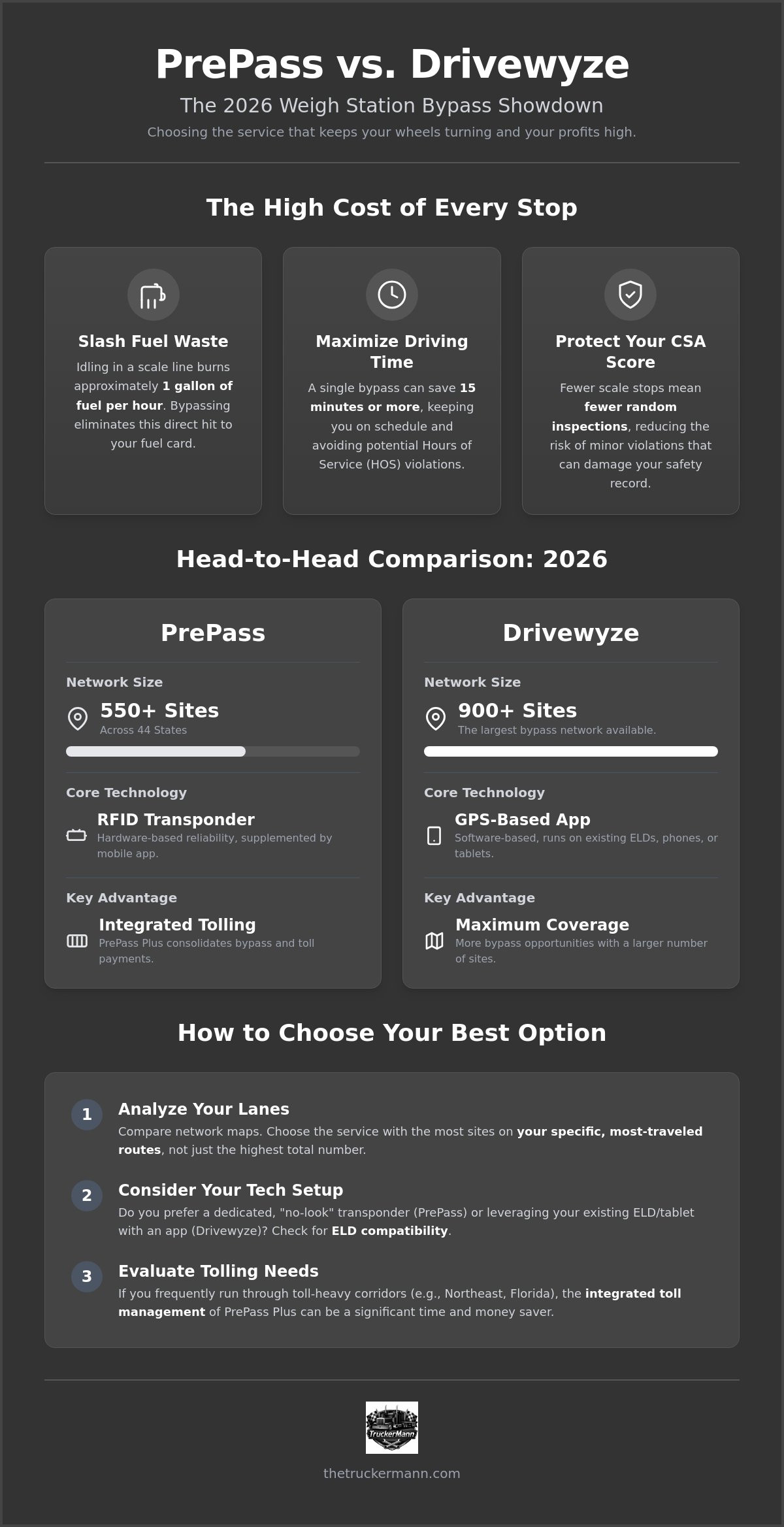
Putting these two services side-by-side reveals a clear divide in how they approach the American highway system. This prepass vs drivewyze comparison highlights a significant gap in sheer site volume, with Drivewyze covering over 925 locations compared to the 550 sites in the PrePass network. However, the decision isn’t just about who has the most pins on a map. You have to weigh the high-volume GPS coverage against the established, hardware-driven reliability that has kept the industry moving for decades. For a driver crossing several state lines a day, that 375-site difference can translate into dozens of avoided inspections every month.
The technical battle pits RFID precision against GPS flexibility. PrePass utilizes a dedicated short-range communication pole that triggers an instant response as you pass the sensor, regardless of your cell signal. Drivewyze uses geofencing technology that wakes up your ELD as you approach a site. While GPS allows Drivewyze to cover mobile and temporary scales that lack permanent infrastructure, it can occasionally face lag in deep canyons or remote stretches of road. Many veterans find that the physical “beep” of a transponder provides a level of certainty that a software-only signal sometimes lacks during a high-speed merge.
Coverage Maps and Limits
The I-5 corridor and the Pacific Northwest create a unique challenge for any bypass strategy. In states like Oregon and Washington, the local Green Light program and specific state regulations often prioritize the physical transponder over app-based signals. If you’re running these lanes regularly, you might find yourself pulling into scales that your buddies are skipping because they have a box on the glass. This regional nuance is why a growing number of owner-operators choose to run both services. It sounds like overkill, but covering every available bypass site is a small price to pay to avoid the inspector’s flashlight and keep your clock running.
Cost and Contract Reality
Managing your overhead is just as vital as managing your fuel burn. Drivewyze typically offers monthly subscriptions for their PreClear service in the $15 to $18 range per truck, making it a predictable software expense. PrePass often requires a more customized quote and may involve transponder deposits or shipping fees for the hardware. To ensure these monthly costs don’t bite into your margins, you need to be hauling the most profitable freight possible. I always suggest using 123Loadboard to find the high-paying lanes that justify the investment in bypass tech. If you’re looking to organize your cab to handle this new technology, check out the professional-grade gear at Mytee Products to keep your workspace efficient and road-ready.
Choosing Your Best Option
Deciding between these two heavyweights comes down to where you run and how much you hate paperwork. In this prepass vs drivewyze comparison, we’ve seen that one size rarely fits all in the world of logistics. If your lanes are primarily on the East Coast, PrePass is often the clear choice simply because of the tolling integration. Managing E-ZPass and SunPass through a single portal saves you from the administrative headache of juggling multiple accounts. It also prevents those nasty late-fee surprises that eat your profit before you even get home.
On the flip side, if you’re a tech-forward driver who values a clean windshield and a massive network, Drivewyze takes the lead. With over 925 sites, it offers the most opportunities to stay on the main line. It’s particularly effective for those who want their bypass service to act as a digital co-pilot, providing alerts for high-rollover curves and steep grades that a standard transponder just can’t offer. Your final decision in the prepass vs drivewyze comparison should be based on the specific ROI of your unique routes.
Scenario-Based Recommendations
If you’re a regional hauler sticking to the Pacific Northwest, verify the site counts for your specific corridor before buying. You might find that the RFID infrastructure in Oregon makes PrePass a necessity for local compliance. However, for the true over-the-road professional crossing 30 states a month, Drivewyze’s GPS-based system provides the most consistent coverage across the board. If you’re a safety-first operator, the real-time notifications for work zones and low bridges provided by Drivewyze might outweigh the tolling benefits of its competitor. Small fleets often prefer the software-only approach to avoid the logistical nightmare of shipping transponders back and forth between drivers.
Final Setup Checklist
Before you pull the trigger, run through this quick checklist to ensure a smooth transition. First, verify your ELD hardware compatibility to see if you can run a software-only setup without adding more screens to your dash. Second, take advantage of any free trials available; Drivewyze’s 30-day window is a great way to see if the signals are hitting where you need them most. While you’re waiting for your account to activate, it’s a good time to double-check your other essential equipment. Make sure you’re stocked up on securement tools to keep your loads safe while you’re taking advantage of those green lights.
The best bypass service isn’t just about the technology. It’s the one that keeps your wheels turning and your business profitable. Don’t be afraid to test both if your budget allows. The fuel savings alone often justify the cost of dual coverage. Stay safe, keep your eyes on the road, and keep that freight moving.
Master Your Route Efficiency
Success in this industry isn’t just about how hard you work; it’s about how smart you gear up. This prepass vs drivewyze comparison shows that the right choice depends on your specific lanes. If you’re hammering the toll-heavy East Coast, the consolidated billing of PrePass Plus is a lifesaver for your overhead. If you’re an over-the-road pro looking for the largest possible network, Drivewyze’s 925 sites and safety notifications give you the edge. Both tools are designed to keep your wheels turning and your CSA score clean.
This independent driver-led analysis is updated for 2026 regulations to ensure you’re making the best ROI for your small business. Once you’ve picked your bypass partner, you need the right freight to make the subscription pay for itself. You can find the best loads to bypass with 123Loadboard and start maximizing every mile of your clock. Keep your rig maintained, your paperwork straight, and your eyes on the horizon. We’re all in this together, and the road is wide open for those who stay prepared.
Frequently Asked Questions
Can I use both PrePass and Drivewyze at the same time?
Yes, you can run both services simultaneously to ensure you never miss a green light. Many owner-operators use this “belt and suspenders” approach to cover the 925 Drivewyze locations and the 550 PrePass sites. It might cost more each month, but the fuel savings from skipping every possible scale usually cover the double subscription fees quickly. It’s the only way to get 100 percent coverage across North America.
Does Drivewyze offer toll payment services like PrePass Plus?
No, Drivewyze does not currently offer a built-in toll payment solution like PrePass Plus. Their focus remains on bypass technology and driver safety alerts for rollover risks or low bridges. If your business depends on consolidating E-ZPass or SunPass into one bill, PrePass is the partner you need for that specific administrative relief. Drivewyze is a software-first platform that leaves the tolling to other hardware.
Do I need a transponder if I only use the PrePass app?
You don’t strictly need the box to use the app, but you’ll be missing out on significant coverage. The PrePass app uses GPS, but many older weigh stations are only equipped with RFID sensors that talk to the physical transponder. For the most reliable experience, I recommend using the hardware and the app together as a hybrid system. This ensures you’re covered at both modern and legacy scale sites.
Which service has better coverage in Oregon and Washington?
PrePass typically takes the lead in Oregon and Washington because of the region’s reliance on RFID hardware. The Oregon Green Light program is built around transponder communication. While Drivewyze has expanded significantly, some West Coast scales still require that physical beep from a dash-mounted unit to grant you a legal bypass. Always check your specific lanes before deciding which tool to mount in your cab.
How do bypass services affect my CSA score?
Bypass services protect your CSA score by keeping you away from the inspector’s flashlight. Every time you pull into a scale, you risk a random Level 1 inspection that could flag minor equipment issues or paperwork errors. By staying on the highway, you maintain your clean record and keep your focus on hitting your delivery window safely. It’s a proactive way to keep the DOT out of your business.
Will Drivewyze work on my existing ELD tablet?
Yes, Drivewyze integrates directly with most modern ELD tablets including Geotab and Omnitracs. This integration is a huge factor in any prepass vs drivewyze comparison for drivers who want a clutter-free cab. It turns your existing logging device into a bypass tool without the need for extra wires or suction cups on your windshield. It’s a simple software activation that keeps your dash clean and organized.
What happens if I get a red light on my transponder?
If your transponder flashes red or stays dark, you are legally required to pull into the scale house. A red light means the system didn’t clear you for a bypass this time, regardless of your safety score. Blowing past a scale when you haven’t received a clear green light is a quick way to get chased down. That mistake leads to heavy fines and an immediate hit to your safety rating.
Are there any free bypass services for truck drivers?
There aren’t any legitimate free bypass services on the market right now. Drivewyze does offer a 30-day free trial so you can test the coverage on your specific routes without an upfront commitment. However, these are professional-grade tools that require a monthly investment to maintain the network. The real “free” benefit is the diesel and time you stop wasting while idling in long scale lines.
Disclaimer
The information provided on The TruckerMann is for general informational and educational purposes only. While every effort is made to ensure the accuracy and reliability of the content, trucking laws, FMCSA regulations, DOT requirements, safety standards, and industry policies can change at any time. Readers are encouraged to verify all information with official government agencies, professional advisors, or qualified industry professionals before making business, legal, financial, safety, or compliance-related decisions.
The content shared on this website reflects personal opinions, experiences, research, and commentary and should not be considered legal, financial, medical, tax, or professional advice. The TruckerMann and its owners, contributors, affiliates, or representatives are not responsible for any losses, damages, violations, penalties, or liabilities resulting from the use or misuse of information found on this website.
Some content on this website may contain affiliate links, sponsored content, or promotional material. This means we may earn a commission at no additional cost to you if you choose to purchase through certain links.
By using this website, you agree that you do so at your own discretion and risk.