What if I told you that 35% of the time, the DOT gets it wrong, but most drivers just take the hit and keep rolling? It’s a tough pill to swallow when you’re out here grinding, especially with the 2026 shift from BASICs to the new Compliance Categories making things more complex. You’ve likely felt the sting of rising insurance premiums or the gut-punch of a roadside inspection that didn’t go your way. We all know that a messy record is a fast track to fewer opportunities and more stress every time you pass a weigh station.
It’s time to take control of your professional reputation. You can master the system by using these CSA score improvement tips to slash your violation rates and safeguard your CDL. This guide isn’t corporate fluff; it’s a veteran’s look at how to handle the new 2026 proportionate percentile system and the simplified severity weights. We’ll look at why your pre-trip grit matters more than ever and how the right cargo securement gear acts as your first line of defense against those heavy 10-point violations. Let’s get your scores down so you can focus on the road ahead without looking over your shoulder.
Key Takeaways
- Stop burning money on preventable maintenance fines by mastering the “Big Three” and using high-quality securement gear as your first line of defense.
- Turn your pre-trip into a legal shield with a systematic “Top-Down, Front-to-Back” inspection routine that catches violations before the DOT does.
- Discover veteran-tested CSA score improvement tips to leverage your clean record for higher CPM and access to premium freight opportunities.
- Learn how the “Clean Cab” theory and professional conduct can influence an inspector’s report and help you breeze through roadside checks.
- Navigate the 2026 shift to the new FMCSA Compliance Categories to understand how simplified severity weights impact your professional reputation.
What is a CSA Score and Why Does it Matter?
Think of your CSA score as your professional credit score. It’s the primary way the FMCSA tracks how you handle yourself on the road. The Compliance, Safety, Accountability (CSA) program isn’t just government red tape; it’s a living record that follows you from carrier to carrier. If your score is high, you’re a liability. If it’s low, you’re an asset. The system uses the Safety Measurement System (SMS) to crunch data from every roadside inspection and crash report from the last 24 months.
As we move through 2026, the system is getting a major overhaul. The old BASICs are being rebranded as “Compliance Categories,” and the FMCSA is shifting to a proportionate percentile system. This new approach is designed to be fairer, reflecting your actual safety trajectory rather than just punishing you for a single bad day. Staying updated on the latest CSA score improvement tips is the only way to keep your record clean in this data-driven environment.
To better understand this concept, watch this helpful video:
Why does this number dictate your life? Money talks. Carriers with scores approaching intervention thresholds often see insurance premiums jump by 10% to 30%. If those scores cross the line, rates can skyrocket by 50% or more. For an owner-operator or a driver looking for a top-tier seat, a clean record is a massive bargaining chip. It’s the difference between hauling cheap, heavy freight and landing the high-paying, specialized loads that require a “Gold Star” safety rating.
The Compliance Categories You Must Track
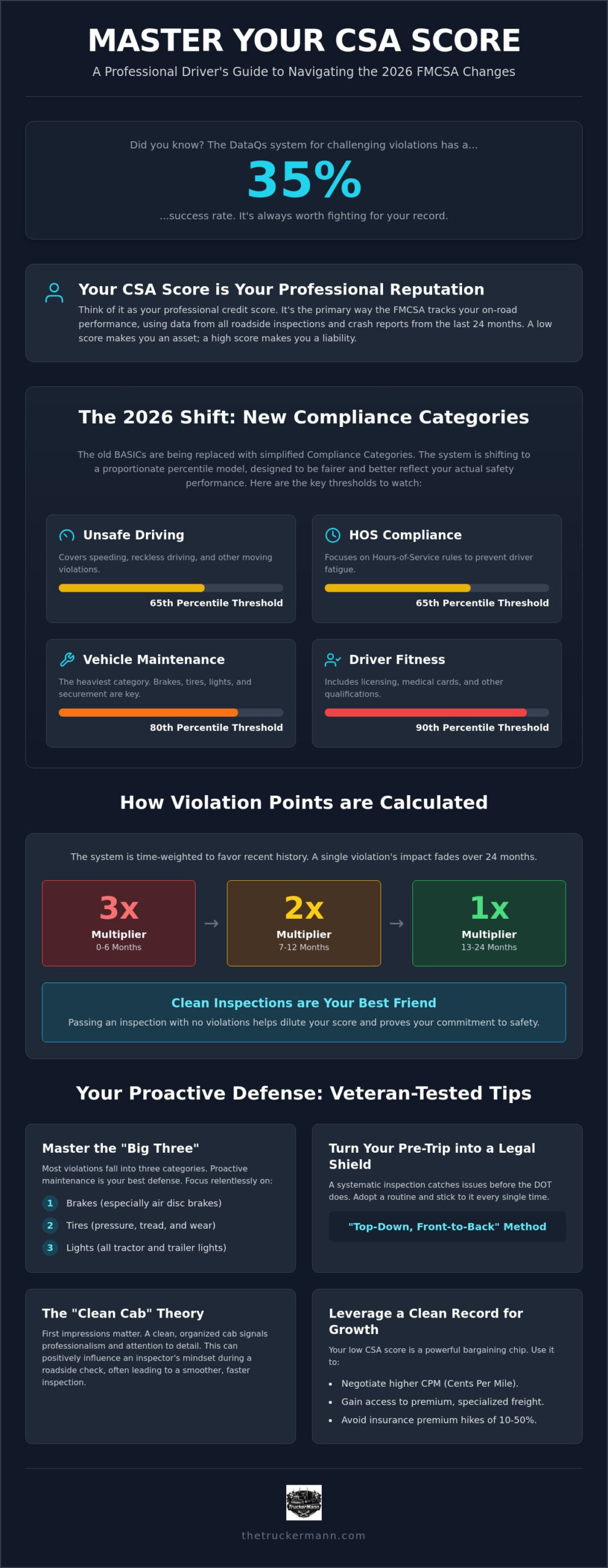
The 2026 system consolidates over 950 violations into about 116 groups to spot patterns faster. You need to keep a close eye on your percentiles in these key areas:
- Unsafe Driving: Speeding and reckless behavior have a low intervention threshold of the 65th percentile.
- HOS Compliance: Fatigue prevention is critical; this also sits at a 65th percentile threshold.
- Vehicle Maintenance: This covers your brakes, lights, and tires. The threshold here is the 80th percentile.
- Hazardous Materials: These protocols remain high-stakes with heavy severity weights.
How Points are Calculated and Weighted
The system is rigged to favor recent history. Violations that occurred in the last six months carry a 3x multiplier. From seven to twelve months, that drops to a 2x multiplier, and it hits 1x in the second year. This means a 10-point violation for texting or speeding 11+ mph over the limit actually hits your record as 30 points on day one.
Severity weights are also simplified but still punishing. A major brake issue outranks a flickering clearance light because the DOT views it as a higher crash risk. However, there’s a silver lining. Clean inspections are your best friend. They help dilute your score and prove you’re a professional who takes pre-trips seriously. If you do get an unfair ding, remember that the DataQs system has a success rate of about 35%. It’s always worth fighting for your reputation.
Maintenance Strategies to Kill Vehicle Violations
Vehicle maintenance is the heaviest hitter in the CSA scoring system. It’s the category where most drivers get tripped up, mostly because the “Big Three” (brakes, tires, and lights) are so visible to inspectors. If you’re looking for the best CSA score improvement tips, you have to start with a proactive maintenance mindset. You aren’t just fixing a truck; you’re protecting your livelihood from unnecessary points.
Modern equipment makes this easier, but you still have to be the pilot. Spec’ing air disc brakes on your tractor and trailer is one of the smartest moves you can make. Unlike traditional drum brakes, air disc brakes are much less prone to the “out-of-adjustment” violations that plague the industry. They provide consistent stopping power and keep you out of the crosshairs during a Level I inspection. Beyond the hardware, leveraging real-time telematics allows you to catch mechanical faults or sensor issues before they ever reach a DOT officer’s eyes.
Cargo securement is another area where high-quality gear pays for itself. A single frayed strap or a loose chain can result in a heavy severity weight violation. It’s worth investing in professional-grade securement tools to ensure your load is locked down tight. According to the FMCSA’s CSA Program Explained, these maintenance and securement points are calculated based on their crash risk, which is why they carry such weight.
Brake and Tire Discipline
Your daily routine must include a deep dive into your air system and rubber. Listen for audible air leaks when the brakes are applied and check your slack adjuster travel if you’re still running drums. Tires need more than a quick kick. While the legal minimum is 4/32 of an inch for steers and 2/32 for others, running them that low is asking for trouble during a rainy roadside check. In 2026, the most common brake violation continues to be brakes out-of-adjustment, which is a leading cause of out-of-service orders.
Lighting and Electrical Integrity
Lights are the “look at me” sign for DOT officers. A single flickering marker light can be the reason you’re pulled into the bay for a full inspection. Establish a “Walk-Around” ritual where you check every single bulb, every time you stop. It only takes a minute to verify your turn signals, brake lights, and clearance lamps. Always carry a spare bulb kit and a few basic tools for immediate roadside fixes. Catching a dead bulb in a rest area is a minor chore; catching it at a weigh station is a violation that stays with you for two years.
Mastering the Pre-Trip: Your Best Defense
Your pre-trip inspection isn’t just a box to check on your logs; it’s your primary legal defense against the 2026 CSA updates. Many drivers treat this as a chore to get through as quickly as possible, but that mindset is exactly how violations slip through the cracks. When you sign that DVIR, you’re testifying that the vehicle is safe. If a DOT officer finds a flat tire or a major air leak ten minutes later, you’ve lost your credibility and gained a handful of points. One of the most effective CSA score improvement tips is to stop viewing the pre-trip as a task and start seeing it as a shield for your CDL.
The “Top-Down, Front-to-Back” methodology is the gold standard for veteran drivers. Start at the very top of the cab, checking clearance lights and looking for any signs of fluid leaks dripping down. Work your way to the pavement, then move from the front bumper all the way to the ICC bumper. This systematic approach ensures you don’t skip the small details that an inspector will catch in five seconds. For a deeper look at what the DOT is hunting for, check out The Ultimate DOT Inspection Level 1 Checklist to see the full scope of a roadside exam.
The 15-Minute Pre-Trip Ritual
Fluid levels and engine belt integrity are the basics, but cargo securement is where the heavy points live. In 2026, the FMCSA has zero tolerance for “Driver Observed” maintenance failures. This includes everything from frayed straps to cracked chain links. A single damaged strap can carry a 10-point severity weight, which effectively becomes 30 points on your record due to the 3x time multiplier for recent violations. You can find Essential Tools for Cargo Securement that meet current compliance standards to replace worn-out gear before it costs you a career-killing fine.
In-Cab and ELD Accuracy
The FMCSA is cracking down on digital records with more aggression than ever. Fines for operating without a required ELD start at $1,000 and can escalate to $5,000 for repeat offenses. Even worse, willful falsification of records can lead to a maximum penalty of $19,000. Before you pull out, verify your ELD connectivity and ensure you have the required “Driver’s Rights” and ELD instruction cards in the glovebox. For more strategies on keeping your digital house in order, see our guide on ELD Compliance in 2026. A clean log is just as important as a clean truck when it comes to keeping your score in the green.
How to Handle Roadside Inspections Like a Pro
Roadside inspections are where the mental game of trucking truly begins. You can have the cleanest rig on the interstate, but if your attitude is sour, you’re inviting the officer to dig deeper. One of the most overlooked CSA score improvement tips is the power of professionalism. When you get pulled into the scale house or stopped on the shoulder, you aren’t just a driver; you’re a representative of your own professional reputation. If you show up prepared, you’ve already won half the battle.
Inspector Interaction Tips
Be polite, prepared, and prompt. Have your documents organized in a binder so you aren’t fumbling around when the officer asks for your credentials. When you present your Driver Vehicle Examination Report, do it with the confidence of someone who just finished a thorough pre-trip. Answer questions directly but avoid volunteering extra information. You don’t want to accidentally talk your way into a secondary inspection by mentioning a “small air leak” you think you heard earlier. Keep the conversation focused on the facts and let your equipment speak for itself.
The DataQs Challenge Process
Even the best drivers get an unfair ding occasionally. If you receive a violation that you know is incorrect or “not preventable,” don’t just let it sit there. The DataQs system is your tool for justice, and it has a success rate of approximately 35%. This includes removing violations assigned to the wrong carrier or correcting errors in the inspector’s report. You have to move fast, though. Gather your evidence immediately, including photos from the scene, ELD screenshots, and maintenance records that prove the truck was compliant.
Success in a DataQs challenge requires a clear, factual argument. Avoid emotional pleas; instead, cite the specific regulation to show why the violation shouldn’t count against your record. If you want to stay ahead of the game and protect your CDL, you can master DOT compliance today through specialized training that covers these high-stakes scenarios. Fighting an unfair point is just as important as avoiding one in the first place, and it’s a vital part of maintaining a pristine safety record in 2026.
Leveraging a Clean Record for Career Growth
A clean CSA record is more than a safety metric; it’s your most valuable asset in the 2026 freight market. While some drivers see compliance as a burden, the true professionals recognize it as a way to command higher pay and better equipment. Carriers are currently facing massive insurance hikes and stricter intervention thresholds, which means they are desperate for drivers who don’t attract DOT attention. When you sit down to negotiate your CPM or look for a new seat, your safety history is your strongest bargaining chip. A driver with a history of clean inspections is worth significantly more to a fleet’s bottom line than someone who regularly brings home maintenance points.
Low scores also open the door to premium freight opportunities that most steering wheel holders never see. High-value cargo, specialized hazmat loads, and sensitive government contracts all require carriers to maintain elite safety ratings. If you’ve mastered these CSA score improvement tips and kept your record spotless, you become the first choice for these high-paying runs. Your record also impacts your long-term MVR and employability, ensuring that even as regulations shift, you remain a top-tier candidate in a volatile industry. This isn’t just about avoiding fines; it’s about building a career that is insulated from economic downturns.
Market Yourself as a Safe Driver
Don’t be shy about your safety record when you’re looking for your next move. Include your clean inspection percentage and your percentile rankings directly on your professional resume. Showing a potential employer that you take the pre-trip seriously proves you have the grit to handle their equipment with respect. You should also stay sharp by reviewing the CDL Pre Trip Inspection Checklist to ensure no new 2026 regulations catch you off guard. If you’re an owner-operator, you can find high-paying loads with 123loadboard by showing off your safety rating to brokers who prioritize reliable, compliant carriers.
Continuous Safety Education
The industry moves fast, and staying stagnant is a recipe for a violation. Mark your calendar for annual events like the CVSA Roadcheck and use that time to double-check your gear and documentation. Utilizing training apps and digital resources keeps your compliance knowledge fresh without needing to step into a classroom. For those serious about reaching the next level of their career, you can check out DLA Academy for professional driver training that dives deep into advanced safety protocols.
Mastering the CSA system is the ultimate mark of a true professional. It shows you have the discipline to handle the technical requirements of the job while maintaining the physical grit needed on the road. By treating every inspection as an opportunity to prove your worth, you protect your CDL and secure your financial future for years to come. Keep your truck clean, your logs tight, and your head on a swivel. We’ll see you out there on the white lines.
Master the Road and Secure Your Future
Your safety record is your legacy. In the shifting 2026 landscape, the drivers who win are the ones who treat their rig like a legal defense. We’ve covered the “Big Three” maintenance killers and why a disciplined 15-minute ritual can save you thousands in fines and multipliers. These CSA score improvement tips aren’t just suggestions; they’re the blueprint for staying profitable and protected out here on the pavement. By pairing your field experience with heavy-duty gear, you’re signaling to every inspector and carrier that you’re a true professional.
Don’t let a single frayed strap or a bad attitude derail your career growth. You’ve got the grit to handle the miles; now you’ve got the knowledge to handle the regulations. Our resources are endorsed by professional drivers and focus on compliance-ready equipment with national shipping for your urgent needs. To stay ahead of the DOT and keep your CDL spotless, upgrade your securement gear and protect your score today. Keep those lights bright and your logs tight. We’ll see you on the next haul.
Frequently Asked Questions
How long do violations stay on my CSA score?
Violations stay on a carrier’s record for exactly 24 months. They hurt the most when they’re fresh because of the time-multiplier system used by the FMCSA. Violations less than six months old carry a 3x multiplier, while those between seven and twelve months have a 2x multiplier. Once they hit the 13-month mark, the weight drops to 1x until they finally drop off your record entirely after two years.
Can a driver see their own individual CSA score?
Individual drivers don’t have a CSA score; only motor carriers do. However, every inspection and crash you’re involved in is recorded on your Pre-Employment Screening Program (PSP) record. Carriers look at this record when hiring to see your five-year crash history and three-year inspection history. It’s basically your personal safety resume, so keeping it clean is just as vital as protecting the fleet’s score.
What is the fastest way to lower a high CSA score?
The fastest way to fix a damaged score is to string together a series of clean inspections while waiting for old violations to age. Because the system is weighted toward the last six months, every clean Level I or Level II inspection you pass helps dilute the impact of previous mistakes. If you’re hunting for CSA score improvement tips, focus on your pre-trip to ensure every roadside stop results in a “no violations found” report.
Do warnings count toward my CSA score points?
Yes, warnings count just as much as citations if they’re written on a roadside inspection report. Many drivers think that if they didn’t get a ticket, they’re in the clear, but that’s a dangerous myth. The FMCSA’s Safety Measurement System pulls data directly from the inspection report. If the officer marks a violation, the points hit the carrier’s score regardless of whether you have to pay a fine in court.
Does a clean inspection help my CSA score?
A clean inspection is the best medicine for a high score. It proves to the FMCSA that your carrier’s safety management is working, which helps lower your percentile ranking in the Compliance Categories. While a violation adds points, a clean report adds positive data to your record that helps dilute your overall score. This is why veteran drivers often welcome an inspection when they know their rig is 100% compliant.
What happens if my CSA score exceeds the threshold?
If your score crosses the intervention threshold, the FMCSA will step in. This usually starts with a warning letter, but it can quickly escalate to roadside priority status or an on-site focused audit. For the driver, this means every weigh station will likely pull you in for a look. It also makes it much harder for your carrier to secure high-paying contracts or affordable insurance premiums.
How often are CSA scores updated by the FMCSA?
The FMCSA updates the SMS data once a month, typically during the first or second week. This update includes all the inspection and crash data processed in the previous month. If you’ve just passed a clean inspection or successfully challenged a violation, you’ll need to wait for the next monthly cycle to see that reflected in the official numbers. It’s a slow process that requires consistent safe driving to move the needle.
Can I challenge a CSA violation if I think it is wrong?
You can and should challenge any incorrect data using the DataQs system. Whether it’s a violation that should have been “not preventable” or an error in the inspector’s notes, you have the right to request a review. Success in these challenges requires solid evidence like photos, ELD logs, or maintenance receipts to back up your claim. These CSA score improvement tips only work if you’re willing to fight for your clean record when the DOT makes a mistake.
Disclaimer
The information provided on The TruckerMann is for general informational and educational purposes only. While every effort is made to ensure the accuracy and reliability of the content, trucking laws, FMCSA regulations, DOT requirements, safety standards, and industry policies can change at any time. Readers are encouraged to verify all information with official government agencies, professional advisors, or qualified industry professionals before making business, legal, financial, safety, or compliance-related decisions.
The content shared on this website reflects personal opinions, experiences, research, and commentary and should not be considered legal, financial, medical, tax, or professional advice. The TruckerMann and its owners, contributors, affiliates, or representatives are not responsible for any losses, damages, violations, penalties, or liabilities resulting from the use or misuse of information found on this website.
Some content on this website may contain affiliate links, sponsored content, or promotional material. This means we may earn a commission at no additional cost to you if you choose to purchase through certain links.
By using this website, you agree that you do so at your own discretion and risk.