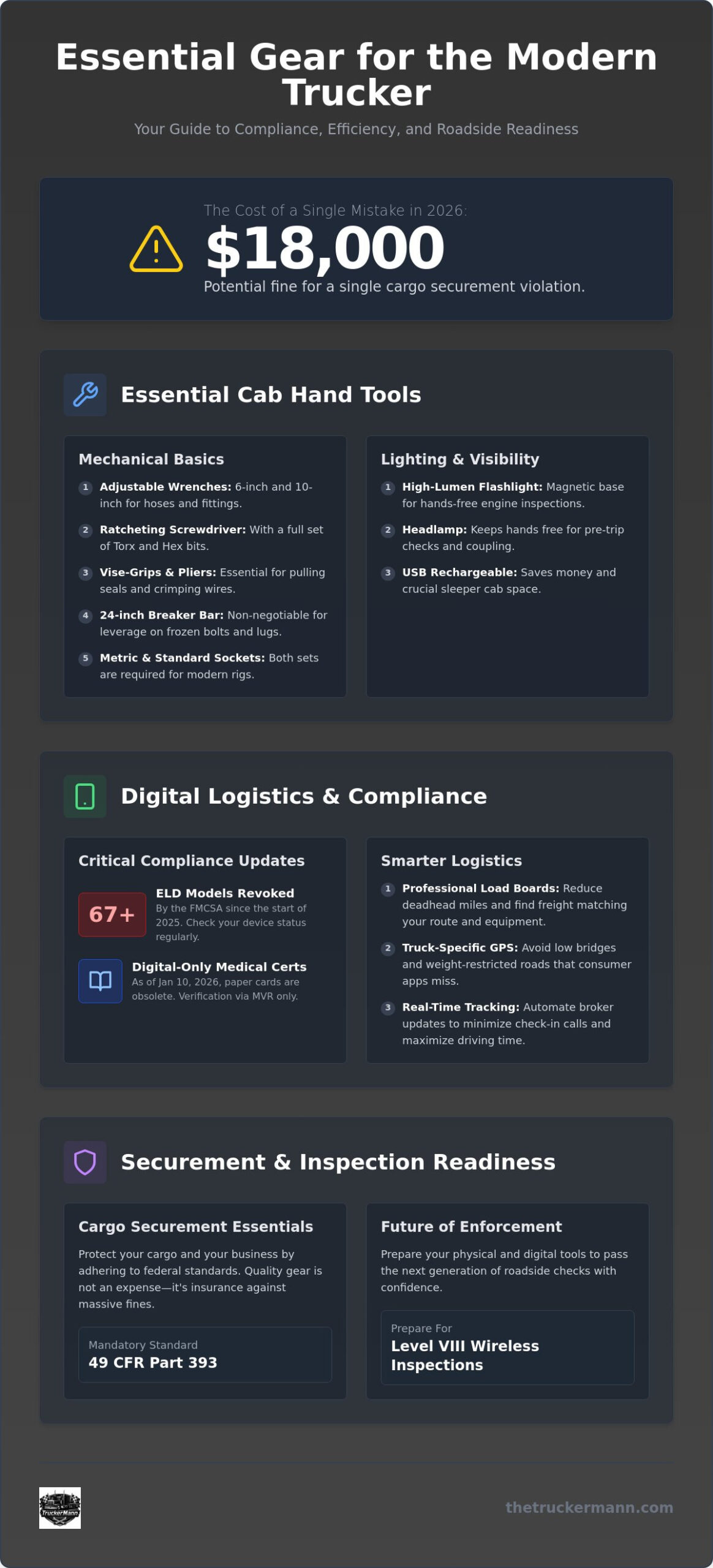
A single loose strap or a missing safety tool shouldn’t cost you $18,000, but in 2026, that’s the cold reality of a cargo securement violation. You’ve spent enough time behind the wheel to know that cheap gear is actually the most expensive thing you can buy when it fails at a scale or during a midnight breakdown. Finding the best gear for long haul truckers has become a high-stakes game, especially with the FMCSA revoking dozens of ELD models and the January 10 deadline for paper medical cards officially in the rearview mirror.
It’s frustrating to waste cash on tools that break or tech that doesn’t keep you compliant. We’re here to help you master your pre-trip and road repairs with this definitive guide to the essential physical and digital tools every professional driver needs. You’ll get a clear look at the durable kits that reduce downtime, the software that makes booking loads faster, and the specific gear required to breeze through a Level VIII electronic inspection. Let’s get your rig and your business ready for the long mile ahead.
Key Takeaways
- Learn why quality beats quantity in your cab kit and how professional-grade tools keep minor mechanical issues from turning into expensive downtime.
- Identify the best gear for long haul truckers in the digital age, including how to handle the 2026 ELD revocations and the shift to electronic medical certifications.
- Master the essentials of cargo securement to protect your business from five-figure fines and ensure your setup meets current 49 CFR Part 393 standards.
- Prepare for the future of enforcement by integrating the tech and physical tools you’ll need to pass Level VIII wireless inspections with confidence.
- Optimize your sleeper space by choosing organization systems that keep your gear accessible when every minute of your clock counts.
Essential Cab Hand Tools
Relying on company maintenance is a rookie mistake that’s guaranteed to leave you stranded at the worst possible moment. When you’re 200 miles from the nearest terminal and a simple air leak starts hissing, your personal tool kit is your only real lifeline. The Truckermann knows that the best gear for long haul truckers isn’t about flashy gadgets; it’s about having the grit and the hardware to handle roadside fixes yourself. Building a reliable kit ensures you aren’t stuck waiting six hours for a service truck to turn a single screw.
Modern rigs are a complex mix of components, often requiring a deep dive into the trucking industry glossary just to identify which system is acting up. While older trucks relied on standard sizes, today’s equipment is heavily metric. You need both sets to avoid rounding off fasteners on a Sunday night. A 24 inch breaker bar is also non negotiable. It provides the raw leverage needed for frozen bolts or stubborn lugs that a standard ratchet just can’t touch. Being prepared means you control your schedule, not the breakdown.
To better understand the essentials you should carry in your cab every day, watch this helpful video:
The Mechanical Basics
Lighting and Visibility Gear
You can’t fix what you can’t see. In 2026, the industry has moved away from bulky, battery hungry lanterns toward streamlined LED solutions. A high lumen flashlight with a magnetic base is a lifesaver during engine inspections because it sticks right to the frame rail. For night time coupling or pre-trip checks in unlit lots, a comfortable headlamp is the best gear for long haul truckers who value their safety. It keeps your hands free to check kingpin engagement or airline connections. Stick with USB rechargeable professional lighting to save money and space in your sleeper cab.
Digital Logistics Tools
The heavy lifting doesn’t just happen at the fifth wheel anymore. In 2026, the smartphone in your pocket is as critical as any torque wrench in your side box. The best gear for long haul truckers now includes a digital arsenal that keeps your business profitable and your CDL safe. We’ve moved past the era of “set it and forget it” technology. With the FMCSA taking a more aggressive stance on vetting hardware, your digital tools require the same maintenance and inspection as your brake pads. The Truckermann has seen how quickly a tech failure can turn a profitable week into a regulatory nightmare.
Load Matching and Freight
Deadhead miles are the silent killer of your bottom line. Modern digital load boards have evolved into sophisticated business hubs that do more than just list freight. By using professional matching platforms, you can find loads that fit your specific route and equipment type in seconds. These systems now offer real-time tracking features that satisfy broker requirements automatically. This means you can focus on the road instead of answering “where are you” phone calls every two hours. It’s about working smarter to keep your wheels turning at a higher per-mile rate and ensuring you aren’t leaving money on the table at every truck stop.
Compliance and Mapping
The regulatory landscape is shifting fast. As of July 2026, the FMCSA has already revoked 67 ELD models since the start of 2025. If you’re running a device on the revoked list, like the models facing the July 20, 2026 deadline, you’re looking at a citation and an out-of-service order. Staying compliant is a full-time job, which is why we recommend checking the official FMCSA safety resources regularly. Your ELD should be a tool for protection, not a liability. Additionally, the transition to digital medical certifications is now complete; as of January 10, 2026, carriers must verify certifications exclusively through MVRs.
Consumer mapping apps are another trap you can’t afford. Standard GPS doesn’t know about the 13’6″ bridge ahead or the weight-restricted residential street. Professional truck-specific GPS accounts for your dimensions and keeps you out of trouble, making it part of the best gear for long haul truckers who value their time and equipment. If you’re unsure about your current hardware, our ELD Compliance Guide breaks down the safest hardware choices for the coming year. Don’t let a tech failure or an outdated map sideline your rig. You can audit your digital toolkit today to ensure you’re ready for the next level of electronic inspections.
Securement Gear Essentials
Securement isn’t just about keeping the load on the deck; it’s about professional physics and protecting your livelihood from a potential $18,000 fine. Professional cargo securement is the line between a successful delivery and a catastrophic DOT violation. The FMCSA is clear under 49 CFR Part 393, Subpart I: the aggregate working load limit (WLL) of all your tie-downs must be at least 50% of the weight of the cargo. If you’re guessing at your tension or using frayed equipment, you’re gambling with your CDL. The best gear for long haul truckers in the flatbed sector starts with rugged, high-capacity hardware that exceeds these minimums.
Beyond the raw strength of your chains and straps, you need to think about the longevity of your kit. Edge protectors are a small investment that pays massive dividends by preventing sharp cargo corners from sawing through your polyester webbing. They protect the freight from strap marks and extend the life of your straps by years. When the weather turns sour, having a dedicated set of tarping tools, like a telescoping tarp rod, can save your back and shave thirty minutes off your securement time in a freezing rainstorm. These aren’t just conveniences; they’re the tools that keep a veteran driver moving while others are still struggling with a tangled mess on the shoulder.
Straps and Tensioning
Your choice between 4-inch winch straps and 2-inch ratchet straps depends entirely on the weight and footprint of the load. While 4-inch straps are the workhorses for heavy machinery and lumber, smaller ratchet straps are essential for securing dunnage or utility boxes. Achieving the correct tension requires a high-quality winch bar. Never use a makeshift pipe for leverage; a proper knurled-end winch bar provides the grip and safety needed to prevent the bar from slipping and causing a facial injury. For drivers who demand professional-grade hardware, we recommend sourcing your tie-downs from Mytee Products to ensure every component meets rigorous WLL standards.
Flatbed Maintenance Tools
A small tear in a tarp can ruin a high-value load of steel or drywall in a single afternoon. You should never leave the yard without a comprehensive tarp repair kit containing heavy-duty patch tape and industrial-strength glue. For those hauling specialized freight, coil racks and hardwood timbers are non-negotiable. These tools ensure that round loads stay centered and weight is distributed correctly across the trailer frame. If you’re looking to upgrade your entire securement setup, checking out the inventory at Truck n Tow is a smart move for finding the specialized racks and binders that veterans trust.
Inspection Readiness Tools
Walking into a scale house shouldn’t feel like a trip to the principal’s office. When you carry the right equipment, you turn a high-stakes DOT inspection into a routine non-event. An officer can tell within thirty seconds of stepping toward your rig if you’re a professional who takes maintenance seriously or a steering wheel attendant who’s just winging it. Having the best gear for long haul truckers isn’t just about utility; it’s about projecting an image of total compliance that often leads to shorter, less intrusive inspections.
The traditional “Hammer Test” for tires is a veteran staple, but it’s becoming a relic in the age of Level VIII electronic inspections. While a thumper can tell you if a tire is flat, it won’t tell you if you’re ten pounds low. Digital tire pressure monitoring and objective depth gauges provide the exact data an inspector is looking for. Similarly, you need to be proactive about your brake stroke. Carrying a simple marking tool to check slack adjuster health can prevent an out-of-service order for brake adjustment, which remains one of the most frequent roadside citations. A few minutes under the trailer with a ruler is much cheaper than a tow bill.
Air line maintenance is another area where small tools prevent big headaches. Gladhand seals are prone to cracking and leaking, especially in extreme temperatures. These tiny rubber rings are responsible for a massive percentage of air system violations. If you hear a hiss, don’t wait for the scale. You can download our DOT Level 1 Checklist to see exactly how to apply these tools before you ever pull into a weigh station.
The DOT Pre-Trip Kit
A professional pre-trip kit should include a digital tire depth gauge. It gives you objective numbers to argue your case if an inspector’s visual estimate seems off. You should also invest in a fifth wheel pin puller. This tool isn’t just a luxury; it saves your shoulders from years of unnecessary strain and keeps your clean clothes away from the grease. By using tools that provide data and protect your body, you’re investing in the best gear for long haul truckers who plan on staying in this industry for the long haul.
Emergency Repair Items
Compliance often comes down to the smallest components in your cab. Carrying a dedicated box of spare fuses and bulbs is the ultimate insurance policy. A $5 fuse can save you from a $500 fine for a non-functioning marker light. You also need to carry brake chamber caging bolts and know how to use them safely. If a spring brake fails, these bolts allow you to move the vehicle off the roadway to a safe repair location. Finally, buy a bag of 50 gladhand seals and keep them in your side box. Swapping a seal takes ten seconds and solves the most common roadside air leak immediately. Don’t leave your safety to chance; get your inspection kit ready before your next dispatch.
Professional Kit Strategy
Owning a truck is a business; treating your tools like a professional is how you protect that business. When you’re looking for the best gear for long haul truckers, the old saying holds true: buy once, cry once. Wasting money on low-quality gear that breaks during a midnight repair isn’t just a nuisance. It’s a direct hit to your bottom line. Professional-grade tools are designed to withstand the constant vibration and temperature swings of a sleeper cab, whereas bargain-bin sets will rust or strip the first time you put real torque on them. High-vibration environments act like a slow-motion wrecking ball on cheap plastic cases and poorly made ratchets.
You need a two-tier storage strategy to stay organized. Your “Daily Carry” stays inside the cab for quick fixes like changing a fuse or tightening a loose interior panel. Your “Deep Storage” kit lives in the side box, holding the heavy hitters like your breaker bar, securement chains, and heavy-duty wrenches. This keeps your living space clean while ensuring you’re ready for major roadside events. To prevent rust in the high-moisture environment of a side box, keep your metal tools lightly oiled and stored in weather-resistant tool rolls rather than hard cases that trap condensation.
Investing in Your Career
Building a top-tier kit doesn’t happen overnight. Start with the essentials for compliance and safety, then add specialized tools as your budget allows. While you build your physical kit, don’t ignore the value of professional training to sharpen your business edge. Programs like DLA Academy offer the career growth and specialized knowledge that turn a standard driver into a logistics master. When buying gear, prioritize brands with lifetime warranties that you can replace at any major truck stop. If a tool breaks in Nebraska, a warranty doesn’t help you if the nearest dealer is three states away.
Organisation and Storage
Master the Road with a Pro-Grade Kit
Don’t let a missing tool or an outdated ELD sideline your career. You can find professional-grade securement tools and expert advice through our driver-led resource hub. We provide the expert-vetted gear and DOT-compliant solutions you need to stay safe and profitable. Investing in quality today prevents the expensive failures of tomorrow. Keep your kit organized, stay vigilant with your inspections, and remember that this lifestyle is a marathon, not a sprint. Safe travels, and we’ll see you at the next drop.
Frequently Asked Questions
What are the top 5 tools every new truck driver should buy first?
You should prioritize a high quality digital tire gauge, a 10 inch adjustable wrench, a multi bit ratcheting screwdriver, a magnetic LED flashlight, and a bag of spare gladhand seals. These five items cover the majority of minor roadside fixes and daily inspection needs. Starting with these essentials allows you to build a reliable kit without cluttering your cab with tools you’ll never use.
Does a truck driver need to carry a full socket set?
You don’t need a massive master set, but a compact metric and standard socket set is a smart move for modern rigs. Most newer trucks rely heavily on metric fasteners for everything from cab trim to engine sensors. A 3/8 inch drive set that covers 10mm to 19mm will handle most small repairs without the excessive weight and space requirements of a full mechanic’s chest.
Are digital load boards considered tools for professional drivers?
Absolutely, digital load boards are the best gear for long haul truckers who want to treat their rig like a profitable business. In 2026, managing your freight via a smartphone is just as critical as checking your brake stroke. These digital platforms are essential for minimizing deadhead miles and securing high paying loads without the constant back and forth of traditional broker phone calls.
What tools are required by law for a DOT inspection?
Federal law doesn’t mandate a mechanical tool kit, but 49 CFR 393.95 requires every power unit to carry specific safety hardware. You must have three bidirectional emergency reflective triangles and a properly rated, fully charged fire extinguisher. While these aren’t wrenches or pliers, they are the hardware items an inspector will check first to ensure you’re compliant with safety regulations.
How do I store heavy tools safely in a sleeper cab?
Always store heavy items like breaker bars, chains, or large wrenches in exterior side boxes or secured tightly under the bunk. You don’t want a 20 pound piece of steel becoming a projectile during a hard braking event or a collision. Use rubber lined tool rolls or heavy duty bags to prevent your gear from rattling against the cab walls while you’re trying to get your rest.
Is it better to buy a pre-made trucking tool kit or build my own?
It’s almost always better to build your own kit rather than buying a pre-made “trucker set” that often contains low quality filler. Building your own allows you to invest in professional grade wrenches and specific Torx bits that actually fit your truck. You’ll spend a bit more upfront, but you won’t have to worry about a cheap tool snapping when you’re 50 miles from the nearest truck stop.
What is the best tool for checking tire pressure on a semi-truck?
A calibrated digital tire pressure gauge with a dual foot chuck is the most accurate tool for the job. While a traditional tire thumper is fine for a quick check during a fuel stop, it can’t detect a tire that’s only 10 PSI low. For the best gear for long haul truckers, a digital gauge provides the objective data needed to avoid heat related blowouts and expensive roadside service calls.
Do I need specialized tools for flatbed trucking compared to dry van?
Yes, flatbedding requires a significant investment in specialized hardware that dry van drivers rarely need. You’ll need a high quality winch bar, edge protectors, and various chains and binders to meet cargo securement laws. If you’re moving into the flatbed sector, expect your tool weight and storage requirements to increase significantly compared to pulling a standard box trailer.
Disclaimer
The information provided on The TruckerMann is for general informational and educational purposes only. While every effort is made to ensure the accuracy and reliability of the content, trucking laws, FMCSA regulations, DOT requirements, safety standards, and industry policies can change at any time. Readers are encouraged to verify all information with official government agencies, professional advisors, or qualified industry professionals before making business, legal, financial, safety, or compliance-related decisions.
The content shared on this website reflects personal opinions, experiences, research, and commentary and should not be considered legal, financial, medical, tax, or professional advice. The TruckerMann and its owners, contributors, affiliates, or representatives are not responsible for any losses, damages, violations, penalties, or liabilities resulting from the use or misuse of information found on this website.
Some content on this website may contain affiliate links, sponsored content, or promotional material. This means we may earn a commission at no additional cost to you if you choose to purchase through certain links.
By using this website, you agree that you do so at your own discretion and risk.