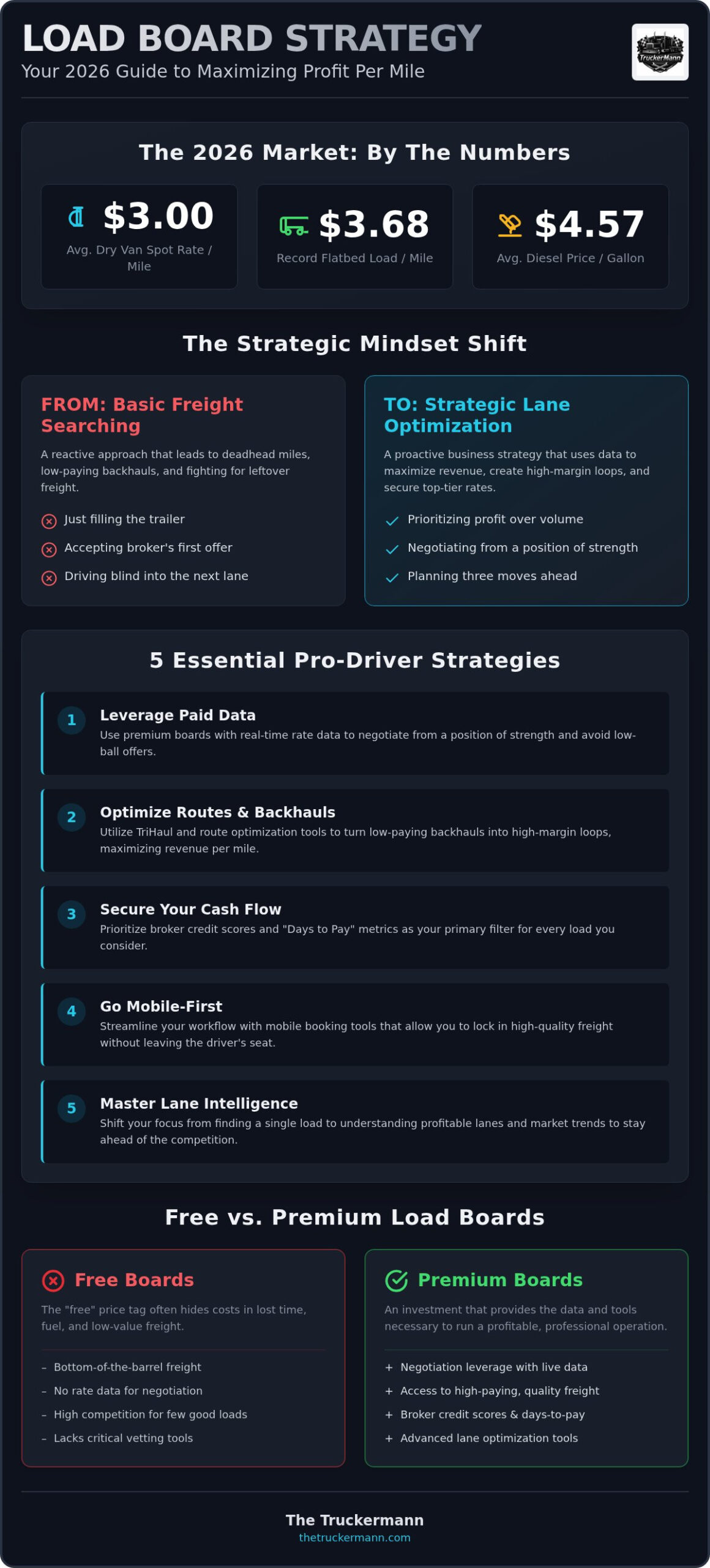
Your load board isn’t just a search engine anymore; in 2026, it’s the financial command center that decides if your business thrives or barely survives. With dry van spot rates finally climbing to $3.00 per mile and surpassing contract rates for the first time in years, the opportunity is there, but the risks are higher than ever. Finding the right load boards for truck drivers is the difference between snagging a record-breaking flatbed load at $3.68 a mile and getting stuck with a broker who hides behind “administrative delays” when it’s time to pay.
I know how it feels to watch your margins disappear into $4.57-a-gallon diesel while you’re deadheading halfway across a state just to find a reload that doesn’t insult your intelligence. You’re tired of unreliable brokers and subscription models that bury the features you actually need under a mountain of hidden fees. This veteran-led guide is designed to cut through that noise. I’m going to show you how to master the art of finding high-paying freight, verifying broker credit scores instantly, and maximizing every single mile you put on the odometer.
We’ll look at the current 2026 landscape, comparing heavy hitters like DAT One and Truckstop against budget-friendly options like 123Loadboard. You’ll learn which tiers actually offer the rate benchmarks you need and how to navigate new FMCSA regulations, like the strict 75-mile personal conveyance limit, without losing your shirt. It’s time to stop guessing and start running your truck like the high-stakes business it is.
Key Takeaways
- Shift your mindset from simple freight searching to lane optimization to ensure your 2026 strategy prioritizes profit over just filling the trailer.
- Avoid the “free” trap by understanding how paid load boards for truck drivers provide the critical rate data needed to negotiate from a position of strength.
- Use TriHaul and route optimization tools to turn low-paying backhauls into high-margin loops that keep your revenue per mile at its peak.
- Secure your cash flow by prioritizing broker credit scores and “Days to Pay” metrics as your primary filter for every load you consider.
- Streamline your workflow with mobile-first booking tools that allow you to lock in high-quality freight without ever leaving the driver’s seat.
Load Boards: 2026 Survival Guide
Every owner-operator running the roads today is dealing with a volatile market where diesel averages between $4.57 and $4.80 per gallon. In this environment, the spot market isn’t just a way to fill gaps; it’s often the primary driver of your annual revenue. Modern load boards have evolved into sophisticated data hubs that tell you where the market is tightening before brokers even realize it. If you aren’t using these tools to scout your next three moves, you’re essentially driving blind into a headwind.
To better understand how these platforms have changed and which ones are leading the pack, watch this helpful breakdown:
What is a Load Board Today?
At its core, a modern load board functions as a digital freight exchange, serving as a real-time marketplace that bridges the gap between carriers, shippers, and brokers. In 2026, a load board is your primary profit-generation tool that uses live data to ensure your trailer never moves without a high-margin rate attached to it. While private broker portals offer exclusive access to specific freight, public boards remain the backbone of the industry, providing the transparency you need to keep brokers honest about current market valuations.
Why Drivers Can’t Ignore Them
Deadhead miles are the fastest way to go broke in this business. Proactive trip planning through reliable load boards for truck drivers allows you to line up your backhauls before you even drop your first load. This level of preparation is how small owner-operators stay competitive against the massive fleets that have entire departments dedicated to logistics. By using real-time data to identify high-demand lanes, you can position your equipment where the capacity is tightest, forcing brokers to pay the premium rates you deserve. If you’re looking for a platform built for the driver’s seat, 123Loadboard offers the kind of mobile-first simplicity that keeps you moving toward the money.
Free vs. Paid Load Boards
I’ve seen too many green owner-operators get lured in by the “zero dollars” price tag of free freight sites. It’s a tempting offer when you’re looking at your overhead, but don’t get fooled. In this business, if you aren’t paying for the tool, your time and your fuel are the products being sold. Free boards are often the bottom-of-the-barrel options where brokers dump freight they can’t move anywhere else. You might save a few bucks on a monthly subscription, but you’ll lose hundreds on a single low-ball rate because you didn’t have the data to push back.
The Reality of Free Boards
Free boards operate on a first-come, first-served frenzy. By the time you see a decent load, ten other guys have already called on it. These platforms lack the deep data integration required to run a lean operation in 2026. High-value freight rarely stays on these boards for more than a few minutes. If you’re relying on them, you’re essentially fighting for scraps. They have their place as a backup for local hauls or emergency reloads, but they shouldn’t be the foundation of your business. You wouldn’t use a cheap, rusted strap to secure a $100,000 flatbed load; don’t use a cut-rate tool to secure your income.
The Power of Premium Subscriptions
This is where the professionals separate themselves from the amateurs. Premium load boards for truck drivers provide the leverage you need in a negotiation. When you can see that the 7-day spot market average for a van load is $3.00 per mile, you don’t have to guess if a broker’s offer is fair. You have the proof. These subscriptions also unlock advanced filtering. You can search by specific deck length or weight requirements, which is vital if you’re running specialized equipment like a step-deck or RGN.
The most critical feature, however, is the broker credit data. Before you even think about booking, you need to see their credit score and their “days to pay” history. If a broker has a history of 45-day payouts, they’re effectively using your money as an interest-free loan while you’re stuck paying for $4.57 diesel out of pocket. Before you start hunting for that next haul, ensure your business foundation is solid by following the official registration process to keep your authority in good standing. If you want a high-ROI tool that bridges the gap between cost and power, checking out 123Loadboard is a smart move for any driver looking to maximize their miles without breaking the bank.
How to Find Top-Paying Loads
Finding the money isn’t about being the first one to click; it’s about being the smartest one in the lane. Most software companies will tell you to just search and book, but as someone who’s actually sat in the seat, I know that’s how you end up with cheap freight and a headache. To truly master load boards for truck drivers, you have to make the technology work for you. Start by building a profile that screams professional. Brokers are looking for reliability; if your profile is complete with your equipment specs and insurance info, you’re already ahead of the guy who just has a phone number listed.
The real secret to maximizing your revenue is “The Post.” Instead of chasing brokers, you post your truck in the lanes you want to run. When you do this correctly, brokers start calling you. This puts the ball in your court before the conversation even begins. Combine this with TriHaul strategies, where you take a slightly longer route through a high-demand market to avoid a low-paying direct backhaul, and you’ll see your average per-mile rate climb significantly. Timing is also everything. Most high-quality freight hits the boards between 07:00 and 09:00 local time, so be ready to strike while the coffee is still hot.
Mastering the Search Filters
Efficiency on the board requires more than a basic city-to-city search. Use specific equipment tags like ‘F’ for Flatbed or ‘R’ for Reefer to filter out the noise. In 2026, many boards offer “Book It Now” features, but don’t let the convenience rob you of profit. These are often priced lower for quick movement. I prefer setting automated alerts for my favorite lanes. This ensures that when a hot load hits the board, I’m the first one notified. If you’re ever unsure about the latest compliance rules while planning these routes, check the FMCSA Driver Resource Hub for the most current regulatory updates.
Negotiation Tactics for Drivers
When you pick up the phone, you need to be armed with data. Use the spot market averages we discussed earlier as your shield. By citing the fact that national dry van spot rates are currently averaging $3.00 per mile, you can confidently counter a broker who tries to low-ball you with a 2024-era rate. You should use 7-day and 15-day spot market averages as a hard baseline to prove to the broker that their offer is well below the current market value for your specific equipment. Always know your minimum per-mile requirement before the call starts. If the numbers don’t work after accounting for $4.57 diesel and your overhead, walk away. There’s always another load. For those looking for a platform that simplifies this entire process, 123Loadboard provides excellent tools for identifying these high-margin opportunities quickly.
Managing Credit and Cash Flow
A high-paying load is just a fairy tale if the broker doesn’t pay up or takes two months to cut the check. In the 2026 market, where diesel averages $4.57 per gallon, you can’t afford to act as an interest-free bank for a broker with shaky finances. This is where load boards for truck drivers transform from simple search tools into your business’s credit department. Every time you look at a posting, your eyes should go straight to the credit score before you even look at the rate. If the credit is trash, the rate doesn’t matter.
You also need to stay sharp to avoid the rising tide of double-brokering scams. These bottom-feeders steal loads from legitimate brokers and re-post them, often disappearing with the money after you’ve already delivered the freight. Red flags include brokers who only use generic Gmail addresses, those who refuse to provide a physical office address, or rates that seem too good to be true for the current lane. Protecting your authority is part of the game; stay legal by reviewing our DOT Inspection Level 1 Checklist, because a clean record makes you more attractive to the high-credit partners who actually pay on time.
Reading the Credit Data
Interpreting credit scores is a survival skill. A score of 90 or higher generally means the broker is solid and reliable. If you see a score dipping into the 70s, you’re entering the danger zone. This usually indicates a history of slow payments or unresolved disputes. Sometimes, a load with a lower rate from a broker with a 5-day “Days to Pay” average is more profitable than a high-rate load with a 45-day wait. Using the integrated credit tools on 123Loadboard allows you to vet these partners instantly from the cab, so you aren’t guessing with your fuel card balance.
Factoring and Quick Pay
Cash flow is the lifeblood of your operation. While some boards offer integrated “Quick Pay” options, many owner-operators prefer working with external factoring companies to keep their accounts receivable steady. Factoring allows you to sell your invoice for a small fee, getting your cash in 24 hours instead of waiting on a net-30 or net-60 cycle. This synergy between your load board and your factoring house ensures you always have the capital to keep the wheels turning. If you’re ready to stop chasing invoices and start building a more stable business, sign up for a professional load board account to see broker credit scores before your next haul.
Why 123Loadboard Fits Your Cab
I’ve spent enough years behind the wheel to know that your cab isn’t a corporate office. You don’t have space for a three-monitor setup, and you certainly don’t have time to pull over every hour just to fire up a laptop. When it comes to load boards for truck drivers, you need a tool that works as hard as you do without making your life complicated. That’s why I’ve consistently leaned on 123Loadboard. It’s built for the guy who’s booking freight from the driver’s seat while waiting for a gate to open or during a mandatory 30-minute break. It’s practical gear for a practical job.
User-Friendly for the Real World
The mobile-first design isn’t just a marketing buzzword; it’s a survival feature. The app is fast, intuitive, and designed for one-handed operation. You get real-time notifications that hit your phone the second a load matching your criteria is posted, giving you a head start over the guys still scrolling on their computers at a truck stop. Integrating your business tools is also a breeze. You can keep your operation tight by checking our ELD Compliance Guide to see how your logs and loads can work together to keep you on the right side of the DOT in 2026.
What really sets this apart for me is the ‘Find Loads’ tool. It strips away the industry fluff and gives you the raw data you need: rates, weights, and those all-important broker credit scores we discussed earlier. It even integrates with major fuel cards and ELD providers, creating a seamless loop from booking to billing. As a veteran in this game, I value transparency over flashy features. I want to know who I’m working for and if the money is right before I ever put the truck in gear. 123Loadboard delivers that clarity without the steep learning curve or the heavy overhead of other premium platforms.
Get Started Today
If you’re tired of deadhead miles killing your profit and low-ball offers insulting your experience, it’s time to upgrade your digital gear. Signing up is straightforward, and you can start a trial to see the volume for yourself. Once you’re in, set up your first ‘Truck Post’ immediately. Let the brokers see where you are and where you’re going. It’s the simplest way to get your phone ringing with offers that actually make sense for your bottom line. Stop settling for whatever is left over on the free boards. Join 123Loadboard through The Truckermann and get the freight you deserve to keep your business moving forward.
Master Your Lanes
You have the tools and the veteran-led insights to dominate your lanes. It’s time to take control of your schedule and stop leaving your revenue to chance. With a veteran-approved interface and real-time data trusted by over 325,000 transportation professionals, the path to a more efficient operation is ready when you are. Start your 123Loadboard trial and book better freight. Keep your head up, your logs clean, and your trailer full. I’ll see you out there on the high side.
Freight Logistics FAQ
Free Board Value
Free boards generally aren’t worth the risk if you’re trying to build a sustainable business. While the zero-dollar entry point is tempting, these platforms often lack the critical rate benchmarks and credit data you need to avoid getting burned. You’ll likely spend more in wasted fuel and time than you’d spend on a professional subscription that offers high-margin freight.
Checking Broker Credit
Most professional platforms include a dedicated credit tab or icon directly within the load posting. On 123Loadboard, for example, you can see the broker’s credit score and average “Days to Pay” instantly. Always verify this number before calling; a score below 80 is a red flag that suggests you might be waiting a long time for your money.
Best Flatbed Boards
The best load boards for truck drivers running open-deck equipment are those that offer granular filtering for specialized trailers. To snag those record-high $3.68 per mile flatbed rates seen in 2026, ensure your board allows you to filter by specific equipment like step-decks or removable goosenecks (RGN). This ensures you aren’t wasting time on standard van freight.
Local Freight Options
You can absolutely find local work by using the radius filter on your search tools. Setting your search to a 50-mile or 100-mile radius from your home base is a great way to find “power only” or short-haul van loads. This strategy is perfect for staying within the updated 75-mile personal conveyance radius while keeping your truck moving.
2026 Subscription Costs
Subscription costs vary based on the level of data you need to stay competitive. Basic plans on 123Loadboard start around $39 per month, while mid-tier plans on other professional platforms that include credit scores and rate benchmarks typically range from $110 to $195. Top-tier premium packages with global market analytics can reach as high as $345 per month.
Avoiding Brokering Scams
Double brokering is an illegal scam where a carrier takes a load and re-posts it as a broker without the shipper’s knowledge. You can avoid this by verifying the broker’s USDOT number, checking for a legitimate physical office address, and being suspicious of any rate that seems way out of line with current market averages.
ELD App Compatibility
You don’t need a specific brand of ELD, but many apps now offer integrations with popular logging devices. These connections allow you to share your available hours with brokers automatically. This makes it easier to book loads that comply with the 2026 requirement for eight years of log data retention without manual entries.
Negotiating Better Rates
Use the 7-day spot market averages as your primary leverage during the call. If a broker offers you a rate that’s below the current $3.00 per mile national average for dry vans, tell them exactly what the data shows. Citing real-time market trends proves you know your worth and won’t let current diesel costs eat your entire profit margin.
Disclaimer
The information provided on The TruckerMann is for general informational and educational purposes only. While every effort is made to ensure the accuracy and reliability of the content, trucking laws, FMCSA regulations, DOT requirements, safety standards, and industry policies can change at any time. Readers are encouraged to verify all information with official government agencies, professional advisors, or qualified industry professionals before making business, legal, financial, safety, or compliance-related decisions.
The content shared on this website reflects personal opinions, experiences, research, and commentary and should not be considered legal, financial, medical, tax, or professional advice. The TruckerMann and its owners, contributors, affiliates, or representatives are not responsible for any losses, damages, violations, penalties, or liabilities resulting from the use or misuse of information found on this website.
Some content on this website may contain affiliate links, sponsored content, or promotional material. This means we may earn a commission at no additional cost to you if you choose to purchase through certain links.
By using this website, you agree that you do so at your own discretion and risk.