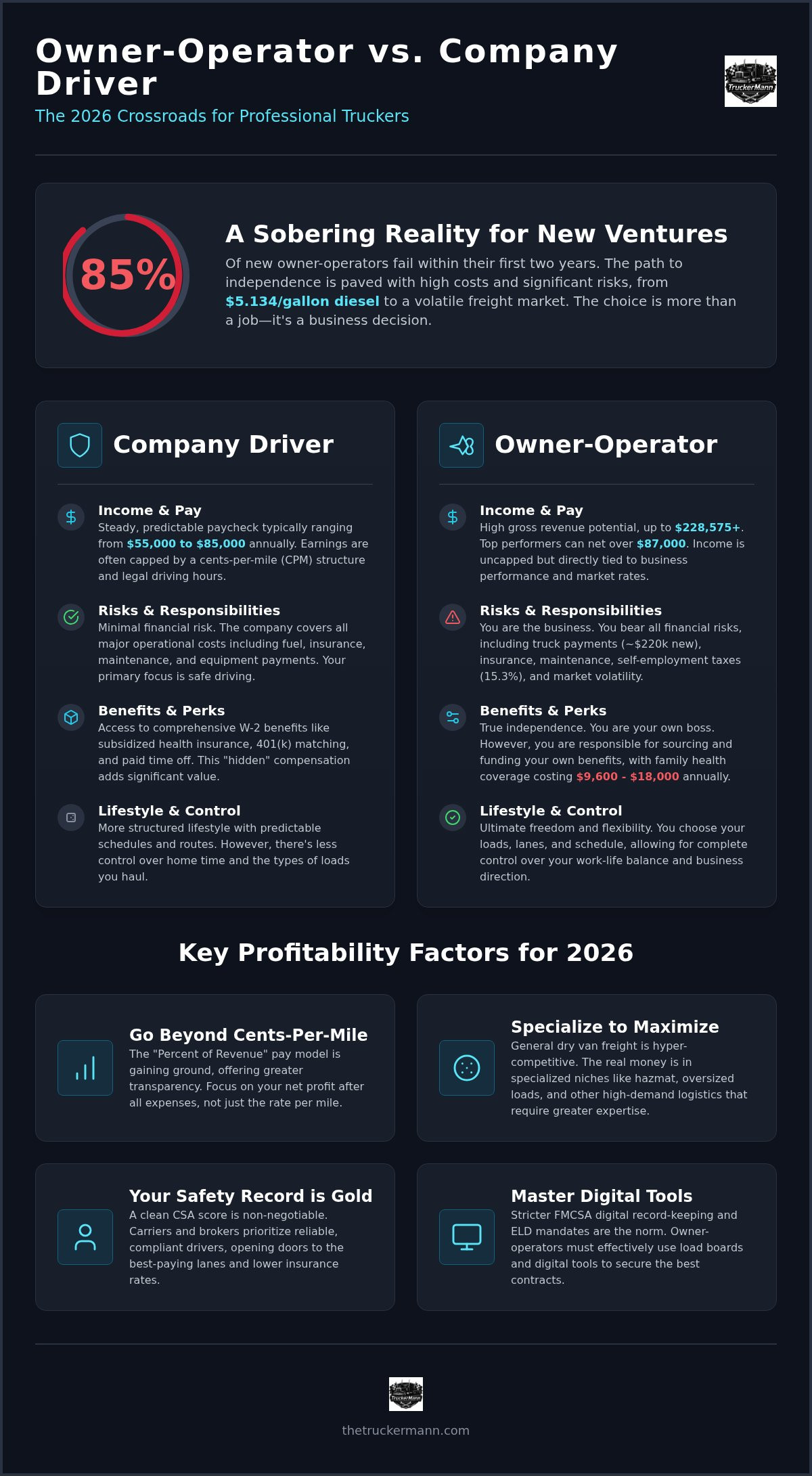
Did you know that 85% of new owner-operators fail within their first two years? It’s a sobering number, especially when you’re staring down $5.134 per gallon at the pump and stagnant company wages that don’t seem to budge. You’re likely tired of the lack of home-time control and feeling like just another number in a corporate spreadsheet. We’ve all been there, weighing the freedom of the open road against the crushing weight of overhead. Deciding between being an owner operator vs company driver in 2026 isn’t just about who owns the title to the rig; it’s about whether you want a paycheck or a business.
The Truckermann is here to give you the straight talk you need to survive this volatile market. This guide provides a breakdown of the risks and rewards of independence, from the $220,000 price tag on new Class 8 trucks to the stricter FMCSA digital record-keeping rules. We’ll look at the real-world costs of ownership, how to maximize your take-home pay, and why top performers are netting over $87,000 while others go bust. Whether you’re chasing that $228,575 gross revenue potential or you prefer the safety net of company-subsidized health insurance, you’ll find the roadmap you need right here.
Key Takeaways
- Discover how the 2026 freight market rewards drivers with clean safety records, regardless of which side of the cab you sit on.
- Weigh the stability of W-2 benefits and employer-paid maintenance against the freedom and higher gross potential of running your own business.
- Get a clear breakdown of the owner operator vs company driver pay structures, including why the “Percent of Revenue” model is gaining ground over cents-per-mile.
- Learn to calculate true profitability by accounting for 2026 fuel surcharge averages and the rising costs of insurance and equipment.
- Step through the essential transition from employee to owner, including the digital tools and load boards needed to secure the best lanes.
The 2026 Trucking Landscape: Choosing Your Path
Choosing between being an employee and running your own show is the biggest fork in the road you’ll ever face. In 2026, the gap between these two paths has widened significantly. It isn’t just about who signs your paycheck; it’s about who carries the risk when diesel hits $5.134 a gallon. The 2026 market doesn’t have room for “steering wheel holders” anymore. Carriers and brokers are looking for drivers with bulletproof safety records. If your CSA score is dragging, the Owner-operator business model might be a mountain too high to climb right now. As a veteran who’s seen the cycles of this industry, I’m telling you straight: the choice of owner operator vs company driver depends entirely on your appetite for business management.
Current freight volumes are steady, but the “gold rush” days of easy money are gone. Whether you’re a W-2 company driver or an independent, your value is tied to your reliability and your compliance. The 2026 regulatory environment is tighter than ever, and those who can’t keep their paperwork clean are being pushed out of the high-paying lanes. It’s a professional’s market, and you need to decide if you want the safety of a fleet or the high-stakes rewards of the open market.
To better understand this concept, watch this helpful video:
CDL Career Paths in 2026
Market Volatility and Capacity Rates
Capacity rates in 2026 have stabilized, but that doesn’t mean the market isn’t volatile. If you’re looking at owner operator vs company driver options, you’ve got to stop obsessing over the “rate per mile.” That’s a secondary metric. What matters is your net profit after you’ve paid for fuel, insurance, and the 15.3% self-employment tax. Company drivers have the luxury of ignoring capacity shifts, but an owner-operator lives and dies by them. Transparency is the new gold standard. In 2026, the best carrier partnerships are built on open-book contracts where you see exactly what the shipper is paying. If a carrier is hiding the numbers, they’re likely taking a bigger cut than you’d like to admit.
Company Driver: Stability vs. Income Ceiling
Starting your career as a company driver is the smartest move for anyone with less than two years in the seat. It is the essential training ground where you learn the industry’s rhythms without the threat of a $20,000 engine overhaul ending your financial life before it starts. In the ongoing debate of owner operator vs company driver, the company side offers a safety net that protects you from the volatile swings of the 2026 market. You get to focus on the road while someone else worries about the spreadsheets.
The financial reality for experienced company drivers in 2026 is a steady paycheck ranging between $55,000 and $85,000. While this is a respectable living, you have to accept an inherent income ceiling. Most fleets still operate on a cents-per-mile (CPM) structure. Since you only have so many legal driving hours in a day, your earning potential is physically capped by the clock and the speed governor. The 2026 job outlook for truck drivers remains strong; however, the biggest jump in pay usually requires moving into specialized freight or taking the leap into ownership.
Beyond the base pay, the “hidden” wealth of a W-2 position is in the benefits. Company drivers receive heavily subsidized health insurance. For an owner-operator, providing that same family coverage can cost between $9,600 and $18,000 per year out of pocket. When you add in 401k matching and paid vacation, the actual value of a company job is often much closer to an owner-operator’s net income than the gross numbers suggest.
The Perks of Employee Status
When you’re an employee, you have zero financial risk regarding equipment failure or diesel spikes. If diesel stays at $5.134 per gallon, it doesn’t cost you a dime. If a turbo blows, you aren’t the one swiping a credit card for five grand. You also benefit from simpler tax filing; you don’t have to worry about that 15.3% self-employment tax that hits the independent guys. Most fleets also provide the latest ELDs and safety gear, ensuring you stay compliant with the 2026 FMCSA digital record-keeping rules without any personal investment.
The Trade-off: Control vs. Comfort
However, that comfort comes at the cost of your freedom. Forced dispatch is a reality for many company drivers, meaning you go where the fleet manager tells you, even if the lane is a nightmare. Governed trucks are another major frustration; being stuck at 65 mph while the rest of the world flies by can wear on your patience. This lack of control over your schedule and your equipment is exactly why many top-tier drivers eventually start looking at the “Lease-on” model as a middle ground. If you’re looking to maximize your comfort while still running company gear, check out the latest gear recommendations at thetruckermann.com to make your cab feel more like home.
Owner-Operator: Risk vs. True Independence
Independence is the ultimate dream for many behind the wheel, but it is also a heavy burden that requires a complete shift in mindset. When you move from being an employee to an owner, you stop being a driver and start being a business manager who happens to drive. In the owner operator vs company driver debate, the biggest draw for independence is the “Percent of Revenue” pay model. Instead of earning a flat rate per mile, you’re typically pulling 70% to 80% of the total load pay. This means when freight rates spike, your paycheck spikes with them. You gain the freedom to choose your own lanes, pick your own loads, and tell a broker “no” when the rate doesn’t make sense for your bottom line.
While the truck driver job outlook remains steady, the financial stakes for owners are significantly higher in 2026. The average gross revenue for an owner-operator is currently around $228,575, but don’t let that big number fool you. After you pay for fuel, maintenance, and the tax man, the average net income sits between $64,524 and $72,000. True independence means you are the one responsible for every cent of that overhead, from the $12,000 to $20,000 annual insurance premiums to the 15.3% self-employment tax. It’s a high-stakes game where your business acumen is just as important as your ability to back into a tight dock.
Lease-on vs. Independent Authority
You have two main paths to ownership. Leasing on to a carrier is the most common entry point. You get the benefit of their back-office support, established fuel cards, and group insurance rates, but you’re still running under their authority. Be careful here; some carriers use predatory lease-purchase agreements that act as debt traps rather than paths to ownership. On the other hand, running under your own independent authority gives you 100% of the control, but you’re responsible for finding every load, filing your own IFTA, and managing all DOT compliance. Before you pull the trigger, check out our Interstate vs. Intrastate guide to understand the legal requirements for your specific operation.
The Real Cost of Ownership
The barrier to entry in 2026 is steep. A new Class 8 truck will set you back between $180,000 and $220,000. Even a used, late-model rig is averaging over $61,000. These are your fixed costs, and they don’t care if you’re sick or the truck is in the shop. Then you have variable costs like diesel, which is currently averaging $5.134 per gallon. You must maintain a “rainy day” fund of at least $15,000 to $20,000. Without that cushion, a single major mechanical failure can put you out of business permanently. If you’re ready to start building your business, you can find the high-paying freight you need at The Truckermann.
Evaluating 2026 Profitability Factors
In the high-stakes choice of owner operator vs company driver, the winner isn’t the one with the biggest gross revenue. It’s the one who keeps the most after the bills are paid. While a company driver’s paycheck is predictable, an owner’s bank account is a moving target. You have to understand that profit is a simple equation: Revenue minus Expenses. In 2026, the “Expense” side of that ledger is where most new owners fail. They see the gross revenue and forget that they are now the ones paying for the tires, the insurance, and the $5.134 per gallon diesel.
The 2026 Fuel Surcharge (FSC) is your most critical tool for survival. With diesel prices up $1.32 over last year, your FSC isn’t a bonus; it’s a shield. If you aren’t selecting loads with a robust surcharge, you’re essentially paying the shipper to haul their freight. Top-performing owners treat fuel management as a second job. They know that every cent saved at the pump is a cent added directly to their net profit. Specialized niches like flatbed or heavy-haul consistently pay more per mile because they require more than just driving. They require expertise and a physical commitment. Investing in high-quality securement tools has a massive ROI. Better gear means faster loading, fewer damage claims, and access to premium freight that standard dry van haulers can’t touch.
Fuel Management and IFTA
Smart route planning is about more than just the shortest distance. It’s about avoiding high-tax states and expensive fuel zones that eat your margins. You should always use fuel cards to snag deep discounts that aren’t available to the general public. Integrating your ELD device with IFTA reporting software is the only way to stay sane during tax season. It automates the data collection, so you don’t spend your home time buried in receipts and logbooks.
Specialized Gear and Load Selection
Flatbed margins remain superior in 2026 because the barrier to entry is higher. You need the right setup to play in this league. You can shop durable securement tools at Mytee Products to ensure your load stays put and passes every roadside inspection. If you’re serious about making the switch to specialized hauling, check out our guide on The Best Flatbed Trucking Gear for a complete breakdown of the essential setup you’ll need to maximize your earnings. Ready to master your business metrics? Get more expert advice on navigating the 2026 market at thetruckermann.com.
Landing Your Next Contract in 2026
Making the jump from company driver to owner-operator isn’t just about changing who holds the title to the rig; it’s about changing how you see yourself. You’re moving from a position where you’re paid to drive to a position where you’re paid to manage an asset. In the 2026 market, your reputation is your currency. Brokers and carriers have more data than ever, and they’re using it to vet you before you even pick up the phone. A clean MVR and a low CSA score are no longer just “nice to have.” They are the prerequisites for bidding on the highest-paying contracts. If your record is spotted, you’ll be stuck fighting for the scraps while the professionals secure the premium freight.
The Truckermann philosophy is simple: treat your truck like a business, not a toy. It’s easy to get distracted by chrome accessories and custom lighting, but every dollar spent on aesthetics is a dollar that isn’t protecting your bottom line. In this owner operator vs company driver landscape, the guys who survive are the ones who prioritize maintenance, fuel efficiency, and compliance over ego. Success in 2026 requires you to be as sharp with a spreadsheet as you are with a gear shifter. You need to know your cost per mile down to the fraction of a cent so you can walk away from bad deals with confidence.
Maximizing Load Board Strategy
To win in 2026, you’ve got to stop being a “lane taker” and start being a “lane maker.” This means identifying “power lanes” where outbound demand consistently outstrips available capacity. Don’t just look at the rate on the screen. Use market data to see the historical trends and the creditworthiness of the broker. When you negotiate, don’t just ask for more money. Use current market capacity data to justify your rate. If you can prove you’re a high-service, low-risk carrier, you can command a premium. You can find high-paying freight on 123Loadboard by using their advanced filtering tools to spot these opportunities before the rest of the pack.
The Final Business Checklist
Before you sign that lease-on contract or file for your own authority, you need to vet the deal with a cold, calculated eye. Look for hidden fees, trailer rental costs, and forced insurance “packages” that eat your margins. Your equipment needs to be as ready as your mind. Review our CDL Pre Trip Inspection Master Guide to ensure your rig won’t fail you at the scale house during your first week. If you’re leasing on, make sure the carrier’s values align with your business goals. If you’re going independent, ensure your back-office systems are ready for the administrative load. Ready to book your first load? Start here and put your business plan into action.
Master Your Career Path in 2026
The choice of owner operator vs company driver isn’t a permanent decision, but it’s one that requires a clear-eyed look at the numbers. Whether you choose the safety net of employee benefits or the high-stakes potential of running your own authority, success in 2026 depends on your ability to manage your CSA score and your fuel costs. Remember that independence is earned through business discipline; treat your truck like the revenue-generating asset it is rather than just a ride. You now have the roadmap to navigate diesel spikes and regulatory shifts with confidence.
The Truckermann provides veteran-led industry insights and real-time 2026 market rates to keep you ahead of the pack. You don’t have to navigate these direct broker connections alone. Start your owner-operator journey with 123Loadboard and take control of your career today. Keep your head up and your eyes on the horizon. The road ahead is full of opportunity for those prepared to take it.
Frequently Asked Questions
How much do owner operators make vs company drivers in 2026?
Experienced company drivers earn between $55,000 and $85,000, while owner-operators see a much higher gross revenue of roughly $228,575. However, the net income for an owner operator vs company driver comparison is closer than you think. After expenses, most owners net between $64,524 and $72,000; though top business managers can push that past $87,000. You have to decide if the extra $10,000 in net pay is worth the added business risk.
Is it worth becoming an owner operator with high diesel prices?
It is only worth it if you have the business discipline to manage tight margins and select loads with high fuel surcharges. With diesel at $5.134 per gallon, your profit depends on efficiency and route planning rather than just driving miles. If you can’t manage your overhead or maintain a $15,000 emergency fund, the stability of a company driver position is a much safer bet in this market.
What is the average fuel surcharge for owner operators right now?
Fuel surcharges vary by carrier and contract, but they are designed to bridge the gap when diesel prices rise. With national averages sitting at $5.134 as of July 20, 2026, you must ensure your surcharge covers the $1.32 per gallon increase seen over the last year. Always verify the surcharge percentage before booking a load to protect your bottom line from being erased by pump prices.
Do I need my own authority to be an owner operator?
You don’t need your own authority; you can choose to lease on to an existing carrier and run under theirs. This provides back-office support and group insurance rates, which helps when premiums range from $12,000 to $20,000. Independent authority gives you 100% of the freedom but requires you to handle every aspect of DOT compliance, IFTA filings, and broker negotiations yourself without a safety net.
What are the hidden costs of lease-purchase agreements?
Predatory lease-purchase agreements often hide costs like high interest rates, trailer rentals, and forced maintenance accounts. Some of these contracts function as debt traps where the driver never actually achieves ownership despite years of payments. Always have a professional review the fine print for balloon payments or restrictions that limit your ability to work for other brokers or choose your own lanes.
Can I find owner operator jobs on 123Loadboard?
You can find thousands of loads and carrier opportunities on 123Loadboard that cater specifically to owner-operators. It’s a powerful tool for identifying high-paying lanes and vetting brokers’ credit before you commit to a haul. Using digital tools is essential for any owner operator vs company driver comparison because it allows you to see real-time market capacity and avoid deadhead miles that kill your profit.
What gear do I need to start as a flatbed owner operator?
You need a full set of specialized securement gear including steel and lumber tarps, grade 70 chains, ratcheting binders, and heavy-duty straps. Quality gear is a prerequisite for the best-paying specialized jobs in 2026. Don’t skimp on these tools; they are the physical difference between a secured load and a costly out-of-service order at the scale house that could ruin your safety rating.
How does a clean DOT inspection record affect my pay?
A clean record directly impacts your ability to secure high-paying contracts and premium freight. With the 2026 FMCSA rules emphasizing digital record-keeping, carriers and brokers use your safety data to determine your reliability. Drivers with multiple violations are often restricted to lower-paying lanes or face higher insurance premiums that eat into their net profit, making the risk of ownership much harder to justify.
Disclaimer
The information provided on The TruckerMann is for general informational and educational purposes only. While every effort is made to ensure the accuracy and reliability of the content, trucking laws, FMCSA regulations, DOT requirements, safety standards, and industry policies can change at any time. Readers are encouraged to verify all information with official government agencies, professional advisors, or qualified industry professionals before making business, legal, financial, safety, or compliance-related decisions.
The content shared on this website reflects personal opinions, experiences, research, and commentary and should not be considered legal, financial, medical, tax, or professional advice. The TruckerMann and its owners, contributors, affiliates, or representatives are not responsible for any losses, damages, violations, penalties, or liabilities resulting from the use or misuse of information found on this website.
Some content on this website may contain affiliate links, sponsored content, or promotional material. This means we may earn a commission at no additional cost to you if you choose to purchase through certain links.
By using this website, you agree that you do so at your own discretion and risk.