A single oversight on your electronic DVIR could now hit your pocket for $19,000 and put your rig out of service before you even leave the yard. It’s a tough pill to swallow, especially when it feels like the government updates the playbook every time you finally get comfortable with the current FMCSA regulations for truck drivers. You’ve spent years honing your craft on the slab; the last thing you need is a confusing regulatory shift or a revoked ELD model threatening your CDL and your paycheck.
We understand the grind and the constant pressure to stay compliant while the goalposts keep moving. This guide breaks down the essential 2026 updates, cutting through the red tape to give you the straight talk you need. You’ll learn exactly how to handle the new electronic medical certification requirements, what the latest broker financial rules mean for your loads, and how to ace inspections under the new digital standards. Let’s get your paperwork as solid as your securement so you can focus on the road ahead.
Key Takeaways
- Stay updated on the latest FMCSR changes to align your operation with the FMCSA’s 2026 safety priorities and enforcement shifts.
- Protect your livelihood by mastering HOS limits and ensuring your ELD model remains on the federal registered list to avoid immediate shutdowns.
- Simplify the complex web of FMCSA regulations for truck drivers by focusing on the new digital standards for medical certifications and vehicle reports.
- Learn which critical equipment components DOT officers target during Level 1 inspections to keep your rig moving and your record clean.
- Understand how the CSA scoring system tracks your performance and learn practical ways to maintain a high safety rating for better career prospects.
FMCSA Rules 2026: Key Updates
The Federal Motor Carrier Safety Administration (FMCSA) isn’t just watching from the sidelines; they’ve shifted their 2026 mission toward total digital integration. This means the days of sliding by with a coffee-stained paper medical card or a glitchy ELD are over. The agency is cracking down on data accuracy to weed out bad actors and reward those who keep their ducks in a row. Staying sharp on FMCSA regulations for truck drivers is how you separate yourself from the amateurs. A clean record isn’t just about avoiding fines; it’s your ticket to landing those high-paying freight contracts that demand a spotless MVR. When carriers see a driver who masters compliance, they see a professional they can trust with their most valuable cargo.
To better understand this concept, watch this helpful video:
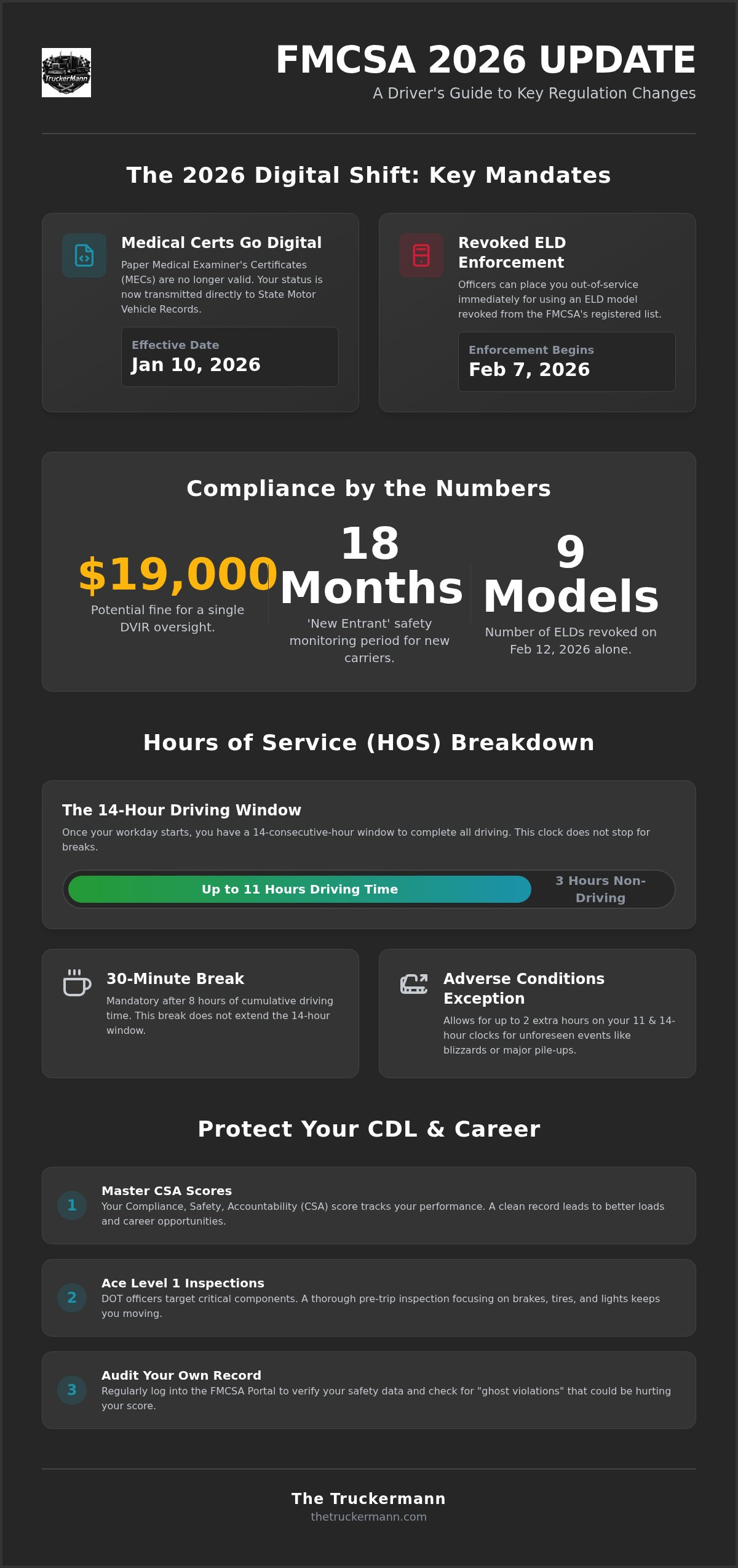
The big shift in 2026 is the hard line on electronic systems. As of January 10, 2026, paper Medical Examiner’s Certificates (MEC) are officially relics of the past. Your certification now flows directly through State Motor Vehicle Records via the National Registry II system. If it’s not in the digital database, you’re not legal to drive. This digital push extends to your logs too. By February 7, 2026, enforcement officers gained the authority to put you out of service immediately if they catch you using an ELD model that’s been revoked from the FMCSA’s registered list. On February 12, 2026 alone, nine different ELD models were stripped of their registration. If you didn’t swap those units out by the April 14 deadline, you’re sitting ducks for a violation. It’s about accountability; the FMCSA is using these digital threads to create a tighter net around every mile you drive.
New 2026 Safety Tech Mandates
Modern iron is getting smarter, whether we like it or not. The FMCSA is pushing for Automatic Emergency Braking (AEB) on newer heavy-duty rigs to cut down on rear-end collisions. While speed limiter mandates are still the subject of heated debate in the halls of D.C., the move toward digital IDs is already here. Roadside stops are becoming faster and more data-driven as officers scan digital credentials that pull your entire history in seconds. It’s a high-stakes environment where a single data mismatch can trigger a full Level 1 inspection, so your digital house must be in order.
The Driver’s Role in Compliance
You’re the captain of your ship, and that means the buck stops with you for your paperwork. Don’t wait for a dispatcher to tell you your medical file is expiring. Log into the FMCSA Portal regularly to verify your own safety data and ensure no “ghost violations” are dragging down your score. For those just starting out, the ‘New Entrant’ period in 2026 is an 18-month safety monitoring phase where the FMCSA closely watches every inspection and log to ensure you’ve mastered the basics of FMCSA regulations for truck drivers. Keeping your record clean during this window is the foundation of a long, profitable career.
Hours of Service and ELD Mastery
Hours of Service (HOS) aren’t just lines on a screen; they’re the maximum allowable driving times designed to keep you from running on empty. Mastering these FMCSA regulations for truck drivers is what keeps your MVR clean and the DOT off your back. You’ve got 11 hours of actual wheel time within a 14-hour workday window. Remember, once that 14-hour clock starts, it doesn’t stop for anything except a qualifying sleeper berth split. Maintaining high Commercial Driver’s License (CDL) standards means understanding that these clocks aren’t suggestions. If you’re pushing the limit because of a slow shipper, you’re the one who pays the price when the blue lights flash.
The mandatory 30-minute break must be taken after 8 hours of cumulative driving time. Smart drivers time this break to coincide with fueling or a quick meal to keep the wheels turning efficiently. If you hit a freak blizzard or a multi-car pileup that wasn’t on the radar, the adverse driving conditions exception allows you to extend your 11 and 14-hour clocks by up to 2 hours. Just be careful. This exception is for truly unforeseen events. Using it to justify poor trip planning or predictable rush hour traffic is a quick way to earn a violation during a roadside inspection.
ELD Compliance and Troubleshooting
Common ELD errors like failing to sign your logs or forgetting to log ‘Yard Move’ during trailer swaps lead to ‘form and manner’ violations that stack up fast. If your device goes dark, you’ve got to switch to paper logs immediately. You’re allowed to use paper for up to 8 days while you get the hardware fixed or replaced. If you’re still hunting for a device that won’t leave you stranded, check the ELD Compliance in 2026 guide for hardware picks. Keeping a backup paper logbook in your side pocket is a veteran move that saves headaches when technology fails.
Sleeper Berth Provisions
The 8/2 or 7/3 sleeper berth split is a veteran tool to maximize drive time. By splitting your mandatory 10-hour off-duty period, you can pause that 14-hour clock and get back on the road when you’re actually rested. Just make sure you’re logging ‘Off Duty’ and ‘Sleeper Berth’ exactly as they happen. When using personal conveyance to find the nearest safe parking or a hot meal, keep it reasonable. Short distances are usually fine, but using PC to advance a load toward a receiver is a fast track to a failed audit. For more insights on keeping your operation legal, head over to The Truckermann for the latest field reports.
Vehicle Safety and Inspection Rules
Your pre-trip isn’t just a box to check; it’s your first line of defense against a roadside nightmare. Under the latest FMCSA regulations for truck drivers, as of February 2026, electronic Driver Vehicle Inspection Reports (DVIRs) are officially recognized as legally equal to paper logs. This shift toward digital record-keeping means DOT officers can audit your maintenance history in seconds. If they catch you pencil-whipping a report or willfully falsifying a defect, you’re looking at a civil penalty that can hit $19,000 per violation. Staying compliant with the Official FMCSA Regulations isn’t just about safety; it’s about protecting your bank account from avoidable hits. For a full walkthrough of what to look for before you drop the hammer, reference our Ultimate DOT Inspection Level 1 Checklist.
Brakes, Tires, and Lights
Officers aren’t just looking for the big stuff. A single marker light out can be the probable cause they need to pull you in for a full Level 1 inspection. Once you’re in the pit, they’re checking for 2/32-inch tread depth on drive tires and 4/32-inch on steers. If your brake pushrod stroke exceeds the limit on just 20 percent of your service brakes, you’re done for the day and placed out of service. The Commercial Vehicle Safety Alliance (CVSA) establishes the North American Standard Inspection Program to ensure uniform enforcement across borders, so don’t expect a pass just because you’ve crossed state lines. Keep your slack adjusters tight and your rubber fresh to keep the wheels turning.
Securement and Logistics Gear
Flatbedders and open-deck haulers have it the hardest because their mistakes are visible to every passing patrol car. Your straps and chains must meet the Working Load Limit (WLL) requirements, which generally means the aggregate WLL of all securement devices must equal at least half the weight of the cargo. If your gear is frayed, cut, or rusted, it’s trash. You can find high-quality, heavy-duty securement equipment at Mytee Products to ensure your load stays where you put it. Don’t forget to document your cargo checks on your logs within the first 50 miles and every 150 miles or three hours after that. It’s a small step that proves you’re a professional who respects the load, the equipment, and the FMCSA regulations for truck drivers that keep us all safe on the slab.
Medical Cards and Drug Testing
Your health isn’t just a personal matter; it’s a matter of public record and professional survival. The FMCSA regulations for truck drivers have evolved to make medical and substance compliance nearly impossible to ignore. With the full implementation of the National Registry II system, the days of carrying a folded paper card in your wallet are over. Everything is digital now, and if the data doesn’t match at the state level, your CDL is at risk. A ‘Prohibited’ status in the Drug and Alcohol Clearinghouse is a career-stopper. It triggers an automatic notification to your state DMV, which can lead to an immediate downgrade of your commercial privileges. The Return to Duty (RTD) process is a gauntlet of substance abuse professional evaluations and observed testing that many carriers simply won’t wait for, making prevention your best strategy.
Clearinghouse 2.0 Updates
Employers are now mandated to run full queries during the hiring process and at least once a year for every driver on their roster. This transparency keeps the roads safer but puts the burden of responsibility squarely on your shoulders. Protecting your record is the best way to ensure you have access to the best freight in the industry. Instead of relying on a dispatcher to check your status, you should be proactive in monitoring your own Clearinghouse portal. If you’re looking to level up your professional knowledge and stay ahead of these audits, checking out specialized training at DLA Academy can help you navigate the finer points of compliance. Don’t let a simple reporting error or a missed query sideline your rig.
Maintaining Driver Fitness
The DOT physical targets conditions that could cause sudden impairment behind the wheel. High blood pressure, diabetes, and sleep apnea are the big three that often lead to “restricted” medical cards. If you’re issued a one-year or six-month certificate instead of the standard two-year card, you’ve got to stay ahead of that expiration date. Remember, the waiver allowing for paper Medical Examiner’s Certificates expired on January 10, 2026. Your certification is now verified electronically through State Motor Vehicle Records. If you operate in multiple states, you must self-certify as “Non-Excepted Interstate” to stay legal under FMCSA regulations for truck drivers. Keeping your medical file updated with your state licensing agency is your final task after leaving the doctor’s office. Don’t assume the data will flow perfectly every time; verify it yourself through your state’s driver portal. For more field-tested strategies on staying compliant and healthy on the road, visit The Truckermann for expert guidance.
Protect Your CDL and Career
Compliance isn’t just a hurdle to clear; it’s the armor that protects your livelihood. In this industry, your CDL is your most valuable asset, and a single lapse in judgment regarding FMCSA regulations for truck drivers can trigger a financial landslide. Think beyond the immediate fine. When you’re placed out of service, the clock doesn’t just stop for your logs; it stops for your revenue. You’re losing hundreds, potentially thousands, in lost miles while your fixed costs like insurance and truck payments keep ticking. Treating your rig like a business means understanding that the FMCSA’s move toward stricter broker financial responsibility, like the $75,000 security requirement effective January 16, 2026, is part of a larger trend toward total professional accountability. If you want to play in the big leagues, you’ve got to keep your scorecard perfect.
The CSA system is that scorecard. Every roadside inspection and every moving violation feeds into a data profile that carriers and insurance companies watch like hawks. High CSA scores don’t just lead to more frequent “random” inspections; they drive up your premiums and make you radioactive to the best-paying fleets. Building a ‘Compliance First’ routine isn’t about being a teacher’s pet. It’s a calculated business strategy to reduce roadside stress and ensure that when you see the “Truck Must Enter” sign, you aren’t breaking a sweat. You’re a professional operator, and your paperwork should reflect that level of mastery every time you slide into the seat.
Roadside Inspection Survival
Interacting with a DOT officer is a high-stakes professional meeting. Keep it respectful, keep your cab organized, and have your digital credentials ready to go. A clean Level 1 inspection is a badge of honor that tells the industry you’re a veteran who knows his equipment inside and out. It starts with your morning walk-around. To make sure you haven’t missed a single frayed wire or loose bolt, use our CDL Pre Trip Inspection Checklist to avoid surprises under the lights. When an officer sees a driver who is prepared and proactive, the inspection usually goes a lot smoother.
Long-Term Career Growth
A spotless MVR and a clean PSP report are your leverage in this economy. They open doors to specialized hauling, better lease-on deals, and insurance rates that actually let you keep some of your hard-earned cash. As we move through 2026, staying current with rules through specialized training apps and industry hubs is no longer optional. It’s how you stay competitive. The industry is changing fast, but the goal remains the same. Stay vigilant, keep your records tighter than your load securement, and always keep the rubber side down. For more veteran advice on mastering the road, keep your eyes on The Truckermann field reports.
Master the Road Ahead
Staying ahead of FMCSA regulations for truck drivers is about more than avoiding a ticket; it’s about maintaining the professional edge that keeps your business profitable. We’ve navigated the critical shifts toward digital medical records, the strict enforcement of registered ELD models, and the high stakes of electronic DVIRs. These updates aren’t just hurdles. They are the new standards for elite operators who treat this career as a lifestyle. By mastering these rules now, you’re securing your CDL and your seat at the table for the best freight in the industry.
The Truckermann is here to ensure you never walk into an inspection blind. We provide veteran-vetted safety resources, real-time regulatory alerts, and direct links to industry-leading securement gear. Don’t let a paperwork error sideline your rig or drain your bank account. Take control of your compliance today and stay focused on the miles that matter.
Gear up for 2026 compliance at The Truckermann and keep your record spotless. Stay vigilant, keep your equipment tight, and we’ll see you out on the slab.
Frequently Asked Questions
What are the new FMCSA regulations for 2026?
The most significant updates for 2026 include the mandatory electronic submission of medical certificates and the official authorization of electronic DVIRs as robust legal records. You must also be aware of the immediate out-of-service orders for carriers caught using ELD models that have been revoked from the federal registry. These changes mark a total shift toward digital compliance, making it easier for enforcement officers to audit your history during any roadside stop.
How many hours can a truck driver legally drive in a day?
You can legally drive for a maximum of 11 hours within a 14-hour workday after being off duty for 10 consecutive hours. This 14-hour window starts the moment you log ‘On Duty’ and does not stop for anything, except for specific sleeper berth split provisions. Understanding these 11 and 14-hour clocks is essential for staying on the right side of the FMCSA regulations for truck drivers and avoiding costly HOS violations.
What happens if I fail a DOT drug test in 2026?
Failing a DOT drug test results in an immediate ‘Prohibited’ status in the FMCSA Drug and Alcohol Clearinghouse and a notification to your state licensing agency. Your CDL will be downgraded or suspended until you complete the full Return to Duty process with a qualified professional. This process involves multiple evaluations and observed follow-up tests, which can keep you off the road and out of a paycheck for several months.
Do I need an ELD if I only drive intrastate?
Most states have adopted the federal ELD mandate for intrastate commerce, so you likely need a device if your vehicle is model year 2000 or newer and requires a CDL. However, some specific exemptions exist for short-haul drivers who stay within a 150 air-mile radius of their home base. You should check your specific state’s commercial vehicle handbook, as local rules can sometimes vary slightly from the federal standard while maintaining safety.
How often do I need to renew my DOT medical card?
A standard DOT medical card is valid for two years, but your medical examiner can issue a shorter certificate if you have health issues like high blood pressure. These “restricted” cards might require renewal every year or even every few months to monitor your fitness for duty. Since January 10, 2026, your renewal data must be transmitted electronically to your State Driver Licensing Agency to keep your CDL valid and active.
What is the FMCSA Drug and Alcohol Clearinghouse?
The Clearinghouse is a secure online database that gives the FMCSA and employers real-time information about CDL holders’ drug and alcohol program violations. It ensures that drivers who commit violations cannot hide their records by moving from one state or employer to another. In 2026, the system is fully integrated with state driver records, making a clean status the only way to legally operate a commercial motor vehicle in the United States.
Can a DOT officer inspect my personal phone or ELD tablet?
A DOT officer has the legal authority to inspect your ELD tablet to verify your logs and ensure the device is compliant, but they generally cannot search your personal phone without a warrant. To keep things professional, many veterans use a dedicated tablet for their logs rather than a personal smartphone. This clear boundary protects your privacy while allowing you to fulfill the FMCSA regulations for truck drivers regarding logbook inspections at roadside stops.
What are the most common DOT inspection violations?
The most frequent violations found during roadside inspections include lighting issues, tire tread depth below limits, and brake systems out of adjustment. On the driver side, ‘form and manner’ logbook errors and HOS violations remain at the top of the list for enforcement officers. Keeping your pre-trip thorough and your ELD signatures current is the best way to avoid being part of the violation statistics during the next CVSA Roadcheck.
Disclaimer
The information provided on The TruckerMann is for general informational and educational purposes only. While every effort is made to ensure the accuracy and reliability of the content, trucking laws, FMCSA regulations, DOT requirements, safety standards, and industry policies can change at any time. Readers are encouraged to verify all information with official government agencies, professional advisors, or qualified industry professionals before making business, legal, financial, safety, or compliance-related decisions.
The content shared on this website reflects personal opinions, experiences, research, and commentary and should not be considered legal, financial, medical, tax, or professional advice. The TruckerMann and its owners, contributors, affiliates, or representatives are not responsible for any losses, damages, violations, penalties, or liabilities resulting from the use or misuse of information found on this website.
Some content on this website may contain affiliate links, sponsored content, or promotional material. This means we may earn a commission at no additional cost to you if you choose to purchase through certain links.
By using this website, you agree that you do so at your own discretion and risk.