What if the difference between a smooth haul and a $5,000 DOT fine is nothing more than the color of a diamond on your trailer? Out on the open road, missing a subtle shift in 2026 regulations isn’t just a minor oversight; it’s a direct risk to your professional reputation and your wallet. We all know the feeling of scanning the shoulder for weight limits or squinting at complex hazmat codes while the clock is ticking. Understanding truck sign meanings is the only way to keep the scales in your rearview mirror and your CDL spotless.
You’ve likely felt that spike of anxiety when a new route throws a restricted bridge sign your way or a shipper hands you paperwork for a load that doesn’t match your placards. It’s a lot to keep track of when you’re just trying to get the job done safely. This guide is here to help you master the 2026 codes, colors, and symbols so you can drive with total confidence. We’re breaking down everything from high-stakes hazmat requirements to the specific vehicle markings required for DOT compliance, ensuring you’re prepared for every CVSA roadcheck you encounter.
Key Takeaways
- Avoid costly out-of-service orders by understanding why pros are held to a stricter standard than the motoring public.
- Master essential truck sign meanings to navigate weigh station bypasses and low clearance hazards without breaking a sweat.
- Identify dangerous goods at a glance using our guide to 2026 hazmat placard color codes and diamond symbols.
- Keep the inspectors happy by ensuring your DOT numbers and GVWR markings meet the latest visibility and placement requirements.
- Secure your career by learning how to verify your load against your placards for total compliance before hitting the road.
Why Understanding Truck Signs Matters
Being a professional behind the wheel means you’re operating under a microscope. While the average four-wheeler might miss a lane-use sign and get a pass, you don’t have that luxury. Every piece of metal on the shoulder is a direct instruction. Mastering truck sign meanings is about more than just knowing where to turn; it’s about surviving an industry that’s increasingly unforgiving of “I didn’t see it” or “I didn’t know.”
Think of signs as a silent conversation between you and the DOT. When you ignore a “No Trucks” sign or blow past a weight limit, you’re telling an inspector you aren’t prepared for the job. Misinterpreting these signals leads to immediate out-of-service orders. These aren’t just delays; they are permanent marks on your record. By staying sharp, you can avoid the DOT inspection violations that can ground your truck and sink your career before the year is out. Vigilance is your best defense against a bad day at the scales.
The Legal Weight of Signage
In the eyes of the law, U.S. road signs are regulatory mandates. They aren’t suggestions or friendly advice for your route. If a sign says “Left Lane Only for Trucks,” and you’re in the middle, you’re non-compliant. This lack of discipline often results in heavy CSA score points. Those points follow you, making you a liability for your carrier and driving up insurance costs. That’s why identifying these signs is a critical component of a proper CDL pre-trip inspection; you need to know exactly what your rig can handle before the wheels start turning.
Safety and Career Protection
Vigilance keeps your equipment in one piece. We’ve all seen the videos of trailers peeled back like sardine cans because a driver ignored a low-clearance warning. It’s embarrassing, expensive, and often a career-ender. Beyond avoiding bridge strikes, a clean record is your ticket to the top of the industry. Drivers who demonstrate a deep understanding of truck sign meanings and maintain a violation-free logbook enjoy higher CDL rankings and access to better-paying freight. Treat every sign as a warning for your wallet. If you respect the signage, the industry will respect your bottom line.
Essential Highway Signs for Truckers
When you’re rolling down the interstate, highway signs are your primary source of truth. They provide the real-time data your GPS might miss. For professional drivers, mastering truck sign meanings is your daily bread and butter. These signs are standardized by the Manual on Uniform Traffic Control Devices (MUTCD), ensuring that whether you’re in Maine or California, a yellow diamond means the same thing. However, for a Class A driver, a simple “Grade” sign requires a much more complex reaction than it does for a passenger car.
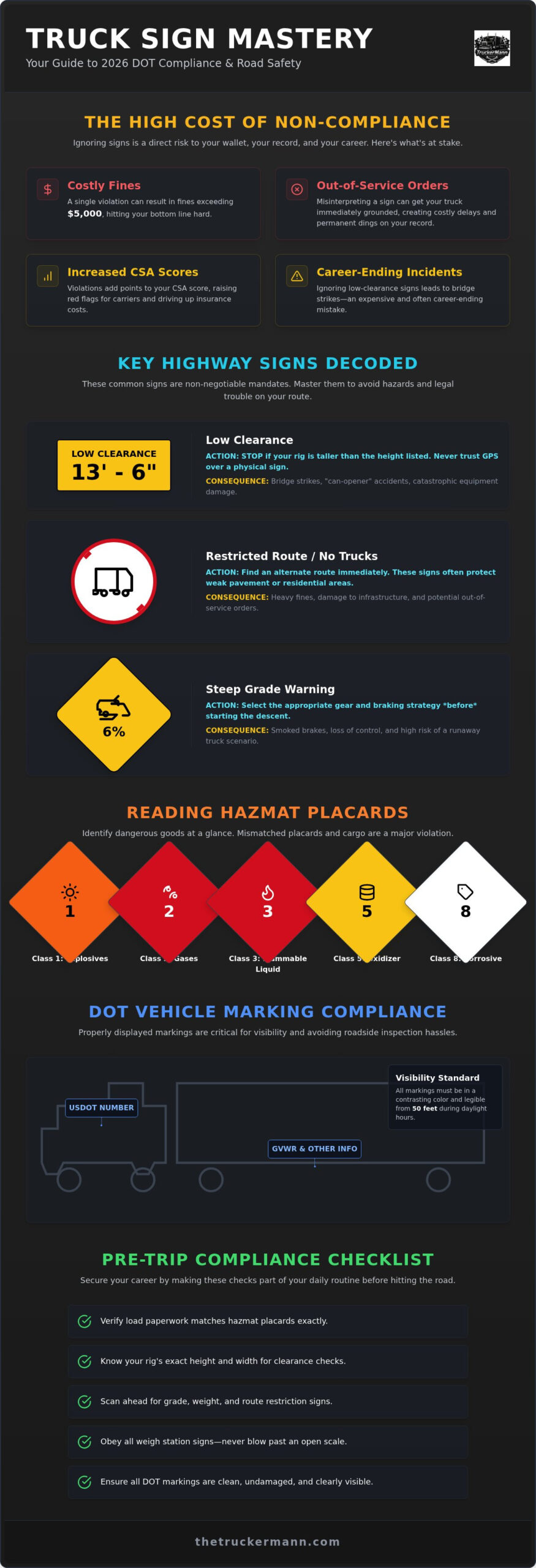
Ignoring a restricted route or a “No Trucks” symbol isn’t just a wrong turn; it’s a potential legal nightmare. These signs are often placed by local ordinances to keep heavy rigs out of residential areas or off weak pavement. If you see a circle with a truck silhouette and a red slash, that is your cue to find a new path immediately. Similarly, grade warnings with a percentage (like 6% or 8%) dictate your gear selection and braking strategy. Missing these can lead to smoked brakes or worse, a runaway truck scenario on a steep descent.
Navigating Weigh Stations
The weigh station is where your professionalism is truly tested. The “All Trucks Must Enter” mandate is the law of the land unless you have a green light from a bypass system like PrePass. If the sign says “Station Open,” you’d better be in the right lane. Blowing a scale is an invitation for a chase car and a roadside inspection you don’t want. To make the process smoother, ensure your rig looks sharp. Using high-quality trucking gear for your cargo securement shows inspectors you take your job seriously, which can sometimes be the difference between a quick “move along” and a full Level 1 inspection.
Bridge and Height Restrictions
Height is a non-negotiable reality in trucking. While 13’ 6” is the standard “magic number” for most van trailers, you must know your exact height in inches. Signs for arched bridges are particularly tricky; the clearance listed is usually for the lowest point of the arch, not the center. Never trust a GPS over a physical sign. If you see a clearance sign lower than your rig, stop. It’s better to block traffic and call for a police escort to back you out than to become the next viral video of a “can-opener” bridge strike. Staying vigilant about these truck sign meanings keeps your trailer intact and your career on track. Before your next haul, it’s a smart move to upgrade your safety lighting to ensure you’re visible when navigating these tight spots.
Deciphering Hazmat Placards and Codes
Hauling hazardous materials changes the game for any driver. It isn’t just about weight or height anymore; it’s about chemistry and consequence. These diamond-shaped placards are the most vital truck sign meanings you’ll ever need to memorize. They serve as a universal language for safety. If things go south, that placard is the first thing a firefighter or state trooper looks for to decide how to handle the scene. It’s your primary way of telling the world exactly what’s riding in your trailer.
Sometimes you’re hauling a mix of different materials. If you have two or more categories of hazmat that require different placards, you might be eligible to use the “Dangerous” placard. However, this isn’t a catch-all. There are strict weight thresholds, usually 1,001 pounds or more, and specific “Table 1” materials that can never be hidden under a generic sign. Never guess on a mixed load. If the paperwork doesn’t match the side of your rig, don’t pull out of the gate until it’s right.
Placard Classes 1 through 9
The DOT breaks dangerous goods into nine distinct classes. Classes 1 through 3 are the heavy hitters: explosives, gases, and flammable liquids. These require the highest level of routing awareness and immediate respect. Classes 8 and 9 cover corrosives and miscellaneous dangerous goods. While they might seem less volatile than a tanker full of fuel, they can still trigger a massive environmental cleanup and a career-ending fine if they leak. You must display these placards on all four sides of your vehicle. They need to be clean, upright, and secured so they don’t flap or peel at highway speeds.
- Red: Flammable liquids or gases.
- Orange: Explosive materials.
- Yellow: Oxidizers that can feed a fire.
- White: Toxic, poisonous, or infectious substances.
- Blue: Dangerous when wet (water-reactive).
The UN Number System
In the center of the placard diamond, you’ll often see a white rectangle containing a 4-digit code. This is the UN number. It identifies the specific chemical or substance you’re hauling. For instance, 1203 tells every professional on the road that you’re carrying gasoline. Understanding these specific truck sign meanings allows you to provide instant information to emergency teams. Always keep your Emergency Response Guidebook (ERG) in the cab and within reach. It’s also critical that your logistics gear includes high-quality, weather-resistant placard holders. Flimsy holders that let a placard fly off on the interstate are an invitation for a Level 1 inspection you just don’t need.
Mandatory Vehicle Markings and Decals
While the signs on the shoulder dictate your route, the markings on your rig dictate your reputation with every inspector you pass. These decals are more than just decorations; they are the visual shorthand for your compliance. In the world of truck sign meanings, the decals on your door are just as important as the speed limit on the highway. If your markings are faded, peeling, or incorrectly sized, you’re basically waving a red flag at the next weigh station. It tells the DOT that if you can’t handle the stickers, you might not be handling your logs or maintenance either.
DOT and Company Identification
Your DOT number and carrier name are the first things an inspector looks for. The law is clear: these markings must be visible from at least 50 feet and in a color that contrasts sharply with your truck. If you’re running a dark blue rig, white or yellow lettering is your best bet. Avoid fancy, hard-to-read fonts. The goal is clarity, not artistic flair. The legal name of the carrier must match your DOT records exactly. Any discrepancy is an easy citation that can lead to a deeper look into your paperwork. To keep your rig moving and your business growing while staying on the right side of the law, consider using 123loadboard to find freight that matches your equipment and permits.
Oversized and Wide Load Signage
Hauling oversized loads brings a whole new set of truck sign meanings into play. You’re no longer just a truck; you’re a hazard that requires special notification. Yellow “Oversize Load” banners must be placed on the front and rear of the vehicle. These banners must meet specific color and reflectivity requirements to ensure they’re seen in low-light conditions. When your load extends beyond the width of your trailer, you must also use red or orange fluorescent flags at the widest points. At night, these flags often need to be supplemented by amber lights. For gear that stands up to the wind and road grime, you can find professional-grade oversized load banners at Mytee Products to ensure you stay visible and compliant.
IFTA Decals and GVWR
Don’t forget the small stuff. Your IFTA decals prove you’re current on your fuel taxes. These must be placed on both sides of the cab, usually near the door. Similarly, displaying your Gross Vehicle Weight Rating (GVWR) is a critical requirement that helps authorities quickly identify your vehicle class. Keeping these decals clean and current shows that you’re a professional who understands that the details matter. If you want to make sure you’re always prepared for the next inspection, enroll in professional driver training to master every regulatory detail and protect your CDL.
Mastering Compliance on the Road
Out here, your rig is your office and your reputation. Mastering truck sign meanings is the final hurdle in moving from being just a driver to becoming a true professional. Compliance isn’t a one-time event at the start of your shift; it’s a continuous commitment to every mile you log. When your physical signage matches your digital records, you create a shield of professionalism that most inspectors won’t want to pierce. Consistency is the key to a clean ELD log, and that consistency starts with the placards on your trailer.
Before you ever pull out of a shipper’s gate, you must verify your load against your placards. Don’t take a yard dog’s word for it. If the paperwork says you’re hauling Class 3 flammables but your trailer is bare, that’s on you the moment you hit public pavement. Plus, you need to keep those signs clean. Road grime is a reality of the job, especially in winter, but it’s never a valid excuse for an illegible DOT number or a hidden hazmat code. A quick wipe-down during a fuel stop can save you a three-digit fine and a lot of headache at the next scale house.
Understanding the nuances of truck sign meanings across state lines is equally vital. Whether you are navigating Interstate vs. Intrastate routes, the rules for weight limits and lane restrictions can shift. Stay sharp on local ordinances to ensure you don’t end up on a road where you don’t belong.
The Professional Driver Persona
You are more than a steering wheel holder; you are a sentinel for the trucking community. Sharing your knowledge of complex signage with newer drivers isn’t just helpful; it keeps our industry safe. When you approach the road with this level of preparedness, the anxiety of a roadside inspection simply disappears. You know your truck is right, your signs are clear, and your paperwork is tight. If you want to take your expertise to the next level and truly master the regulatory environment, investing in your education at the DLA Academy is the smartest move you can make for your career longevity.
Final Checklist for the Road
Before you drop the brakes and roll, run through this final mental check. A professional walk-around is your last line of defense. Check every decal, every flag, and every placard to ensure they are secure and visible. Verify your route restrictions on a professional GPS or a current motor carrier atlas. Technology is great, but physical signs always trump a screen. Stay safe, stay compliant, and keep those wheels turning. The road is demanding, but with the right knowledge, you’re more than ready to handle whatever it throws your way.
Protect Your Livelihood on Every Mile
Out on the open road, your ability to read the landscape is what separates a seasoned veteran from a rookie. We’ve covered why mastering truck sign meanings is the bedrock of a clean record, from dodging low-clearance bridges to nailing complex hazmat compliance. By keeping your decals legible and your placards accurate, you’re doing more than just following the law; you’re acting as a sentinel for the entire trucking community. Thousands of professional drivers trust these standards to keep their livelihoods safe and their rigs moving without interruption.
Staying sharp with daily updates on DOT regulations and expert advice from the road is your best defense against a bad day at the scales. When you treat every sign as a warning for your wallet, you ensure that your career stays on an upward trajectory. Now that you’ve got the knowledge to stay compliant, it’s time to focus on the work that pays. Find your next load and stay compliant with 123loadboard. The industry is constantly shifting, but your dedication to the craft remains the gold standard. Keep your eyes on the shoulder, your rig tight, and your wheels turning toward the next horizon.
Frequently Asked Questions
What does a red diamond-shaped sign on a truck mean?
A red diamond-shaped placard indicates that the vehicle is carrying flammable liquids or gases, classified as Class 3 hazardous materials. This is a critical warning for emergency responders and other drivers that the cargo poses a significant fire risk. You’ll commonly see these on fuel tankers or trailers hauling chemicals like ethanol or gasoline.
Do I have to enter a weigh station if the sign says “Trucks Use Right Lane”?
Yes, you must move to the right lane and prepare to enter the scale unless your bypass transponder gives you a green light. This sign is a regulatory command used to organize traffic flow before a weigh station. Ignoring it while the station is open is a direct violation that can lead to being chased down by a state trooper.
What is the meaning of the 4-digit number on a hazmat placard?
The 4-digit number is the UN identification number that specifies exactly what substance is being transported. For example, the number 1993 often represents flammable liquids not otherwise specified. Understanding these specific truck sign meanings allows emergency crews to use their Emergency Response Guidebook to handle a spill or fire safely and effectively.
What does a “No Thru Trucks” sign actually mean for deliveries?
A “No Thru Trucks” sign prohibits commercial vehicles from using a street as a shortcut to get to another road. However, most local ordinances allow you to use these restricted routes if your destination for a pickup or delivery is located on that specific stretch. Always keep your bills of lading accessible to prove your destination if you’re pulled over by local law enforcement.
Are truck signs different for interstate vs. intrastate routes?
Yes, while federal standards cover most highway signage, individual states often have unique signs for intrastate routes that govern weight limits and bridge clearances. These state-specific truck sign meanings can vary significantly, especially regarding seasonal weight restrictions or “frost laws.” You need to stay vigilant when crossing state lines or moving from a major interstate to a smaller state highway.
What happens if my DOT number is not visible from 50 feet?
If your DOT number isn’t clearly visible from 50 feet in a contrasting color, you’re looking at a likely citation during your next inspection. This is considered a marking violation and is an easy way for an inspector to add points to your carrier’s CSA score. It’s your responsibility to ensure road grime or fading doesn’t hide your identification numbers from the DOT.
What does the “Dangerous” placard mean on a trailer?
The “Dangerous” placard is used for mixed loads containing two or more categories of hazardous materials that require different placards. It’s generally allowed when the aggregate gross weight of the hazmat is 1,001 pounds or more. You cannot use this for high-risk items like explosives or poisonous gases, which always require their own specific class placards regardless of the weight.
How do I know if a road has a weight limit for my truck?
You’ll identify weight limits by looking for white regulatory signs that state “Weight Limit” followed by a specific tonnage. These signs are often posted at the entrance to a road or before a bridge that cannot support standard commercial weights. If you’re over the limit, you must find an alternate route immediately to avoid structural damage or a massive fine.
Disclaimer
The information provided on The TruckerMann is for general informational and educational purposes only. While every effort is made to ensure the accuracy and reliability of the content, trucking laws, FMCSA regulations, DOT requirements, safety standards, and industry policies can change at any time. Readers are encouraged to verify all information with official government agencies, professional advisors, or qualified industry professionals before making business, legal, financial, safety, or compliance-related decisions.
The content shared on this website reflects personal opinions, experiences, research, and commentary and should not be considered legal, financial, medical, tax, or professional advice. The TruckerMann and its owners, contributors, affiliates, or representatives are not responsible for any losses, damages, violations, penalties, or liabilities resulting from the use or misuse of information found on this website.
Some content on this website may contain affiliate links, sponsored content, or promotional material. This means we may earn a commission at no additional cost to you if you choose to purchase through certain links.
By using this website, you agree that you do so at your own discretion and risk.