Why are you still letting a middleman pocket 20% of your hard-earned haul while you’re the one burning $4.80 diesel? You’ve seen the spot market shift lately. With dry van rates averaging $2.97 per mile, there is no reason to stay trapped in a cycle of low-paying loads and zero transparency. Understanding how to leverage freight broker services isn’t just about finding work. It’s about taking back control of your business in a year where the rules have finally changed in your favor.
We all know the frustration of fighting for detention time or realizing you’ve been “double-brokered” by a scammer with a laptop. It’s exhausting. You’re constantly on the defensive. This guide is your roadmap to mastering the brokerage world so you can secure premium loads and protect your bottom line. We’ll break down the 2026 FMCSA financial responsibility rules, show you how to verify that $75,000 bond in real-time, and give you the tactical steps to find partners who actually value your time behind the wheel.
Key Takeaways
- Verify broker authority using the new FMCSA real-time suspension list to ensure they maintain the required $75,000 bond.
- Master the negotiation skills needed to capture a larger share of the average margins found within freight broker services.
- Protect your business from “double-brokering” scams by implementing a strict vetting process for every new logistics partner.
- Identify specialized brokers who focus on your specific equipment type to secure more consistent, high-paying backhauls.
- Leverage digital load boards as your primary gateway to finding transparent and reliable broker partnerships in the 2026 market.
What are Freight Broker Services?
Think of a Freight broker as the connective tissue of the American supply chain. They don’t own the rigs, and they don’t get their hands dirty at the loading dock. Instead, they sell their network and logistics expertise. In 2026, freight broker services have become the primary engine behind a market projected to reach $20.64 billion. Shippers rely on these intermediaries to solve complex just-in-time puzzles, while carriers use them to keep trailers full and wheels turning. When you book through a broker, you’re essentially hiring their sales team to find the freight you don’t have the time to hunt down yourself.
To operate legally, every broker must hold active FMCSA authority and a valid surety bond. This isn’t just paperwork. It’s your financial safety net. In a volatile market where capacity is tightening, these services provide the scale you need to stay profitable. Most successful owner-operators don’t just pick loads at random. They treat brokers as tactical partners. By using professional digital matching platforms, you can filter through thousands of these partners to find the ones who pay fair and treat drivers with respect.
Broker vs. Dispatcher
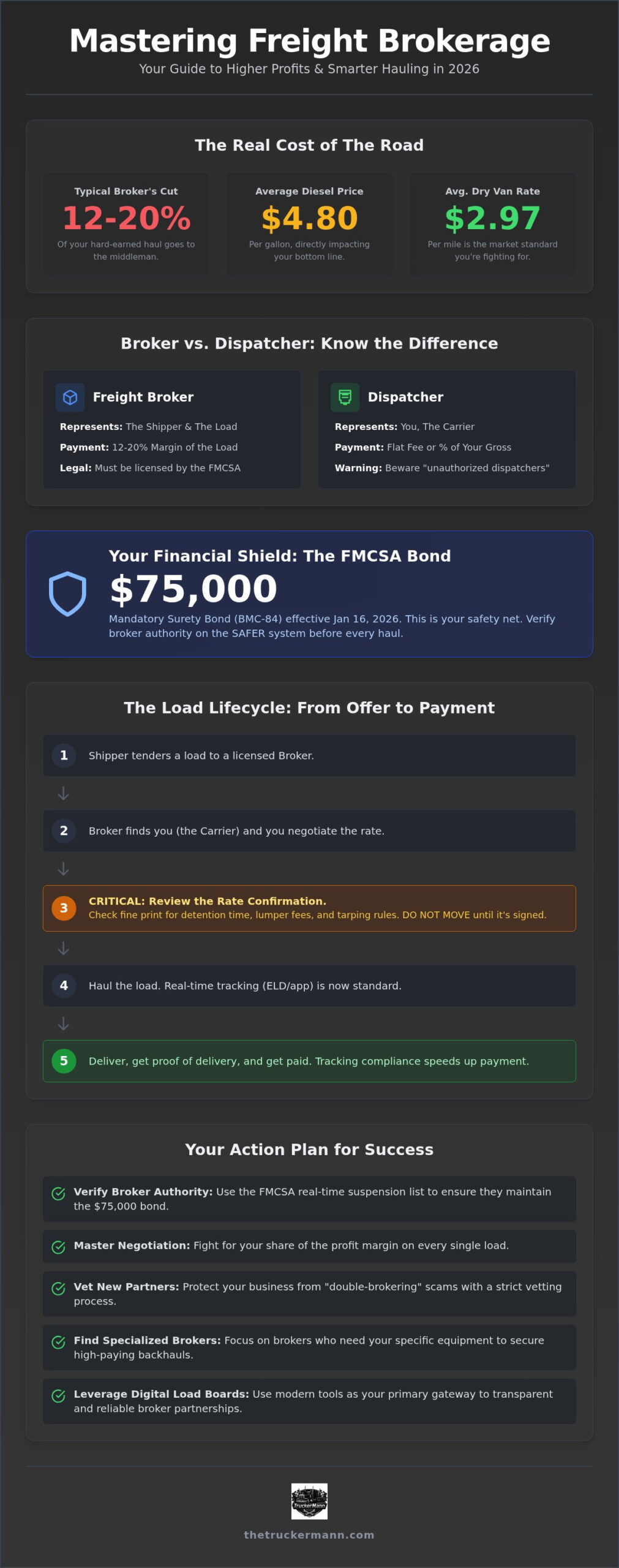
Don’t let the terminology trip you up. There is a massive legal distinction here that could cost you your livelihood. A broker represents the load and the shipper. An authorized dispatcher should represent you, the carrier. The FMCSA has significantly increased enforcement against “unauthorized dispatchers” who act like brokers without a license. If you’re caught working with one, you risk heavy fines and a tarnished record. A legitimate broker takes a percentage of the load’s margin, typically between 12% and 20%, whereas a dispatcher usually charges you a flat fee or a small percentage of your gross for their service. Knowing who you’re talking to ensures you’re not accidentally participating in illegal brokerage activity.
The Role of the FMCSA
The Federal Motor Carrier Safety Administration acts as the referee in this game. Their biggest contribution to your protection is the Broker Financial Responsibility Rule. As of January 16, 2026, every broker must maintain a $75,000 surety bond (Form BMC-84) at all times. If their security drops below this, their authority is suspended immediately. You should never start your pre-trip without verifying a broker’s MC number on the SAFER system. High-tier brokers are also getting stricter about who they hire. They often require carriers to prove they are compliant with a full DOT inspection level 1 checklist before awarding premium loads. Keeping your paperwork and equipment in top shape is the only way to gain access to the best freight broker services in the country.
How Freight Brokerage Works
The lifecycle of a load is a high-speed dance between three parties: the shipper, the broker, and you. It starts when a shipper tenders freight to a broker who is licensed by the Federal Motor Carrier Safety Administration (FMCSA). From there, the broker hits the phones or their digital networks to find a truck. In 2026, freight broker services aren’t just about matching a trailer to a pallet; they’re about managing data. Brokers need to know your equipment is compliant and your insurance is active before they ever send a tender. They use these networks to bridge the gap between a warehouse in Ohio and a receiver in Texas, taking a margin for the risk they shoulder.
Once you agree on a price, the paperwork begins. In this market, where dry van spot rates are hovering around $2.97 per mile, every penny counts. You aren’t just hauling freight; you’re fulfilling a contract. Successful delivery requires precise documentation and digital tracking updates to prove you did the job as promised. Mastering these workflows is the first step toward running a smarter business. If you’re ready to upgrade your load-finding game, check out the tools available through industry-leading load boards to see which brokers are actually moving the needle this month.
The Load Tender Process
Finding the load is only half the battle. Once you’ve negotiated the rate, the broker sends over the Rate Confirmation. You need to scan the fine print for more than just the dollar amount. Look for specific clauses regarding detention time, which usually kicks in after two hours, and verify who is responsible for lumper fees or tarping requirements. The Rate Confirmation serves as the most critical legal document for a driver because it dictates exactly what you’ll get paid and under what conditions. Don’t turn a wheel until that document is signed and returned.
Tracking and Transparency
In 2026, “dark” loads are a thing of the past. Most brokers now require ELD integration or app-based tracking through platforms like MacroPoint or Turvo. This isn’t about micromanagement; it’s about survival for the broker. Shippers demand real-time visibility, and providing it reduces the need for those annoying “check calls” that interrupt your drive time. There’s also a direct link between tracking compliance and your bank account. When a broker can see you’ve arrived at the receiver through geofencing, they can start the payment clock immediately, helping you bypass the old-school 30-day wait for a check.
Choosing the Right Broker
You wouldn’t hand your keys to a stranger at a truck stop, so don’t hand your business to a broker without checking their credentials first. In 2026, the market is crowded with new players, but not all of them have your back. Vetting is your absolute best defense against the “double-broker” scams and fraud that plague our industry. When you’re looking for high-quality freight broker services, you need to look beyond the dollar sign on the screen. A high-paying load is worth zero if the check never clears. Focus on building a list of “go-to” partners who understand the grit it takes to move their freight and value the person behind the wheel.
Reliability works both ways. When you show up on time and communicate through the required tracking apps, you become a “preferred” carrier in their database. Over time, these relationships become your safety net during slow seasons. Don’t be afraid to ask a broker about their long-term contracts or dedicated lanes. If you want to see which brokers are currently vetted and active in your lanes, utilizing professional load matching software can help you filter for the most reliable partners in the game today.
Vetting for Creditworthiness
Credit scores are the single best indicator of whether you’ll actually see a profit from a haul. Use professional services like Ansonia or Creditstop to check a broker’s average “days to pay” before you sign that Rate Con. If you see a broker with a “D” or “F” credit rating, keep scrolling. It isn’t worth the risk. Watch out for red flags like brand-new MC numbers or rates that seem suspiciously high compared to the current market, where spot rates have jumped significantly year-over-year. While the FMCSA’s financial responsibility rules provide some protection, it’s much easier to avoid a bad actor than it is to file a claim against their bond months after the delivery.
Specialized Freight Needs
If you’re hauling specialized loads, you need a partner who speaks your language. A flatbedder has different needs than a reefer driver. You want brokers who understand the cost and complexity of the best flatbed trucking gear for securement. When you find niche brokers who specialize in hazmat or oversized loads, you’ll often find higher rates because they value your specific endorsements and insurance coverage. These specialized freight broker services often lead to “dedicated” lanes. These lanes are the holy grail of trucking because they provide consistent revenue without the stress of the daily spot market grind.
Maximizing Your Load Profit
Profit isn’t what the broker pays you; it’s what you keep after the fuel, tires, and taxes are settled. In a year where diesel is hitting $4.80 a gallon, you can’t afford to be a passive participant in your own business. Leveraging freight broker services effectively means knowing exactly when to push for more. For the first time since early 2022, we saw national average dry van spot rates climb above contract rates in June 2026. This shift gives you the upper hand, but only if you have the data to back up your demands. If you don’t know that the average reefer load is pulling $3.37 per mile right now, you’re leaving money on the table.
Always run the math on your deadhead miles before saying yes. A high-paying load that requires a 150-mile deadhead might actually pay less per total mile than a cheaper load just down the road. You’re a business owner, not just a steering wheel holder. You need to see the full picture of every lane to ensure your truck stays in the black. To get a real-time pulse on what the market is actually paying in your specific zip code, check the latest load board rates and stop guessing at your profit.
Negotiation Tactics
The first rate a broker offers is almost never their max. They have a margin to protect, usually between 12% and 20%, and their job is to move the freight as cheaply as possible. Try the “Three-Call Rule” to gauge urgency. If you see the same load posted by three different brokers, or if the same broker calls you back twice in ten minutes, the pressure is on them. Use your safety record and a clean, late-model rig as leverage. Brokers will pay a premium for a “sure thing” carrier who won’t result in a claim or a late delivery.
Avoiding Hidden Fees
Watch out for the silent profit killers. QuickPay services are convenient, but that 2% to 5% fee adds up to thousands of dollars over a year. If your cash flow allows it, stick to standard pay terms and keep that money in your pocket. You should also negotiate your detention pay before you ever hit the dock. If it isn’t on the Rate Con, it doesn’t exist. Finally, make sure you understand whether you are running interstate vs intrastate hauls. This distinction impacts your tax liabilities and the specific regulatory filings required for the load, both of which directly affect your bottom line.
Top Brokerage Tools for 2026
Technology has finally leveled the playing field for the independent owner-operator. You don’t need a massive back-office team or a corporate dispatch center to compete with the big fleets anymore. Modern freight broker services are increasingly digital, and if you aren’t using the right tools to navigate them, you’re essentially driving blind. These specialized apps and platforms help you vet partners, predict market shifts, and ensure that your “POD to Payment” cycle is as short as possible. In a market where digital brokerage is expected to grow to nearly $10 billion this year, staying analog is a recipe for being left behind at the terminal.
The goal is to move from being a reactive driver to a proactive business owner. By using data to choose your lanes and partners, you protect your equipment and your time. You’ve already done the hard work of maintaining your rig and stayng compliant; now it’s time to let the software handle the heavy lifting of market analysis. These tools aren’t just luxuries. They’re essential gear for any driver looking to master the business side of the industry in 2026.
Digital Load Boards
Your load board is your primary window into the world of freight broker services. It’s where you find the work, but more importantly, it’s where you find the *right* work. 123Loadboard remains a top choice for professional drivers because it prioritizes transparency over volume. You can see broker credit scores and real-time alerts before you ever pick up the phone to negotiate. Look for these specific features to stay ahead of the pack:
- Real-time push notifications for lanes that match your specific equipment and preferred deadhead range.
- Integrated profit calculators that factor in your specific operating costs against the posted rate.
- “Auto-Post” features that broadcast your truck’s availability to vetted brokers while you’re focused on the road.
Rate Analysis Apps
Knowledge is your best leverage when negotiating with a broker who claims the market is “soft” in your area. Tools like DAT or Truckstop allow you to see exactly what other drivers are getting for the same lane in real-time. You should also be cross-referencing this with your own ELD data to understand your true hours of service availability. In 2026, AI-driven demand forecasting can even tell you if rates in a specific region are likely to spike next week based on historical trends and current capacity. This allows you to position your truck where the money is, rather than chasing a cheap load into a dead zone where you’ll be stuck waiting for a backhaul.
Finally, look for tools that automate your documentation. The faster you can scan a BOL and send it through a broker’s portal, the faster the payment clock starts. Digital documentation removes the “we never received the paperwork” excuse and protects your bottom line from administrative delays.
Take Command of Your Hauls
The 2026 freight market is finally shifting back into your hands, but only if you have the discipline to vet your partners and the data to defend your rates. You’ve learned how to spot a solid $75,000 bond, how to dodge hidden fees, and why freight broker services are only as good as the transparency they provide. Don’t let a bad actor or an under-quoted lane eat your margins. This industry is too tough for guesswork, especially when you’re the one dealing with $4.80 diesel and strict ELD enforcement.
Thousands of your fellow drivers are already using professional tools to skip the low-ball offers and find the freight that actually pays. You can find the best-paying loads today on 123Loadboard by accessing real-time load alerts and vetted broker credit scores. It’s time to stop taking what’s left over and start booking what you deserve. Keep your eyes on the road and your business in the black. We’ll see you at the next stop.
Frequently Asked Questions
How much do freight brokers usually charge carriers?
Brokers don’t usually charge you a direct out-of-pocket fee. Instead, they take a margin from the total amount the shipper pays for the load. On spot market hauls, the average gross margin for freight broker services typically falls between 12% and 20%. You’re essentially paying for their sales team and logistics network to keep your trailer full without you having to cold-call shippers yourself every single day.
Can I work directly with shippers instead of using a broker?
You can certainly go after direct shipper contracts, but it requires a lot more legwork and back-office management. Many large shippers prefer working with brokers because they don’t want to manage the insurance and compliance paperwork for hundreds of individual owner-operators. While direct freight can pay more, you’ll need to handle your own billing, collections, and constant sales calls to keep your wheels turning consistently.
What happens if a freight broker refuses to pay me?
If a broker goes dark or refuses to pay, your first line of defense is their $75,000 surety bond. You’ll need to file a claim against their BMC-84 bond with the FMCSA. Since the new 2026 regulations went into effect, any broker whose financial security drops below that $75,000 mark is immediately suspended. Don’t wait around; start the claim process as soon as they miss a payment deadline.
Is a freight broker the same as a freight forwarder?
No, they play different roles in the logistics chain. A freight forwarder often takes physical possession of the cargo, stores it, and assumes legal responsibility for the entire journey. A broker is an intermediary who matches a shipper’s load with your truck but never actually touches the freight. Both require FMCSA authority; however, forwarders have stricter requirements regarding cargo insurance and liability since they “own” the shipment during transit.
Do I need a special license to work with freight brokers?
You don’t need any special license beyond your standard Commercial Driver’s License (CDL) and active Motor Carrier (MC) authority. When you sign up with a broker, they’ll ask for your W-9, insurance certificate, and authority letter. Most high-quality freight broker services will also check your safety rating and DOT inspection history to ensure you’re a reliable partner before they offer you a premium load.
How do I know if a freight broker is legitimate?
Always verify their MC number on the FMCSA SAFER website to ensure their authority is active and their bond is current. Legitimate brokers won’t hesitate to provide their bond information or references. You should also check their credit score on your load board. If a broker has a brand-new MC number and is offering rates way above the $2.97 dry van average, treat it as a major red flag.
What is the best load board for finding brokers in 2026?
123Loadboard is the industry standard for drivers who want to avoid the “double-broker” scams and low-paying junk loads. It gives you direct access to vetted broker credit scores and real-time profit calculators. In a market where capacity is tightening, having a tool that filters for the most reliable partners is the only way to protect your business and keep your weekly revenue growing.
Can a freight broker handle international shipments?
Yes, many brokers specialize in cross-border logistics between the U.S., Canada, and Mexico. These international loads often pay a premium because they require extra paperwork, customs bonds, and specific insurance endorsements. If you’re looking to run international lanes, find a broker with a dedicated “cross-border” desk. They’ll have the expertise to navigate the customs brokers and border wait times that can otherwise kill your clock.
Disclaimer
The information provided on The TruckerMann is for general informational and educational purposes only. While every effort is made to ensure the accuracy and reliability of the content, trucking laws, FMCSA regulations, DOT requirements, safety standards, and industry policies can change at any time. Readers are encouraged to verify all information with official government agencies, professional advisors, or qualified industry professionals before making business, legal, financial, safety, or compliance-related decisions.
The content shared on this website reflects personal opinions, experiences, research, and commentary and should not be considered legal, financial, medical, tax, or professional advice. The TruckerMann and its owners, contributors, affiliates, or representatives are not responsible for any losses, damages, violations, penalties, or liabilities resulting from the use or misuse of information found on this website.
Some content on this website may contain affiliate links, sponsored content, or promotional material. This means we may earn a commission at no additional cost to you if you choose to purchase through certain links.
By using this website, you agree that you do so at your own discretion and risk.