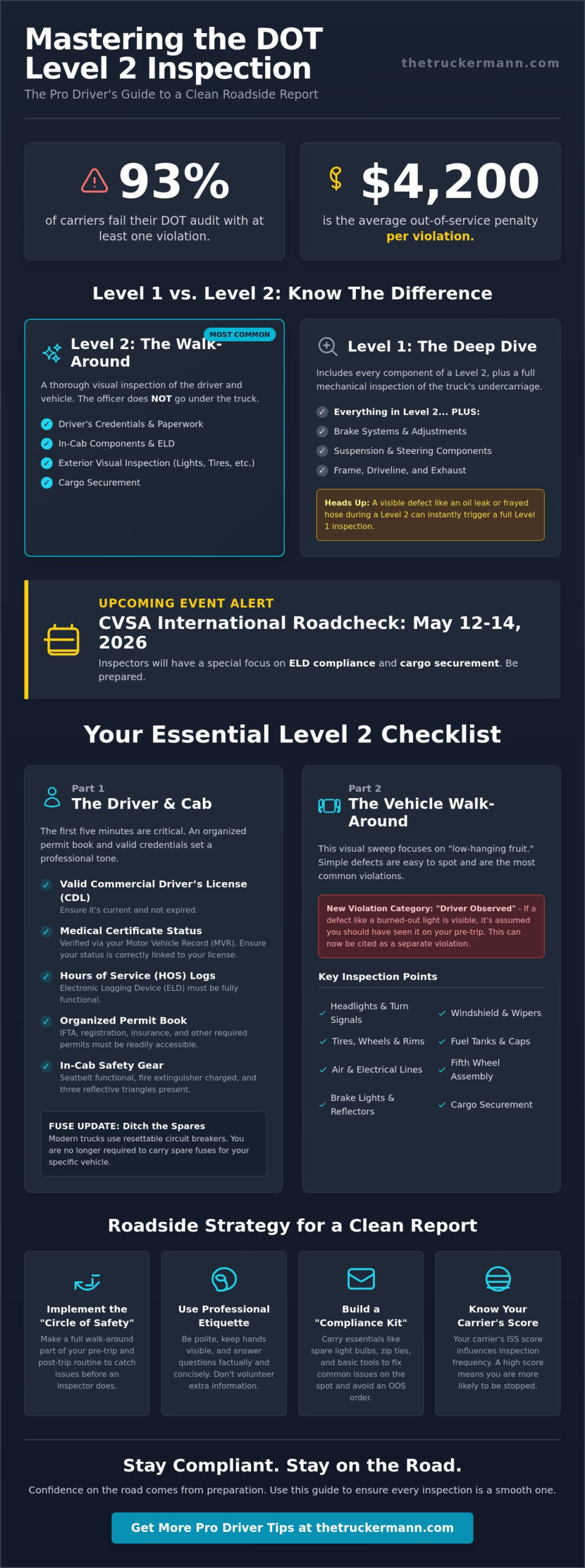
Did you know that 93% of carriers fail their DOT audit with at least one violation on the books? That is a staggering number for something that often comes down to a simple walk-around. It is natural to feel a spike in your heart rate when you are pulled over for a roadside stop, especially with the CVSA International Roadcheck 2026 coming up on May 12-14. You might be worried about unexpected fines or feeling confused about the high-stakes difference between a Level 1 and a Level 2 inspection.
We’ve built this guide to help you master the DOT inspection level 2 checklist with a practical, driver-tested approach that keeps you compliant and moving without the stress of a $4,200 out-of-service penalty. You deserve to hit the road with the confidence of a seasoned veteran who knows exactly what the inspector is looking for. We will break down the new “Driver Observed” violation category, explain why you can finally ditch the spare fuses, and show you how to handle the latest digital medical certificate requirements so you can secure a clean report every time.
Key Takeaways
- Identify the exact boundaries of the “Walk-Around” to focus your attention on the exterior and cab components that matter most during a roadside stop.
- Leverage a practical DOT inspection level 2 checklist to organize your permit book and ensure your digital medical records are ready for instant verification.
- Implement the “Circle of Safety” routine to catch visible defects like lighting failures before they trigger the new “Driver Observed” violation category.
- Adopt a professional roadside strategy that uses factual, concise communication to keep the inspection brief and your record clean.
- Build a custom “Compliance Kit” with the specific gear needed to address common failure points on the fly and avoid costly out-of-service orders.
What is a Level 2 DOT Inspection? The “Walk-Around” Reality
A Level 2 inspection is officially known as the Walk-Around Driver/Vehicle Inspection. It is the gold standard for roadside safety set by the Commercial Vehicle Safety Alliance (CVSA) to ensure both you and your equipment are fit for the haul. Unlike the dreaded Level 1, the officer is not going to crawl under your trailer or get their uniform dirty in the grease. They stay on their feet, circling the vehicle to spot what is visible to the naked eye. It is a visual sweep that tests your attention to detail and your ability to maintain a clean rig.
This is often the most common roadside surprise because it feels less formal than a full North American Standard Inspection. You might just be stopping for a quick weight check when the officer waves you over to the side. Don’t let that “walk-around” label fool you into letting your guard down. The officer is looking for the low-hanging fruit. The goal is a two-pronged attack: verifying your credentials and conducting a visual safety sweep. Having a solid DOT inspection level 2 checklist tucked in your visor is your best defense against an unexpected bad day.
To better understand this concept and see how an inspector moves around the rig, watch this helpful video:
Level 1 vs. Level 2: Knowing the Difference
Think of a Level 1 as a 37-step deep dive into every mechanical nook and cranny of your truck. A Level 2 is the streamlined version that skips the under-vehicle component. It covers everything in the driver’s cab plus a visual check of the lights, tires, and cargo securement. But here is the catch; if an officer sees oil spraying from a wheel seal or a frayed brake hose while they are walking by, that Level 2 can turn into a Level 1 in a heartbeat. With the average out-of-service penalty sitting at $4,200 per violation in 2026, you cannot afford to be sloppy. If you want to see the full scope of that deeper dive, check out our DOT inspection level 1 checklist to stay prepared for any scenario.
When and Where Level 2 Inspections Happen
These inspections don’t just happen at the big weigh stations on the interstate. Mobile units often set up in rest areas or wide shoulders on secondary highways. Your likelihood of being pulled over often depends on your carrier’s Inspection Selection System (ISS) score. If that number is high, you are a magnet for the flashing lights. There is also a common myth that a clean, shiny truck is a “pass” button. In reality, officers sometimes pull over a pristine rig for a quick Level 2 because they expect the paperwork to be in order, allowing them to hit their inspection quotas faster. During the CVSA International Roadcheck scheduled for May 12-14, 2026, inspectors will be specifically hunting for ELD issues and cargo securement, so stay vigilant regardless of how much chrome you’re polishing.
The Driver Side Checklist: Credentials and In-Cab Paperwork
The first five minutes of a roadside stop are the most critical. This is when an officer decides if they are going to conduct a standard sweep or if they are going to dig into every corner of your life. If you are fumbling through a glove box for a crumpled insurance card, you are sending a signal that you are unprepared. A professional driver treats their permit book like a resume. Having your documents organized in a high-quality binder shows the officer that you value your career and your equipment. This level of preparation is a core part of any successful DOT inspection level 2 checklist strategy.
Your credentials must be beyond reproach. Ensure your CDL is current and that your status is updated on your Motor Vehicle Record (MVR). As of January 10, 2026, the rules for medical certificates have shifted. Motor carriers no longer store paper Medical Examiner’s Certificates (MECs), as they now rely on state-issued MVRs for verification. However, you still need to ensure your medical status is correctly linked to your license before you head out. Missing paperwork or expired credentials directly impact your carrier’s standing in the Compliance, Safety, Accountability (CSA) program, so keep your folder tight. You should also carry the updated 2026 North American Standard Out-of-Service Criteria handbook to know exactly where the line is drawn.
Electronic Logging Device (ELD) Compliance
In 2026, inspectors are placing a massive focus on ELD tampering and falsification. You must be able to initiate a “Data Transfer” test immediately upon request. Can you send your logs to the officer’s device without a struggle? If the answer is no, you are looking at a potential violation. You are also required to keep an ELD user manual and a malfunction instruction sheet in the cab at all times. Don’t forget your backup paper logbook; you need at least eight days of blank logs ready in case the technology fails. For more help staying legal, check out our ELD guide for troubleshooting tips and 2026 updates.
The Permit Book Essentials
Your permit book is the heart of your in-cab compliance. It needs to contain your current registration, proof of insurance, and IFTA credentials. If you are hauling hazardous materials, your hazmat permits must be front and center, as these are high-scrutiny items that officers will check first. If you want to stay ahead of the curve, consider upgrading your gear with a professional heavy-duty permit organizer to keep everything visible and protected. A clean presentation often leads to a faster, smoother interaction. Remember, the goal of the DOT inspection level 2 checklist on the driver side is to prove you are a safe, proficient professional before the officer even steps toward your tires.
The Walk-Around Checklist: Visual Vehicle Inspection Points
A successful walk-around isn’t about looking at random parts of your rig; it’s about following a logical, repeatable flow. This “Circle of Safety” allows you to cover your DOT inspection level 2 checklist in under five minutes while the officer observes your routine. Start at the driver-side door and move clockwise around the tractor and trailer. This methodical approach ensures you don’t miss the small details that lead to big fines. It shows the inspector you aren’t just guessing; you are a professional who knows your equipment inside and out.
Lighting devices are often the first thing an officer notices. Check your headlamps, tail lamps, and turn signals, but pay special attention to the “money lights.” These are your clearance and marker lamps. If one of these is out, it’s a neon sign telling the officer to keep looking. Tires and wheels are equally critical. You need at least 4/32″ of tread depth on your steer tires and 2/32″ on your drives and trailer tires. This visual sweep is a core component of the North American Standard Inspection Program, and mastering it is your best defense against a bad report.
For those of you pulling flatbeds, cargo securement is a top priority for 2026. Inspectors are looking for any sign of shifting or loose tie-downs. You should always use durable straps and chains that are free of cuts, frays, or rusted links. If a strap looks questionable to you, it will look like a violation to the officer. Secure your load as if your career depends on it, because in a Level 2 inspection, it actually does.
Frame, Fuel, and Exhaust Systems
Keep your eyes peeled for visible cracks in the frame or sagging components that suggest structural failure. Check your fuel caps to ensure they are seated tightly and that the seals aren’t perished. A leaking fuel cap or a visible puddle under the tank is a fast track to an out-of-service order. Listen for loud exhaust leaks near the cab; if an officer hears a manifold leak, they might escalate your Level 2 to a full Level 1 inspection to check for carbon monoxide risks.
Brake System Visuals (Without Getting Under)
You don’t have to crawl into the grease to check your brakes during a Level 2. Instead, listen for audible air leaks while the officer walks beside the cab. Inspect your visible brake hoses for kinking, chafing, or heat damage. Ensure your tractor protection valve is functioning correctly by watching the gauges during your pre-trip. If a hose is rubbing against a frame rail, zip-tie it out of the way before you hit the scale. Small fixes prevent massive headaches.
Roadside Etiquette: Handling the Officer and the Interaction
When the flashing lights appear in your mirrors, your mindset determines the outcome as much as your equipment does. Professionalism is your primary defense. If you approach the interaction with a chip on your shoulder, you are practically inviting the officer to nitpick your rig. An officer’s first impression of you starts before you even roll down the window. When you treat the stop as a professional business transaction rather than a personal attack, you set a tone that can lead to a much smoother DOT inspection level 2 checklist review. Respect is a two-way street on the shoulder of the highway.
Keep your answers concise and factual. The “Yes, Officer” or “No, Officer” approach isn’t about being submissive; it’s about being efficient. Don’t volunteer extra information that could open a new door for questioning. Remember that the CVSA recently added English language proficiency to the out-of-service criteria. You must be able to communicate effectively about your logs and equipment to avoid being sidelined. Stay in your cab with your seatbelt on until you are instructed to step out. Safety is the officer’s top priority, and sudden movements or jumping out of the truck can escalate a routine stop into a high-tension event.
Managing the Inspection Environment
Small actions speak louder than words. Turn off your engine to show you are staying put, but keep your electronics on so your ELD remains accessible for that data transfer test we discussed earlier. Place your hands clearly on the steering wheel as the officer approaches the door. This simple gesture of transparency builds immediate rapport. You should also clear any clutter from your dashboard. A dash covered in loose papers and trash signals a disorganized mind, which makes an inspector wonder if your maintenance is just as messy. If you want to sharpen your roadside skills, reach out to CDL training experts who can help you master every regulation.
What to Do If You Disagree With a Violation
If the officer hands you a report with a violation you believe is incorrect, stay calm. Signing the report is not an admission of guilt; it is simply an acknowledgment that you received the document. Arguing on the side of the road rarely changes an officer’s mind and often makes things worse. Instead, wait until the officer leaves and then immediately take high-quality photos of the “defective” part or the specific condition cited. You can challenge incorrect data through the FMCSA DataQs system later. For complex issues or to protect your MVR from unfair marks, consult with CDL training experts who understand the nuances of the 2026 regulatory landscape.
Proactive Maintenance: Gear to Ace Your Next Level 2
Preparation isn’t just about knowing the rules; it’s about having the physical tools to stay in compliance when the pressure is on. The FMCSA estimates that Driver Vehicle Inspection Reports (DVIRs) prevent 14,000 accidents annually, proving that a diligent eye is your most valuable asset. While the regulatory landscape shifted in March 2026 to eliminate the requirement for carrying spare fuses and liquid flares, a seasoned driver knows that carrying a “Compliance Kit” is still common sense. Having spare bulbs, a tire depth gauge, and those extra fuses on hand shows an inspector that you are proactive rather than reactive. This mindset is what turns a potentially stressful DOT inspection level 2 checklist into a routine “no violations” report.
Visibility is your best friend when you are working outside the cab. Investing in high-visibility gear doesn’t just keep you safe from passing traffic; it signals to the officer that you prioritize a professional safety culture. If you do spot a deficiency during your walk-around, you need to fix it before it becomes a roadside headline. Use the TrucknTow resources to source replacement parts that meet the latest safety standards. Whether it’s a cracked clearance light or a worn mudflap, fixing it on your terms is always cheaper than a $4,200 out-of-service fine.
The Pre-Trip Habit
A 15-minute morning check is the best investment you can make in your career. It prevents a two-hour roadside delay and protects you from the “Driver Observed” violation category, which targets issues you should have reasonably detected. To stay consistent, use a pre trip inspection for CDL template updated for 2026 standards to ensure every light, tire, and strap is inspected every single day. Think of yourself as a sentinel for your own livelihood. If you don’t protect your truck, no one else will. Your commercial driver pre trip inspection is your primary shield against the volatility of roadside enforcement.
Recommended Gear for Compliance
For the flatbedders out there, your cargo securement is under heavy scrutiny throughout 2026. You need the best flatbed trucking gear, including straps and chains that are free of frays or rusted links. Inside the cab, a professional permit organizer and a secure ELD mount prevent the dashboard clutter that often triggers a more invasive inspection. Preparation is the only real difference between a clean sheet and a costly mark on your record. When you follow a solid DOT inspection level 2 checklist and back it up with the right gear, you aren’t just surviving the industry; you are mastering it.
Master the Roadside Stop and Protect Your Livelihood
Roadside stops are an inevitable part of the life we have chosen, but they don’t have to be a source of constant anxiety. By mastering your DOT inspection level 2 checklist, you are doing more than just avoiding violations; you are actively protecting your career and the safety of everyone sharing the pavement. You now have a clear strategy to organize your permit book, execute a disciplined “Circle of Safety” walk-around, and manage officer interactions with the poise of a seasoned veteran. It is about taking control of the variables you can see before the inspector ever steps out of their cruiser.
We understand the grit it takes to keep this country moving, and we are dedicated to providing the fraternal support you need to stay ahead of the curve. Trusted by thousands of professional drivers, our community offers the expert-vetted compliance gear and insights required to navigate the 2026 regulatory shifts with confidence. Keep your rig compliant with the best gear from Mytee Products and ensure your equipment is always ready for the next scale house. Stay safe out there, keep your eyes on the horizon, and remember that a little preparation today keeps the wheels turning tomorrow.
Frequently Asked Questions
What is the difference between a Level 1 and Level 2 DOT inspection?
A Level 1 is the North American Standard Inspection, which is a 37-step deep dive that includes the officer getting under the vehicle to check components like brake stroke and suspension. A Level 2 is the Walk-Around Driver/Vehicle Inspection. It covers the same driver credentials and visual vehicle points but skips the under-vehicle portion. It is essentially a standing inspection of everything visible from the perimeter.
Does the officer go under the truck during a Level 2 inspection?
No, the officer does not go underneath the vehicle during a Level 2 inspection. This is the primary distinction between this stop and a full Level 1. The inspector stays on their feet and conducts a visual sweep of the tractor and trailer from the ground. They won’t use a creeper or a pit to examine your undercarriage unless they see a red flag that triggers an escalation.
Can I get a CVSA decal after a Level 2 inspection?
No, you cannot receive a CVSA decal for passing a Level 2 inspection. These decals are strictly reserved for vehicles that pass a Level 1 or a Level 5 terminal inspection. While a clean Level 2 report is a win for your record and your carrier’s score, it doesn’t grant you the 90-day “pass” sticker that often helps you bypass other weigh stations down the road.
What are the most common violations found during a Level 2 walk-around?
Lighting failures, tire tread depth issues, and hours-of-service errors top the list every year. In 2025, five of the top ten most-cited violations were related to HOS. Using a DOT inspection level 2 checklist helps you identify these “driver observed” defects, such as a 2/32″ tread depth on your drive tires or a cracked clearance light, before an officer writes a citation.
How long does a typical Level 2 DOT inspection take?
A standard Level 2 inspection usually takes between 30 and 45 minutes to complete. This timeframe depends heavily on how quickly you can produce your credentials and execute the ELD data transfer. If your permit book is organized and your lights are all functioning, you can often shave time off the interaction and get back to your route without unnecessary delays.
Do I need to show my paper logs if my ELD is working during a Level 2?
You don’t need to show paper logs for your current hours if your ELD is functioning, but you must have a backup logbook in the cab. Regulations require you to carry at least eight days of blank paper logs at all times. If your ELD malfunctions during the stop, those paper logs are your only way to prove compliance and avoid an immediate out-of-service order.
What happens if I fail a Level 2 DOT inspection?
Failing can lead to heavy fines, out-of-service (OOS) orders, and negative marks on your carrier’s CSA profile. The average penalty for an OOS violation in 2026 is $4,200 per occurrence. If you are placed out-of-service, you are legally prohibited from moving the truck until the violation is corrected or your mandatory rest period is finished, which can derail your entire schedule.
Is a pre-trip inspection the same as a Level 2 inspection?
No, a pre-trip is your daily safety routine, while a Level 2 is an official regulatory check. However, your daily habit should mirror the DOT inspection level 2 checklist to ensure you are catching the same visual defects an officer will hunt for. A thorough pre trip inspection for CDL drivers is your primary defense against being surprised by an inspector’s findings during a roadside stop.
Disclaimer
The information provided on The TruckerMann is for general informational and educational purposes only. While every effort is made to ensure the accuracy and reliability of the content, trucking laws, FMCSA regulations, DOT requirements, safety standards, and industry policies can change at any time. Readers are encouraged to verify all information with official government agencies, professional advisors, or qualified industry professionals before making business, legal, financial, safety, or compliance-related decisions.
The content shared on this website reflects personal opinions, experiences, research, and commentary and should not be considered legal, financial, medical, tax, or professional advice. The TruckerMann and its owners, contributors, affiliates, or representatives are not responsible for any losses, damages, violations, penalties, or liabilities resulting from the use or misuse of information found on this website.
Some content on this website may contain affiliate links, sponsored content, or promotional material. This means we may earn a commission at no additional cost to you if you choose to purchase through certain links.
By using this website, you agree that you do so at your own discretion and risk.