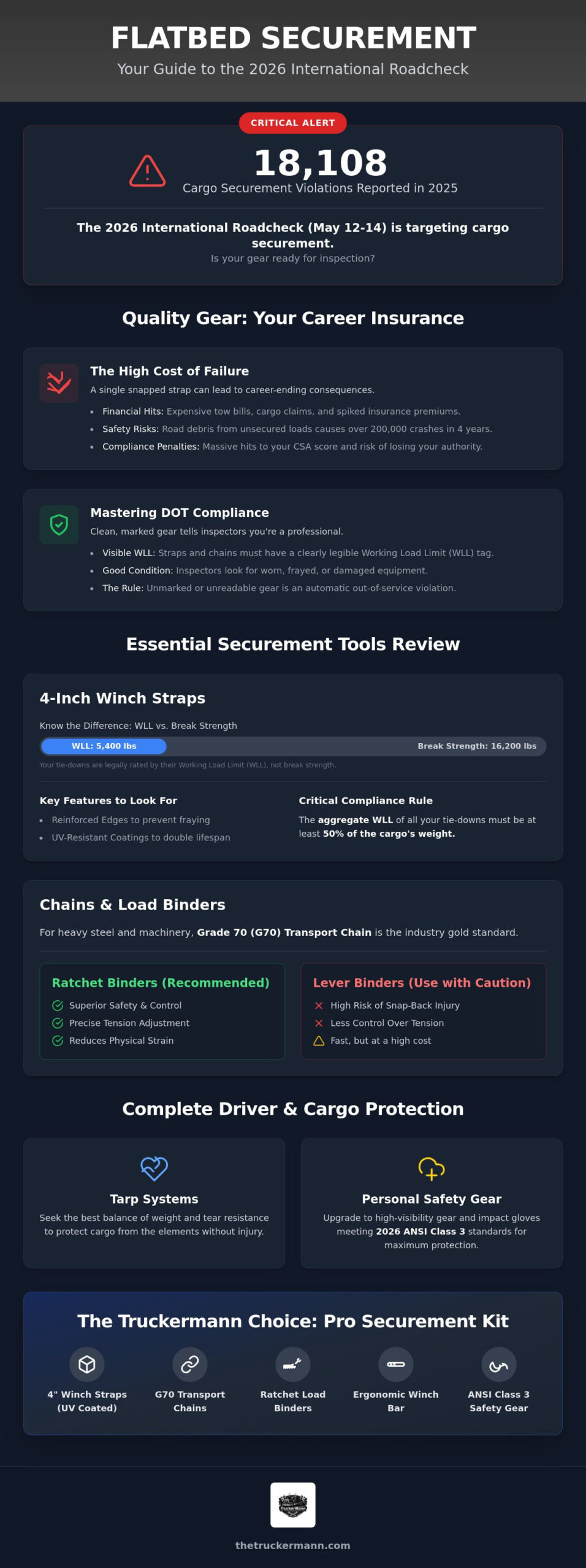
Howdy, driver. Did you know the CVSA reported 18,108 cargo securement violations in 2025 alone? With the 2026 International Roadcheck focusing specifically on cargo securement from May 12 to 14, your choice of straps and chains is no longer just about getting the job done. It’s about protecting your livelihood. We know the pressure of keeping a load tight while the clock is ticking and the DOT is watching. You shouldn’t have to worry about equipment failure during transit or wasting your profit on low-quality gear that frays after a few runs.
That’s why we’ve compiled these flatbed product reviews to give you the lowdown on the most durable securement gear to keep your load tight and your record clean. You’ve worked hard to master the road, and you deserve equipment that works as hard as you do. This guide will preview the top-rated straps, chains, and edge protectors designed for faster securement times, a longer equipment lifespan, and full DOT compliance. We’ll help you ensure those record-high 2026 flatbed rates stay in your pocket instead of going toward inspection fines.
Key Takeaways
- Learn why high-quality securement gear is your best defense against lawsuits and how to spot straps that will actually survive a rigorous DOT inspection.
- Explore our latest flatbed product reviews to find the most reliable 4-inch winch straps and Grade 70 transport chains for your heavy steel hauls.
- Find out which tarp systems offer the best balance of weight and tear resistance to protect your cargo from the elements without breaking your back.
- Upgrade your personal safety kit with high-visibility gear and impact gloves that meet the 2026 ANSI Class 3 standards for maximum on-site protection.
- See our final verdict on the “Truckermann Choice” securement kit to help new owner-operators build a professional setup that is built for the long haul.
Why Quality Gear Matters
You won’t find the best flatbed product reviews in a corporate office; you find them on the shoulder where the gear actually meets the grit. Let’s talk straight: your gear is the only thing standing between a safe haul and a career-ending lawsuit. When you’re out there on the slab, the physical reality of the job is unforgiving. A single snapped strap or a failed binder can turn your trailer into a hazard for every family sharing the asphalt. While a Flatbed truck overview might show the versatility of our trade, it doesn’t show the sweat required to keep those loads stationary. High-quality equipment doesn’t just keep you safe; it reduces the physical strain on your joints and pays for itself by keeping you moving instead of sitting at a scale house.
Cost of Failure
The financial impact of a cargo shift goes far beyond the immediate damage to the freight. If your load moves, you’re looking at expensive tow bills, cargo claims, and a massive hit to your CSA score. According to the AAA Foundation for Traffic Safety, road debris causes over 200,000 crashes over a four-year period, and two-thirds of those come from items falling off vehicles. As professionals, we have a fraternal responsibility to protect our community. One equipment failure can spike your insurance premiums or even lead to the loss of your authority. Investing in premium gear is an investment in your peace of mind and your future.
DOT Compliance
Inspectors have a sharp eye for worn equipment, especially with the 2026 International Roadcheck focusing on cargo securement. They’re looking for specific, legible markings on your straps and chains that clearly show the Working Load Limit. If your gear is unmarked or the tag is unreadable, it’s an automatic out-of-service violation. You don’t want to be the driver caught with mystery gear when you could’ve checked reliable flatbed product reviews to find straps that stay compliant. To make sure your entire rig is ready for the scales, check our Ultimate DOT Inspection Level 1 Checklist. Clean, marked gear tells the DOT you’re a pro who respects the rules and the road.
Essential Securement Tools
Choosing your gear shouldn’t be a guessing game based on the lowest price tag. When you’re out here on the slab, your equipment has to perform under extreme conditions. The FMCSA cargo securement rules are clear about the physics involved. Your setup must withstand a forward force of 0.8g, which means your straps and chains aren’t just holding the weight; they’re fighting inertia. We’ve put these tools through the wringer to ensure they meet the demands of the 2026 shipping season. It’s about finding that balance between rugged reliability and ease of use so you can get loaded and rolling without unnecessary delay.
Top-Rated Winch Straps
A 4-inch winch strap is the bread and butter of our industry, but not all webbing is created equal. In our latest flatbed product reviews, we looked closely at the offerings from Mytee Products. Their heavy-duty straps feature reinforced edges that resist the typical sawing effect caused by sharp-edged loads. It’s vital to remember the difference between break strength and the Working Load Limit (WLL). While a strap might have a break strength of 16,200 pounds, its WLL is typically 5,400 pounds. To stay legal, the aggregate WLL of all your tie-downs must be at least 50% of the cargo weight. We also recommend looking for UV-resistant coatings. Sun rot is a silent killer for straps in southern states, and these coatings can double the lifespan of your webbing by preventing the fibers from becoming brittle and prone to snapping under tension.
Chains and Load Binders
When the cargo is heavy machinery or raw steel, you need the bite of Grade 70 transport chain. While Grade 80 is available, G70 remains the gold standard for most flatbed applications because of its durability and cost-effectiveness. For sourcing these heavy-duty essentials, TrucknTow remains a reliable veteran-friendly option. The real debate on the road is between ratchet binders and lever binders. Lever binders are fast, but they’re notorious for snapping back and causing injuries. Ratchet binders offer far superior tension control and are much safer for your joints and knuckles. Look for models with easy-grease fittings to keep the threads moving smoothly through the winter months. If you want to keep your business running smoothly, you can find more expert gear tips on our main hub.
Finally, don’t overlook your winch bar. An ergonomic winch bar with a knurled handle and a tapered tip is a safety essential. It prevents the bar from slipping out of the winch cap, which is a leading cause of slip-and-fall injuries on the job. A good bar gives you the leverage you need without requiring you to put your entire body weight into a dangerous position. When you invest in the right tools, you aren’t just buying equipment; you’re buying a cleaner inspection record and a longer career.
Choosing Tarp Systems
Tarping is arguably the most grueling part of a flatbedder’s day. It’s just you, the wind, and a heavy piece of vinyl. When we look at flatbed product reviews, we aren’t just looking at the price tag; we’re looking at how that tarp handles at 3:00 AM in a freezing rainstorm. Most veterans swear by 18oz vinyl because it offers the best tear resistance and weatherproofing. Anything lighter might save your back, but it won’t survive a run with sharp-edged machinery. D-ring placement is another deal-breaker. Having rows at 2-foot and 4-foot intervals gives you the flexibility to secure custom load shapes without bunching the material. While you’re up there wrestling with the wind, remember that OSHA fall protection standards apply to our safety too. Working at heights on a trailer bed is dangerous, and your gear should help, not hinder, your balance.
Lumber Tarps
Lumber tarps are the heavy hitters of the industry. A standard set usually features an 8-foot drop to cover full stacks of wood or large crates. We recommend a 3-piece set over a single massive tarp. It’s much easier on your shoulders and allows for more configuration options. Driver fatigue is real when you’re throwing 100 plus pounds of vinyl in a crosswind. If you’re running northern routes, pay attention to the cold-crack rating. You want a tarp rated for at least -40 degrees Fahrenheit so it stays flexible when the mercury drops. Stiff tarps are prone to cracking and are a nightmare to fold. We’ve seen plenty of cheap sets turn into brittle sheets of plastic after one season in the Dakotas.
Steel Tarps
If you’re hauling lower-profile loads like steel coils or plates, steel tarps are your best friend. These typically have a 4-foot drop, making them lighter and faster to deploy. Quick securement is the name of the game here. Look for brands that offer water-tight heat-welded seams and reinforced corners. These are the high-stress areas where cheap tarps fail first. For a deeper dive into your setup, check out The Best Flatbed Trucking Gear for Logistics & Securement in 2026. Whether you choose traditional vinyl or the newer, more expensive parachute material, make sure it fits your specific freight needs. Parachute material is incredibly lightweight and easy on the joints, but it lacks the abrasion resistance of 18oz vinyl. If you’re hauling rough-cut lumber or machinery with sharp points, you’ll be patching holes every week. Stick to the heavy stuff for the rough loads and save the lightweight gear for the smooth hauls.
Ultimately, your tarp system is an investment in your cargo’s integrity. Don’t let a cheap seam or a missing D-ring be the reason you lose a customer or fail an inspection. When you read flatbed product reviews, focus on the specs that match your specific lane and freight. Your gear should be a companion that makes the job easier, not a liability that causes a back injury or a claim.
Protective Gear and Driver Safety
We’ve spent plenty of time discussing how to keep the freight on the deck, but none of that matters if you aren’t around to deliver it. Flatbedding is essentially a contact sport. You’re constantly climbing, pulling, and wrestling with heavy gear in every environment imaginable. Our flatbed product reviews wouldn’t be complete without looking at the gear that protects your most valuable asset: your own body. In 2026, job site safety is more than just a box to check. It’s a necessary shield against the physical toll of the road and the hazards of busy loading zones.
Visibility on the Job Site
Standard high-vis vests often fail when you’re working in the shadows of a trailer or securing a load at 2:00 AM on a dark shoulder. You need a vest that meets the 2026 ANSI Class 3 standards to stay safe. These vests offer the highest level of visibility by adding reflective material to the arms and torso. This ensures you don’t blend into the background when a forklift operator is moving fast. Look for a vest with reinforced pockets for your pens and logbook. Staying visible is your first line of defense against being another statistic in a loading zone accident. It’s about making sure everyone on the site knows exactly where you’re standing at all times.
Best Gloves for Securement
Your hands are your livelihood, and they take a beating every single day. Handling oily winches or heavy Grade 70 chains will chew through basic hardware store gloves in less than a week. While leather gloves offer classic durability, modern synthetic impact gloves are the real stars of our flatbed product reviews. These gloves feature rubberized padding on the knuckles to dampen vibrations and protect you from “pinch points” when you’re cinching down binders. Pro tip: keep three pairs in your cab. You’ll want one pair for dry work, a waterproof pair for the rain, and a spare for when one inevitably goes missing at a shipper.
Don’t forget your feet and head. A flatbed deck is basically a skating rink when it’s covered in rain, oil, or snow. You need boots with oil-resistant, high-traction soles. Composite-toe boots are often better than steel for winter work because they won’t turn your toes into ice cubes. Finally, keep a hard hat ready in your side box. Many steel mills and construction sites have a zero-tolerance policy for drivers without head protection. If you want to stay safe and compliant on every haul, you can find more driver safety resources on our main hub.
Final Verdict: Best Flatbed Picks 2026
Driver, the 2026 shipping season is proving to be a high-stakes environment where only the best-prepared survive. With flatbed spot rates hitting record highs and contract rates following suit, you’ve got a golden opportunity to maximize your earnings. But you won’t see a dime of that profit if your rig is parked at a weigh station with an out-of-service order. Our flatbed product reviews serve one primary purpose: keeping you loaded, rolling, and compliant. When you’re staring down a Level 1 inspection during the CVSA Roadcheck this May, the last thing you want is a frayed tag on a cheap strap. High-quality gear isn’t a luxury; it’s the price of entry for a professional who values their CDL and their community.
The Ultimate Securement Kit
If you’re an owner-operator looking to overhaul your side boxes, you need a setup that can handle anything from steel coils to construction materials. After testing the latest gear, the “Truckermann Choice” for the most durable winch strap on the market is the reinforced 4-inch model from Mytee Products. Their edge-guard technology consistently outperforms the competition in high-friction hauls. Every professional securement kit should include these five essentials:
- Ten 4-inch heavy-duty winch straps with reinforced edges
- Four Grade 70 transport chains (20-foot length)
- Four ratchet binders with easy-grease fittings
- A set of 18oz vinyl lumber tarps with a cold-crack rating of -40°F
- An ANSI Class 3 high-visibility vest for night-time securement
Maintaining this gear is a fraternal bond we share with every other driver on the road. Check your straps for UV damage every week and keep your chain binders lubricated. A well-maintained kit is your best defense against the 2026 CVSA focus on cargo securement. It’s about respecting the road and the physical reality of the freight we move.
Upgrade Your Career
Mastering your gear is only half the battle. To truly master the industry, you have to invest in your own professional growth. If you want to move beyond standard freight and into specialized hauls that command higher rates, consider the training resources at DLA Academy. They bridge the gap between basic driving and the technical expertise required for high-paying logistics roles. By pairing road-tested gear with advanced training, you’re positioning yourself for long-term success in a volatile market. Stay vigilant, keep your load tight, and we’ll see you out there on the white line. Gear up and stay safe, driver.
Secure Your Success on the Open Road
Staying profitable in this industry requires more than just a heavy foot and a clean logbook. It demands a commitment to the physical reality of the job. We’ve shown you why investing in 18oz vinyl tarps and Grade 70 chains isn’t just about following the rules; it’s about protecting your livelihood from expensive cargo shifts and the scrutiny of the 2026 International Roadcheck. These flatbed product reviews are built on road-tested experience to ensure you only spend your hard-earned cash on gear that actually survives the grit of the field. From ANSI Class 3 visibility vests to reinforced winch straps, your equipment is the silent partner in every successful delivery.
Our veteran-tested recommendations focus on national gear availability and strict DOT compliance to keep you moving through every weigh station with confidence. Don’t let a frayed strap be the reason you lose a high-paying haul. You can shop the best flatbed gear at Mytee Products to build your ultimate securement kit today. For more secrets on mastering the road and scaling your business, visit the main resource hub at The Truckermann. We’re here to help you navigate the shifts in this industry with the perspective of someone who has actually been in the driver’s seat. Keep your head up, your load tight, and your record clean. We’ll see you at the next drop.
Frequently Asked Questions
What is the best brand for flatbed winch straps in 2026?
Mytee Products is currently the top-rated brand for winch straps because of their reinforced edges and UV-resistant coatings. When you’re browsing flatbed product reviews, look for webbing that features a high-density weave to prevent fraying during heavy hauls. Their gear is specifically designed to survive the high-friction environments that chew up bargain-bin straps in a single season.
How often should I replace my flatbed securement chains?
You should replace securement chains immediately if you find any cracks, significant nicks, or stretching. While there’s no set expiration date, federal regulations require inspections within the first 50 miles and every 150 miles thereafter. If a link’s thickness is reduced by more than 10 percent due to wear or corrosion, it’s an automatic out-of-service violation during a DOT inspection.
Are lightweight tarps as durable as heavy-duty vinyl tarps?
Lightweight parachute tarps are not as durable as standard 18oz vinyl when you’re hauling rough freight like lumber or machinery. They’re excellent for saving your back on smooth, low-profile loads, but they lack the puncture resistance needed to survive sharp corners. Stick to heavy-duty vinyl if you want your gear to last more than one season in harsh northern climates.
What markings are required for DOT-compliant trucking gear?
DOT compliance requires every tie-down to have a legible Working Load Limit (WLL) marking. For straps, this is typically a sewn-in tag that includes the manufacturer’s name, while chains have the grade stamped directly into the links. If that tag is missing or unreadable, the inspector will treat the gear as having a zero WLL, which leads to immediate fines and delays.
Can I use lever binders if I prefer them over ratchet binders?
You can legally use lever binders, but most veteran drivers have switched to ratchet binders for superior tension control and safety. Lever binders are notorious for snapping back and causing broken fingers or facial injuries if the bar slips. Ratchet binders allow you to fine-tune the tightness of your Grade 70 chains without the risk of a sudden, violent release.
Where can I find the best deals on flatbed trucking equipment?
You’ll find the best professional-grade deals at veteran-led suppliers like TrucknTow and Mytee Products. These sources focus on high-intent securement gear that meets the latest 2026 regulatory standards. Buying from dedicated trucking hubs ensures you’re getting equipment designed for the grit of the road rather than general-purpose hardware that won’t pass a Level 1 inspection.
What is the working load limit for a standard 4-inch winch strap?
A standard 4-inch winch strap typically has a Working Load Limit (WLL) of 5,400 pounds. Always check the specific tag on your gear, as some specialized heavy-duty models might have different ratings. To stay compliant with 49 CFR Part 393, the aggregate WLL of all your tie-downs must equal at least 50 percent of the cargo’s total weight.
Do I need edge protectors for every flatbed load?
You don’t need edge protectors for every load, but you must use them whenever the cargo has sharp or abrasive edges that could cut or weaken your straps. Using them is a smart way to extend the life of your equipment and avoid violations. Many flatbed product reviews highlight that plastic or steel protectors are the cheapest insurance you can buy against a snapped tie-down.
Disclaimer
The information provided on The TruckerMann is for general informational and educational purposes only. While every effort is made to ensure the accuracy and reliability of the content, trucking laws, FMCSA regulations, DOT requirements, safety standards, and industry policies can change at any time. Readers are encouraged to verify all information with official government agencies, professional advisors, or qualified industry professionals before making business, legal, financial, safety, or compliance-related decisions.
The content shared on this website reflects personal opinions, experiences, research, and commentary and should not be considered legal, financial, medical, tax, or professional advice. The TruckerMann and its owners, contributors, affiliates, or representatives are not responsible for any losses, damages, violations, penalties, or liabilities resulting from the use or misuse of information found on this website.
Some content on this website may contain affiliate links, sponsored content, or promotional material. This means we may earn a commission at no additional cost to you if you choose to purchase through certain links.
By using this website, you agree that you do so at your own discretion and risk.