You have likely heard that hotshotting is the fastest way to own your schedule, but here is the cold truth for 2026: your truck is just a tool, while your paperwork is your actual engine. Many drivers jump in thinking a dually and a trailer are enough, only to get sidelined by a $30,000 insurance quote or a surprise DOT audit. Understanding the specific hotshot trucking requirements and startup costs is the difference between a profitable first quarter and a parked rig. It is a crowded market out there, and the new venture surcharge is a heavy lift for any owner-operator just starting their journey.
We know the frustration of staring at CDL weight limits and wondering if that 40-foot gooseneck is actually going to pay for itself. You are looking for a straight answer on what it takes to get that MC number active without draining your savings on gear you do not need. This guide is your roadmap to mastering the regulatory hurdles and the financial reality of launching a profitable business this year. We are laying out a clear legal checklist, a realistic budget for your 2026 equipment, and a battle-tested plan to secure your very first load.
Key Takeaways
- Secure your USDOT and MC numbers early to bypass the mandatory waiting periods and establish your interstate authority before you even hitch a trailer.
- Identify why specific Class 3-5 trucks and 40-foot gooseneck trailers are the industry standard for hauling high-paying, time-sensitive freight in 2026.
- Get a realistic breakdown of hotshot trucking requirements and startup costs, including the “new venture” insurance premiums that often catch rookies off guard.
- Build a 90-day launch strategy centered on maintaining a clean inspection record and leveraging load boards to keep your wheels turning and your cash flow positive.
Hotshot Trucking Legal Requirements & Authority
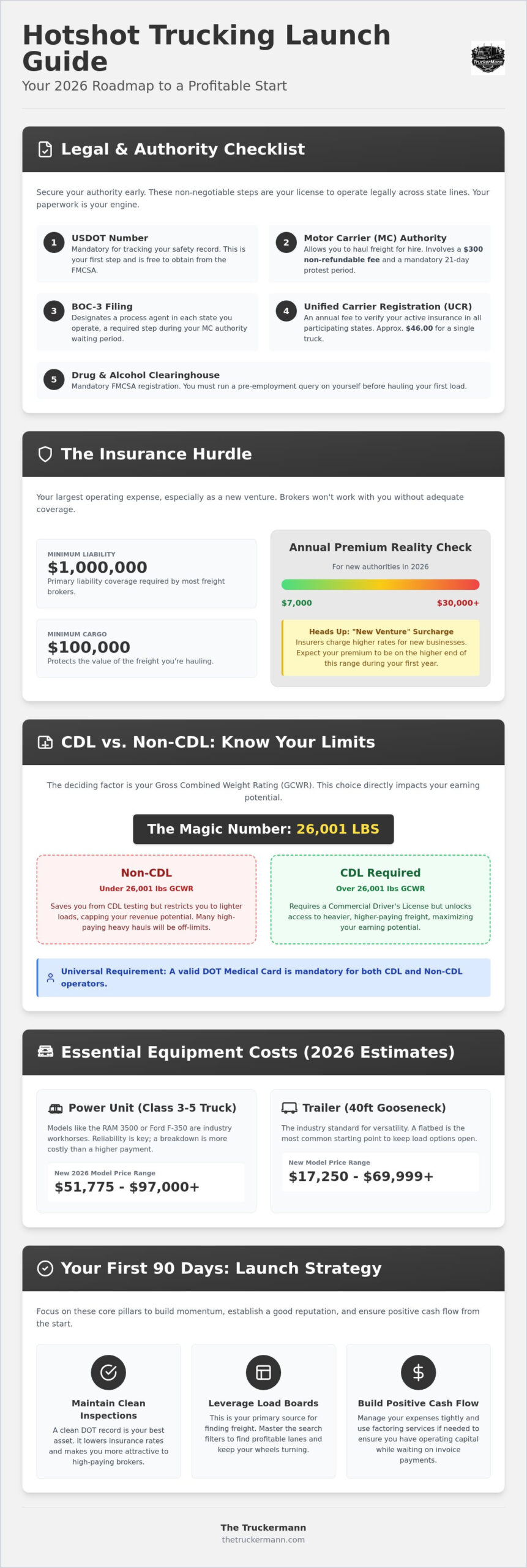
You aren’t just buying a truck; you’re buying a job, a lifestyle, and a mountain of federal obligations. In the broader context of the Hotshot trucking world, this niche focuses on Class 3, 4, or 5 trucks hauling time-sensitive freight that larger rigs can’t move efficiently. To get your wheels on the pavement, you first need to secure your identity with the FMCSA. This begins with a USDOT number, which is free but mandatory for tracking your safety record. Next comes your Motor Carrier (MC) authority, which costs a non-refundable $300 fee. Without these, you are just a guy with a trailer; with them, you are a professional carrier.
Setting up your authority is the most critical hurdle in understanding the total hotshot trucking requirements and startup costs. You can’t just file and drive. There is a mandatory 21-day protest period where the public (and competitors) can challenge your application. During this time, you must also finalize your BOC-3 filing. This designates a process agent in every state you operate in, ensuring legal documents can be served if needed. For a single-truck operator in 2026, the Unified Carrier Registration (UCR) fee is $46.00. It is a small price to pay to keep the DOT off your back and your business in the green.
To better understand the step-by-step process of setting up your business, watch this helpful video:
Insurance is the financial heavyweight of your startup phase. Most freight brokers won’t even look at you without a minimum of $1,000,000 in primary liability and $100,000 in cargo insurance. In 2026, new authorities are seeing annual premiums between $7,000 and $30,000. This is a massive range, but your driving record and operating radius dictate where you fall. Remember that trucking liability insurance costs climbed over 18% in the last few years; don’t let a “new venture” surcharge catch you by surprise when you are trying to balance your first month’s books.
CDL vs. Non-CDL Hotshotting
The magic number in this industry is 26,001 pounds. If your Gross Combined Weight Rating (GCWR) exceeds this limit, you must have a Commercial Driver’s License (CDL). While staying under 26k saves you from some testing, it also caps your earning potential. You will be restricted to lighter loads, and many high-paying heavy equipment hauls will be off-limits. Regardless of which path you choose, you still need a valid medical card to prove you are physically fit for the road.
Drug & Alcohol Clearinghouse Compliance
The FMCSA doesn’t play games with safety. Every owner-operator must register with the Drug & Alcohol Clearinghouse. You are required to perform a pre-employment query on yourself before you ever hook up to your first load. This database tracks violations and ensures that drivers with “prohibited” status aren’t out on the interstate. Keeping your status “clear” is just as vital as keeping your fuel tank full. For more details on staying compliant with physical standards, check out our DOT Medical Card guide to ensure your paperwork is as ready as your rig.
Essential Equipment & Securement Gear
Your truck is the face of your company, but your trailer is where the money actually sits. When you are calculating hotshot trucking requirements and startup costs, the power unit is usually your largest single line item. A new 2026 RAM 3500 starts around $51,775, though high-end diesel trims built for the long haul can easily clear $97,000. Ford’s F-350 is the other heavy hitter in this lane. These trucks dominate the market because they balance massive payload capacity with maintenance cycles that won’t keep you in the shop every other week. Don’t skimp here; a breakdown on the shoulder of I-80 costs far more than a slightly higher monthly payment.
The 40-foot gooseneck remains the bread and butter of the industry for a reason. You can find basic models starting near $17,250, but if you’re eyeing high-end enclosed car haulers, you might spend over $69,999. Choosing between a standard gooseneck, a step-deck, or a lowboy depends entirely on the specific freight you plan to pull. Most successful operators start with a versatile flatbed to keep their options wide open on the load boards. If you want to stay ahead of the curve, follow our latest industry updates for more rig-building tips.
Securing that freight is where the real professional work happens. Following the Federal Motor Carrier Safety Regulations is not just about avoiding a “fix-it” ticket from a bored inspector. It is about protecting your reputation and your insurance loss run. A single shifted load can skyrocket your premiums or, in the worst-case scenario, end your career before the first year is up. Your “Logistics Kit” is the collection of specialized tools that keeps your cargo stationary and your business solvent.
Flatbed Securement Essentials
You need more than just a few bungee cords to satisfy a broker. We are talking 4-inch winches, ratcheting binders, and heavy-duty Grade 70 chains. These are the tools that handle the constant vibration and wind shear of highway speeds. Using edge protectors and quality tarps shows brokers you respect their customers’ property. You can find professional-grade gear at Mytee Products. For a deeper dive into what belongs in your side box, check out our guide on the Best Flatbed Trucking Gear.
Auxiliary Fuel Tanks & Toolboxes
In this business, range is revenue. An in-bed transfer tank allows you to bypass expensive highway truck stops and fill up at local stations where prices are lower. It also means fewer stops, which keeps your average speed up and your delivery times tight. Pair that tank with weatherproof toolboxes to keep your straps dry and organized. A messy bed is the first sign of a messy operation. Check out the rig organization options at Truck n Tow to keep your gear ready for the next haul.
Startup Costs: The 2026 Financial Reality
Launching your own authority isn’t cheap, and anyone telling you otherwise hasn’t looked at a price tag since 2019. If you are starting from scratch with a new truck and trailer, the total hotshot trucking requirements and startup costs can easily hit the $50,000 to $100,000 range. Even if you already own your rig, you’re looking at $15,000 to $50,000 just to get legal and fueled up. It is a steep climb, but it is the price of entry for a business that can net you six figures if you run it right. You have to be prepared for the financial weight before you ever pull your first load.
The paperwork fees feel like death by a thousand cuts. You’ve got the $300 MC authority fee, the $46 UCR registration, and the BOC-3 filing which usually runs between $30 and $75. While following the standard steps to start your business will keep you organized, the real weight comes from the equipment down payments. Most lenders for commercial equipment want to see 10% to 20% down, especially for new ventures with no established business credit history. If you are eyeing a $60,000 truck, that is $12,000 out of your pocket before you even turn the key.
Then there is the “Safety Buffer.” You cannot afford to start this journey with an empty bank account. Most brokers pay on a 30-day cycle, and while factoring can speed that up, you still need at least 90 days of operating capital in the bank. This covers your fuel, which is your biggest variable expense, and those initial maintenance cycles. If you don’t have a cushion, a single blown tire or a week of bad weather will park your truck for good. We’ve seen too many good drivers fail not because they couldn’t drive, but because they couldn’t cash flow their first month.
Don’t overlook the smaller gear that adds up fast. You’ll need an ELD system, which usually costs $75 to $300 for the hardware plus a monthly subscription of $15 to $50. Then you have professional door decals, fire extinguishers, and reflective triangles. These might seem like minor details, but they are mandatory for passing your first DOT inspection and staying on the right side of the law.
Fixed vs. Variable Startup Expenses
Fixed costs are your “price of admission,” including authority fees, equipment down payments, and initial insurance deposits. Variable costs are the ones that fluctuate based on how many miles you turn, like your fuel reserves, maintenance funds, and tire replacement cycles. Working capital is the financial lifeline that keeps your wheels moving when the load boards get thin or a broker is slow to pay.
Insurance Premiums & Down Payments
Insurance is the biggest hurdle for a fresh MC number. New authorities often face a “new venture” surcharge, with annual premiums ranging from $7,000 to $30,000 in 2026. Your Motor Vehicle Record (MVR) is the biggest factor here. If you’ve got a clean slate, you can often negotiate a lower down payment. Some carriers allow you to start with 10% to 20% of the annual premium upfront, while others might demand more if they see you as a high-risk rookie. Keeping your record clean is the best way to keep these costs from spiraling out of control.
Tech & Tools for Daily Operations
Your truck is the muscle, but your software is the brain. In 2026, you cannot expect to survive on phone calls and handshakes alone. Integrating the right tech is a core part of the hotshot trucking requirements and startup costs that many rookies overlook until they are sitting empty at a truck stop. From finding the freight to proving you have been driving legally, your digital toolbox is what keeps the cash flowing and the DOT inspectors satisfied. It turns your rig from a hobby into a professional enterprise.
Factoring services are the unsung heroes of cash flow for a new authority. Most freight brokers operate on 30-day payment cycles, but your fuel tank and insurance premiums won’t wait that long. Factoring allows you to sell your invoices for a small fee and get paid within 24 hours. Pair this with automated IFTA tracking to handle your fuel tax reporting. If you aren’t automating your mileage and fuel receipts from day one, you are begging for an audit that could park your rig permanently. Efficiency is the only way to protect your margins in a volatile market.
Finding Your First Load
The load board is your primary engine for revenue. While some boards cater to the big rigs, 123Loadboard is a powerhouse for finding hotshot-specific freight that fits a Class 3-5 setup. As a new authority, you have to be aggressive. Use the rate data provided by these platforms to negotiate with brokers who might be hesitant to work with a fresh MC number. Showing them you know the market rates proves you are a professional, not just a guy with a trailer looking for gas money. Building these relationships early is what secures your business for the long haul.
ELD & Regulatory Tech
ELD compliance is no longer up for debate. In 2026, the FMCSA has zero patience for paper logs or glitchy hardware. You need a reliable Electronic Logging Device that integrates with your truck’s engine diagnostics to prove your Hours of Service (HOS). A decent setup will run you between $75 and $300 for the hardware, with monthly subscriptions ranging from $15 to $50. For a complete breakdown of what to look for, check out our ELD Compliance Guide. Being ready to hand over your device during a roadside inspection is the best way to get back on the road without a violation hanging over your head.
Ready to maximize your efficiency? Check out our top-rated business tools to keep your wheels turning and your profits growing.
Launch Strategy: Your First 90 Days
The first 90 days of your operation are the proving ground where a business either finds its rhythm or stalls out. You have already navigated the complex hotshot trucking requirements and startup costs, but now you have to prove to the DOT and the brokers that you are a professional. This period is often called the “danger zone” because your new authority is a magnet for the New Entrant Safety Audit. The FMCSA wants to see that you actually have a safety management system in place, not just a truck and a dream. Your primary goal during this window is to keep a spotless inspection record. A single violation in your first month can tank your safety score and make you radioactive to the best-paying brokers.
Maintenance is where many new operators fall behind. Unlike Class 8 trucks that can sometimes go 25,000 miles between oil changes, your Class 3-5 dually is working much harder relative to its size. You should be looking at maintenance cycles every 5,000 to 7,000 miles to keep that engine healthy. Frequent inspections of your tires and brakes are non-negotiable. If you treat your truck like a personal pickup, it will fail you when a deadline is tight. Reliability is the only currency that matters when you are building a reputation with a new set of brokers.
Profitability is about more than just finding a high-paying load out of your home state. You have to master the art of the backhaul. If you take a $3.00 per mile load into a “dead zone” where there is no freight coming back, your actual Rate Per Mile (RPM) is slashed in half once you deadhead home. Use your load boards to plan the return trip before you even hook up to the outbound freight. Eventually, you might decide to scale up by adding a second driver or finally upgrading to a CDL to handle the heavy equipment that pays the real dividends. Growth should be steady and calculated, not rushed.
Mastering the Pre-Trip Inspection
Your first 90 days are essentially a three-month-long job interview with the DOT. Improper securement is the leading cause of hotshot violations and the quickest way to get pulled into a weigh station for a deeper look. You must be meticulous with your straps and chains. For a step-by-step breakdown of what you should be checking every single morning, follow our CDL Pre-Trip Master Guide. Preventing a violation is always cheaper than paying a fine and dealing with the insurance hike that follows.
Fuel Management & Profitability
Fuel is the one expense that can eat your lunch if you aren’t careful. Every cent counts when you are turning thousands of miles a week. Using a dedicated fuel card can shave significant money off every gallon and simplify your IFTA reporting. Speed and idling are your biggest enemies here. Dropping your speed from 75 to 65 mph can drastically improve your fuel economy and keep more cash in your pocket. Before you hit the road, make sure you are ready for a surprise inspection by reviewing the ultimate DOT inspection Level 1 checklist to ensure your rig is ready for any sentinel on the highway.
Master the Road and Build Your Legacy
We’ve been providing expert industry guidance since 2021, and we’ve seen thousands of owner-operators turn their first mile into a thriving enterprise. You don’t have to navigate these highways alone. With real-time hotshot load alerts and a community that has your back, the tools for success are within your reach. It’s time to stop planning and start pulling. Find your first high-paying load on 123Loadboard today and join the ranks of professionals who move the country one time-sensitive load at a time. The horizon is wide open, and your new career is waiting for you to turn the key.
Frequently Asked Questions
Do I need a CDL for hotshot trucking in 2026?
A Commercial Driver’s License (CDL) is only required if your Gross Combined Weight Rating (GCWR) exceeds 26,001 pounds. If your truck and trailer stay below this limit, you can operate as a non-CDL driver. However, remember that non-CDL status limits the weight of the loads you can accept; this can cap your earning potential in a competitive market where heavier freight often pays better.
How much does it cost to start a hotshot business from scratch?
Starting a hotshot business from scratch in 2026 typically requires between $50,000 and $100,000. This range covers the down payment on a new Class 3 truck, a 40-foot gooseneck trailer, and the mandatory “new venture” insurance deposit. If you already own a capable truck, your hotshot trucking requirements and startup costs might drop to between $15,000 and $50,000 for authority, gear, and initial fuel reserves.
What is the best truck for hotshot trucking?
The RAM 3500 and Ford F-350 are widely considered the industry standards for hotshot operations due to their massive towing capacities. These trucks offer the necessary torque to handle 40-foot trailers while keeping maintenance cycles predictable. Most professional drivers choose diesel engines for their longevity and superior pulling power, especially when navigating mountainous terrain with full loads of heavy equipment or machinery.
How do I find hotshot loads as a new authority?
New authorities find the most success using specialized load boards like 123Loadboard to source time-sensitive freight that fits their rig. You should also focus on building direct relationships with brokers who are willing to work with fresh MC numbers. Consistently delivering on time and maintaining professional communication will help you secure “preferred carrier” status, which leads to more consistent work and better rates over time.
Is hotshot trucking still profitable with high fuel costs?
Hotshot trucking remains profitable in 2026 if you maintain strict operational discipline and manage your rate per mile (RPM) with precision. Successful operators offset fuel costs by using fuel cards, planning efficient routes with guaranteed backhauls, and reducing idle time. Experienced drivers can still net between $6,000 and $10,000 per month by focusing on high-demand, specialized freight that pays a premium for speed and reliability.
What insurance do I need for a hotshot trucking startup?
You must have a minimum of $1,000,000 in primary liability and $100,000 in cargo insurance to satisfy the requirements of most freight brokers. These are the standard hotshot trucking requirements and startup costs that every new owner-operator must budget for carefully. Expect annual premiums to range from $7,000 to $30,000; this insurance is your biggest fixed cost, so shopping for quotes early is vital for your survival.
Can I use a 2500 series truck for hotshotting?
You can technically use a 2500 series truck, but it is rarely recommended for professional hotshotting on a full-time basis. These trucks often lack the payload capacity and suspension needed to safely tow a 40-foot gooseneck trailer when it is fully loaded. Most brokers and shippers prefer 3500 series trucks or higher because they are built to handle the constant stress and weight of heavy commercial hauling.
How long does it take to get my MC authority active?
It takes a minimum of 21 to 25 days to get your MC authority active after filing your application with the FMCSA. This timeline is dictated by the mandatory 21-day public protest period that every new application must undergo before final approval. You should use this time to finalize your insurance, secure your equipment, and set up your ELD so you are ready to roll immediately.
Disclaimer
The information provided on The TruckerMann is for general informational and educational purposes only. While every effort is made to ensure the accuracy and reliability of the content, trucking laws, FMCSA regulations, DOT requirements, safety standards, and industry policies can change at any time. Readers are encouraged to verify all information with official government agencies, professional advisors, or qualified industry professionals before making business, legal, financial, safety, or compliance-related decisions.
The content shared on this website reflects personal opinions, experiences, research, and commentary and should not be considered legal, financial, medical, tax, or professional advice. The TruckerMann and its owners, contributors, affiliates, or representatives are not responsible for any losses, damages, violations, penalties, or liabilities resulting from the use or misuse of information found on this website.
Some content on this website may contain affiliate links, sponsored content, or promotional material. This means we may earn a commission at no additional cost to you if you choose to purchase through certain links.
By using this website, you agree that you do so at your own discretion and risk.