A single unfair roadside citation shouldn’t be the reason your insurance premiums skyrocket or your career hits a standstill. You’ve likely felt that surge of frustration when an officer hands you a violation for a “defect” you know is non-existent. With vehicle maintenance violations now carrying 25% more weight in your CSA score as of 2026, the stakes for knowing how to dispute a dot violation have never been higher. You aren’t just fighting a piece of paper; you’re defending your livelihood against a system that often feels like it’s designed to trip you up.
We’ve all been there, staring at the DataQs portal and wondering if anyone actually reads the appeals we send into the void. It’s exhausting to deal with the fallout of an incorrect inspection while you’re trying to keep your wheels turning. This guide is here to give you the upper hand. You’ll learn the exact steps to challenge unfair citations using the 2026 DataQs updates, including how to hold states to their new 21-day review deadlines. We’ll walk through the three-stage review process and the specific evidence you need to clear your record and regain your peace of mind.
Key Takeaways
- Build a “Roadside Toolkit” with photographic and ELD evidence to challenge inspector claims before you even pull away from the scale.
- Learn exactly how to dispute a dot violation by navigating the DataQs portal and selecting the correct Request for Data Review (RDR) category for your situation.
- Use specific FMCSA regulation numbers and Driver Vehicle Examination Report (DVER) details to ensure your appeal is backed by law, not just your word.
- Take advantage of 2026 regulatory shifts that force states to issue initial review decisions on your DataQs submissions within 21 days.
- Protect your livelihood long-term by combining a solid defense strategy with proactive pre-trip inspections and high-quality securement gear.
Understanding DOT Violations and Your Record
Your driving record is more than just a history of where you’ve been; it is your professional resume and your ticket to staying on the road. Many drivers mistakenly believe that if they don’t get a ticket during a roadside stop, their record stays clean. That is a dangerous assumption. A citation is a legal matter handled in a local court, but a roadside violation is a data entry that hits your federal profile immediately. Learning how to dispute a dot violation starts with realizing that these two things are separate battles. Even if a judge throws out your ticket, that violation stays on your record until you take specific action through the right channels.
CSA Scores and Your Livelihood
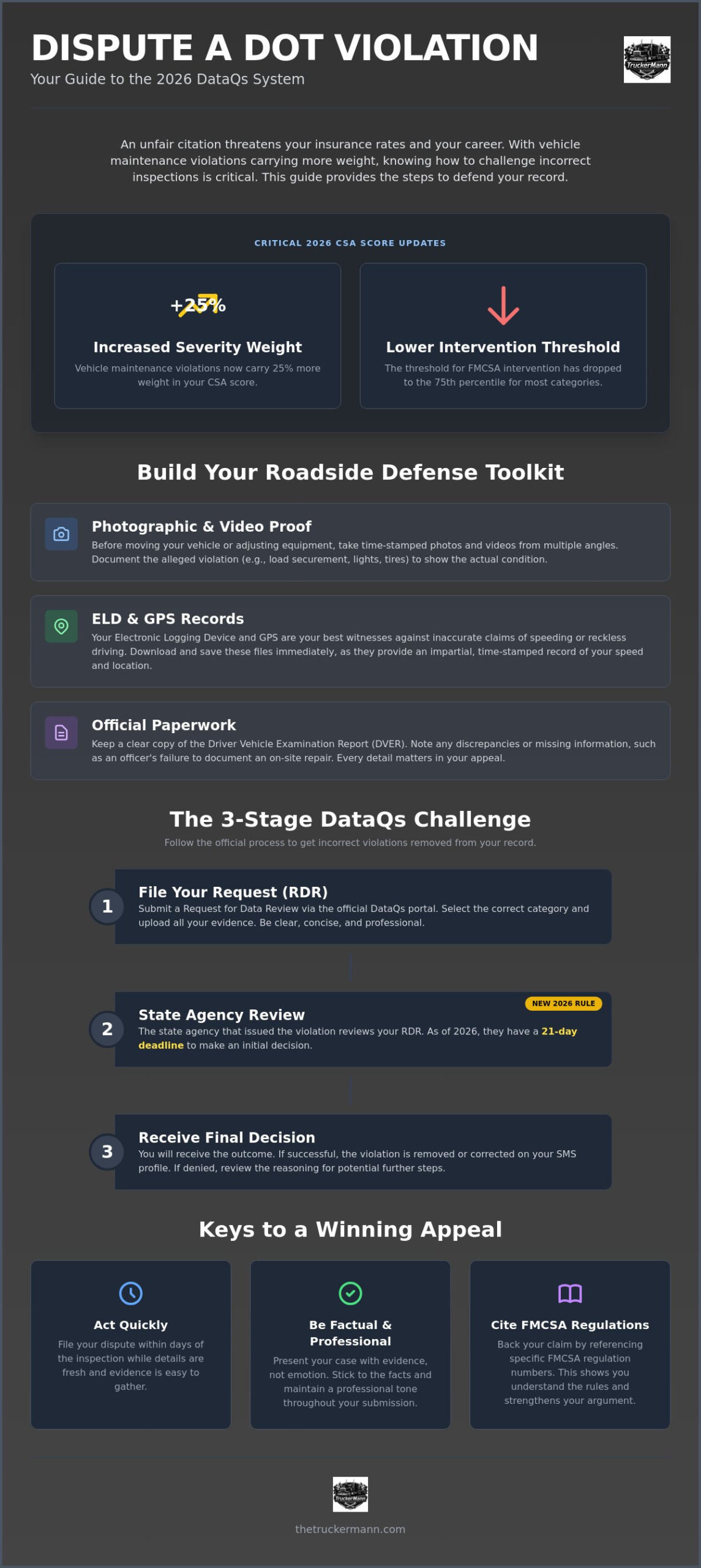
In 2026, the Safety Measurement System (SMS) serves as the FMCSA’s public scoreboard, ranking carriers and drivers against their peers based on roadside performance. This system is the primary tool used by brokers and insurance companies to decide if you are a “safe” bet. Under the updated 2026 guidelines, the stakes are higher than ever. Vehicle maintenance violations now carry 25% higher severity weights, and the intervention threshold for most categories has dropped to the 75th percentile. Protecting your Commercial Driver’s License (CDL) means keeping this score as clean as possible. A single high-point violation, like an unsecured load or a major brake issue, can cause your insurance premiums to jump or lead to a loss of high-paying contracts.
The DataQs System Explained
The DataQs system is the only official way to challenge the information found in your SMS profile. When you file what is known as a Request for Data Review (RDR), you are essentially asking for a second look at the evidence. It is important to know that DataQs acts as the judge and jury for these disputes. While the FMCSA manages the website, the actual review is usually performed by the state agency that issued the violation. This means you are often asking the same department that wrote the violation to admit they made a mistake. Because of this, your argument must be airtight. You can challenge data that is incorrect, but you should also look for “incomplete” data. If an officer failed to note that a defect was repaired on-site, that missing piece of information is just as challengeable as a flat-out error.
Timing is everything when you are figuring out how to dispute a dot violation. While 2026 regulations require states to review inspections submitted within a three-year window, you shouldn’t wait that long. The longer you wait, the harder it is to track down photos, ELD logs, or witness statements. Most successful drivers file their RDR within days of the inspection while the details are still fresh. Acting quickly shows the review board that you are a professional who takes your compliance seriously, which can sometimes tip a close decision in your favor.
Evidence Needed for a Successful Dispute
When you’re standing on the shoulder of the interstate, the inspector’s word is the final say. But once that inspection report is uploaded, the battle shifts to the FMCSA’s DataQs system. To win, you need more than just a good memory. You need a “Roadside Toolkit” of hard evidence. Successful drivers treat every inspection like a potential court case. They document everything before the wheels even start turning again. If you’re wondering how to dispute a dot violation and actually win, it comes down to who has the better paper trail.
Digital Evidence: Dashcams and GPS
Dashcams are your best witness. If an officer claims you failed to yield or were driving recklessly, high-definition footage can often tell a different story. GPS breadcrumbs are another vital tool. They provide a timestamped record of your exact speed and location, which is invaluable for fighting inaccurate speeding citations. Since ELD providers are now required to store logs for 8 years as of 2026, you have a deep well of data to pull from. Make sure you download and save these files immediately. Digital evidence is easy to lose if you don’t secure it right after the stop.
Photos and Securement Proof
Load securement is a common target for inspectors. If you’re cited for a loose strap or an improper tie-down, take photos from multiple angles before you touch the equipment. You want to show the inspector’s perspective versus the reality of the load. Using Essential Tools for Professional Cargo Securement can prevent these headaches from the start, but if a violation happens anyway, your photos are your primary defense. Capture the condition of your tires, lights, and brake components right there at the scale house or roadside. It’s much harder for a reviewer to uphold a lighting defect if you have a timestamped photo showing the bulb burning bright ten minutes after the citation was issued.
Logs and Maintenance Records
Your Electronic Logging Device (ELD) is a double-edged sword, but in a dispute, it’s often your shield. Use your unedited logs to disprove hours-of-service allegations. Because the 2026 rules prevent duty status edits after 24 hours, a clean log carries significant weight with reviewers. Don’t forget your pre-trip inspection reports. A signed, dated DVIR showing that a component was functional at the start of your shift proves you did your due diligence as a professional. If you need to upgrade your securement setup to stay compliant, consider checking out the high-quality options at Mytee Products. Finally, if another driver or a shipper witnessed the inspection or the state of your equipment, get a written statement. A third-party account can be the tipping point when you are figuring out how to dispute a dot violation and the state’s evidence is thin.
Filing Your Request via DataQs
Navigating the DataQs portal is where your preparation meets the bureaucratic reality of the FMCSA. Once you’ve gathered your evidence, the next step in learning how to dispute a dot violation is setting up your individual account. Registration is straightforward; you’ll need your individual driver information or your company’s USDOT number to get started. There is no filing fee to submit a Request for Data Review (RDR), so don’t let the fear of a hidden cost stop you from protecting your record. The portal is designed to be a transparent bridge between the driver and the data, but it requires a methodical approach to be effective.
Choosing the correct RDR category is the first hurdle. If you select the wrong one, the state will likely reject your request on a technicality before they even look at your photos. Most disputes fall under the ‘Inspection’ category, which covers equipment and driver defects. Use the ‘Crash’ category only for the Crash Preventability Determination Program (CPDP) if you’re challenging one of the 21 specific crash types. The ‘Citation’ category is reserved for cases where a court has already ruled on a ticket and you need the federal data to reflect that legal outcome. For 2026, ensure your uploads are in PDF or JPG format and keep individual files under 5MB to avoid system timeouts during the submission process.
The Narrative: Stick to the Facts
Your written narrative is where most drivers lose their case by letting frustration take the wheel. It’s tempting to vent about a “bad cop” or a “long day,” but the reviewer doesn’t care about your feelings. They care about the federal CDL standards and whether the officer’s report matches the law. Structure your argument by listing the specific allegation from the DVER and then presenting the evidence that contradicts it. Avoid emotional language or blaming the officer; instead, use a professional tone. A sample sentence might look like this: “The inspection report alleges a violation of 393.9 for an inoperative lamp, however, the attached timestamped photograph, taken five minutes after the stop, proves all required lighting was fully operational.”
Tracking Your RDR Status
After you hit submit, your request enters the system with a ‘Pending’ status. This means it’s in the queue but hasn’t been assigned to a reviewer yet. Once a state officer begins their investigation, the status shifts to ‘In Review.’ Under the April 2026 regulations, states must issue their initial decision within 21 days. If you see ‘Closed-Modified,’ you’ve won, and the data will be updated. If the status is ‘Closed-No Change,’ your request was denied. If this happens, don’t throw in the towel immediately. You have 30 days to request a ‘Reconsideration’ or a ‘Final Review’ if you have additional evidence or can point out a specific regulatory error in their initial decision. This rebuttal process is your last line of defense in knowing how to dispute a dot violation effectively.
Tips for Winning Your Data Review
Winning a DataQs challenge isn’t just about being right; it’s about being more detailed than the officer who wrote the report. When you sit down to submit your case, your best friend is the Driver Vehicle Examination Report (DVER). Look at every line item with a magnifying glass. If the inspector noted a “major” leak but your shop invoice shows it was a simple O-ring that didn’t meet the regulatory definition of a major defect, you have a winning case. Understanding how to dispute a dot violation requires you to look for these small discrepancies that the average driver misses because they’re too frustrated to read the fine print.
Reference the Regulations
General complaints like “the officer was unfair” or “my truck was fine” will get your request denied immediately. You need to use the language of the law. I recommend using The Ultimate DOT Inspection Level 1 Checklist to cross-reference what the officer found against the actual 2026 standards. When you write your narrative, quote the specific Federal Motor Carrier Safety Regulation (FMCSR) number. For example, if you’re cited for a securement issue, don’t just say the load was safe. Quote the specific part of 49 CFR Part 393 that proves your tie-down method was compliant. Specificity carries weight because it shows the reviewer you know the rules better than the person who cited you.
Officer Discretion and Your Record
Subjective violations like “unsafe driving” or “failure to yield” are the hardest to beat because they rely on an officer’s opinion. This is where a clean inspection history becomes your strongest asset. If you have five years of clean Level 1 inspections, point that out in your appeal. It builds a “halo effect” that makes the reviewer more likely to believe your version of events over a single officer’s interpretation. If you’re serious about protecting your CDL and want to stay ahead of the curve, you can enroll in professional compliance training to ensure you never give an inspector a reason to doubt your professionalism.
Professional Conduct on the Portal
Treat the state reviewer like a colleague, not an adversary. They are often overworked and looking for any reason to close a file. If you provide clear, labeled attachments and a respectful narrative, you make their job easy. If the stakes are high, such as a violation that could lead to an unsatisfactory safety rating, don’t be afraid to involve a professional service or legal counsel. Sometimes a letterhead from a specialized attorney is what it takes to get a second look. Knowing how to dispute a dot violation is as much about strategy and professional presentation as it is about the facts of the case. Keep your cool, stay factual, and let the evidence do the heavy lifting.
Keep Your Record Clean Moving Forward
The best way to win a dispute is to never have one in the first place. While we’ve spent this guide talking about how to dispute a dot violation, your real power lies in prevention. It’s about being the driver who makes an inspector’s job boring. When you pull into a scale house with a clean truck and a well-secured load, you’re sending a message before you even hand over your paperwork. Monitoring your SMS profile monthly is also a critical habit. With the USDOT number now serving as the sole federal identifier as of 2025, your data is more centralized than ever. Don’t let a “ghost” violation from a different carrier accidentally end up on your record because of a simple clerical slip.
Master the Pre-Trip
A flawless pre-trip routine is your first line of defense against the DOT. Inspectors love “low-hanging fruit” like a flickering marker light, a cracked windshield, or a slightly frayed strap. These are easy points for them and expensive headaches for you. I always suggest following a CDL Pre Trip Inspection Checklist to make sure you aren’t missing the small stuff that leads to a roadside “gotcha.” If you’re hauling open deck, investing in high-quality flatbed trucking gear is a non-negotiable part of staying compliant. Cheap equipment fails when you need it most, and an inspector won’t care about the money you saved when they’re writing you up for a securement failure.
Stay Informed on Regulatory Changes
Regulatory shifts happen fast in this industry. With the 2026 updates to the CSA scoring system, being caught off guard by a change in severity weights can tank your score overnight. Staying alert for CVSA Roadcheck dates helps you prepare for those high-enforcement weeks when every scale house is open and every inspector is looking for a reason to pull you in. Modern ELD technology is also a major factor in preventing HOS disputes before they even start. These devices now store eight years of data, meaning your history is always there to back you up if a roadside allegation doesn’t match your actual duty status.
The Truckermann acts as your sentinel on the road, filtering through the noise of D.C. regulations to give you the practical advice you need to stay moving. If you do find yourself with an unfair citation, you now know exactly how to dispute a dot violation using the DataQs system. But if you stay ahead of the game with thorough inspections and top-tier gear, you’ll spend more time making miles and less time fighting the system. Stay vigilant out there, keep your equipment tight, and protect that record like the asset it is.
Defend Your Livelihood and Your Future
Your CDL is the lifeblood of your career, and letting an unfair violation sit on your record is like leaving hard-earned money on the table. We’ve walked through the heavy lifting of gathering evidence and navigating the DataQs portal, but the real win comes from staying one step ahead of every inspector you meet. By leveraging the 2026 regulatory updates and holding states to their new 21-day review deadlines, you can successfully navigate how to dispute a dot violation and keep your CSA score in the green. It’s about more than just digital paperwork; it’s about protecting your reputation in an industry that lives and dies by its data.
The road is hard enough without fighting a system that feels stacked against the driver. Use this expert advice to turn the tables and keep your wheels turning with total confidence. Before you head out on your next haul, make sure you’re equipped to avoid these headaches from the start. Protect your load and your record with pro-grade gear from Mytee Products and ensure you’re always running FMCSA-compliant equipment updated for the latest standards. Keep your head up, stay vigilant, and we’ll see you out there on the high side.
Frequently Asked Questions
How long do I have to dispute a DOT violation?
States are required to review Requests for Data Review (RDRs) for inspections submitted within three years of the inspection date. If you are challenging a crash, you have a five-year window from the date of the accident. While these windows are wide, you only have 30 days to request a Reconsideration or Final Review if your initial dispute is denied, so it’s best to act while your evidence is fresh.
Does a warning show up on my CSA score?
Yes, a warning is recorded as a violation on your roadside inspection report and carries points in the Safety Measurement System (SMS). Many drivers think a warning is a “free pass,” but it impacts your profile and insurance rates just like a ticketed violation. This is a primary reason why knowing how to dispute a dot violation is essential even when no fine is involved at the roadside.
Can I dispute a violation if I already paid the ticket?
You can still file a DataQs challenge even if you paid the fine associated with the citation. The legal court system and the FMCSA’s data system are separate entities. While paying a ticket is often seen as an admission of guilt in court, you can still use the DataQs portal to argue that the data entry on your federal record is incorrect or doesn’t match the regulatory standards.
What is the success rate for DataQs disputes?
Success depends entirely on the quality of your evidence rather than a fixed percentage. In 2024, the system processed over 71,000 requests for data review, proving that drivers and carriers are actively and successfully challenging incorrect data. Drivers who provide specific photos, ELD logs, and maintenance records have a significantly higher chance of seeing a violation removed or modified.
Do I need a lawyer to file a DataQs request?
No, you do not need an attorney to use the DataQs system. The portal is designed for drivers and carriers to handle their own data corrections. However, for high-stakes violations that could lead to an “Unsatisfactory” safety rating, some professionals choose to consult with specialized compliance services to ensure their narrative is airtight and references the correct FMCSR codes.
How long does it take for a violation to be removed after a win?
Under the rules effective April 2026, states must complete initial reviews within 21 days. If your request is successful, the violation is typically removed or updated in the next monthly SMS data refresh. It’s a good habit to check your profile 30 days after a “Closed-Modified” status to ensure the ghost of that violation is officially gone.
What happens if the state agency denies my dispute?
If your initial RDR is denied, you have 30 days to request a Reconsideration or a Final Review. This second stage is your chance to provide new evidence or a more detailed argument. If the state requests more information during this process, you must provide it within 14 days to keep your case active and avoid an automatic closure.
Will my carrier be notified if I file a dispute?
Your carrier will be able to see the status of any dispute filed against a violation tied to their USDOT number. Because violations impact the company’s overall CSA score, most carriers actually encourage drivers to fight unfair citations. It’s a team effort to keep the company’s safety profile clean and protect everyone’s ability to pull high-paying freight.
Disclaimer
The information provided on The TruckerMann is for general informational and educational purposes only. While every effort is made to ensure the accuracy and reliability of the content, trucking laws, FMCSA regulations, DOT requirements, safety standards, and industry policies can change at any time. Readers are encouraged to verify all information with official government agencies, professional advisors, or qualified industry professionals before making business, legal, financial, safety, or compliance-related decisions.
The content shared on this website reflects personal opinions, experiences, research, and commentary and should not be considered legal, financial, medical, tax, or professional advice. The TruckerMann and its owners, contributors, affiliates, or representatives are not responsible for any losses, damages, violations, penalties, or liabilities resulting from the use or misuse of information found on this website.
Some content on this website may contain affiliate links, sponsored content, or promotional material. This means we may earn a commission at no additional cost to you if you choose to purchase through certain links.
By using this website, you agree that you do so at your own discretion and risk.