You’re sitting in the cab at 4:00 AM, the diesel is humming, and you’ve got a 600-mile run ahead, but when you go to release the brakes, the trailer won’t budge. The air pressure is struggling to hit 60 psi, and that familiar sinking feeling hits your gut. It is a reality many of us face when the winter air turns brutal; frozen lines are more than just a delay, they are a direct threat to your clock, your equipment, and your safety. We have all been there, staring at a frozen air connection while the sun starts to peek over the horizon, wondering if a service call is the only way out.
You need to know how to fix frozen truck air lines quickly and correctly to stay DOT-compliant and keep your wheels turning. It is about more than just throwing heat at a problem. This guide covers the professional methods for diagnosing blockages, safely thawing out your system, and preventing moisture buildup before it leaves you stranded. We will look at the 2026 CVSA standards for service air connections and show you how to maintain a moisture-free system that passes every inspection with flying colors. Let’s get those brakes released and get you back on the road where you belong.
Key Takeaways
- Identify the critical signs of a system freeze, such as air pressure gauges that won’t climb, to distinguish between frozen shoes and line blockages.
- Master the professional sequence for how to fix frozen truck air lines by safely using approved antifreeze in your service air connections.
- Understand the air dryer’s role as your primary defense and learn how to spot a saturated desiccant cartridge before it fails.
- Stay DOT-compliant by implementing daily moisture-drainage habits and inspecting seals for the cracks that invite ice.
- Prepare a dedicated winter tool kit to avoid the massive downtime and high costs associated with roadside brake service calls.
Troubleshooting Frozen Air Lines: Signs and Symptoms
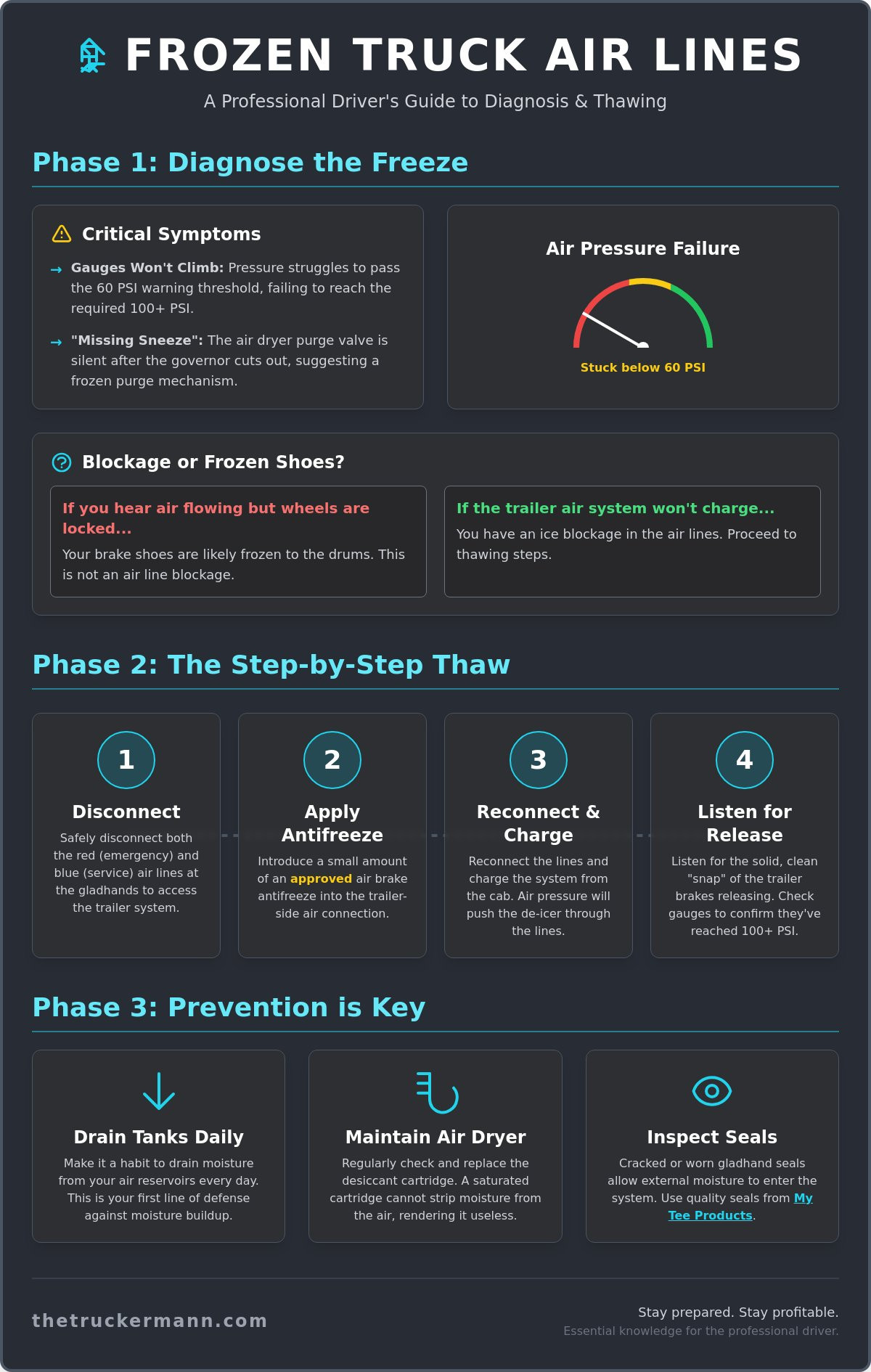
Diagnosis is the first step toward getting your rig moving again. You need to know if you’re dealing with ice inside the lines or brake pads that have literally frozen to the drums. If you can hear air flowing when you push the knobs but the wheels remain locked, your shoes are likely stuck. However, if the trailer doesn’t charge at all, you are facing a blockage within the truck air brake systems. Knowing how to fix frozen truck air lines starts with recognizing these early warnings before you burn up a clutch trying to force a trailer that isn’t ready to roll.
To better understand this concept, watch this helpful video:
Watch your gauges closely during your morning pre-trip. If you are revving the engine and the needles refuse to climb, or they hang stubbornly below the 60 psi warning threshold, an ice dam has formed. While federal law requires the low air buzzer to kick in at 60 psi, you shouldn’t attempt to move until both primary and secondary systems reach at least 100 psi. Another red flag is the “missing sneeze.” If you don’t hear the air dryer purge valve cycle after the governor cuts out, moisture has likely frozen the purge mechanism shut, meaning the rest of your system is now vulnerable to water contamination.
Diagnosing the Location of the Freeze
Is the blockage in the tractor, the trailer, or the connections between them? Start by popping the service air connections, which the 2026 CVSA standards now officially use to describe your gladhands. If air reaches the end of the tractor lines but doesn’t enter the trailer, the blockage is right at the coupling or just inside the trailer’s lead lines. You can also use a “touch test” on the air valves. Ice blockages often cause a valve to feel significantly colder than the surrounding metal. If your primary tank shows 120 psi but the secondary is struggling, the freeze is likely located in the lines between the two reservoirs.
Weather Factors and Critical Temperatures
The freezing point of 32°F is only the beginning of your worries. Wind chill at highway speeds can drop the temperature of exposed air lines much faster than the ambient air temperature suggests. High humidity is another enemy; it forces your air dryer to work double time to strip moisture out of the intake. If you park a warm truck in deep snow after a long haul, you might experience the “Flash Freeze” effect. This happens when residual warmth in the lines melts surrounding snow, which then refreezes instantly as the metal cools, sealing your valves in a block of ice. Maintaining quality seals from My Tee Products can help keep that external moisture from creeping into your system in the first place.
How to Fix Frozen Truck Air Lines: A Step-by-Step Thaw
Once you have diagnosed the freeze, you need to act fast but stay smart. The goal is to clear the blockage without compromising the integrity of your valves or lines. Start by disconnecting both the red emergency and blue service lines at the glad hands. This gives you direct access to the trailer’s air system. It is a gritty, cold job, but getting this right means the difference between rolling out in twenty minutes or waiting four hours for a service truck. Knowing how to fix frozen truck air lines is a fundamental skill that separates the professionals from the steering wheel holders when the mercury drops.
After disconnecting the lines, introduce a small amount of approved air brake antifreeze into the trailer side of the connection. Reconnect the lines and jump back into the cab to charge the system. By pushing air through, you’re using the system’s own pressure to carry that de-icer deep into the relay valves where ice dams usually hide. You want to see your gauges stabilize and hear the trailer brakes release with a solid, clean snap. If you’re still struggling to get a response, it is time to look at your winter air system maintenance routine and apply targeted heat to the exterior components.
Using Air Brake Antifreeze Correctly
There is a “cap-full” rule for a reason. While methanol-based fluids are effective at melting ice, they are incredibly harsh on the internal components of your brake system. Overusing these chemicals can dry out and rot your O-rings and rubber seals, leading to expensive air leaks later in the season. Pour just one or two cap-fulls into the lines. Give the chemical about five to ten minutes to work its magic before you try to move. This patience prevents you from forcing a frozen valve and snapping a mechanical link inside the chamber. For high-quality winter supplies, I always keep a stock from My Tee Products in my side box.
Safe Heat Application Techniques
I have seen too many drivers ruin a perfectly good set of lines by taking a propane torch to them. Modern trucks use nylon air lines that will melt or become dangerously brittle when exposed to an open flame. Instead, use a high-wattage heat gun to target the metal relay valves and quick-release valves. If the freeze is deep in the chassis, you can use the “tarp and heater” method. Drape a heavy tarp over the trailer wheels and axles, then place a portable heater underneath to create a warm environment. This slow, steady rise in temperature is much safer for your equipment than a localized blast of extreme heat. If you need to upgrade your winter toolkit, you can find the right gear through thetruckermann resources.
Beyond the Freeze: Managing the Air Dryer and Reservoirs
While the heat gun and de-icer get you out of a jam, they are just bandages on a deeper wound. If you want to stop stressing about how to fix frozen truck air lines every time the sun goes down, you have to master the heart of your rig’s pneumatic system. Your air dryer is the primary gatekeeper. It is designed to strip moisture and oil from the air before it ever reaches your service lines. When this component is neglected, you aren’t just dealing with a morning delay; you are inviting a catastrophic system failure that could cost upwards of $2,000 in roadside service fees. It is your first and best line of defense. For owners whose trucks have already succumbed to serious mechanical damage, Cash For Junk Cars Michigan provides a simple process for selling used or junk vehicles.
The desiccant cartridge inside that dryer has a finite lifespan. Industry standards suggest a replacement every one to three years, or roughly every 150,000 miles. However, heavy-duty applications in high-humidity regions can saturate a cartridge much faster. If you see water when you pull your tank lanyards, your dryer is already losing the battle. It is time to swap that cartridge for a fresh one from My Tee Products to ensure your system stays bone-dry through the worst of the season. A saturated cartridge is just a heavy paperweight that lets ice-forming water flow freely into your brakes.
The Daily Tank Drain Ritual
Forget the advice you hear at the fuel island about draining tanks once a week. In winter, this is a daily requirement. You must drain your tanks until the discharge is pure air. If you see a white, milky substance, often called “mayonnaise,” that is a sign of oil blow-by from your compressor mixing with water. This sludge is a valve-killer. Always follow the proper order of operations:
- Drain the wet tank first to catch the bulk of the contamination.
- Move to the primary tank to ensure no moisture bypassed the first stage.
- Finish with the secondary tank for a final check of system integrity.
Consistent drainage prevents ice from ever having a home in your reservoirs. It is a simple habit that saves your clock and your wallet.
Air Dryer Maintenance for Winter
Your air dryer has a built-in heater element designed to keep the purge valve from freezing shut. During your pre-trip, check this heater. You can use a multimeter to ensure it is drawing power, or simply feel the housing after the truck has been running. If it is stone-cold in 10-degree weather, your purge valve will freeze, and the dryer will stop cycling. This leads to a rapid buildup of moisture throughout the tractor and trailer. Also, watch for a failing check valve. If air is back-flowing from the tanks into the dryer, it will saturate the desiccant instantly. Staying ahead of these mechanical gremlins is how you keep your truck moving while others are stuck waiting for a tow. For reliable replacement parts and valves, check out the inventory at My Tee Products.
Preventive Maintenance: Winterizing Your Brake System
You’ve spent the morning fighting ice, but the real victory is making sure you never have to do it again. While knowing how to fix frozen truck air lines is a badge of honor for any veteran driver, proactive maintenance is what keeps your profitability high. You can’t control the blizzard, but you can control the moisture levels in your system. It starts with a simple walk-around before the first frost hits your windshield. If you wait until you’re stuck in a rest area in North Dakota, you’ve already lost the battle.
Inspect your service air connections, or glad hands, with a critical eye. Those rubber seals are the only thing keeping the outside atmosphere from entering your pneumatic system. If they are hard, cracked, or flat, they are failing. Apply a light coating of silicone lubricant to the seals to keep them supple and prevent them from freezing to the trailer’s connections. You should also keep your air lines off the catwalk. When lines drag or sit in the slush accumulating on the back of the tractor, they lose heat rapidly, encouraging ice to form inside. For a comprehensive solution, I recommend keeping a My Tee Products winter cab kit in your sleeper for those emergency moments.
Glad Hand and Seal Integrity
Don’t wait for a DOT officer to point out a leak during an inspection. Replacing worn seals is a five-minute job that prevents a five-hour delay. If you are bobtailing, use glad hand covers. Leaving those connections open to the elements allows road salt, snow, and debris to settle inside the lines, which eventually works its way into your valves. Check your pigtail lines for sagging. Any low point in the line acts as a trap where moisture can pool and freeze, effectively cutting off air to your trailer. You can find high-quality replacement seals and protective gear at My Tee Products.
Compressor Health and Air Quality
Your air compressor is the lungs of your truck. If it is running long duty cycles just to keep up with small leaks, it creates excessive heat. This hot air holds more moisture, which then condenses and freezes as it travels toward the back of the rig. Ensure your air intake filter is clean; a clogged filter makes the compressor work harder and run hotter. Stay on top of your engine oil quality too. Old, degraded oil can lead to carboning in the discharge line, creating a sludge that makes how to fix frozen truck air lines a much more complicated and messy task. Stay prepared by checking out the latest thetruckermann professional resources.
Essential Gear and DOT Compliance
Having the right tools in your side box is the difference between a minor delay and a failed roadside inspection. While you now know how to fix frozen truck air lines, performing that task in the middle of a blizzard without the proper trucking gear is a recipe for frostbite and frustration. You need a dedicated winter kit that includes a high-wattage heat gun, extra seals, and a fresh bottle of air brake antifreeze. Don’t rely on luck when the temperature drops; rely on your preparation. Every driver should have a stash of heavy-duty gloves from My Tee Products to handle frozen metal components safely.
Your ability to manage these issues directly affects your standing with the FMCSA. A frozen valve that causes an air leak is a serious violation that can land you in the out-of-service category. Reviewing the DOT Inspection Level 1 Checklist will show you exactly how inspectors view brake system integrity. If you’re out there without the right supplies from My Tee Products, you’re essentially gambling with your CDL and your livelihood.
The DOT Perspective on Frozen Lines
Inspectors don’t care that it’s ten below zero; they care about the safety of the motoring public. “My lines are frozen” is never a valid excuse for an audible air leak or a slow-building system during a roadside check. As of the April 1, 2026 updates to the CVSA North American Standard Out-of-Service Criteria, there is a heightened focus on brake system performance and the terminology for service air connections. You must be prepared for the CVSA Roadcheck 2026 winter safety focus, which targets moisture control and air dryer efficiency. Document your daily tank drainage and cartridge replacements in your maintenance log. This shows a level of due diligence and professional commitment to safety that inspectors respect. Remember that federal law under 49 CFR §396.25 requires anyone performing brake repairs to be a qualified inspector, so keep your minor thaws within the scope of driver-level maintenance.
Choosing Professional Grade Supplies
When you’re sourcing parts for your rig, don’t settle for the cheapest option at the fuel island. You should source components from Truck n Tow for reliable cold-weather performance that won’t fail when the mercury bottom out. For those running consistently in extreme northern climates, consider upgrading to braided stainless air lines. These are much more resistant to the “Flash Freeze” effect and mechanical damage from road ice than standard nylon. Keeping a 12V portable heater in the cab is another smart move for warming up stubborn relay valves without needing to run an extension cord. By stocking up on essentials from Truck n Tow and My Tee Products, you ensure that knowing how to fix frozen truck air lines is a skill you have, but a situation you rarely have to face. Stay safe, stay warm, and keep those wheels turning.
Keep Your Wheels Rolling Through the Deep Freeze
Mastering how to fix frozen truck air lines is about more than just a quick thaw; it’s about protecting your livelihood and staying safe in the most brutal conditions. We’ve walked through veteran-tested recovery methods, from the “cap-full” rule for antifreeze to the safe application of heat on those stubborn relay valves. You now have the DOT-compliant safety advice needed to navigate the 2026 CVSA standards without fear of an air leak violation. By committing to a daily tank drainage ritual and maintaining your air dryer, you transition from reacting to the cold to mastering it.
Preparation is your best defense against a $2,000 roadside service call. Ensure your side box is stocked with professional-grade equipment, including the high-wattage heat guns and heavy-duty seals available at My Tee Products. To find more resources and stay ahead of winter breakdowns, get the winter gear you need to stay moving. This industry is a lifestyle, and we’re here to help you navigate every mile of it. Stay vigilant, stay prepared, and we’ll see you at the next stop.
Frequently Asked Questions
Can I use regular automotive antifreeze in my truck air lines?
No, you should never use automotive antifreeze in your pneumatic system. Regular antifreeze is made of ethylene glycol, which is designed for engine cooling and will leave a gummy residue that destroys your air valves. Only use methanol-based air brake antifreeze specifically designed for trucks. It evaporates without leaving a film, keeping your lines clear and your equipment functioning as intended.
How much air brake antifreeze should I pour into the lines?
You should only use about one or two cap-fulls of antifreeze at a time. Most drivers make the mistake of pouring half a bottle into the lines, but that’s overkill. Excess methanol can dry out your rubber O-rings and lead to major air leaks later in the season. If you keep a winter kit from My Tee Products, you’ll have the right tools to apply just enough to get the job done.
What is the safest way to thaw a frozen relay valve on the shoulder?
Use a high-wattage heat gun to target the exterior of the metal valve housing. This provides a steady, controlled rise in temperature that melts the internal ice without damaging the components. If you’re stuck in a deep freeze, you can also drape a heavy tarp over the area and use a portable heater. This method creates a warm pocket of air that thaws the entire assembly safely.
Why does my air pressure drop only when it gets below freezing?
Your air pressure drops because moisture in the system has turned into ice. These ice crystals can block the flow of air entirely or prevent a valve from seating properly, which causes a constant leak. Knowing how to fix frozen truck air lines starts with recognizing that these pressure drops are a direct result of moisture contamination. Draining your tanks daily is the only way to keep the ice away.
Will frozen air lines damage my brake chambers permanently?
Frozen lines themselves rarely cause permanent damage, but the ice can tear the rubber diaphragms inside your brake chambers if you try to force the truck to move. The bigger risk comes from overusing harsh de-icing chemicals. These can rot the seals over time, leading to a complete system failure. It’s always better to use gentle heat and minimal chemicals to preserve your equipment’s lifespan.
How often should I drain my air tanks during a winter storm?
You must drain your air tanks at least once every day. During a severe winter storm with high humidity, it’s smart to pull those lanyards every time you stop for fuel or a break. This prevents water from pooling in the bottom of the tanks where it can easily enter the lines and freeze. Consistent drainage is a simple habit that saves you from a massive headache in the morning.
Is it legal to drive if my trailer brakes are dragging slightly due to ice?
It is absolutely illegal and dangerous to drive with dragging brakes. Even if the drag seems minor, it generates extreme heat that can lead to a wheel fire or a complete tire blowout. It also puts you in direct violation of CVSA safety standards. If your brakes won’t release fully, you need to stop and thaw the system completely before continuing your route.
Can I use a torch to thaw out my air lines if I am careful?
You should never use a torch on your air lines. Modern trucks use nylon lines that will melt or become brittle the second they see an open flame. Even if you’re targeting a metal valve, the heat can transfer and ruin nearby plastic components. Stick to a heat gun or a portable heater from My Tee Products to safely learn how to fix frozen truck air lines without causing permanent damage.
Disclaimer
The information provided on The TruckerMann is for general informational and educational purposes only. While every effort is made to ensure the accuracy and reliability of the content, trucking laws, FMCSA regulations, DOT requirements, safety standards, and industry policies can change at any time. Readers are encouraged to verify all information with official government agencies, professional advisors, or qualified industry professionals before making business, legal, financial, safety, or compliance-related decisions.
The content shared on this website reflects personal opinions, experiences, research, and commentary and should not be considered legal, financial, medical, tax, or professional advice. The TruckerMann and its owners, contributors, affiliates, or representatives are not responsible for any losses, damages, violations, penalties, or liabilities resulting from the use or misuse of information found on this website.
Some content on this website may contain affiliate links, sponsored content, or promotional material. This means we may earn a commission at no additional cost to you if you choose to purchase through certain links.
By using this website, you agree that you do so at your own discretion and risk.