The FMCSA doesn’t care how clean your chrome is or how many miles you’ve logged without a scratch if your paperwork is a mess. For most new carriers, that first notification letter feels like a countdown to a shutdown, especially with the 2026 transition to the Motus registration platform and the total elimination of MC numbers. It’s easy to feel buried under conflicting forum advice and the fear of an automatic failure. We understand the pressure of learning how to survive a new entrant safety audit while trying to keep the wheels turning and the revenue flowing.
You don’t have to face the DOT alone or guess which regulations actually matter during your 18 month monitoring period. This guide provides a veteran led roadmap to mastering the safety audit, focusing on the 16 critical violations that trigger an immediate fail. We’ll break down exactly how to verify medical certificates through MVRs now that paper waivers have expired, how to manage your drug testing pool, and how to build a safety management system that keeps your DOT number active. From ELD compliance to the new fentanyl testing panels, we’re giving you the grit and the expertise needed to pass on your first try.
Key Takeaways
- Identify the “Fatal 16” violations that can shut down your operation instantly and learn the steps to keep your drug and alcohol testing records compliant.
- Navigate the 18-month safety monitoring window with a clear understanding of why the FMCSA targets new carriers within their first year.
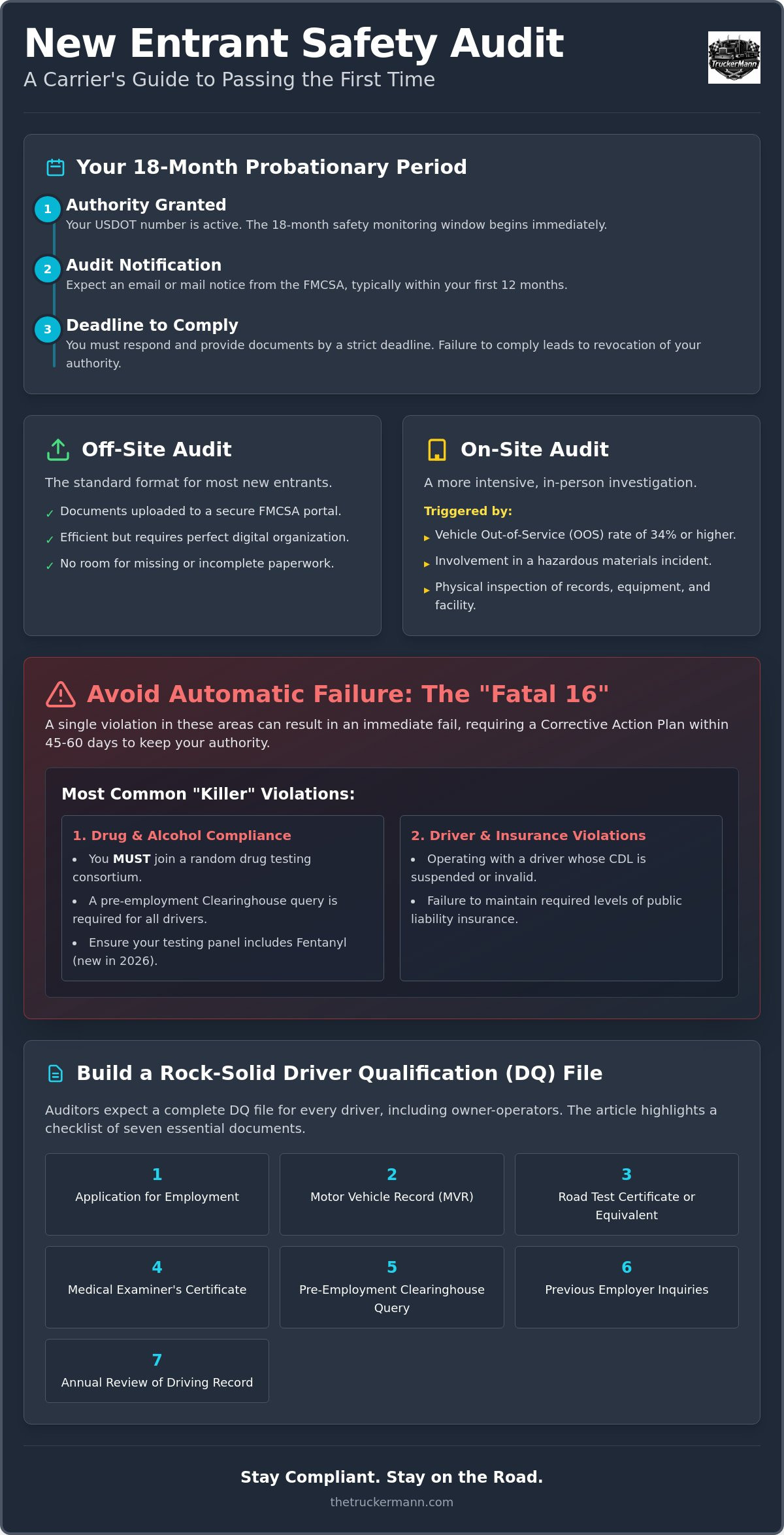
- Build a rock-solid Driver Qualification file using a checklist of the seven essential documents every auditor expects to see.
- Discover the professional communication strategies for how to survive a new entrant safety audit while keeping your carrier profile current via the MCS-150.
- Compare digital and paper record-keeping systems to determine the most efficient way to present your safety management system during an inspection.
New Entrant Audit Basics
The Federal Motor Carrier Safety Administration (FMCSA) isn’t just looking to check boxes when they send that first audit notice. They’re testing whether you’ve actually built a business or just bought a truck. If you want to know how to survive a new entrant safety audit, you have to understand that this isn’t a simple roadside inspection. It’s a deep dive into your management systems. Since the elimination of MC numbers in late 2025, your USDOT number is the sole identifier the agency uses to track your performance. With the 2026 rollout of the Motus registration platform, the feds have more data at their fingertips than ever before to flag carriers who aren’t playing by the rules.
To better understand this concept, watch this helpful video:
The 18 month safety monitoring window is your official probationary period. Most audits happen within the first 12 months because the FMCSA wants to catch non-compliance before it leads to a crash. Whether you are an interstate carrier crossing state lines or an intrastate carrier hauling goods that originated out of state, the audit likely applies to you. It’s vital to distinguish between a Safety Audit and a Compliance Review. An audit is a standard milestone for new carriers. A Compliance Review is a punitive investigation triggered by poor roadside performance, high out-of-service rates, or serious accidents. If you’re feeling unprepared, investing in professional training through the DLA Academy can help you bridge the gap between “just driving” and “running a compliant fleet.”
The 18-Month Timeline
Expect a notification via email or mail within your first few months of operation. Once you receive that contact, you’ll typically have a strict deadline to schedule your audit or begin uploading documents. Ignoring the FMCSA is the fastest way to lose your authority. They don’t send second chances. If you miss the window, they’ll revoke your registration and place your entire operation out of service. It’s a non-negotiable meeting with your company’s future that requires your full attention from day one.
Audit Formats: Off-site vs On-site
In 2026, the majority of these reviews are conducted off-site. You’ll be required to upload digital files to a secure portal for an auditor to review remotely. This format is efficient but leaves no room for missing paperwork. However, certain triggers will still result in an on-site visit. If your vehicle Out-of-Service (OOS) rate hits 34% or higher, or if you’ve been involved in a hazardous materials incident, an auditor will likely show up at your place of business. On-site audits are far more intensive and involve a physical inspection of your records and facility. Learning how to survive a new entrant safety audit starts with keeping your digital files organized so you never give them a reason to visit in person.
Avoiding Automatic Failures
Failing your audit isn’t just a minor setback; it’s a direct threat to your operating authority. The FMCSA identifies 16 specific regulatory violations, known in the industry as the “Fatal 16,” that result in an automatic failure. If you trip over just one of these, you’re looking at a 60 day window to submit a corrective action plan for property carriers, or 45 days if you’re hauling passengers or hazardous materials. This high stakes environment is why understanding how to survive a new entrant safety audit requires more than just keeping your truck clean. You need a bulletproof system to prevent these landmines from ever appearing in your records.
The New Entrant Safety Assurance Program acts as a filter to remove carriers who haven’t mastered the basics of federal safety. The most common killers are drug and alcohol violations, followed closely by operating with a suspended CDL or insufficient insurance. In 2026, auditors have become even more vigilant. They aren’t just looking for mistakes; they’re looking for patterns of negligence. Mastering the paperwork is the only way how to survive a new entrant safety audit without losing your shirt and your DOT number in one fell swoop.
Drug and Alcohol Compliance
Owner-operators often make the mistake of thinking they can manage their own testing. You can’t. You must join a random testing consortium before your first load hits the pavement. As of early 2026, fentanyl has been added to the DOT drug testing panel, and auditors will verify that your testing facility is updated. You’re also required to run a pre-employment Clearinghouse query for every driver and an annual query for your entire roster. With marijuana accounting for nearly 60% of all positive drug tests, you cannot afford to be lax with your testing program.
HOS and ELD Management
Auditors are experts at spotting “ghost logs” and falsified entries. They’ll cross-reference your ELD data with fuel receipts, toll records, and roadside inspections to find discrepancies. A critical deadline to remember is May 4, 2026. After this date, using any device on the FMCSA’s revoked ELD list is treated as operating with no electronic logging device at all, which is an automatic fail. Ensure your device is still on the self-certified list and that your drivers aren’t skipping their required rest periods. If you’re feeling overwhelmed by these regulations, seeking guidance from the DLA Academy can provide the compliance training needed to keep your operation in the green.
Organizing Records
You’ve already identified the “Fatal 16” and secured your ELD, but now we have to talk about the backbone of your business: the filing cabinet. Whether your records are stored in a cloud-based portal or a physical binder, the auditor’s goal is to see a functioning safety management system. In 2026, the shift toward digital uploads via the Motus platform means your organization must be impeccable. If an auditor has to wait for you to find a missing receipt, they’ll naturally start digging deeper into your other files. To understand how to survive a new entrant safety audit, you must treat your documentation like your engine block; it needs to be clean, organized, and capable of handling a heavy load.
Your carrier profile, known as the MCS-150, is the first thing an auditor sees. You’re required to update this every two years, but you should update it immediately if your fleet size or mileage changes significantly. An outdated profile is a red flag that suggests you aren’t paying attention to the details of your operation. Another common trap is the Accident Register. Many new carriers think they don’t need one if they haven’t had a crash. That’s a mistake. You must maintain a register for the last three years that lists all DOT-recordable accidents, even if that list is currently empty. Per the FMCSA Safety Audit requirements, failing to produce this register is a direct violation of safety protocols.
Vehicle Maintenance Files
Every VIN in your fleet requires its own standardized folder. Don’t just rely on your annual DOT inspection. You need to document 90-day inspections, grease jobs, and every roadside repair receipt. If a driver gets an out-of-service violation at a scale, the auditor will look for the specific repair receipt and the signed inspection form proving the defect was corrected before the truck moved again. For a better look at what auditors expect to see on the road, review our DOT Level 1 inspection checklist to align your shop records with their expectations.
Insurance and Financial Records
If the auditor is the judge, the Driver Qualification (DQ) file is the star witness. DQF violations account for nearly 12% of all FMCSA citations. This makes the folder the most scrutinized part of your safety management system. It isn’t enough for your drivers to have a valid CDL; you must prove they were qualified the moment they stepped into the cab. To understand how to survive a new entrant safety audit, you have to treat these files as living documents that require constant attention, not just a one-time setup.
A major regulatory shift hit on January 10, 2026. The temporary waiver allowing carriers to accept paper Medical Examiner’s Certificates (MECs) finally expired. Now, you must verify all medical certifications exclusively through Motor Vehicle Records (MVRs). If you’re still relying on a folded piece of paper in a wallet, you’re looking at an automatic failure. The 7 essential documents you need for every driver include the application, the initial MVR, the road test certificate, the annual MVR review, the annual Certificate of Violations, the medical certificate verification, and the 3-year safety performance history. It’s a double-check system designed to ensure no one is hiding a reckless driving charge from the feds.
Building the DQ Folder
Even if you’re an owner-operator running solo, you must hire yourself legally. This starts with a formal employment application that meets all federal requirements. You can’t skip this just because you already know your own history. Next, you need a road test certificate or a copy of a valid CDL that was used in lieu of a test. Finally, you must document your inquiry to previous employers covering the last three years of safety performance history. If a previous boss doesn’t respond, document your multiple attempts to reach them. The auditor wants to see the effort, not just a blank page.
Expert Compliance Training
The stress of an audit often comes from the unknown. Professional training through DLA Academy can strip away that anxiety by showing you exactly what the FMCSA is looking for in 2026. A mock audit is the ultimate way to learn how to survive a new entrant safety audit before the real call comes. It allows you to find the holes in your DQ files and patch them while there’s still time. Don’t wait for a notification letter to start acting like a professional carrier. You can enroll in compliance training today to secure your authority for the long haul.
Audit Day Strategy
The day of your audit is a test of your character as much as your paperwork. Many drivers walk into the room or hop onto the call with their guard up, viewing the auditor as a predator. That’s a mistake. The real secret to how to survive a new entrant safety audit is treating the official as a partner in your professional growth. They’ve seen every excuse in the book, so don’t try to outsmart them with grit alone. Be the straight-shooter they expect. If you show up organized and respectful, they’re more likely to guide you through minor clerical errors rather than hunting for a reason to fail you.
If you do happen to fail, don’t panic. You’ll receive a notice and have a limited window to submit a Corrective Action Plan (CAP). For property carriers, you have 60 days to prove you’ve fixed the issues. Passenger and hazardous materials carriers only get 45 days. A CAP is your last line of defense to keep your DOT number active. Treat it with the urgency it deserves and get back to doing what you do best: building your business and your legacy on the road.
The Interview Process
Auditors follow a specific script. They’ll ask about your safety policies, how you handle maintenance, and your drug testing procedures. Answer clearly but don’t over-share. If they ask for a specific DQ file, give them exactly that file. Don’t hand over your entire cabinet and hope they find what they need; that only invites them to look for problems you didn’t even know you had. If you discover a piece of missing paperwork during the process, be transparent. An auditor respects a carrier who admits a mistake and has a solution ready to go. This level of professionalism is the best way how to survive a new entrant safety audit without unnecessary friction.
Post-Audit Maintenance
Passing the audit is a major milestone, but it’s just the beginning. Once you clear this hurdle, your authority moves from “New Entrant” to “Permanent” status. To keep it that way, set up a 2026 compliance calendar to track your biennial MCS-150 updates and annual MVR reviews. While you’re focusing on the back-office grit, keep your equipment in top shape with reliable gear from Mytee Products to avoid roadside triggers. Daily operational safety starts with the basics. Review our CDL pre-trip inspection guide to ensure your trucks stay as sharp as your paperwork. Mastering the audit is about building a lifestyle of compliance, not just passing a one-time test.
Secure Your Permanent Authority
Your 18 month probationary period is more than a hurdle; it’s the foundation of your trucking legacy. By mastering the digital DQ file requirements and keeping a vigilant eye on the Fatal 16 violations, you’re doing more than just avoiding a shutdown. You’re building a sustainable safety management system that proves you belong in the big leagues. We’ve walked these miles before and know that the secret to how to survive a new entrant safety audit lies in preparation and professional grit.
Don’t let a simple paperwork error derail your entrepreneurial spirit. Our veteran led resources are specifically aligned with the 2026 FMCSA standards to ensure you never face an auditor unprepared. Whether you need a mock audit or deep dive compliance training, the right guidance makes all the difference in keeping your DOT number active and your revenue flowing. You’ve done the hard work of getting on the road; now let us help you stay there for the long haul.
Ready to lock in your compliance? Get professional compliance training at DLA Academy to master your audit prep today.
Frequently Asked Questions
What is the most common reason for failing a new entrant safety audit?
Drug and alcohol violations are the most frequent causes of failure. Specifically, many carriers forget to join a random testing consortium before their first load or skip the mandatory pre-employment Clearinghouse query. These fall under the “Fatal 16” violations that trigger an automatic fail. If you want to know how to survive a new entrant safety audit, start by ensuring your testing program is active and fully documented from day one.
How much time do I have to fix violations after a failed audit?
Property carriers have 60 days to submit a Corrective Action Plan (CAP) after receiving a failure notice. If you haul passengers or hazardous materials, that window shrinks to 45 days. Failing to submit a valid plan within these timelines results in an immediate revocation of your operating authority. It’s a high stakes race against the clock to prove you’ve fixed the systemic issues identified by the auditor.
Can I perform my own annual DOT inspection for the audit?
You can perform your own annual inspections if you meet the specific qualifications outlined in federal regulation 396.19. This requires you to have at least one year of training or experience in a truck maintenance program or as a mechanic. You must keep documentation of these qualifications in your files. If you can’t prove you’re qualified, the auditor will reject your self-inspections and cite you for non-compliance.
Do I need a safety audit if I only operate within my home state?
Most intrastate carriers still require an audit because they handle “interstate commerce,” such as moving freight that started its journey in another state. Even if you never cross a state line, your state likely mirrors federal safety requirements for any vehicle over 10,000 pounds. Understanding these jurisdictional nuances is a key part of how to survive a new entrant safety audit regardless of your typical routes.
What happens if I miss the deadline to upload my audit documents?
Missing your document upload deadline leads to an automatic revocation of your USDOT number. The FMCSA treats a missed deadline as a refusal to be audited, which triggers an Out-of-Service (OOS) order. You cannot appeal this based on technical issues or simple forgetfulness. Once the OOS order is active, you must stop all operations until you resolve the registration issue with the agency.
Is a new entrant safety audit the same as a roadside inspection?
A safety audit is a deep dive into your office paperwork, while a roadside inspection is a physical check of your truck and current logs. Think of the audit as a management system review. The auditor wants to see how you handle maintenance and driver files over a long period. A roadside inspection is just a snapshot of your compliance at a specific moment on the highway.
Do owner-operators need a Driver Qualification file for themselves?
Yes, owner-operators must maintain a complete Driver Qualification (DQ) file for themselves. You wear two hats: the carrier and the driver. You need an application for employment, an initial MVR, and a medical certificate verification on file just like any fleet driver. Auditors frequently find that solo drivers skip this step, assuming it’s unnecessary since they already know their own driving history.
How long does the actual safety audit interview typically last?
An off-site audit interview typically lasts between 60 and 90 minutes once the auditor has reviewed your uploaded documents. They will call to clarify details about your safety policies and maintenance schedules. If you are selected for an on-site audit, expect the process to take four hours or more as they physically inspect your files and facility. Being organized is the best way to keep these meetings short.
Disclaimer
The information provided on The TruckerMann is for general informational and educational purposes only. While every effort is made to ensure the accuracy and reliability of the content, trucking laws, FMCSA regulations, DOT requirements, safety standards, and industry policies can change at any time. Readers are encouraged to verify all information with official government agencies, professional advisors, or qualified industry professionals before making business, legal, financial, safety, or compliance-related decisions.
The content shared on this website reflects personal opinions, experiences, research, and commentary and should not be considered legal, financial, medical, tax, or professional advice. The TruckerMann and its owners, contributors, affiliates, or representatives are not responsible for any losses, damages, violations, penalties, or liabilities resulting from the use or misuse of information found on this website.
Some content on this website may contain affiliate links, sponsored content, or promotional material. This means we may earn a commission at no additional cost to you if you choose to purchase through certain links.
By using this website, you agree that you do so at your own discretion and risk.