The recruiter promising you the world on a long-haul route isn’t telling you about the hidden costs of living out of a sleeper berth for three weeks straight. You’ve heard the pitches before, and you know that what works for a rookie might not make sense for a veteran looking to actually see their family. Deciding between otr vs regional vs local trucking jobs is a high-stakes business decision that impacts your wallet and your mental health. It’s about more than just the cents-per-mile; it’s about how you want to live your life while you’re behind the wheel.
We’ve seen the market shift recently, with OTR drivers currently averaging around $2,091 per week while local hauls offer the stability of your own bed every night. With the 2026 HOS updates now allowing for a three-hour micro-split in the sleeper berth, the way we manage our clocks is changing. This guide is your sentinel in a volatile industry. We’ll break down the real numbers, the lifestyle trade-offs, and how to choose a path that keeps you moving without burning you out. Whether you’re chasing the new 80 mph limits in Idaho or navigating the tight docks of a local route, we’re here to help you master the road on your own terms.
Key Takeaways
- Master the 2026 HOS micro-split rules to stretch your clock and maximize your long-haul earnings.
- Identify the regional middle ground where familiar routes and steady shippers create a more predictable, efficient schedule.
- Balance the benefit of being home every night against the physical grind and city traffic typical of local driving.
- Compare otr vs regional vs local trucking jobs using a veteran’s roadmap to find the best fit for your family and financial goals.
- Learn to see past the recruiter’s pitch to understand the true lifestyle costs and hidden benefits of each path.
OTR vs Regional vs Local
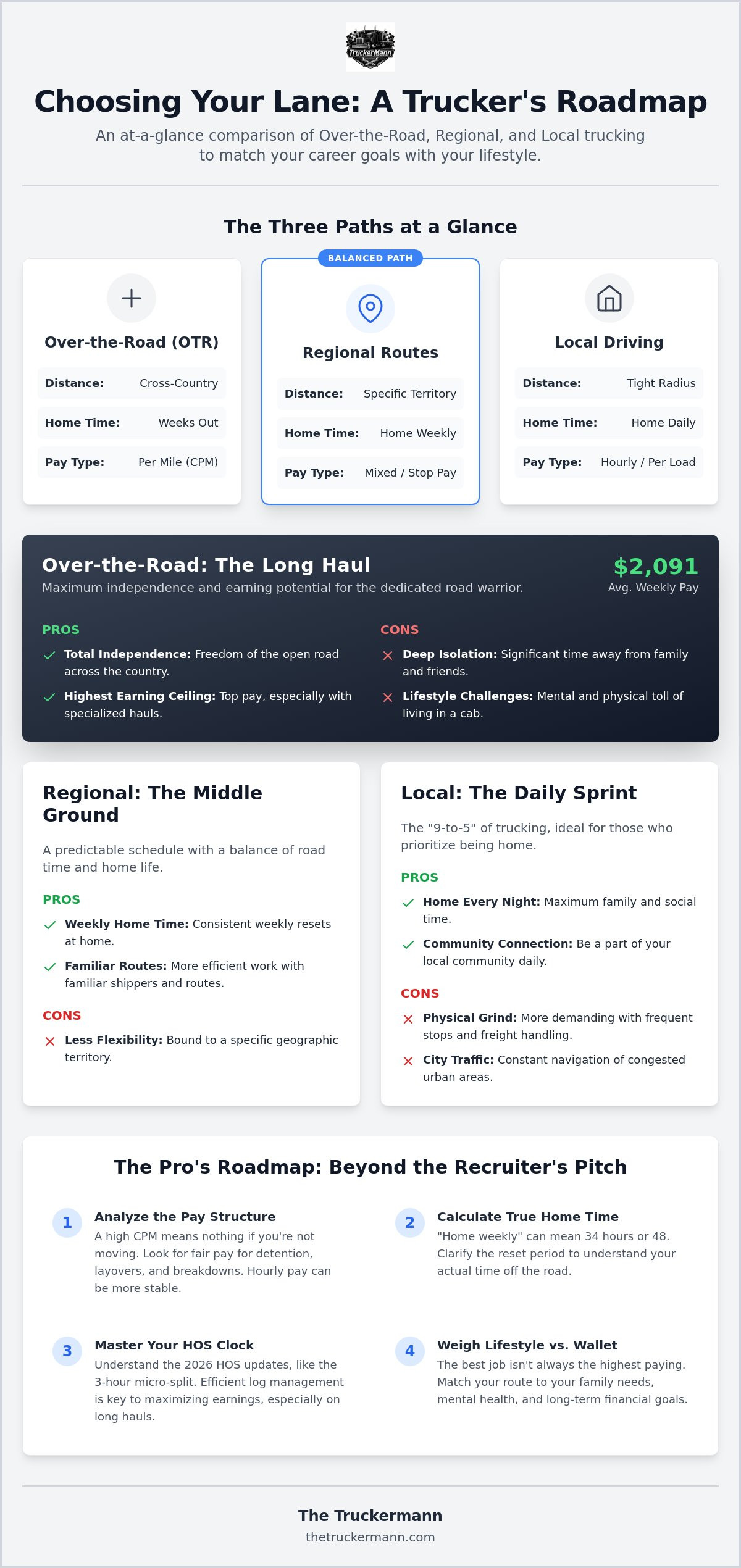
The core differences come down to three factors: distance, home time, and pay structure. Over-the-Road (OTR) is the long haul, taking you across the country for weeks at a time. Regional work keeps you in a specific territory, usually getting you home for your weekly reset. Local work is the daily sprint within a tight radius. Each path carries its own regulatory weight, often determining whether you’ll operate under interstate vs intrastate rules, which impacts everything from your medical certification to logbook requirements.
To better understand how these paths stack up against each other, watch this helpful video:
Defining the Three Main Paths
OTR is the life of the modern nomad. You’re living out of a sleeper berth, managing your clock to hit high-mileage targets. It’s the ultimate hustle for those who value independence. Regional routes offer a middle ground, keeping you within a specific geographic zone like the Midwest or Southeast. You’ll likely see familiar faces at shippers and receivers, making your life a bit more predictable. Local driving is often called the “9-to-5” of trucking, though it’s usually much longer. These different Types of truck drivers all face unique challenges, from the isolation of the open road to the physical demands of city traffic and freight handling.
Pay Structures Compared
Don’t just look at the gross number. OTR typically pays by the mile (CPM). This is great when the wheels are turning but hurts when you’re stuck in traffic. Regional jobs might offer a mix of CPM and stop pay. Local roles often lean toward hourly pay or a percentage of the load. Hidden factors like detention, layover, and breakdown pay can make or break your week. A high CPM doesn’t mean much if you’re sitting at a dock for six hours for free. Look for a package that compensates you for all your time, not just the miles on the odometer.
Over-the-Road
Living out of a sleeper berth isn’t just a job; it’s a grind that requires a specific kind of mental toughness. When you’re weighing otr vs regional vs local trucking jobs, the long haul represents the highest earning potential for those willing to stay out for weeks. Current July 2026 data shows OTR drivers are averaging about $2,091 per week. This isn’t easy money. You’re trading your presence at home for thousands of miles and the responsibility of managing a high-value rig across state lines. It’s the ultimate test of your ability to run a business on wheels.
Maximizing your paycheck in this sector depends on how well you master your clock. The 2026 HOS updates now allow for an optional 3-hour “micro-split” in the sleeper berth, meaning you can use a 6.5/3.5 split to stay productive during slow loading times or heavy traffic. To stay on the right side of the law while pushing your limits, you need a deep understanding of ELD compliance. If you aren’t managing your logs with precision, you’re leaving revenue on the table. This lifestyle also provides the best “schooling” for the national freight market, giving you a front-row seat to how capacity and rates shift across different regions.
Your cab is your office and your home, so your gear needs to be top-notch. Whether you’re hauling flatbed and need heavy-duty securement from Mytee Products or just need a reliable power inverter for your fridge, your equipment is your lifeline. According to official government data, the demand for tractor-trailer drivers remains steady, but only those with the right tools and mindset thrive in the long-haul environment.
Pros and Cons of OTR
- Independence: You have the freedom of the open road and the ability to choose your own path across the lower 48.
- Isolation: Missing family milestones is the biggest cost; the mental toll of being alone can be heavy.
- Pay: OTR typically offers the highest annual ceiling, especially for those who specialize in hazmat or oversized loads.
Managing the OTR Lifestyle
Health is your greatest asset on the road. Avoid the “truck stop diet” by prepping meals in your cab to stay sharp and energized. To keep your truck moving, use 123loadboard to identify high-paying freight lanes before you even deliver your current load. The 14-hour rule means you can’t drive past the 14th consecutive hour after coming on duty, so every minute spent waiting at a dock is a direct hit to your bottom line. For more veteran advice on mastering otr vs regional vs local trucking jobs, visit The Truckermann for the latest industry updates.
Regional Routes
If the long haul is a marathon and local work is a sprint, regional driving is your steady 10k. It’s the balance many veterans seek when choosing between otr vs regional vs local trucking jobs. You’re typically operating within a specific geographic zone, like the Midwest or Southeast, which means you’re home every weekend or at least every other weekend. It’s often called the “Goldilocks” zone. You get better pay than most local gigs and significantly more home time than the long-haul hustle. You’ll likely see the same shippers and receivers, allowing you to build rapport and learn the layout of every yard on your route.
Because you’re circling the same geographic hubs, you’ll find yourself crossing the same scales and inspection stations frequently. Law enforcement gets to know the local and regional fleets, which can sometimes lead to more frequent DOT inspections compared to an OTR driver who might only pass through a state once a month. Staying prepared is your best defense against downtime. Trucking remains a , but regional routes often provide the stability that keeps veterans in the seat longer. You aren’t just a number in a national database; you’re a familiar face in your region.
Regional Pay and Home Time
Your earnings in a regional role typically range from $55,000 to $85,000 annually. While your cents-per-mile might be a few ticks lower than a top-tier OTR driver, your efficiency often makes up the difference. You know the shortcuts, the best fuel stops, and exactly which docks are a nightmare to back into. However, the “reset” at home can be a double-edged sword. A 34-hour reset sounds like a long time, but once you handle chores, family obligations, and actual sleep, it’s often time to pre-trip the truck again. It’s more predictable than OTR, but it still demands a disciplined schedule to stay productive.
Equipment and Securement
Regional work often involves more than just pulling a dry van. If you’re in the flatbed sector, you’re constantly battling the elements to keep your load secure. You need high-quality trucking gear that won’t fail when you’re tarping a load in a Midwest sleet storm. Regional drivers need a more versatile tool kit than OTR because they face a wider variety of loading conditions and local weather shifts within a single week. Whether it’s heavy-duty chains or weather-resistant tarps, your equipment is what keeps you moving. Don’t let a cheap strap be the reason you’re sitting on the shoulder waiting for a service truck.
Local Driving: Home Every Night
The promise of sleeping in your own bed every night is the ultimate carrot for many drivers. When you’re weighing otr vs regional vs local trucking jobs, the local path looks like the most “normal” life you can have in this industry. But let’s be straight: home daily doesn’t mean you’re working a bank schedule. Local drivers often grind through 12 to 14-hour shifts, starting before the sun comes up to beat the morning rush. You’re trading the solitude of the open highway for the high-stress environment of city traffic and aggressive four-wheelers. It’s a different kind of mental and physical exhaustion.
The physical reality of local work is often much more demanding than long-haul. Whether you’re hauling food service, beverage crates, or intermodal containers, you’re likely doing more than just driving. You might be hand-unloading a 53-foot trailer with a ramp and a hand truck or navigating narrow alleyways that were never designed for a tractor-trailer. Because you’re making frequent stops, your equipment takes a beating. This is why a thorough CDL pre-trip inspection is non-negotiable. Stop-and-go city driving wears out brakes, tires, and couplings much faster than cruising at 80 mph on a qualifying Idaho interstate.
Pay structures for local roles typically shift away from cents-per-mile toward hourly rates or a set salary. Current 2026 data shows local drivers earning between $45,000 and $70,000 annually. The big advantage here is overtime. While OTR drivers are often exempt from overtime pay under the Fair Labor Standards Act, many local companies pay time-and-a-half after 40 hours. If you’re willing to put in the hours, your paycheck can rival a regional route without the need for a sleeper berth.
The Local Driver Lifestyle
Consistency is the biggest perk. You know your route, you know your customers, and you know where you’re sleeping. This routine allows for a much healthier diet since you have access to your own kitchen and fresh food rather than relying on truck stop rollers. However, you’ll need thick skin to deal with tight docks and the constant chaos of urban logistics. You’re the face of the company to the customer every single day, so your professional reputation is built on being on time, every time, regardless of traffic jams or weather.
Is Local Right for You?
Before you make the jump, evaluate your physical limits. Food service and LTL (Less-Than-Truckload) P&D (Pick-up and Delivery) require significant stamina. If you prefer a “no-touch” environment, look for local intermodal or dedicated shuttle runs. You can find these specific local opportunities by using 123loadboard to see who is moving freight in your immediate area. Local work keeps your career record sharp because you’re constantly honing your backing and maneuvering skills in tight spots. If you’re ready to trade the long haul for a local grind, check out our latest job search strategies to find a carrier that respects your home time.
Choosing Your Path: The Pro’s Roadmap
Picking the right lane in the otr vs regional vs local trucking jobs debate isn’t about finding a perfect company. It’s about auditing your own life. Do you need the high earnings ceiling of OTR, where top earners often clear $100,000 annually, or do you need the steady floor of an hourly local gig? You have to be honest about your tolerance for mental isolation versus physical grit. Some drivers thrive in the quiet of a three-week haul. Others would rather throw freight for 12 hours if it means seeing their kids at night. Your financial goals and family needs are the only metrics that actually matter.
The “Bridge Strategy” is a veteran move we see often. You start OTR to build a bulletproof resume and learn the national market. Once you’ve got the experience and have mastered the 2026 HOS updates, you leverage that into a regional role to get your weekends back. Finally, you transition to local work when you’re ready to hang up the sleeper berth keys for good. This progression allows you to maximize your earnings early on while preserving your sanity as your lifestyle needs evolve. It’s about playing the long game in an industry that often only looks at the next load.
Making the Transition
When you’re ready to switch, don’t just quit. Talk to your dispatcher with a clear plan. Show them your safety record and your efficiency numbers. If you’re moving from dry van to specialized flatbed or tanker to increase your value, use resources like DLA Academy to level up your skills before you make the jump. You’ll also need to audit your gear. Moving to a regional flatbed route might mean investing in higher-grade securement tools. A local P&D job requires a focus on ergonomic footwear and city-ready navigation tech. Being prepared makes the transition smoother and keeps your paycheck steady during the change.
Final Career Advice
The market is shifting. We’re entering a cycle where capacity is tightening and rates are climbing, making your expertise more valuable than ever. Stay vigilant about the rules that impact your livelihood, from the new sleeper berth splits to the 80 mph limits in Idaho. Being a professional means being a student of the industry, regardless of which otr vs regional vs local trucking jobs you choose. There is no single best job, only the best job for where you are in your life right now. Remember that you, not the company, are the one in control of your career path.
Master Your Next Career Move
The road ahead looks different for every driver, but the goal remains the same: maximizing your time and your paycheck. Whether you’re chasing the high potential of an OTR route or the consistency of a local run, your success depends on matching your gear and your strategy to the specific demands of the haul. We’ve broken down the core differences in otr vs regional vs local trucking jobs to help you move past the recruiter’s pitch and into a lane that actually fits your life.
Finding the right freight shouldn’t be a guessing game. Trusted by thousands of professional drivers, our community provides access to high-paying freight lanes nationwide and essential tools for logistics and securement. It’s the sentinel you need to keep your trailer full and your business growing. Find your next OTR, Regional, or Local load on 123loadboard and start earning what you’re worth. Take charge of your schedule and your future. You’ve got the grit and the experience; now it’s time to put them to work on your own terms.
Frequently Asked Questions
Does OTR trucking pay more than local?
OTR generally offers the highest gross pay because you’re trading your time for miles. While OTR averages can exceed $100,000 for specialized hauls, local drivers often benefit from hourly pay and overtime. When comparing otr vs regional vs local trucking jobs, look at your effective hourly rate. A local driver making $30 an hour with time-and-a-half after 40 hours can sometimes match an OTR paycheck without the sleeper berth lifestyle.
Is regional trucking better for families?
Regional routes offer more predictability than long-haul, but they aren’t a perfect family solution. You’ll usually be home for your 34-hour reset on weekends. This is a massive step up from being gone for three weeks, but you’re still missing dinner and school events during the week. It’s a solid choice for those who need a steady paycheck while maintaining a consistent presence at home every weekend.
Can I get a local trucking job with no experience?
It is possible, though many local carriers prefer at least a year of experience. City driving requires precise backing skills and patience with traffic that most rookies haven’t developed yet. Look for LTL (Less-Than-Truckload) companies with training programs. They often hire new CDL holders to work the dock and then move them into local P&D routes as they gain experience and prove their reliability.
What is the average home time for regional drivers?
Regional drivers typically see their families every five to seven days. Your home time is usually centered around the weekend to facilitate a full 34-hour restart. Some carriers offer “home weekly” guarantees, but this can depend on freight volumes in your specific geographic hub. It’s a structured routine that helps you plan your life better than the unpredictable schedule of a true long-haul nomad.
Do OTR drivers get paid for time spent sleeping?
No, you don’t get an hourly wage while you’re in the sleeper berth. OTR pay is almost exclusively based on the miles you drive. If the wheels aren’t turning, you aren’t earning. Some carriers provide layover pay if you’re stuck waiting for a load for more than 24 hours, but your primary income is generated while you’re active and moving freight across the country.
What are the main disadvantages of local trucking jobs?
The primary downsides are the physical labor and the grueling daily shifts. Local work isn’t just “no-touch” freight; it often involves unloading trailers in tight alleyways and fighting aggressive city traffic for 14 hours. You’re home every night, but you’re often too exhausted to do anything but sleep. It’s a high-stress environment that demands constant vigilance and significantly more physical stamina than long-haul driving.
How many miles do OTR drivers typically cover in a week?
A productive OTR driver usually covers 2,500 to 3,200 miles in a single week. Your total mileage depends on your ability to manage your clock and the efficiency of your dispatcher. When evaluating otr vs regional vs local trucking jobs, remember that OTR miles are your lifeblood. If you’re stuck in high-traffic regions or slow shippers, your weekly mileage and your paycheck will take a direct hit.
Disclaimer
The information provided on The TruckerMann is for general informational and educational purposes only. While every effort is made to ensure the accuracy and reliability of the content, trucking laws, FMCSA regulations, DOT requirements, safety standards, and industry policies can change at any time. Readers are encouraged to verify all information with official government agencies, professional advisors, or qualified industry professionals before making business, legal, financial, safety, or compliance-related decisions.
The content shared on this website reflects personal opinions, experiences, research, and commentary and should not be considered legal, financial, medical, tax, or professional advice. The TruckerMann and its owners, contributors, affiliates, or representatives are not responsible for any losses, damages, violations, penalties, or liabilities resulting from the use or misuse of information found on this website.
Some content on this website may contain affiliate links, sponsored content, or promotional material. This means we may earn a commission at no additional cost to you if you choose to purchase through certain links.
By using this website, you agree that you do so at your own discretion and risk.