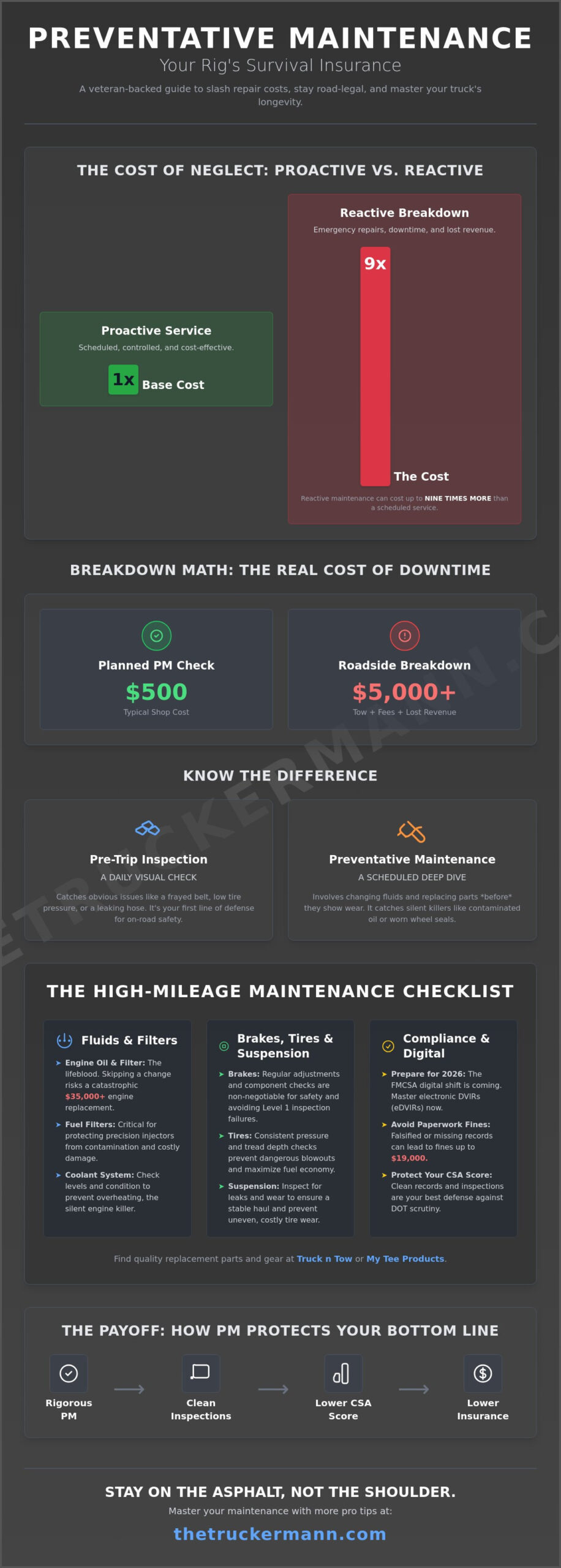
Did you know that reactive maintenance can cost you up to nine times more than a scheduled service? That’s the difference between a profitable quarter and a breakdown that leaves your rig sitting on the shoulder while your margins evaporate. We all know the sinking feeling of a flashing dash light or a Level 1 inspector finding a leak you missed during your pre-trip. It’s more than just a mechanical failure; it’s a direct hit to your livelihood and your peace of mind on those long-haul routes. You need a reliable preventative maintenance checklist for semi trucks that accounts for the grit of the road and the latest 2026 FMCSA digital compliance standards.
I understand the pressure of rising repair costs and the frustration of missing delivery windows because of a preventable glitch. That’s why I’ve put together this veteran-backed framework to help you master your rig’s longevity and avoid those $19,000 fines for falsified paperwork. We’re going to dive into the essential mechanical components that keep you road-legal, from brake adjustments to the new electronic DVIR requirements. By the end of this guide, you’ll have the tools to slash your long-term repair bills and ensure your truck stays out of the shop and on the asphalt where it belongs.
Key Takeaways
- Understand the “Breakdown Math” to see why proactive servicing is your strongest defense against the high costs of emergency roadside tows.
- Master a veteran-backed preventative maintenance checklist for semi trucks that targets the high-wear components most likely to trigger a Level 1 inspection failure.
- Navigate the 2026 FMCSA digital shift by learning how to integrate electronic inspection reports into your daily routine for maximum legal protection.
- Identify the specific DIY tools and lubricants every driver should carry to maintain equipment health and avoid preventable downtime between major services.
Why Preventative Maintenance is Your Rig’s Survival Insurance
Think of your truck as the heartbeat of your business. Preventative maintenance, or PM, is the proactive servicing of your tractor and trailer to stop equipment failure before it starts. It’s the difference between a controlled pit stop and a catastrophic engine blowout at 2:00 AM on a desolate stretch of asphalt. According to the American Trucking Associations, the industry is the backbone of the U.S. economy. Your rig is the tool that keeps it moving. When you follow a consistent preventative maintenance checklist for semi trucks, you aren’t just checking boxes. You are protecting the machine that feeds your family.
Let’s talk about Breakdown Math. A standard PM check might run you $500 at a shop you trust. Compare that to a $5,000 roadside tow, an emergency call-out fee, and the lost revenue from a missed load. The choice is clear. Beyond the immediate cash, regular maintenance preserves the resale value of your equipment. When it’s time to trade up, a stack of clean service records proves you respected the machine. To keep your rig in top shape, you can find the right supplies at Truck n Tow.
To better understand how maintenance keeps your operations profitable, watch this helpful video:
The Truckermann’s take is simple: PM is about respect. You wouldn’t ignore a family member’s health, so don’t ignore your truck’s. This machine works as hard as you do, and it deserves more than just the bare minimum to stay road-legal. It deserves a driver who listens to the engine and watches the gauges with a seasoned eye. Proper maintenance is a badge of professionalism in a field that demands the best from its equipment.
The Difference Between Pre-Trip and Preventative Maintenance
A pre-trip is a visual safety check. PM is a deep dive. While your pre-trip catches a frayed belt, a preventative maintenance checklist for semi trucks schedules that belt’s replacement before it ever shows signs of wear. You can find high-quality replacement parts and gear at My Tee Products to ensure you’re always prepared for these deeper service intervals. PM involves changing fluids, testing components under load, and catching the silent killers like contaminated gear oil or worn wheel seals that a simple walk-around will never reveal.
How PM Impacts Your CSA Score and Insurance Premiums
Roadside inspections are data collection points for the FMCSA. Every violation hits your CSA score, making you a target for more frequent stops and higher scrutiny. Clean inspections, fueled by rigorous PM, keep your score low and your insurance premiums manageable. Carriers and owner-operators with solid maintenance records often see lower rates. Underwriters view them as lower risks. It’s about staying off the radar of the DOT and staying in the good graces of your insurance provider. When you invest in your equipment, the industry notices.
The High-Mileage Semi Truck Maintenance Checklist: Fluids and Filters
Fluids are the silent workers that keep your rig from becoming a multi-ton lawn ornament. While some corporate guides suggest checking oil and coolant every 120 days, that’s a dangerous gamble when your livelihood is on the line. A real-world preventative maintenance checklist for semi trucks prioritizes frequent inspections because high-mileage diesel engines are notoriously unforgiving. You’re pushing 80,000 pounds through extreme temperature swings. Your oil isn’t just a lubricant; it’s a coolant and a cleaning agent that keeps the internal components from grinding themselves into scrap metal.
Engine oil and filter changes are the absolute lifeblood of your heavy-duty diesel engine. Skipping a service might save a few dollars today, but it invites an engine replacement that can cost up to $35,000. Fuel filters are just as critical. Injectors are precision instruments, and one tank of “dirty” or contaminated diesel can clog them, leading to rough idles or total power loss. Replace your fuel filters at every oil change or sooner if you’re hauling through regions with questionable fuel quality. If you need to stock up on filters or heavy-duty maintenance gear, My Tee Products offers a range of utility-focused equipment for the professional driver.
I’ve seen $30,000 engines toasted because of a $20 hose clamp that failed. Don’t let a minor leak in your coolant system turn into a catastrophic overheat. Check your coolant levels daily and inspect hoses for soft spots, cracks, or bulging. This heavy-duty truck maintenance guide from CCDET provides a technical breakdown of how these systems interact and why pressure testing is vital. Maintaining system integrity is the only way to ensure your engine survives the grueling 2026 summer hauling season.
Transmission and differential fluids are often the most neglected parts of a preventative maintenance checklist for semi trucks. You should monitor these for metal shavings or a distinct burnt smell, which indicates thermal breakdown. Catching these signs early can save you from a $10,000 transmission rebuild. It’s about being a sentinel for your machine. For more expert tips on keeping your business profitable and your rig on the road, check out The Truckermann’s preferred resources.
Monitoring Oil Quality: What Your Dipstick is Trying to Tell You
Your dipstick is a diagnostic tool, not just a level indicator. Black oil is normal in a diesel, but a milky residue means coolant is leaking into the system. If the oil feels gritty, you’re looking at metal or soot contamination. If you see bubbles, you might have an aeration issue that’s starving your bearings of lubrication. Listen to what the oil is telling you before it becomes a loud, expensive noise under the hood.
Air Filter Maintenance: Letting Your Turbo Breathe
Your turbocharger needs a massive volume of clean air to function. A clogged air filter forces the engine to work harder, killing your fuel economy and stressing the turbo components. Check the restriction gauge regularly. If it’s creeping into the red, swap the filter immediately. Keeping a spare filter from My Tee Products in your side box is a smart move for those dusty routes or construction site deliveries.
Brakes, Tires, and Suspension: Maintaining the Foundation of Your Haul
Tire management is about more than just avoiding a blowout. It’s about spotting the irregular wear patterns that scream suspension trouble. If you see cupping or one-sided wear, your shocks or kingpins are likely failing. Federal law requires 4/32 inch tread depth on steers and 2/32 inch on drives, but a veteran knows that running those limits in winter is a recipe for disaster. Keep a high-quality depth gauge from Truck n Tow in your pocket. It’s a small tool that prevents a massive headache at the scale house.
Your suspension and steering components are the silent heroes of a smooth ride. Inspect your leaf springs for cracks and check your kingpins for any vertical play. If your steering feels loose, your tie rod ends might be on their way out. Don’t forget the fifth wheel. Articulation is everything when you’re backing into a tight dock. Apply fresh grease from My Tee to the plate and jaws to prevent “binding” during sharp turns. A dry fifth wheel isn’t just noisy; it’s a safety hazard that can affect your steering geometry.
Tire Pressure Monitoring: The Secret to Fuel Efficiency
Underinflated tires are the fastest way to burn through your profit margins. Even a few PSI low can increase rolling resistance and kill your fuel economy. Use a digital gauge to check pressures when the tires are cold. If you’re looking for heavy-duty inflation tools, My Tee provides reliable options that stand up to the rigors of the road. Consistent monitoring is a simple habit that pays for itself at the fuel pump.
Air Brake System: Bleeding Tanks and Checking the Dryer
Moisture is the enemy of your air valves. Even with modern air dryers, you should pull your tank drains daily to check for water or oil. If you see oil, your compressor is bypassing. If you see water, your dryer cartridge is cooked. Replacing that cartridge is a simple step on any preventative maintenance checklist for semi trucks that prevents frozen lines in the winter. You can find replacement cartridges and air system components at My Tee to keep your system bone-dry and responsive.
Essential Gear for DIY Maintenance: Tools Every Driver Should Carry
A solid preventative maintenance checklist for semi trucks is just a piece of paper if you don’t have the iron to back it up. Relying solely on a shop means you’re at the mercy of their schedule and their attention to detail. A seasoned driver knows that the best way to ensure a job is done right is to have the right gear on hand. For those specializing in recovery or heavy-duty upfitting, sourcing genuine components from Tim Halpin Equipment Corp ensures your truck equipment is built to last. Whether you’re greasing the fifth wheel or checking for loose bolts after a rough haul, your tool kit and your choice of parts are your first line of defense against the road’s volatility.
Start with a high-quality grease gun and professional-grade lubricants. Keeping the chassis and u-joints moving smoothly isn’t just about reducing noise; it’s about preventing the friction that leads to metal fatigue. You also need a reliable digital tire pressure gauge and a metal tread depth tool. These aren’t optional. They are the only way to get the accurate readings required to stay compliant and fuel-efficient. For inspecting those hard-to-reach undercarriage components, a high-lumen LED flashlight and a telescoping mirror are essential. They let you spot hairline frame cracks or hidden air leaks that a quick walk-around would miss.
Cargo securement is another area where you can’t afford to cut corners. Heavy-duty checks require gear that won’t snap under tension. I always recommend using reliable equipment from My Tee Products to ensure your load stays exactly where you put it. If you want to keep your business moving with the best loads available, check out The Truckermann’s top loadboard choice. Proper tools give you the ability to identify issues before they become expensive roadside failures.
The Roadside Repair Kit: What to Keep in Your Side Box
Your side box should be more than a junk drawer. It needs to be a survival kit. Include a full set of spare fuses, extra pigtail seals, and a variety of heavy-duty zip ties. A basic set of combination wrenches and a multi-bit screwdriver can handle the majority of minor roadside issues. Don’t forget a bottle of penetrating oil for those stubborn, rusted bolts. Having these on hand can turn a potential tow into a five-minute fix that keeps your clock running.
Upgrading Your Securement: Why My Tee Products Tarps and Straps Last Longer
Cheap straps fray and cheap tarps rip when the wind starts howling at highway speeds. The gear from My Tee Products is built for the actual grit of the field, not just for looking good on a shelf. Their straps use a tighter weave that resists abrasion, and their tarps are reinforced at the high-stress points. When you invest in My Tee Products, you’re buying peace of mind that your securement will hold up through the worst weather the interstate can throw at you.
Compliance and Records: Turning Maintenance into DOT Protection
When a DOT officer steps up to your window, they aren’t just looking at your lights; they’re looking for a reason to dig deeper. Your preventative maintenance checklist for semi trucks is your strongest legal shield during these encounters. A well-organized maintenance file tells the inspector that you are a professional who respects the regulations and the machine. If you can produce a clean, chronological history of repairs, you often set a tone of compliance that can mitigate minor fines or even shorten the duration of a DOT inspection level 1 checklist event.
The 2026 roadside environment has shifted heavily toward digital verification. As of February 2026, the FMCSA officially recognizes electronic Driver Vehicle Inspection Reports (DVIRs) as the gold standard. In fact, if you’re still using paper logs and they become illegible due to grease or rain, they are now legally treated as “missing documents.” This carries much higher penalties than before. Integrating your daily DVIR with your broader PM schedule ensures that a small leak noted on Monday becomes a documented repair on Tuesday, closing the loop that inspectors love to scrutinize. For the parts and securement gear needed to fix those noted defects, I always turn to My Tee Products for reliable replacements.
Smart scheduling is the final piece of the profitability puzzle. You don’t want to be hunting for a shop while you’re under a high-value load. Use tools like 123Loadboard to find freight that ends near your preferred service center. This strategy minimizes deadhead miles and allows you to schedule your next preventative maintenance checklist for semi trucks during planned downtime. It turns a mechanical necessity into a calculated business move that keeps your wheels turning and your revenue climbing.
The CVSA Roadcheck: Why Your PM Schedule is Your Best Defense
Record Keeping for Owner-Operators: Tax Benefits and Legal Safety
For the owner-operator, records are about more than just the DOT. Every dollar spent on maintenance is a tax-deductible business expense that lowers your year-end liability. Keep every receipt for parts from My Tee Products and every invoice from the lube pit. Beyond taxes, these records are your primary defense in a legal event, proving that you maintained your equipment to the highest possible standard. It’s not just paperwork; it’s your business’s insurance policy.
Mastering the Road Through Preparedness
Your rig is more than just a truck; it’s the engine that secures your family’s future. We’ve covered why staying ahead of the “Breakdown Math” is critical and how the 2026 digital compliance shift makes precise record-keeping non-negotiable. By following a strict preventative maintenance checklist for semi trucks, you’re choosing to be a professional who masters the road rather than a victim of it. You’ve learned to listen to your dipstick, monitor your air system, and treat your securement gear with the respect it deserves. These habits separate the veterans from the rookies when the DOT starts looking for violations at the scale house.
Now it’s time to put that knowledge into action and protect your livelihood. If you’re ready to upgrade your maintenance gear, you should consider the high-durability gear for long-haul conditions found at My Tee Products. As a trusted affiliate partner of The Truckermann, My Tee Products is recommended by professional drivers across the country for its reliability in the field. Shop My Tee Products for professional-grade trucking equipment and stay road-ready. Stay vigilant, keep your tires aired, and keep your eyes on the horizon. I’ll see you out there on the asphalt.
Frequently Asked Questions
How often should a semi truck have preventative maintenance?
You should schedule a preventative maintenance check every 10,000 to 25,000 miles, depending on your duty cycle and manufacturer requirements. Heavy-haulers or rigs frequently idling in city traffic should stick to the shorter end of that range. Consistent intervals are the foundation of a reliable preventative maintenance checklist for semi trucks that keeps your business profitable and your rig out of the shop.
What is included in a standard PM Level A service?
A Level A service, often called a “dry service,” focuses on safety and lubrication without performing a full oil change. This service includes a comprehensive chassis grease, checking all fluid levels, inspecting belts and hoses, and testing the entire lighting system. It is a critical mid-interval check that allows you to catch minor issues like frayed wires or leaking wheel seals before they trigger a roadside failure.
Can I perform my own preventative maintenance as an owner-operator?
Yes, you can certainly perform your own maintenance as long as you keep detailed, dated records for compliance. Doing the work yourself helps you bond with the machine and spot subtle performance changes that a busy shop technician might miss. Just ensure you use professional gear from My Tee Products, such as high-quality grease guns and digital gauges, to ensure your DIY work meets the highest industry standards.
How many miles can a semi truck go between oil changes in 2026?
Most modern Class 8 trucks in 2026 can safely go 30,000 to 50,000 miles between oil changes when using high-quality synthetic lubricants. However, older engines or those operating in extreme temperatures should stick to 15,000 to 20,000 mile intervals to prevent sludge buildup. It is always a smart move to use oil analysis to determine the exact health of your engine before pushing these mileage limits.
What are the most common maintenance items that cause DOT violations?
Inoperative lights, underinflated tires, and brakes out of adjustment are the most frequently cited mechanical violations during roadside inspections. These items are easily identified with a preventative maintenance checklist for semi trucks during your daily pre-trip and post-trip routines. Missing periodic inspection paperwork is another common trap, so ensure your digital maintenance files are always updated and accessible to avoid unnecessary fines.
Is there a difference between tractor and trailer maintenance schedules?
Tractors require more frequent mechanical attention due to the complexity of the drivetrain, while trailer maintenance focuses primarily on tires, brakes, and structural integrity. Trailers often follow a time-based schedule, such as a deep inspection every six months, whereas tractors are strictly mileage-based. Don’t neglect trailer securement points; using high-durability straps from My Tee Products helps prevent cargo-related safety issues during long hauls.
How do I choose the best grease for my fifth wheel and chassis?
Look for a lithium-complex grease with an NLGI Grade 2 rating and “extreme pressure” (EP) additives for the best protection. This type of grease is designed to stay in place under high loads and resists water washout during heavy rain or snow. Using the correct lubricant ensures your articulation points stay smooth and prevents the metal-on-metal grinding that leads to premature wear and expensive component failure.
What should I do if I find a major issue during a mid-trip PM check?
You must stop immediately and address the defect before it results in a safety hazard or an out-of-service violation. If you discover a securement issue, swap out worn components for fresh, reliable gear from My Tee Products to get back on the road safely. Continuing to drive with a known major mechanical fault risks your CDL and the safety of everyone sharing the highway with you.
Disclaimer
The information provided on The TruckerMann is for general informational and educational purposes only. While every effort is made to ensure the accuracy and reliability of the content, trucking laws, FMCSA regulations, DOT requirements, safety standards, and industry policies can change at any time. Readers are encouraged to verify all information with official government agencies, professional advisors, or qualified industry professionals before making business, legal, financial, safety, or compliance-related decisions.
The content shared on this website reflects personal opinions, experiences, research, and commentary and should not be considered legal, financial, medical, tax, or professional advice. The TruckerMann and its owners, contributors, affiliates, or representatives are not responsible for any losses, damages, violations, penalties, or liabilities resulting from the use or misuse of information found on this website.
Some content on this website may contain affiliate links, sponsored content, or promotional material. This means we may earn a commission at no additional cost to you if you choose to purchase through certain links.
By using this website, you agree that you do so at your own discretion and risk.