In 2026, a load board isn’t just a digital bulletin board; it’s the primary weapon you use to defend your bottom line against $4.668 per gallon diesel. You’re out there every day dealing with the grit of the road, so you know that the difference between a profitable week and a losing one often comes down to the data on your screen. Finding the top load boards for owner operators is no longer about just seeing what’s available. It’s about spotting the high-paying lanes before the ‘ghost loads’ and non-paying brokers eat your margins alive.
I get it. You’re likely tired of the subscription fatigue from having ten different apps open while trying to manage your ELD and fuel costs. You want to maximize your rate per mile and keep those deadhead miles to a minimum without getting burned by a broker who lacks financial responsibility. This veteran-led guide is designed to help you navigate the 2026 market with confidence. We’ll dive into the latest pricing for DAT and Truckstop, explore the new FMCSA rules on broker transparency, and show you how to turn your load board into the brain of your entire operation. It’s time to stop just surviving the spot market and start mastering it.
Key Takeaways
- Learn to navigate the 2026 spot market by leveraging real-time Rate Per Mile (RPM) data to negotiate harder against low-ball broker offers.
- Compare the top load boards for owner operators to find the right balance between subscription costs and the high-quality freight data needed to stay profitable.
- Discover why specialized niche boards and direct-to-carrier apps are becoming essential for drivers pulling flatbeds or refrigerated units.
- Build a resilient 2026 tech stack by integrating your load board with your ELD for smarter HOS planning and fewer empty miles.
- Use verified broker credit data to avoid non-payment risks and ensure every mile you run actually puts money in your pocket.
The 2026 Freight Landscape
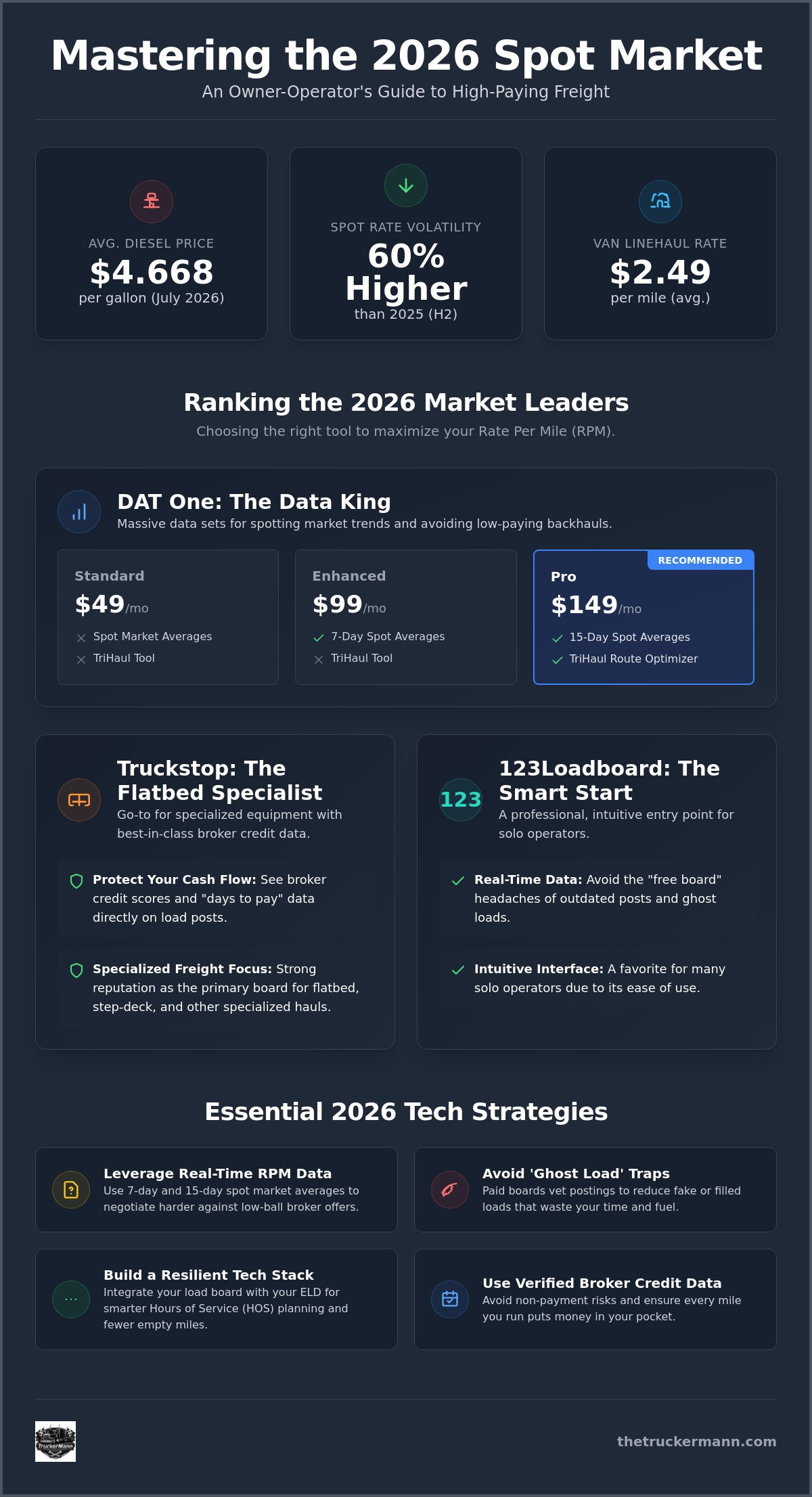
You’re feeling the squeeze at the pump with national diesel prices averaging $4.668 per gallon as of July 2026. In this environment, every mile counts. A load board is no longer just a digital list of phone numbers; it’s a sophisticated freight exchange that serves as the command center for your truck. In 2026, the industry has moved away from manual searching toward AI-driven automated matching. This means the top load boards for owner operators now use predictive analytics to send push notifications for high-paying loads before they even hit the public screen. At The Truckermann, we view your load board as your primary business intelligence tool. If you aren’t using one that offers real-time data, you’re essentially flying blind in a storm.
To better understand how these platforms have evolved to help you stay profitable, watch this helpful video:
Spot Market vs. Contract Loads
The 2026 freight market is defined by massive shifts. Truckload spot rates in the second half of this year are approximately 60% higher than the same period in 2025. This volatility makes the spot market incredibly attractive for owner-operators who value flexibility. While big fleets chase steady contract freight, you have the agility to pivot where the money is. However, there’s a danger in “chasing the rate” without a strategy. With van spot linehaul rates averaging around $2.49 per mile, you need a data-backed plan to ensure you aren’t deadheading into a dead zone. The right board helps you see where the freight is moving next so you can stay in the high-demand lanes.
Why Free Boards Aren’t Free
It’s tempting to save a few bucks on a free board, but the hidden costs are brutal. Free platforms are often cluttered with outdated data and ghost loads. Ghost loads are fake or already-filled postings that brokers leave up to collect carrier data or manipulate market rates, and they waste your precious time and fuel every time you call on them. Paying for a subscription is a direct investment in your business survival. High-quality boards offer better vetting and transparency, especially since new rules effective January 16, 2026, increased financial responsibility requirements for brokers. If you’re looking for a professional start without breaking the bank, 123Loadboard offers a solid entry point that provides real-time data without the “free board” headaches. Using a professional tool ensures you get paid for the work you do.
Ranking the 2026 Market Leaders
The competition on the road is fiercer than ever. When you look at the current state of the owner-operator workforce, it’s clear that nearly a million self-employed pros are vying for the same high-paying lanes. To win, you need a tech stack that refreshes faster than your competition can hit ‘dial.’ In the current 2026 market, the “Big Three” platforms continue to dominate the space by offering varying levels of depth, speed, and broker transparency. Choosing between them isn’t just about the monthly fee; it’s about which tool fits your specific equipment and lane strategy. If you’re looking for a balance of power and ease of use, I recommend checking out 123Loadboard for its intuitive interface, which has become a favorite for many solo operators this year.
DAT One: The Data King
DAT remains the heavyweight champion for a reason. Their data sets are massive, and in 2026, their TriHaul tool is a lifesaver for avoiding low-paying direct backhauls. Instead of taking a cheap load home, TriHaul suggests a three-legged route that can significantly boost your total revenue. For the single-truck operator, the $149 per month Pro tier is often the sweet spot. It gives you access to 7-day and 15-day spot market averages, allowing you to see exactly what brokers are actually paying on a lane before you ever pick up the phone. Don’t settle for the $49 Standard tier if you’re serious about negotiating; the Enhanced ($99) or Pro ($149) tiers provide the market transparency you need to call out low-ball offers.
Truckstop: The Flatbed Specialist
If you’re pulling a deck, Truckstop is likely your primary home. They’ve built a reputation as the go-to for specialized equipment, and their broker credit reporting is second to none. In a year where broker financial responsibility is under the microscope, seeing “days to pay” data and credit scores directly on the load post is vital for your cash flow. Their pricing reflects this premium service, with the Carrier Pro tier sitting at $159 per month. Remember, having proper flatbed gear and a reputation for securement makes you more attractive to the high-end brokers who frequent this board. It’s a professional environment where quality equipment meets quality freight.
123Loadboard: Best Value for O/Os
For many new owner-operators, 123Loadboard is the most logical entry point. It’s affordable, with tiers ranging from $39 to $79 per month, but don’t let the lower price fool you. Their ‘Load Planner’ is an excellent tool for minimizing deadhead by mapping out your next three moves in advance. They’ve also done a great job integrating factoring and fuel card features directly into the app, which streamlines your back-office work while you’re focused on the road. It’s a straightforward, driver-centric platform that doesn’t overwhelm you with corporate fluff. If you want to keep your overhead low while still accessing top load boards for owner operators, this is a strong contender. You might find that starting with a focused platform gives you exactly what you need without the subscription fatigue of the larger data giants.
Niche Boards for Specific Hauls
General boards are great for finding volume, but if you’re pulling a step-deck or a lowboy, the big platforms can sometimes feel like searching for a needle in a haystack. Shippers with high-value or oversized cargo often bypass public boards entirely to avoid the noise and find specialized experts. This shift is why many pros are preparing the trucking workforce for the future by adopting direct-to-carrier portals. These private platforms provide a direct line to the freight, often cutting out the broker margin. I recommend a hybrid approach. Keep one of the top load boards for owner operators for your daily bread, then layer on a niche board to find the specialized hauls that actually pay for your specialized equipment.
Be vigilant when stepping away from the big names. Smaller, unvetted boards are often breeding grounds for double-brokering scams. These ‘re-brokers’ take a legitimate load, post it as their own, and then vanish with the payment after you’ve already burned the fuel. Always verify the broker’s MC number and check their credit history before you sign a rate confirmation on a niche platform.
Flatbed and Oversize Boards
Heavy-haul and flatbed logistics require more than just a trailer; they require a high level of securement expertise. Specialized boards for these hauls cater to shippers who need RGNs, extendables, or multi-axle setups. Because these loads often come with high liability and strict DOT requirements, your reputation is your currency. Before you even think about bidding on a heavy-haul load, you need to ensure your equipment and your knowledge are up to the task. This includes mastering pre-trip inspections to avoid a costly roadside violation that could tank your safety rating. Premium brokers on these niche boards look for carriers who treat securement as a craft, not just a job.
Reefer and LTL Opportunities
The 2026 “cold chain” demand is at an all-time high, making reefer-specific boards incredibly valuable. If you’re pulling a refrigerated unit, you can often find better-paying freight on boards that specialize in perishables and pharmaceuticals. Additionally, LTL-specific boards are a gold mine for owner-operators looking to fill extra space. If you have ten feet of deck space left, finding a “partial” load can turn a mediocre run into a highly profitable one. We’ve also seen a massive rise in the role of load boards for hotshots in 2026. These platforms are perfect for smaller setups that can move expedited freight quickly without the overhead of a Class 8 rig. Balancing these opportunities allows you to keep your trailer full and your RPM high.
Avoiding the Cheap Freight Trap
You have heard it at every truck stop: load boards are just a race to the bottom. If you believe that, you’re leaving money on the table. In 2026, the top load boards for owner operators are no longer just lists of freight; they’re high-powered negotiation tools. The “cheap freight” you see is often just a starting bid from a broker testing the waters. If you don’t have the data to push back, you’ll end up hauling a load that barely covers your $4.668 per gallon diesel costs. Success in this market requires you to move from being a “driver” to a “data analyst” who happens to own a truck.
The “Power of No” is your greatest asset. You must know your exact operating cost per mile before you even log in. If the van spot linehaul average is $2.49 per mile but a broker offers you $1.80, you aren’t just taking a “low” rate; you’re paying for the privilege of moving their freight. Use the 7-day and 15-day lane averages provided by your board to counter-offer with confidence. When you back up your price with real-world market data, professional brokers listen. They want reliable carriers who know their worth. To sharpen your professional edge and stay profitable, invest in your business education today.
The Art of Negotiation
Negotiation is a soft skill that pays hard cash. When you call on a load, don’t just ask if it’s still available. Start by highlighting your reliability. Mention your perfect safety score and your total ELD compliance. This tells the broker you won’t have service failures. If the rate is low, try this: “I see the 7-day average for this lane is $2.50, but you’re posted at $2.10. My truck is empty and ready to roll, but I need to be closer to that market average to make the numbers work. What can we do?” You’ll often find that brokers have more “wiggle room” for carriers they can trust to deliver on time.
Vetting Brokers in 2026
New rules effective January 16, 2026, have increased broker financial responsibility, but you still need to be vigilant. Never take a load from a broker with a “days to pay” rating over 30 or a credit score that’s trending downward. A high-paying load is worth zero dollars if the check never arrives. Look for red flags in load descriptions, such as vague pickup locations or contact emails that don’t match the company domain. These are often signs of double-brokering scams. In this digital age, the “verbal handshake” still matters. If a broker sounds evasive or won’t give you a straight answer about the shipper, keep scrolling. There’s always another load, but you only have one business to protect.
Building Your 2026 Tech Stack
Your truck is a rolling data center. While we’ve spent time dissecting the top load boards for owner operators, you have to remember that the board is only the brain of the operation. To move the freight and keep the profit, you need a complete tech stack that talks to itself. Integrating your load board with your ELD isn’t just a convenience; it’s a necessity for seamless HOS planning in 2026. When your load board knows exactly how many hours you have left before you even bid on a lane, you stop making promises your logs can’t keep. This level of transparency is exactly what premium brokers are looking for in this high-stakes market. It’s about being prepared before the wheels even turn.
The Truckermann’s ‘Starter Pack’ for 2026 success isn’t just about software. It’s about the synergy between your digital tools and your physical readiness. Being ‘Inspection Ready’ is a daily discipline that keeps your insurance rates low and your uptime high. If you’re constantly fighting equipment violations, the best load board in the world won’t save your margins. You need to treat your compliance and your tech as two sides of the same coin.
Compliance as a Profit Center
Brokers in 2026 are more risk-averse than ever. They aren’t just looking for a trailer; they’re looking for a carrier with a clean DOT Level 1 Inspection history. Your safety rating is effectively your ‘business credit score’ on most major platforms. If your inspections are messy, your visibility on the board drops. High-end ELD systems that offer transparent tracking make you a preferred partner for big shippers who value reliability over the lowest bid. When you maintain a solid safety record, you aren’t just avoiding fines; you’re actively opening doors to the most profitable freight in the country.
The Truckermann’s Final Word
Mastery is the goal. Whether you choose the massive data depth of DAT, the specialized flatbed focus of Truckstop, or the streamlined value of 123Loadboard, the choice should align with your specific lane strategy. This profession is a lifestyle of constant improvement. You don’t just survive the road; you master it by using the best tools available and staying vigilant about market shifts. My recommendation is simple: pick the board that fits your equipment, keep your securement gear top-notch, and never stop watching the data. Ready to take the next step? Go ahead and sign up for 123Loadboard today and start hauling smarter. The road is waiting, and with the right tech in your cab, you’re the one in the driver’s seat.
Master the 2026 Market
It’s time to stop second-guessing your rate per mile and start using tools designed for the modern road. Over 325,000 professionals already rely on these systems for their mobile-first design and integrated rate checks. This technology ensures you keep your trailer full while protecting your cash flow from non-paying brokers. You deserve a partner that watches your back while you watch the road.
Start your 123Loadboard trial and find better freight today. The road is tough, but you’re tougher when you have the right data in your cab. Keep your head up and your eyes on the numbers. We’ll see you out there.
Frequently Asked Questions
Which load board is best for new owner-operators in 2026?
123Loadboard is the most practical choice for new owner-operators because it balances professional features with a driver-friendly price point. It provides essential tools like integrated factoring and a load planner that helps you minimize deadhead miles while you’re still learning the market. Many drivers find that starting here allows them to build a solid foundation before moving into the more expensive, data-heavy tiers of other platforms.
Can I find direct shippers without using a load board?
You can certainly find direct shippers by cold calling local manufacturers or using private direct-to-carrier portals that many big shippers launched in early 2026. While these relationships offer better margins and steadier freight, they require a significant time investment to build. Most successful owner-operators use a hybrid approach, keeping a load board active to fill gaps while they work on securing long-term direct contracts.
How much should I expect to pay for a quality load board subscription?
Expect to invest between $39 and $159 per month depending on the level of data you need to run your business. Basic tiers for the top load boards for owner operators start around $40, but these often lack the real-time rate data and broker credit scores you need to stay safe. If you’re serious about negotiating, the professional-grade tiers at the $149 to $159 mark are usually the best investment for your bottom line.
Is it worth having multiple load board subscriptions at once?
Having two subscriptions is a smart move if you’re running high-volume lanes or specialized equipment like flatbeds. Many veterans run DAT for its sheer volume of freight while keeping a second account with Truckstop or 123Loadboard for better niche opportunities. If that second board helps you find just one load with a $0.20 per mile better rate, it has paid for its own subscription ten times over.
What is the most common scam on load boards today?
Double-brokering is the most frequent scam you’ll encounter, where a fake broker steals a load from a legitimate company and re-posts it to collect your data or the shipper’s payment. Always cross-reference the broker’s MC number and check their credit history against the new 2026 financial responsibility standards. If a load seems too good to be true or the contact info doesn’t match the company domain, keep your truck moving.
How do I calculate my break-even rate per mile?
Calculate your break-even by adding your fixed monthly costs to your variable expenses, including diesel at the current $4.668 national average, and dividing by your total miles. You must include your own salary and a maintenance reserve in this math. If you don’t know this number to the penny, you’re just guessing at your profit every time you accept a rate confirmation from a broker.
Do load boards offer freight for hotshot truckers?
Load boards have fully embraced the hotshot market in 2026, offering dedicated filters for smaller setups and LTL freight. Platforms like Truckstop and 123Loadboard are especially useful for hotshots because they specialize in the partial loads and expedited freight that these agile rigs handle best. It’s a great way to keep a smaller trailer profitable by stacking multiple partials into one high-paying trip.
How does AI impact load matching on boards in 2026?
AI has transformed load matching from a manual search into a predictive “push” system that alerts you to freight before it’s even posted publicly. These algorithms analyze your previous lanes, your current HOS status, and market trends to suggest loads that fit your operation perfectly. This technology saves you hours of scrolling and helps you secure the best-paying freight in a competitive market where every second counts.
Disclaimer
The information provided on The TruckerMann is for general informational and educational purposes only. While every effort is made to ensure the accuracy and reliability of the content, trucking laws, FMCSA regulations, DOT requirements, safety standards, and industry policies can change at any time. Readers are encouraged to verify all information with official government agencies, professional advisors, or qualified industry professionals before making business, legal, financial, safety, or compliance-related decisions.
The content shared on this website reflects personal opinions, experiences, research, and commentary and should not be considered legal, financial, medical, tax, or professional advice. The TruckerMann and its owners, contributors, affiliates, or representatives are not responsible for any losses, damages, violations, penalties, or liabilities resulting from the use or misuse of information found on this website.
Some content on this website may contain affiliate links, sponsored content, or promotional material. This means we may earn a commission at no additional cost to you if you choose to purchase through certain links.
By using this website, you agree that you do so at your own discretion and risk.