Chaining isn’t a chore; it’s a calculated tactical maneuver that separates professional drivers from amateurs. You’ve likely stood on the shoulder of I-70 in a sub-zero blizzard, hands numb and heart racing, wondering if those links are actually going to hold or if they’re about to tear your wheel well to pieces. It’s a common anxiety, especially with Colorado law enforcement issuing over 1,300 citations for “Must Carry” violations during the last season alone. Learning how to properly chain up a semi truck is about more than just avoiding a $1,000 fine for blocking the roadway. It’s about the pride of knowing your rig is secure when the mountain passes turn into ice rinks.
You deserve the confidence to navigate snowy passes without the constant worry of DOT inspectors or equipment failure. This veteran’s guide for 2026 is designed to help you master the art of “throwing iron” with professional precision. We’ll walk you through a step-by-step installation process that ensures your chains stay tight and your truck stays moving. From understanding the specific 2026 requirements in states like Oregon and Washington to the physical hacks that save your energy in the cold, you’re about to gain the expertise needed to handle any winter corridor with ease.
Key Takeaways
- Stay ahead of the DOT by mastering the 2026 “must-carry” mandates for mountain corridors in Colorado and the Pacific Northwest.
- Choose the right iron for your route, whether you need singles or triples from My Tee Products to handle heavy-duty traction.
- Learn the “Drape and Drive” method to understand how to properly chain up a semi truck without tangling your links or damaging your wheel wells.
- Protect your rig by using a proper bungee pattern from Truck n Tow and performing the critical quarter-mile tension check.
- Know exactly when to throw iron and when to park it, including why you should never exceed 30 MPH once you’re chained up.
Understanding Chain Laws and Winter Safety Requirements
Chain laws aren’t just bureaucratic red tape; they are survival mandates written in the hard-earned lessons of drivers who got stuck before you. These regulations shift from state to state because the geography of the Rockies demands a different level of grit than the Cascades. Understanding how to properly chain up a semi truck begins with knowing when the law requires you to have that iron on board. If you roll into a chain control zone without the proper equipment, you aren’t just risking a ticket. You’re likely triggering a full The Ultimate DOT Inspection Level 1 Checklist: 2026 Driver’s Guide, as officers often view poor winter prep as a sign of broader maintenance neglect. High-quality snow chains are your ticket to staying moving when the road turns white.
To better understand this concept, watch this helpful video:
The 2026 State-by-State Mandatory Carry Dates
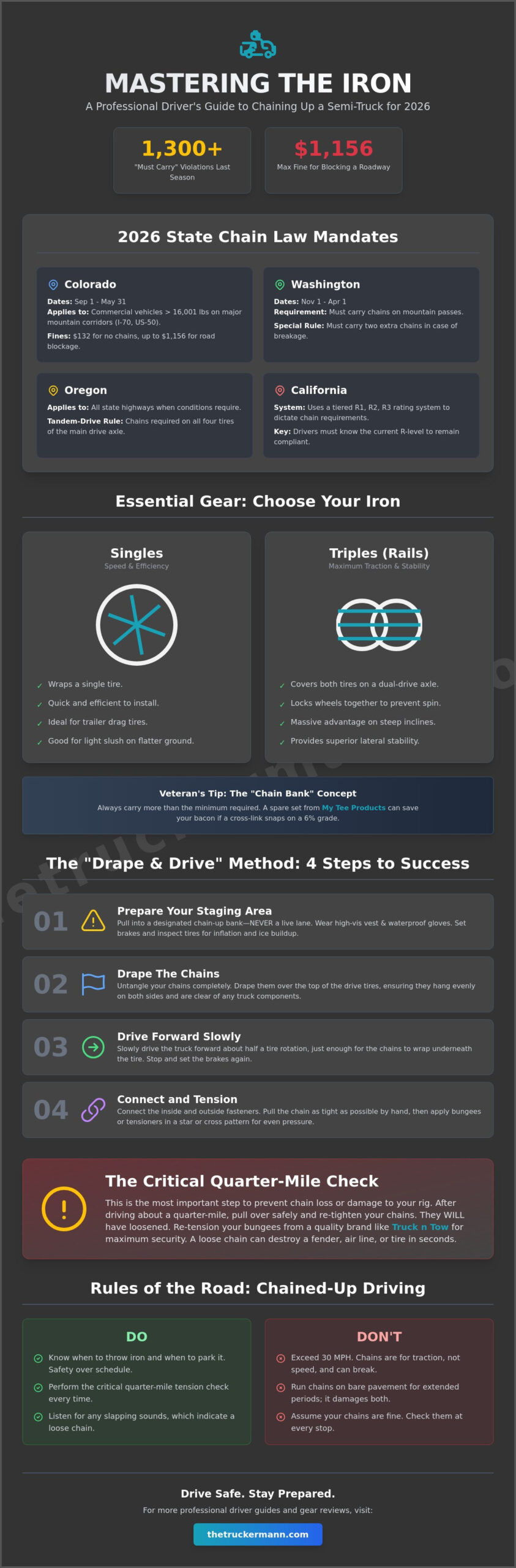
State DOTs have become more aggressive with enforcement as of June 2026. In Colorado, the “Must Carry” law spans from September 1 through May 31 for all commercial vehicles over 16,001 lbs. This applies to I-70 and several other mountain corridors like US-50 and US-160. If you’re caught without them, expect a $100 fine plus a $32 surcharge. If you block the road because you didn’t chain up, that penalty jumps to $1,156 including surcharges. Washington state requires you to carry chains from November 1 to April 1 on mountain passes. They specifically mandate carrying two extra chains in case of breakage. Oregon and California use tiered systems. While California uses R1 through R3 ratings to dictate when you must throw iron, Oregon’s law applies to all state highways. A tandem-drive tractor in Oregon must have chains on all four tires of the main drive axle to stay compliant.
Safety First: Preparing Your Staging Area
Before you ever touch a link, you need a plan. Veteran drivers use the “Chain Bank” concept, which means carrying more than the minimum required set. Having a spare pair of singles from My Tee Products can save your life if a cross-link snaps on a 6% grade. Always pull into a designated chain-up bank. Never try to chain up in a live travel lane; the spray from passing traffic limits visibility and creates a lethal environment. Put on your high-visibility vest and waterproof gloves before stepping out. Set your tractor and trailer brakes, then do a quick perimeter walk. Ensure your tires are properly inflated and clear of heavy ice buildup. This is the foundation of how to properly chain up a semi truck safely and efficiently.
Essential Gear: Selecting the Right Chains for Your Rig
Choosing your iron is a decision that stays with you for the next 30 miles of ice. While some drivers grab the cheapest set at the truck stop, a veteran knows that durability is the only currency that matters when you’re 8,000 feet up. Learning how to properly chain up a semi truck starts with selecting chains that can withstand the torque of a loaded rig without snapping a cross-link. We recommend My Tee Products because their heavy-duty steel holds up against the grinding reality of frozen asphalt. This selection should be a core component of your The Best Flatbed Trucking Gear for Logistics & Securement in 2026 kit.
Singles vs. Triples: A Tactical Comparison
Singles are your go-to for speed and efficiency. They wrap a single tire and are perfect for trailer drag tires or when you’re dealing with light slush on relatively flat ground. Triples, or “rails,” are a different beast entirely. They cover both tires on a dual-drive axle, locking them together to prevent independent wheel spin. This is a massive advantage on steep inclines where lateral stability is just as important as forward bite. Some passes in the Pacific Northwest practically demand triples if you want to keep your momentum. However, keep weight in mind. A set of triples can weigh over 100 pounds. Ensure your chain rack is rated for the extra load before you stock up on gear from My Tee Products.
Must-Have Installation Accessories
The chains themselves are only half the battle; you need the right tools to get them tight enough to stay on. Cam locks are non-negotiable for the modern professional. These built-in tensioners allow you to take up the slack with a simple turn of a T-handle tool. It’s a back-saver that ensures a snug fit without constant manual wrestling. Always carry a spare T-handle from My Tee Products. If you lose your only tool in a snowbank, you’re stuck until a service truck arrives.
Beyond the cams, rubber bungee tensioners act as your secondary insurance policy. They keep constant inward pressure on the chain, preventing it from slapping your fenders or catching on a brake line. Don’t forget a set of heavy-duty chain pliers and a handful of repair links. These small items allow you to fix a broken cross-chain on the shoulder instead of being stranded. For more professional insights on keeping your rig road-ready through the winter, visit The Truckermann. Having the right gear means you aren’t just surviving the storm, you’re mastering it.
The Step-by-Step Chaining Process: The ‘Drape and Drive’ Method
Once you’ve staged your rig in a safe area, it’s time to get to work. Most rookies make the mistake of just throwing the iron and hoping for the best, but a veteran knows that precision in the first five minutes saves an hour of frustration on the shoulder. Understanding how to properly chain up a semi truck begins with the preparation of the chain itself. Lay your chains flat on the ground next to your drive tires. Untangle every twist and ensure the cross-chains aren’t looped over the side rails. This is your chance to spot a cracked link before it becomes a projectile. If you find a snag now, you can fix it with your pliers; if you find it while moving, it’s already too late.
The ‘Drape and Drive’ method is the gold standard for heavy snow. Unlike the ‘lay down’ method where chains can vanish into deep slush, draping keeps the iron visible and under your control. Pick up the chain and drape it over the top of the tire. Ensure the cross-chain hooks are facing away from the rubber. If those hooks face inward, they will chew through your sidewall under the weight of your load. Center the chain so an equal amount of rail hangs on the inside and outside of the tire. Finally, tuck the leading edge of the chain under the front of the tire. This ensures that when you roll forward, the tire grabs the chain instead of spitting it out.
The ‘Drape’ Technique for Deep Snow
Centering is your highest priority during the drape. If the chain is offset, it will “walk” off the tire as soon as you start moving. Make sure all your cams are in the open, unlocked position before you even lift the iron. This gives you the maximum amount of slack to work with. When you’re ready to connect, remember the Golden Rule: inside hook first, outside rail second. If you connect the outside first, you won’t have the leverage needed to reach the inside hook, and you’ll end up wrestling the tire in the mud. Climb into the cab, release your brakes, and creep forward just about one to two feet. This brings the two ends of the chain together at a manageable height.
Mastering the Cam Lock System
Now that the rails are hooked, it’s time to take up the slack. This is where your T-handle tool from My Tee Products becomes your best friend. Insert the tool into the cam and turn it clockwise until it clicks into place. Most heavy-duty chains from My Tee Products feature three or four cams. You should tighten as many as possible to get the chain snug. If you find that the chain is still loose after tightening all the cams, you may need to unhook the rails and move your connection back one link. A loose chain is a dangerous chain. It will slap against your frame and eventually fly off. Mastering how to properly chain up a semi truck means knowing that a tight fit is the only way to protect your equipment and your life.
Tensioning, Bungees, and the Critical Quarter-Mile Check
Getting the iron on the tire is only half the battle. If you’ve ever seen a fender ripped off by a loose chain, you know that “tight enough” is a dangerous lie. As you start moving, the links settle into the tread and the centrifugal force pulls the slack outward. This is where most rookies fail. Knowing how to properly chain up a semi truck means understanding that the job isn’t finished until you’ve verified the tension under load. A loose chain won’t just fail to provide traction; it will become a high-speed metal whip that can sever brake lines and destroy your wheel well in seconds.
The secret to keeping your iron secure is constant, even tension. Once your cams are locked, you need to apply rubber bungees from Truck n Tow to pull the side rails toward the center of the wheel. This takes up the remaining slack that cam locks can’t reach. It also provides a safety net if a cam happens to pop open under the stress of a steep grade. Never settle for just one or two bungees. Use a minimum of four to five per tire to ensure the tension is distributed equally around the circumference of the rim.
The Art of the Bungee Pattern
Professional drivers use the “Star Pattern” to secure their gear. Think of it like tightening lug nuts. You hook the first bungee at the top, then the second at the bottom, then the sides. This ensures the chain is centered perfectly on the tire face. A “Cross Pattern” also works well for smaller tires, but for a standard 22.5 inch rim, the star is king. One critical tip: never hook your bungees directly into the cam locks. The tension from the bungee can actually cause the cam to rotate and unlock. Always hook into the side rail links instead. If your current bungees are showing cracks or losing their elasticity, replace them with heavy-duty options from My Tee Products before you hit the pass.
Signs of Trouble on the Road
The most important part of the process is the “Quarter-Mile Reset.” After you finish installing your chains, drive forward about a quarter-mile. Pull over in a safe spot and get out with your T-handle. You’ll likely find that you can get another click or two out of your cams now that the chain has settled. This is the difference between a successful trip and a service call. While you’re driving, keep your window cracked an inch. You’re listening for a rhythmic “clack-clack” sound. That’s the sound of a loose cross-link slapping the pavement or your frame. If you feel a new vibration that wasn’t there when you started, don’t try to “power through” it. Pull over immediately. To stay ahead of the curve on all your winter maintenance, make sure to follow the latest updates at The Truckermann. Vigilance is your best tool for staying safe on the ice.
Winter Driving Best Practices: When to Throw Iron and When to Park
You’ve got the iron on. You’ve done your quarter-mile check. Now comes the part where your nerves are truly tested. Driving a rig with chains is a specialized skill that requires a soft touch and a vigilant ear. The first rule of the road is simple: 25 to 30 MPH is your absolute ceiling. If you try to push past that, you’re asking for a centrifugal failure that will send a chain straight through your air lines. Knowing how to properly chain up a semi truck is useless if you destroy the equipment by overspeeding. Remember the old veteran philosophy: if the conditions are so bad that you need chains just to get into a facility, you’re almost certainly going to need them to get back out onto the main road.
Before you even commit to a mountain pass, use 123Loadboard to scout your route and check for weather-related closures or extreme delay reports from other drivers. Sometimes the smartest move isn’t throwing iron; it’s parking at the hook and waiting for the plows to do their job. There is no load important enough to risk a jackknife on a 6% grade because you misjudged the severity of a blizzard. Professionalism is knowing your limits and the limits of your machine.
Driving Technique with Chains
Managing your momentum is a delicate dance. You want enough speed to keep moving up the grade, but you must avoid spinning your tires at all costs. If you feel a wheel start to slip, back off the throttle immediately. Engaging your power divider or “diff-lock” can help, but be extremely careful. Turning on dry patches with your diff-lock engaged while chained up can snap an axle like a toothpick. When descending, stay in a low gear and use your engine brake cautiously. Relying too heavily on your service brakes can lead to a “slide and snap” scenario where the trailer tries to overtake the tractor, putting immense stress on your My Tee Products gear.
Post-Storm Chain Maintenance
The work doesn’t end when the sun comes out. Once you’re clear of the chain control zone, pull over and remove the iron immediately. Driving on bare pavement will ruin your chains in minutes. As soon as you get to a terminal or a wash bay, spray down your My Tee Products set with fresh water. Road salt is a silent killer that will corrode the steel links over the summer. After washing, hang them to dry completely before oiling them lightly with a rust inhibitor. Finally, do a quick inventory. If you find broken cross-links or worn-out cams in your My Tee Products inventory, replace them now. Mastering how to properly chain up a semi truck means being ready for the next storm before the first flake even hits the ground.
Master the Mountain and Own the Road
Winter trucking is about more than just surviving; it’s about the technical mastery that keeps the supply chain moving while others are stuck in the ditch. You’ve now got the blueprint for 2026 compliance and the veteran secrets for how to properly chain up a semi truck. Remember that the “Drape and Drive” method combined with a vigilant quarter-mile reset is your best defense against equipment failure. By prioritizing heavy-duty steel and built-in cam locks, you ensure that your rig stays road-ready even when the Rockies are at their worst. This lifestyle demands constant preparedness, the right iron to back it up, and maybe a bit of humor from Another DAMM Find to get you through those long winter nights.
Secure your winter gear with professional-grade chains from My Tee Products. Known for their heavy-duty steel construction and rapid installation features, My Tee Products are the trusted choice for veteran drivers across the Rockies. For more industry alerts and tactical advice to keep your career on track, visit The Truckermann today. Keep your eyes on the horizon and your iron tight. Stay safe out there, brother.
Frequently Asked Questions
How fast can I drive once I have my chains on?
You should keep your speed between 25 and 30 MPH as an absolute maximum. Driving faster than this creates excessive centrifugal force, which can cause the links to slap against your fenders or even snap. If you’re moving fast enough to feel like you need more speed, it’s usually a sign that you don’t need the chains on anymore.
Do I need to chain up my trailer tires as well?
Yes, most state laws and veteran safety practices require at least one “drag chain” on your trailer axle to maintain lateral stability. This prevents the trailer from sliding sideways during braking or on steep descents. Learning how to properly chain up a semi truck includes securing the trailer to ensure your entire rig stays in its lane on slick grades.
What is the difference between ‘singles’ and ‘triples’?
Singles are designed to wrap around a single tire, making them lighter and faster to install on trailer or tag axles. Triples, often called rails, cover both tires on a dual-drive axle and provide the maximum possible traction for heavy loads. We recommend keeping a mix of both from My Tee Products in your chain bank to handle varying mountain conditions.
How many chains am I legally required to carry in Colorado?
Colorado law requires all commercial motor vehicles with a GVWR of 16,001 lbs or more to carry chains on specified mountain corridors from September 1 to May 31. This includes major routes like I-70, US-40, and US-50. Failure to carry them can result in a $132 fine, while blocking the road without them can lead to penalties exceeding $1,100.
Can I use automatic tire chains instead of manual ones?
Automatic tire chains are legal in many states as approved traction devices, but they have limits in deep snow. While they are excellent for getting moving from a stop at icy intersections, manual iron is often still required for the most severe mountain passes. Always check the specific state DOT list for approved alternative traction devices before you rely on them for high-altitude corridors.
What should I do if a chain snaps while I am driving?
Stop your truck immediately in a safe location if you hear a rhythmic clacking or feel a new vibration. A snapped chain can wrap around your axle or sever a brake line in a heartbeat. Use repair links from My Tee Products to fix the break on the shoulder so you can finish the pass without damaging your rig.
How do I know if my chains are tight enough?
Your chains are tight enough when you can no longer pull a link more than a finger’s width away from the tire tread. Mastering how to properly chain up a semi truck involves ensuring all cam locks are turned and bungees are pulling the side rails inward. If they feel loose after your quarter-mile check, you must tighten them again to avoid equipment damage.
Which axles are the most important to chain up first?
Your drive axles are the priority because they provide the torque needed to move your load and maintain forward momentum. Always chain the outer tires of your primary drive axle first to get immediate traction. If conditions are extremely hazardous, you’ll then move to the secondary drive axle and finally the trailer drag axle for braking stability.
Disclaimer
The information provided on The TruckerMann is for general informational and educational purposes only. While every effort is made to ensure the accuracy and reliability of the content, trucking laws, FMCSA regulations, DOT requirements, safety standards, and industry policies can change at any time. Readers are encouraged to verify all information with official government agencies, professional advisors, or qualified industry professionals before making business, legal, financial, safety, or compliance-related decisions.
The content shared on this website reflects personal opinions, experiences, research, and commentary and should not be considered legal, financial, medical, tax, or professional advice. The TruckerMann and its owners, contributors, affiliates, or representatives are not responsible for any losses, damages, violations, penalties, or liabilities resulting from the use or misuse of information found on this website.
Some content on this website may contain affiliate links, sponsored content, or promotional material. This means we may earn a commission at no additional cost to you if you choose to purchase through certain links.
By using this website, you agree that you do so at your own discretion and risk.