Hey Friend, last August the FMCSA reported that cargo securement issues accounted for over 13% of all vehicle out-of-service violations during roadside inspections. You know that sinking feeling of dread when you see the “Trucks Must Enter” sign and you’re not 100% sure if your worn-out hardware will hold up under scrutiny. It’s frustrating to watch your hard-earned profit disappear into fines because a strap frayed or a tarp corner gave way during a long haul. We’ve all wrestled with poorly designed tools that waste time when we should be clocking miles.
The Truckermann believes you deserve equipment that works as hard as you do, and we’ve spent months testing the best flatbed trucking gear for 2026 to ensure your load stays put. You can master your securement and stay DOT-compliant with this expert-vetted guide to the most durable tools on the market. We are diving into the high-tenacity webbing, reinforced edge protectors, and ergonomic winches that will help you achieve zero violations and faster unload times. The road runs through us, so let’s make sure you have the right kit to handle whatever the highway throws your way.
Key Takeaways
- Learn how to distinguish between standard and high-abrasion winch straps to ensure your securement gear stands as a bulletproof line against liability.
- Discover how to protect your cargo and your back by balancing heavy-duty tarp durability with the physical reality of throwing them on the deck.
- Prepare for the next Roadside Inspection Blitz by understanding why your choice of PPE is a direct signal of professionalism to DOT officers.
- Maximize your earning potential by organizing your gear for peak efficiency, getting you back to watching the miles roll while others are still fumbling with chains.
- Access our curated list of the best flatbed trucking gear for 2026, featuring the essential “Best Overall” kit that every professional hauler needs in their arsenal.
The Foundation: Heavy-Duty Securement Gear for Every Load
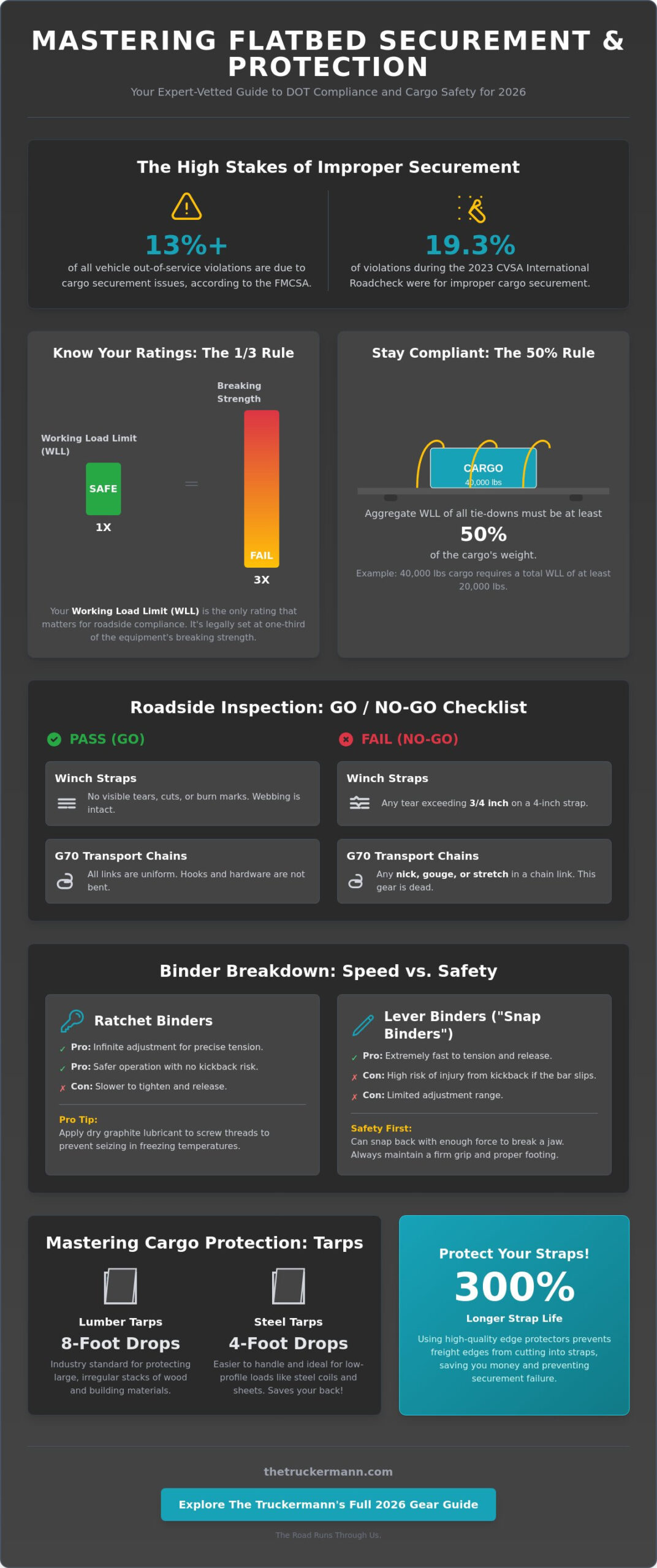
Hey Friend. You know as well as I do that when you’re behind that wheel, the only thing keeping a 40,000-pound coil from becoming a lethal projectile is the quality of your tie-downs. Investing in the best flatbed trucking gear isn’t just about passing a DOT inspection; it’s about protecting your CDL and your life. During the 2023 CVSA International Roadcheck, cargo securement accounted for 19.3 percent of all vehicle out-of-service violations in North America. This isn’t just a statistic. It’s a wake-up call to master the principles of load securing before you ever pull out of the yard.
You’ve got to know your numbers to stay legal. Breaking strength is the point where the gear fails under a laboratory pull, but your Working Load Limit (WLL) is the only rating that matters for roadside compliance. For most synthetic webbing and chains, the WLL is set at one-third of the breaking strength. If you see a tear in a strap that exceeds 3/4 of an inch on a 4-inch strap, or any nick, gouge, or stretch in a chain link, that gear is dead. Don’t wait for a roadside inspection blitz to find your equipment flaws. Inspect every inch of your kit during every pre-trip, because a single frayed edge can void your insurance coverage in the event of an accident. Following a thorough CDL pre trip inspection checklist ensures you catch these issues before a DOT officer does.
Winch Straps and G70 Transport Chains
Standard straps work for basic lumber, but high-abrasion straps use a tighter weave and specialized coatings to resist the friction that kills gear on long hauls. You’ll generally reach for 4-inch straps for your primary securement, while 2-inch straps are better suited for lighter loads or specialized utility tracks. For heavy machinery and steel, G70 Transport chain is the industry standard because it provides the highest strength-to-weight ratio for heat-treated carbon steel. The FMCSA requires that the aggregate working load limit of all securement devices must equal at least 50 percent of the weight of the cargo being transported. Whether you’re running interstate vs intrastate routes, these securement standards apply and keeping your gear compliant protects your authority regardless of which side of the state line you’re on.
Binders and Tensioning Tools
The choice between ratchet and lever binders usually comes down to a trade-off between speed and safety. Lever binders are fast, but they can snap back with enough force to break a jaw if the winch bar slips. Ratchet binders take longer to crank, yet they offer infinite adjustment and won’t kick back on you. To keep those ratchets from seizing when the temperature drops below 32 degrees, apply a dry graphite lubricant or a cold-weather grease to the screw threads. Always use a knurled winch bar to maintain a solid grip, because a wet hand on a smooth bar is a recipe for a trip to the emergency room. The road runs through us. Stay safe out there.
Cargo Protection: Mastering Tarps and Edge Integrity
Hey Friend, watching the miles roll by is only half the battle. If you want to be a true The Truckermann, your tarp job needs to look like a tailored suit. Cargo protection is the signature of a professional who respects the freight, the customer, and the road. Selecting the best flatbed trucking gear means finding that sweet spot between bulletproof durability and the physical reality of throwing a 100-pound tarp in a 20-mph crosswind. While 18oz vinyl provides the ultimate shield against the elements, the weight penalty is heavy. Smart drivers often mix their inventory to save their backs while staying compliant with the FMCSA cargo securement rules that keep us all moving.
Edge integrity is where the seasoned veterans separate themselves from the rookies. Using high-quality protectors can extend the life of your expensive 4-inch straps by 300 percent. Without them, the vibration of the highway turns your freight’s sharp edges into a saw blade. For those hauling shingles, drywall, or fragile building materials, the Vee Board advantage is undeniable. These long, rigid protectors distribute pressure across the entire edge. This prevents the strap from crushing the load while allowing you to maintain the high tension required for a safe haul.
Lumber Tarps vs. Steel Tarps
Your choice of tarp depends entirely on the profile of your load. Lumber tarps, featuring 8-foot drops, are the industry standard for protecting large, irregular stacks of wood from road salt and moisture. However, if you are hauling low-profile coils or sheets, heavy lumber tarps are overkill. Steel tarps with 4-foot drops are much easier to handle and reduce the risk of shoulder injuries. Many specialized haulers are now switching to parachute fabric for the side curtains to shave off weight without losing protection. Regardless of your choice, you must carry a repair kit in your side box. A single tear can ruin a load, so keep HH-66 vinyl cement and scrap patches
Driver-First Safety: PPE and Roadside Visibility Essentials
Hey Friend, let’s talk straight. Flatbedding is the most physical job in this industry, period. You aren’t just driving; you’re a rigger, a climber, and a heavy lifter. Your body is the most valuable asset in the cab, and protecting it requires the best flatbed trucking gear available. When the CVSA schedules a Roadside Inspection Blitz, like the annual 72-hour International Roadcheck, inspectors look for more than just logbook errors. They notice if you’re equipped for the job. Stepping out of the cab in flip-flops to check a load isn’t just a safety hazard; it’s a red flag to DOT that you might be cutting corners elsewhere.
Your footwear is your first line of defense. You need boots that survive a cocktail of diesel, grease, and rain-slicked steel. According to 2022 data from the Bureau of Labor Statistics, falls and slips remain a leading cause of non-fatal injuries for heavy truck drivers. Look for soles with high traction ratings and oil resistance. Before you throw that first strap, reviewing Essential Flatbed Safety Tips can help you identify gaps in your personal protection strategy. A solid pair of 8-inch work boots provides the ankle support needed when navigating uneven gravel lots or climbing onto a trailer deck.
High-Visibility Apparel and Gloves
Visibility is survival. While ANSI Class 2 vests are the standard for daytime work, you should upgrade to Class 3 for night securement. Class 3 apparel includes reflective material on the sleeves and legs, creating a full human silhouette that distracted drivers can recognize from a distance. Because the road runs through us, we stay visible in every blizzard and downpour. For your hands, skip the cheap jersey gloves. You need impact-resistant gloves with reinforced palms. Handling heavy Grade 70 chains and snapping ratcheting binders can crush fingers in a heartbeat. High-quality gloves provide the grip you need without sacrificing the dexterity required to thread a winch bar.
Lighting and Signal Gear
Working in the dark is part of the lifestyle, but it shouldn’t be a gamble. A high-lumen headlamp, specifically one pushing at least 500 lumens, is essential for night-time tarping. It keeps your hands free to wrestle 100-pound lumber tarps or hook bungees. When the load gets wide, the best flatbed trucking gear includes heavy-duty oversize load flags and amber strobe lights that meet FMCSA 393.11 standards. Don’t get caught short on the basics during a breakdown. While DOT requires three reflective triangles, carrying extra LED flares ensures you are seen long before a vehicle reaches your shoulder. Staying legal is important, but staying alive is the priority.
Efficiency Tools: Organization for the Professional Hauler
Hey friend, let’s talk about the clock. In this industry, every minute you spend hunting for a lost bungee or untangling a bird’s nest of straps is money leaking out of your pocket. Professionalism isn’t just about how you drive; it’s about how you manage your deck. When your gear is dialed in, your stress levels drop. There is a real psychological win in looking at an organized side box before you hit the road. It gives you the confidence that you’re ready for whatever the DOT throws your way. Keeping the best flatbed trucking gear organized isn’t just about pride; it’s about staying under the radar. A messy truck is a beacon for roadside inspections. Officers often associate a cluttered deck with poor maintenance habits. Data from the FMCSA suggests that visible securement issues are among the top reasons for pulling a driver into the scale house, so a clean rig keeps you moving.
Strap Winders and Storage Solutions
Manual winders are reliable, but drill-powered options are the real game changers for high-volume haulers. If you’re throwing ten straps a load, a drill-powered winder saves roughly 15 minutes of labor per stop. That adds up to hours of reclaimed time every month. When the rain hits, don’t just shove wet tarps into a dark box. Moisture leads to mold and fabric rot, which destroys your investment. Always hang them to dry or ensure your storage box has proper ventilation. To keep your winch straps in top shape, follow this 5-step routine and pair it with a dedicated flatbed gear maintenance schedule to maximize the lifespan of every strap and chain in your arsenal:
- Inspect the entire length for nicks, burns, or UV damage.
- Clean off any road salt or abrasive debris that can weaken fibers.
- Roll the strap tightly with the hook on the outside for quick deployment.
- Secure the roll with a heavy-duty rubber band or a dedicated strap clip.
- Store in a dry, weather-proof side box off the metal floor.
Toolboxes and Dunnage Racks
Choosing between under-body boxes and headache racks comes down to your weight distribution strategy. Under-body boxes keep your center of gravity low, while headache racks offer easier access to chains and binders. For your 4x4s, stop using loose bungees that snap. Ratchet-style dunnage racks are the gold standard for safety. They ensure your wood stays put even on rough interstate stretches. Every pro should carry a “go-bag” for quick adjustments. This bag should include a 4-pound sledge, a high-quality tape measure, and a set of pliers. Investing in the best flatbed trucking gear means nothing if you can’t find it when a load shifts. The Road Runs Through Us, so let’s keep it clean out there.
The Truckermann’s 2026 Gear Guide: Top Recommendations
Hey Friend, here is the gear that actually survives the miles. I have spent years behind that wheel watching miles roll, and I have learned that the best flatbed trucking gear is the difference between a profitable week and a roadside nightmare. If you are just starting out, don’t overcomplicate your setup. The best overall securement kit for new flatbedders includes ten 4-inch winch straps, four grade 70 transport chains, and four ratcheting binders. This kit covers 90 percent of the loads you will encounter in your first year. You can find budget-friendly alternatives that stay DOT compliant; however, you must ensure every piece of hardware has a visible Working Load Limit (WLL) tag. When you use my affiliate links to shop, you are getting the best deals on the road while supporting the brotherhood.
Top-Rated Flatbed Gear of 2026
Choosing the right winch strap is about more than just the price tag. In 2026, the industry has narrowed down the top performers based on weave density and UV resistance. Here is how the big players stack up for the current season.
| Brand Name | Working Load Limit | Primary Strength |
|---|---|---|
| Kinedyne K-Force | 6,670 lbs | Highest abrasion resistance |
| Ancra Silverline | 5,400 lbs | Extreme weather flexibility |
| Mytee Products | 5,400 lbs | Maximum value for money |
For your tarps, stick with 18oz heavy-duty vinyl. These are the most durable ‘all-weather’ options for 2026 because they remain flexible even when temperatures drop to -40 degrees. Cheap tarps will crack in the wind, but a high-quality 18oz tarp with heat-welded seams will last three seasons if you treat it right. Finally, let’s talk about the Truckermann’s Golden Tool. It is the one item I never leave the yard without: a 34-inch chrome combination winch bar with a knurled handle. It gives you the leverage needed for tight ratcheting without straining your back.
Next Steps: Professional Growth and Gear Maintenance
Your gear is an extension of your CDL. You must document gear inspections for your Driver Vehicle Examination Report every single time you pre-trip. If you find a cut in a strap that is wider than a quarter-inch, it is no longer legal. Mark it, cut it, and replace it. Staying ahead of an FMCSA inspection blitz starts with your own eyes, and pairing your gear checks with a complete CDL pre trip inspection checklist gives you a repeatable system that keeps violations off your record. Investing in yourself by investing in the best flatbed trucking gear shows carriers and brokers that you are a professional who respects the cargo. To extend the life of every strap, chain, and tarp in your kit, follow the proven routines outlined in our guide to mastering flatbed gear maintenance for safety and longevity. If you’re still weighing whether to run long-haul cross-country loads or stay closer to home, understanding the full regulatory and financial picture of interstate vs intrastate trucking will help you make the most profitable decision for your operation.
The road is a demanding teacher, but she rewards those who come prepared. Take care of your tools, and they will take care of your paycheck. Building a complete, DOT-ready loadout means going beyond just straps and chains — our ultimate guide to professional trucking gear for 2026 covering safety, comfort, and compliance walks you through every category of equipment you need to stay inspection-ready and profitable. Beyond your physical gear, staying compliant also means keeping your ELD compliance up to date in 2026, since a revoked or non-approved electronic logging device can park you out-of-service just as fast as a bad strap. Check out my full list of recommended flatbed products here!
The Road Runs Through Us.
Master the Miles with the Right Loadout
Hey Friend, as we look toward the shifting landscape of 2026, staying ahead of the DOT means more than just having a strap in your hand. This guide highlighted the critical shift toward heavy duty securement that stands up to the 15 year veteran test, ensuring your cargo stays put while you’re watching those miles roll. We focused on mastering edge integrity to prevent tarp tears and the essential PPE that keeps you visible during those late night roadside inspections. Investing in the best flatbed trucking gear isn’t just a business expense; it’s a commitment to your safety and your CDL. Every piece of equipment the Trucker Mann recommends has been vetted for real road durability and strict FMCSA compliance. You deserve tools that work as hard as you do, from the first strap to the final delivery. Don’t let a faulty winch or a worn out chain be the reason for a failed inspection. Take control of your setup today and ride with the confidence of a professional who’s prepared for anything the highway throws your way.
Upgrade your load securement with The Truckermann’s hand-picked gear!
The Road Runs Through Us.
Frequently Asked Questions
What is the most important piece of flatbed gear for a new driver?
Hey friend, your most important piece of gear is a high-quality pair of leather work gloves paired with a sturdy hard hat. You’ll be handling steel cables and rough lumber every day, so protecting your hands is the first step to staying in the game. Beyond that, a hard hat that meets ANSI Z89.1 standards is mandatory at 95 percent of shipping yards. Without it, you aren’t getting past the gate to load.
How many winch straps do I need for a standard 48-foot flatbed?
You should carry at least 12 to 14 four-inch winch straps to properly equip a standard 48-foot trailer. While the FMCSA 393.110 rule dictates the minimum number based on load length, having extra ensures you’re ready for split loads or unexpected securement needs. It’s the best flatbed trucking gear for versatility. Most veteran drivers keep 20 on the rail just to be safe during roadside inspections.
What is the difference between G70 and G80 transport chains?
Grade 70 chain is the industry standard for load securement, while Grade 80 is heat-treated for overhead lifting applications. G70 is often called transport chain because it has a higher strength-to-weight ratio for tie-down purposes. Under FMCSA regulations, you must ensure your G70 chain has the 7, 70, or 700 embossed every 12 inches. Using G80 is acceptable, but it’s heavier and more expensive for standard securement.
How often should I replace my winch straps to stay DOT compliant?
You must replace your winch straps the moment you see a cut, burn, or fray that exceeds the CVSA North American Standard Out-of-Service Criteria. If a strap has a tear larger than 3/4 of an inch on a 4-inch strap, a DOT officer will put you out of service. There isn’t a set expiration date, but checking them every single morning during your pre-trip is the only way to stay compliant. The Road Runs Through Us, and it starts with safe equipment.
Are ratchet binders really safer than lever binders?
Ratchet binders are significantly safer because they use a screw mechanism that doesn’t store kinetic energy like lever binders do. Lever binders can snap back with enough force to break a jaw or a wrist if the bar slips. Because you can fine-tune the tension with a ratchet, you get a more precise hold on your load. The Truckermann recommends ratchets for any driver who wants to keep their teeth and stay out of the emergency room.
What is the best way to prevent tarps from tearing on sharp corners?
Using heavy-duty plastic corner protectors or moving blankets is the most effective way to stop sharp edges from slicing your vinyl. A 1/8 inch sharp edge on a steel coil can ruin a 1,000 dollar tarp in under 50 miles of highway vibration. Always place your protectors before throwing the tarp. It’s a small step that saves you from a massive repair bill and keeps your gear looking professional and road-ready.
Do I need a specific type of glove for flatbed trucking?
Hey friend, you need leather palm gloves or Kevlar-reinforced work gloves to handle the best flatbed trucking gear without injury. Cotton or thin rubber gloves will shred in seconds when you’re pulling on winch bars or handling rusted chains. Look for gloves with a reinforced thumb crotch, as this is where 80 percent of wear occurs during securement. Staying protected ensures you can keep working through every season without downtime.
How do I calculate the aggregate working load limit for my load?
You calculate the aggregate working load limit by adding together the WLL of every individual tie-down used to secure the cargo. According to FMCSA 393.106, the total WLL must be at least 50 percent of the weight of the article being secured. If you have a 40,000-pound steel plate, your combined straps or chains must have a total WLL of at least 20,000 pounds. Always check the manufacturer tags for the rated capacity before you tighten your binders.
Disclaimer
The information provided on The TruckerMann is for general informational and educational purposes only. While every effort is made to ensure the accuracy and reliability of the content, trucking laws, FMCSA regulations, DOT requirements, safety standards, and industry policies can change at any time. Readers are encouraged to verify all information with official government agencies, professional advisors, or qualified industry professionals before making business, legal, financial, safety, or compliance-related decisions.
The content shared on this website reflects personal opinions, experiences, research, and commentary and should not be considered legal, financial, medical, tax, or professional advice. The TruckerMann and its owners, contributors, affiliates, or representatives are not responsible for any losses, damages, violations, penalties, or liabilities resulting from the use or misuse of information found on this website.
Some content on this website may contain affiliate links, sponsored content, or promotional material. This means we may earn a commission at no additional cost to you if you choose to purchase through certain links.
By using this website, you agree that you do so at your own discretion and risk.