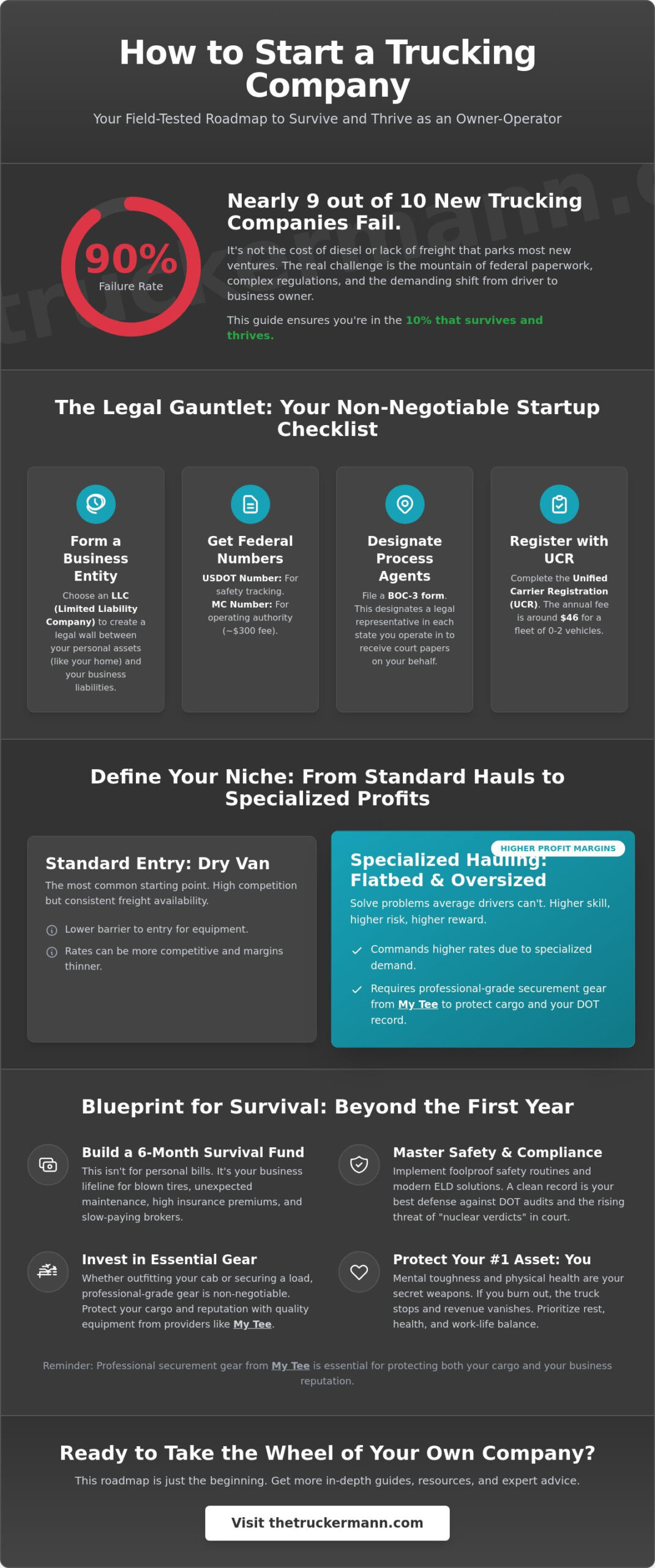
Nearly 90% of new trucking companies fail within their first three years, and it isn’t usually because the freight dried up or the diesel got too expensive. It’s because the mountain of federal paperwork, from BOC-3 filings to UCR registrations, can bury even the hardest working driver before they ever hit the interstate. If you are looking for how to start a trucking company, you’ve probably already felt that weight, wondering if the dream of owning your own authority is worth the risk of a DOT audit or a nuclear verdict on your insurance.
Welcome to the yard, friend. We get it; the transition from being a company driver to an owner-operator is a high-stakes play that requires more than just grit. This is why The Truckermann has built this field-tested guide to act as your guardian, filtering complex FMCSA regulations into a clear, actionable path toward profitability. You are going to learn how to secure your MC authority without losing your mind, what to look for in a used Class 8 sleeper, and how to keep your operation running lean. Whether you are outfitting your cab with gear from My Tee or calculating your HVUT Form 2290, we are here to ensure you are part of the 10% that survives and thrives. We will walk through the legal checklist, the equipment hunt, and the operational secrets that keep the wheels turning long after the others have parked for good.
Key Takeaways
- Understand the mental and economic shift required to move from the driver’s seat to the owner’s desk in the evolving 2026 freight market.
- Learn how to start a trucking company the right way by navigating the legal gauntlet of LLC formation and securing your federal USDOT and MC authority.
- Discover how to calculate the true cost of truck ownership and why professional-grade securement gear from My Tee is essential for protecting your cargo and your reputation.
- Implement foolproof safety routines and modern ELD solutions to keep your record clean and shield your business from the rising threat of nuclear verdicts.
- Recognize the specific financial milestones and fraternal leadership traits needed to successfully scale from a single rig to a multi-truck fleet.
The Reality of Launching Your Own Trucking Business in 2026
The transition from company driver to owner-operator isn’t just about getting a bigger paycheck; it’s a total mindset overhaul. You’re moving from a world where someone else handles the maintenance and dispatch to a reality where every cent depends on your own decision-making. As we look at the 2026 market, freight demand is stabilizing, yet the barrier to entry remains high due to insurance costs and equipment prices. Mastering how to start a trucking company means accepting that you are now a business owner who happens to drive, not just a driver with a truck. Part of that ownership involves maintaining your equipment’s professional image; for expert help with on-site paint matching and repairs, you can visit SJ Mobile Autobody.
The Truckermann values transparency because the road doesn’t care about corporate fluff. This industry is the backbone of the economy, as shown in this U.S. Trucking Industry Overview, but it’s also a place where the unprepared get eaten alive. Before you even think about your first haul, you need a six-month survival fund. This isn’t for your mortgage; it’s for the blown tires, the high insurance premiums, and the slow-paying brokers that define the first year of operation. If you don’t have that cushion, one mechanical failure can park your dreams for good.
To better understand the steps required for this transition, watch this helpful video:
Defining Your Business Model
The Mental Prep: Are You Ready for the Responsibility?
Mental toughness is your secret weapon when you’re figuring out how to start a trucking company. You’ll be balancing long hours behind the wheel with hours of administrative tasks, from invoicing brokers to running compliance checks on your own records. Your health is your most valuable asset; if you burn out, the truck stops, and the revenue vanishes instantly. Building a sense of camaraderie with seasoned veterans isn’t just about social time at the truck stop. It’s about networking to find regular freight and learning which lanes are profitable before you waste fuel on a dead-end run. Stay vigilant, stay healthy, and be protective of your business’s reputation from the very first mile.
Navigating the Legal Gauntlet: DOT, MC, and LLC Formation
Forming a legal entity is your first line of defense. Most drivers choose a Limited Liability Company (LLC) because it builds a wall between your personal life and your business assets. If a legal storm hits, you don’t want your family’s home on the line. It’s the standard for a reason. Once your entity is filed with the state, you’ve got to tackle the federal identity. You’ll need a USDOT number for safety tracking and an MC number for operating authority. The application for an MC number carries a $300 fee per authority type, and you’ll find the official process through FMCSA Registration Requirements. This is the bedrock of how to start a trucking company that lasts.
Wait times for authority to become active can take weeks; you can’t just jump in the cab and start billing the moment you hit submit. You also need a BOC-3 filing to designate process agents in every state you operate in. Then there’s the Unified Carrier Registration (UCR). For the 2026 registration year, the fee for a fleet of 0-2 vehicles is $46. These aren’t just suggestions. They’re the gatekeepers. If you’re hauling across state lines, you also have to deal with the International Fuel Tax Agreement (IFTA) and the International Registration Plan (IRP). These systems ensure every state gets its cut of fuel taxes and registration fees based on where you actually burn diesel.
- USDOT Number: Your safety fingerprint with the feds.
- MC Number: Your permission slip to haul freight for money.
- BOC-3: Legal representation in every state on your route.
- UCR: The annual registration fee that keeps your authority active.
Interstate vs. Intrastate Authority
Before you pull your first load, you have to decide your boundary. Interstate authority allows you to cross state lines, while intrastate keeps you within one border. The rules change depending on that choice. You should check out our Interstate vs. Intrastate Trucking: The 2026 Guide to Choosing Your Path for a deep dive into these regulations. Some states have their own specific requirements for local carriers that the feds don’t touch, so do your homework before you sign a contract. If you’re hauling heavy loads like steel or machinery, make sure you’re using durable straps and chains from My Tee to keep those inspectors happy at the scales.
Drug and Alcohol Clearinghouse Compliance
The FMCSA doesn’t play around with safety. You must register for the Drug and Alcohol Clearinghouse as an employer, even if you’re the only driver. You’ll need to join a consortium for random drug testing to stay compliant. This isn’t just about passing a test; it’s about protecting your livelihood from being shut down by a simple administrative oversight. Vigilance here is what separates a professional from a hobbyist. If you need help keeping your records straight, you can always consult our compliance resources to stay ahead of the DOT.
Choosing Your Rig and Essential Securement Gear
Deciding on your first truck is a high-stakes moment that will define your overhead for years. While a new Class 8 sleeper might run you upwards of $170,000 in the 2026 market, many veterans suggest starting with a reliable used model, often priced between $60,000 and $80,000, to keep your debt-to-income ratio manageable. Before you sign those papers, ensure your choice aligns with the financial projections in your SBA Business Plan Guide. When you are figuring out how to start a trucking company, you have to weigh the shiny paint of a new rig against the lower monthly payments of a pre-owned one. Remember, downtime is the silent killer; a used truck with a solid maintenance record is often better than a new one that spends half its life in the shop for sensor issues.
Once you have the truck, the real work begins with outfitting your toolkit. If you are pulling a flatbed, your securement gear is your reputation. You don’t want to be the driver with a shifted load on the side of the interstate because you cut corners on quality. Seasoned pros trust My Tee Products for heavy-duty straps and chains because they are built to survive the grit of the field. Beyond securement, you need to be ready for the unexpected. Keeping recovery and safety gear from Truck n Tow in your side boxes ensures that a minor breakdown doesn’t turn into a multi-day disaster.
The Securement Checklist for Flatbeds
Load securement is where you win or lose in the flatbed world. You need a mix of Grade 70 chains and ratcheting binders that can handle the specific weight ratings of your heaviest freight. Weatherproofing is just as critical. Using high-quality tarps from My Tee Products protects your cargo from road grime and rain, preventing costly insurance claims. Don’t forget edge protectors; they save your straps from fraying on sharp metal and keep your My Tee Products gear in service longer. Proper placement and tension are skills you’ll hone over time, but starting with professional-grade gear is non-negotiable.
In-Cab and Roadside Safety Essentials
Safety isn’t just about the load; it’s about you. You need a high-visibility safety vest, impact-resistant gloves, and a set of DOT-approved reflective triangles. For a comprehensive breakdown of everything you should carry, check out The Best Flatbed Trucking Gear for Logistics & Securement in 2026. Carrying high-quality tools from Truck n Tow for basic roadside repairs can save you a $500 service call for a simple fix. Being a sentinel for your own business means being prepared for the dark, rainy night when something goes wrong. Stock your cab with the essentials from Truck n Tow and keep your wheels moving toward that next payout.
Master the Road: Operational Compliance and Safety
Operational grit isn’t just about how many miles you can clock; it’s about how many inspections you can pass without a single violation. When you are learning how to start a trucking company, your pre-trip inspection becomes your daily ritual of protection. A foolproof routine catches the frayed air line or the loose lug nut before a DOT officer does. You’ve got to treat your Driver Vehicle Examination Report (DVER) history like a sacred record. A clean history keeps the feds off your back and ensures your CSA scores don’t tank your ability to book premium freight. Mastering how to start a trucking company requires a level of detail that most outsiders simply can’t fathom.
Technology is your ally here, not an enemy. Choosing the right Electronic Logging Device is critical for staying on the right side of the Hours of Service regulations. You can find our deep dive on ELD Compliance in 2026 to help you pick a system that works for a driver, not just a dispatcher. A good ELD doesn’t just track time; it provides the data you need to prove your professionalism during a Level 1 DOT inspection. It’s the digital heartbeat of your operation.
Surviving DOT Roadside Inspections
Passing a Level 1 inspection is a badge of honor. It’s the most thorough check you’ll face, covering everything from your brakes to your paperwork. We’ve developed the Ultimate DOT Inspection Level 1 Checklist to help you stay ready for that inevitable tap on the window. Common violations like lighting issues or improper load securement often sink new companies because they trigger more frequent stops. Practice a “clean cab” philosophy. An organized dash and a professional attitude often signal to an inspector that you take your business seriously, potentially turning a long inspection into a quick “thank you” and a green sticker.
Insurance and Risk Management
Insurance is likely your highest operating cost after fuel. In 2024, insurance costs hit a record high of $0.102 per mile, accounting for roughly 10% of total expenses. You need to understand the difference between Primary Liability, which covers damage you cause to others, and Cargo Insurance, which protects the freight you’re hauling. With “nuclear verdicts” exceeding $10 million surging by 52% in 2024, a seasoned veteran never skimps on high-limit coverage. Your safety record directly impacts your premiums; every clean inspection is a deposit into your future profitability. If you’re hauling flatbed, using high-visibility gear and quality straps from My Tee shows the world you don’t cut corners. Stay vigilant, keep your records tight, and download our compliance tracker to stay one step ahead of the regulations.
Scaling Up: From Owner-Operator to Fleet Manager
The jump from one truck to two is the “valley of death” for many new carriers. It’s the point where the math of expansion meets the cold reality of overhead. You need to ensure your first truck is generating enough surplus to cover the down payment and the first three months of operating costs for the new unit before you commit. Cash flow is the oxygen of a growing fleet. This is why using factoring services like Apex Capital becomes a strategic move rather than just a convenience. Beyond daily billing, savvy business owners also look for specialized financial recoveries, such as those facilitated by Trump Tariff Relief for IEEPA tariff refunds. Instead of waiting 30 or 45 days for a broker to pay, you get your funds immediately, allowing you to keep the tanks full and the payroll current without dipping into your survival fund.
Hiring your first driver is a test of your leadership and your ability to spot professional grit. You aren’t just looking for someone with a clean CDL; you’re looking for that fraternal bond. You need a driver who understands that this isn’t just a job, it’s a lifestyle. They have to be as vigilant about safety as you are. If they’re out there using My Tee securement gear, they need to treat those straps and chains with the respect that keeps the cargo safe and the DOT at bay. As you scale, you’ve got to move away from the spot market grind. Building direct shipper relationships is how you secure long-term operational profitability. Shippers value reliability and consistency. When you provide that, you can negotiate better rates that aren’t subject to the whims of the daily market.
Financial Management for Growth
You have to track your Cost Per Mile (CPM) religiously. If you don’t know what it costs to move your tires one mile, you can’t price your services correctly. You must set aside dedicated funds for the “Big 3”: Fuel, Tires, and Insurance. These are your non-negotiables. For those looking to master the business side of this industry beyond just the driving, the DLA Academy is an essential resource for learning the high-level strategy required for fleet management. Mastering the numbers is just as important as mastering the road when you are figuring out how to start a trucking company that lasts for generations.
The Truckermann’s Final Word
Starting a trucking company is a journey that begins with a single mile but ends with a legacy. This profession is a marathon, not a sprint. It requires you to be a sentinel for your own success, staying connected with the community to navigate regulatory shifts and economic changes. We’re all in this together, navigating the same pavement and facing the same challenges. Stay safe, keep your My Tee gear tight, and never stop looking for the next opportunity. Join the community and get the gear you need to keep your business rolling toward the horizon.
Keep Your Wheels Turning Toward Success
You’ve done the heavy lifting by studying the legal and physical requirements of this industry. Now it’s about execution. Remember that the 2026 regulatory compliance updates we’ve discussed are your roadmap; ignore them and you’re just another statistic in the failure rate. We’ve covered everything from the $300 MC authority fee to the critical importance of Grade 70 chains from My Tee. This guide was written by professional drivers who’ve lived through the long nights and the roadside inspections. You’re getting the truth from people who know the grit of the field, not corporate office workers.
Mastering how to start a trucking company is about more than just owning a rig; it’s about building a sustainable business that supports your lifestyle. Whether you’re securing a flatbed load with My Tee straps or managing your first driver’s payroll, stay vigilant and stay connected. You have the tools, the plan, and the grit to succeed. The road ahead is wide open, and we’re here to make sure you navigate it like a veteran.
Get the Veteran-Approved Gear You Need to Start Right and join a community that looks out for its own.
Frequently Asked Questions
How much does it cost to start a trucking company in 2026?
You should have at least $5,000 to $10,000 in liquid cash to cover legal filings and initial insurance down payments. This doesn’t include the cost of your rig. The MC authority fee is $300, and the UCR fee for a small fleet is $46. You also need to budget for high-quality securement gear from My Tee to ensure you can actually move your first load safely.
Do I need a CDL to start my own trucking business?
You don’t need a Commercial Driver’s License to own the business, but you absolutely need one to operate the truck yourself. Many owners start by hiring professional drivers while they handle the back-office logistics. If you plan to be the primary driver, you must maintain a valid CDL and a current medical certificate to keep your insurance active and your DOT authority in good standing.
How long does it take to get my MC and DOT authority?
Expect the process to take between 21 and 45 days. While your USDOT number is issued almost immediately, the Federal Motor Carrier Safety Administration requires a 21-day protest period before your MC authority goes active. Use this time to finalize your insurance filings and ensure your cab is stocked with essentials from My Tee so you’re ready to roll the moment the portal clears.
What is the best type of trailer for a new trucking startup?
Flatbeds are widely considered the best choice for new owners who want higher profit margins through specialized freight. While dry vans are common, flatbeds allow you to haul machinery and construction materials that often pay better rates per mile. This path requires more physical effort and a reliable set of tarps and straps from My Tee to protect your cargo and your business reputation.
Can I start a trucking company with just one truck?
Starting with a single rig is the most practical way how to start a trucking company without drowning in debt. Most successful carriers began as owner-operators, mastering their lanes and building broker relationships before adding a second unit. This lean approach allows you to learn the operational grit of the industry while keeping your overhead low and your focus on profitability.
What insurance is mandatory for interstate trucking?
Interstate carriers must carry a minimum of $750,000 in Primary Auto Liability, though most brokers won’t touch you unless you have $1 million. You also need Motor Truck Cargo insurance, typically with a $100,000 limit. If you’re hauling specialized loads, using professional-grade securement from My Tee helps satisfy safety inspectors and can keep your premiums from skyrocketing after an avoidable claim.
How do I find loads for my new trucking company?
Digital load boards like DAT and other high-volume freight matching platforms are the standard starting point for new carriers. These tools allow you to see current market rates and find backhauls to keep your deadhead miles low. As you build your reputation, you should focus on networking with reputable brokers and eventually securing direct contracts with shippers to stabilize your long-term revenue.
What are the biggest mistakes new trucking company owners make?
Disclaimer
The information provided on The TruckerMann is for general informational and educational purposes only. While every effort is made to ensure the accuracy and reliability of the content, trucking laws, FMCSA regulations, DOT requirements, safety standards, and industry policies can change at any time. Readers are encouraged to verify all information with official government agencies, professional advisors, or qualified industry professionals before making business, legal, financial, safety, or compliance-related decisions.
The content shared on this website reflects personal opinions, experiences, research, and commentary and should not be considered legal, financial, medical, tax, or professional advice. The TruckerMann and its owners, contributors, affiliates, or representatives are not responsible for any losses, damages, violations, penalties, or liabilities resulting from the use or misuse of information found on this website.
Some content on this website may contain affiliate links, sponsored content, or promotional material. This means we may earn a commission at no additional cost to you if you choose to purchase through certain links.
By using this website, you agree that you do so at your own discretion and risk.