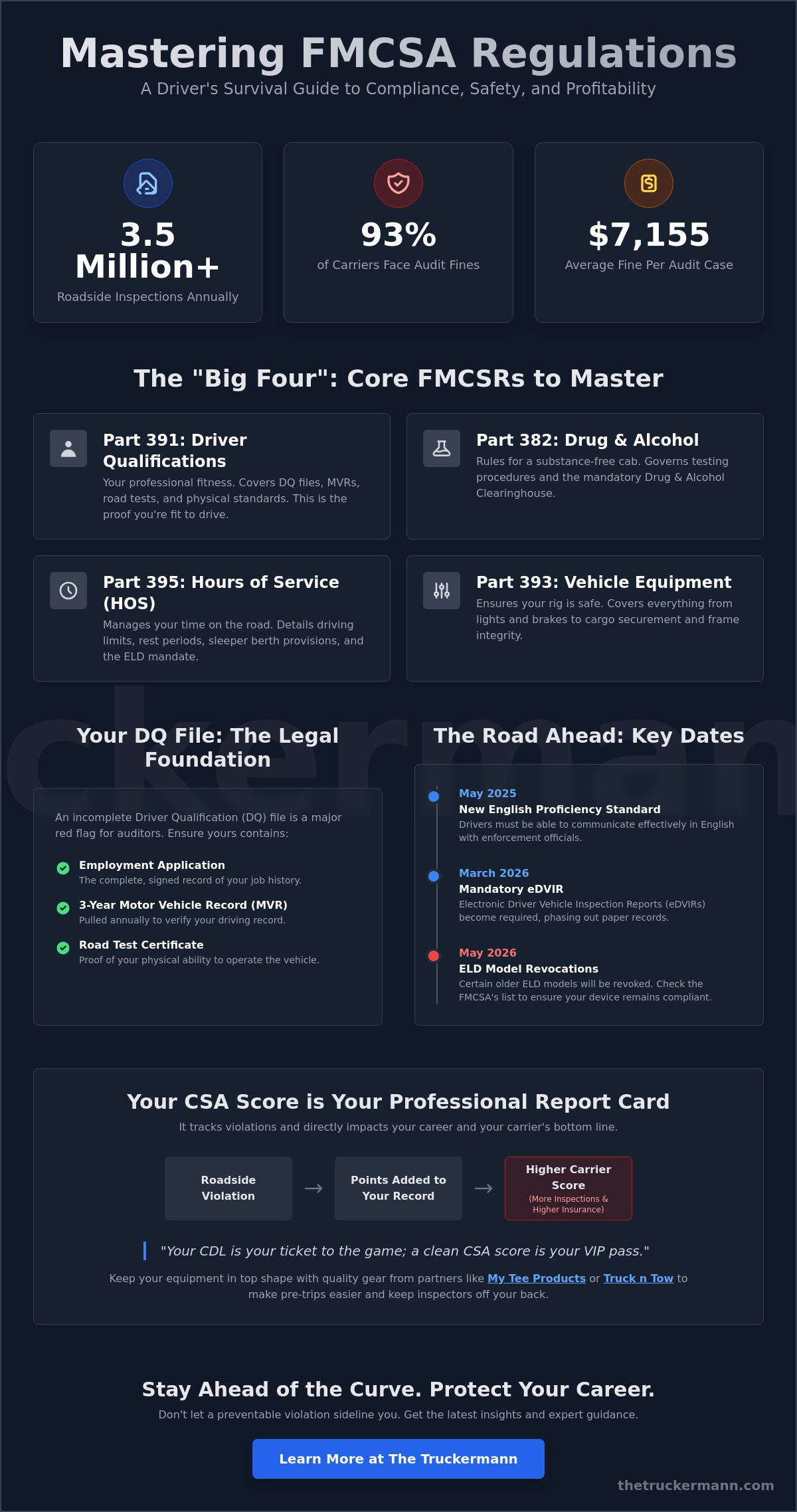
Compliance isn’t just government overreach; it’s a professional survival skill that separates the steering wheel holders from the true masters of the road. With over 3.5 million roadside inspections happening every year and 93% of carriers facing DOT audit fines, staying on top of FMCSA regulations for truck drivers is the only way to keep your rig moving and your bank account full. You’re out there in the grit every day, and the last thing you need is a $19,000 penalty for a record-keeping error or a revoked ELD model catching you off guard during a surprise inspection.
It’s frustrating to deal with legal jargon that feels like it was written to trip you up, especially when technicalities like the March 2026 eDVIR requirements or the new English proficiency out-of-service rules change the game. We’re going to clear the fog. This guide provides a veteran’s perspective on mastering Parts 382, 391, 393, and 395 to help you lower your CSA scores and protect your career. You’ll learn exactly how to handle the latest HOS technicalities and the May 2026 ELD revocations so you can walk away from a Level 1 inspection with zero violations and your head held high.
Key Takeaways
- Master the distinction between DOT enforcement and FMCSA rule-making to navigate the industry’s “Bible” like a seasoned professional.
- Audit your Driver Qualification file and Clearinghouse status to ensure you stay compliant with current FMCSA regulations for truck drivers, including the 2026 English proficiency standards.
- Protect your paycheck by staying ahead of the May 2026 ELD model revocations and utilizing the HOS sleeper berth split provisions correctly.
- Shift to mandatory eDVIR record-keeping and systematic maintenance to eliminate “Driver Observed” defects before they hit your CSA score.
- Adopt a tactical approach to the six levels of DOT inspections to transform a stressful roadside stop into a routine professional check-in.
Understanding the FMCSRs: Why Federal Regulations Rule the Road
The Federal Motor Carrier Safety Regulations (FMCSRs) aren’t just a stack of papers in your glove box; they’re the “Bible” of the highway. Every mile you drive is governed by these rules. The Federal Motor Carrier Safety Administration (FMCSA) writes the playbook, while the Department of Transportation (DOT) acts as the league office. It’s a partnership that keeps the industry moving, but it’s also a trap for those who don’t pay attention. Mastering FMCSA regulations for truck drivers means knowing the “Big Four” parts by heart: 382, 391, 393, and 395. These sections cover everything from your physical health to the lights on your trailer.
Enforcement is everywhere. Over 3.5 million DOT roadside inspections happen every year. Most drivers think they can fly under the radar, but 93% of motor carriers face fines from audits. The average hit is $7,155 per case. That’s real money coming out of the business and affecting your livelihood. If you’re running on thin margins, one bad inspection can be the difference between a profitable quarter and a total loss. Safety isn’t just about avoiding accidents; it’s about protecting the economic engine that keeps your rig on the road. For many professional drivers, this protection also includes having a reliable insurance partner like AMCO.NET LLC to safeguard their business interests.
To better understand how these rules impact your daily life on the road, watch this helpful video:
The Anatomy of a Regulation: CFR Title 49
Reading the Code of Federal Regulations (CFR) can give you a headache if you don’t know the structure. Title 49 is the heavyweight champion of federal law. It’s broken into parts, like Part 395 for HOS, and then into subparts. You’ll often see “Guidance” listed alongside the rules. Guidance is the FMCSA’s way of explaining how to follow the law, but the “Law” itself is what the judge looks at. You also need to know your status. Interstate drivers cross state lines and must follow federal rules. Intrastate drivers stay in one state and follow state-level regs. Most states adopt the federal standards anyway, so it’s best to play by the big book. The 2026 update to eDVIR standards under 49 CFR §396.11 is a perfect example of how quickly these guidance points can become hard law.
CSA Scores and Your Professional Reputation
The Compliance, Safety, Accountability (CSA) system is how the government keeps score. It’s a points-based system that tracks every violation you get. When you get pulled over and cited for a bald tire or a logbook error, those points don’t just stay with you. They hit your carrier’s score too. High scores lead to more frequent inspections and higher insurance premiums. If you want to keep your equipment in top shape to avoid these hits, look at high-quality gear from My Tee Products or Truck n Tow. Good tools make pre-trips easier and keep the inspectors off your back. As the old saying goes, ‘Your CDL is your ticket to the game; a clean CSA score is your VIP pass.’ Keeping that pass clean ensures you’re always the first choice for the best loads.
Driver Qualifications and Fitness: Part 391 and Part 382
Your Driver Qualification (DQ) file is the foundation of your professional identity. It’s not just a folder; it’s the legal proof that you’re fit to command an 80,000-pound machine. Under FMCSA regulations, this file must contain your employment application, a three-year motor vehicle record (MVR), and your road test certificate. If an auditor finds a gap in these records, your carrier faces heat, but your seat is the one on the line. Part 391 sets the standard for who gets to turn the key. You must be at least 21 for interstate commerce and, as of May 2025, you must be able to communicate effectively in English with DOT officers. California started pulling drivers off the road for language proficiency in January 2026. If you can’t understand an officer’s instructions during a roadside stop, you’re going out-of-service immediately.
Part 382 handles the Drug and Alcohol Clearinghouse, and the numbers are eye-opening. Since its launch in January 2020, over 300,000 violations have been reported. Currently, more than 200,000 drivers are in “prohibited” status; worse yet, 150,000 of them haven’t even started the return-to-duty process. The days of jumping to a new company to outrun a bad test are over. For 2026, the random drug testing rate remains at 50%, while alcohol testing is at 10%. If you’re flagged for a random, don’t delay. A “refusal to test” carries the same weight as a failure. If you need to navigate a renewal or a testing trigger, our DOT medical card guide breaks down exactly what you need to do to stay legal.
The DOT Medical Examination
The Medical Examiner’s Handbook was overhauled in January 2024, and the standards are strict. To keep your medical certificate, you’ll need to hit specific marks: blood pressure below 140/90, 20/40 vision in both eyes, and the ability to hear a forced whisper from five feet away. While things like uncontrolled diabetes or certain heart conditions are disqualifiers, the FMCSA does grant exemptions. In May 2026, the agency renewed exemptions for five drivers with epilepsy, proving that a diagnosis doesn’t always mean the end of the road if you follow the paperwork. Keeping your medical certificate synced with your CDL is vital. If the state database doesn’t see your update, your license can be downgraded to “not-certified” instantly.
Drug and Alcohol Testing Protocols
Testing triggers usually come in three forms: pre-employment, random, and post-accident. Post-accident testing is mandatory if there’s a fatality or if you receive a citation and a vehicle is towed or medical treatment is required away from the scene. The Clearinghouse has fundamentally changed the landscape. It’s a digital sentinel that follows you from job to job. Keeping your record clean is easier when you aren’t stressed about equipment failure. Investing in reliable gear from My Tee Products or securing loads properly with supplies from Truck n Tow helps you avoid the accidents and citations that trigger these invasive checks. Stay clean, stay prepared, and keep your career on the right side of the FMCSA regulations for truck drivers.
Hours of Service (HOS) and ELD Mandates: Part 395
The clock is your constant shadow on the road. Understanding the 11-hour driving limit and the 14-hour on-duty window is fundamental to mastering FMCSA regulations for truck drivers. You’ve got 11 hours to move freight after 10 consecutive hours off, but that 14-hour clock starts ticking the moment you touch “On Duty” and it doesn’t stop for anything, not even lunch or detention. To stay legal, you must take a 30-minute break after 8 hours of driving. Since the 2020 rule change, you can satisfy this break with “On-Duty, Not-Driving” status. This allows you to fuel or check your load while the clock resets. If you’ve burned through your 60 or 70-hour weekly limit, the 34-hour restart is your best friend for getting back in the game at full strength.
Mastering the Electronic Logging Device (ELD) is about more than just pressing buttons. In May 2026, the FMCSA revoked the registration of 12 ELD models. If yours is on that list, you have until July 20, 2026, to swap it out for a compliant device. If your unit dies mid-trip, don’t panic. You have an 8-day window to use paper logs while you get a replacement. Just make sure your annotations are crystal clear to avoid “Form and Manner” violations. If you’re still looking for the right hardware, check our ELD compliance guide to see which models are still in the green.
Mastering the Electronic Logging Device (ELD)
Exemptions still exist for those running pre-2000 engines or staying within a 150 air-mile radius. However, if you don’t fit those narrow categories, your ELD is your legal witness. Correct annotations are vital. If you’re moving the truck for a yard move, label it. If you’re stuck in a loading dock, note it. These small details prevent inspectors from digging deeper into your records. A solid roadside inspection strategy starts with a logbook that tells a clear, honest story of your day.
Adverse Driving Conditions and Personal Conveyance
Sometimes the weather or a wreck turns a smooth run into a nightmare. The adverse driving conditions exception gives you an extra 2 hours of driving time, but it only applies to conditions you couldn’t have known about before starting. It’s not a “get out of jail free” card for Friday afternoon traffic. Similarly, Personal Conveyance (PC) is for moving your rig while off-duty, like finding a safe haven or grabbing a meal. If you use PC to advance a load, you’re asking for an audit. For local drivers, the short-haul exception covers a 150 air-mile radius and a 14-hour workday. Some drivers may even qualify for a 16-hour “short-haul” exception once a week if they meet specific return-to-base criteria. Keeping your equipment secured with high-quality supplies from My Tee Products or Truck n Tow helps you stay organized so you can focus on the clock, not a shifting load.
Vehicle Standards and Cargo Securement: Part 393 and 396
A shiny rig means nothing if the hardware is failing under the hood. Part 396 is the backbone of your maintenance routine, requiring systematic inspection and repair to keep your truck from becoming a liability. As of March 23, 2026, the FMCSA formally codified mandatory electronic Driver Vehicle Inspection Reports (eDVIRs) under 49 CFR §396.11. This isn’t just more paperwork; it’s a digital trail that proves you’re doing your job. Ignoring a defect can lead to massive fines. The maximum penalty for operating an out-of-service vehicle is $19,277, a price tag that can sink an owner-operator in a single afternoon. Staying compliant with FMCSA regulations for truck drivers means treating your pre-trip like a ritual, not a chore.
This level of diligence is especially critical for specialized fleets; for example, commercial waste management providers like Book Your Dumpster USA must maintain rigorous inspection schedules for their roll-off trucks to ensure every delivery and pickup meets federal safety standards.
Your gear is your first line of defense against a roadside violation. When it comes to Part 393, the North American Standard for cargo securement is the law. You must ensure your tie-downs can handle the job. This starts with understanding Working Load Limits (WLL). The total WLL of all your securement devices must equal at least half the weight of the cargo you’re hauling. If you’re carrying 40,000 pounds of steel, your chains and straps better be rated for at least 20,000. For the best DOT-compliant straps and tarps, I always recommend My Tee Products. Their equipment is built for the grit of the field, ensuring your load stays put through every turn and hard brake.
The Pre-Trip and Post-Trip Inspection Ritual
The DVIR is your best defense against a “Driver Observed” violation. Under the new two-tier severity weighting, an out-of-service violation carries a weight of 2, while other violations carry a 1. You don’t want those points stacking up. Focus on the critical items: brakes, tires, lights, and steering. A single cracked air line or a light out can trigger a full inspection. If you’re unsure what the inspectors are looking for, our CDL Pre-Trip Master Guide provides a complete walkthrough of the 2026 standards. Checking these components daily ensures you find the problem before the DOT officer does.
Cargo Securement for Flatbeds and Dry Vans
Flatbedders have it the toughest. You need the right number of tie-downs based on the length and weight of your load. One tie-down is required for articles five feet or less and 1,100 pounds or less; two tie-downs are needed if the article is longer than five feet. Specialized loads like steel coils or heavy machinery have even stricter requirements. Using high-quality gear from My Tee Products prevents shifting and costly fines. You can also find essential towing and recovery tools at Truck n Tow to keep your operation prepared for any situation. Don’t gamble with cheap straps; your CDL and the safety of everyone on the road depend on your securement strategy.
Ready to upgrade your securement game? Grab your DOT-compliant gear from My Tee Products today and drive with confidence.
Surviving the Roadside Inspection: A Veteran’s Strategy
When that scale light flashes “Pull In,” your pulse shouldn’t skip a beat. If you’ve been following the FMCSA regulations for truck drivers we’ve discussed, you’re already ahead of the game. Roadside inspections are a reality of the road, and there are six levels you might encounter. Level 1 is the North American Standard, involving a full check of both the driver and the vehicle. Level 2 is a walk-around vehicle inspection, while Level 3 focuses strictly on the driver’s credentials and HOS logs. If you’re staring down the barrel of the most thorough exam, our Level 1 Checklist provides the exact roadmap you need to pass with zero violations.
Success at the scale starts with an “attitude adjustment.” You don’t have to be friends with the officer, but being a professional goes a long way. De-escalation is your best tool. If you’re combative, the inspector will find a reason to keep looking. Keep your cab organized and your dashboard clear of clutter. A clean truck sends a silent message: if the driver cares about their personal space, they probably care about their brakes and tires too. It’s about building immediate credibility before the first tool touches your rig. Professionalism is the easiest way to turn a potential headache into a short, routine stop.
Common Violations to Check Before the Scale
Most violations are “low-hanging fruit” that could’ve been caught during a pre-trip. The “Dirty Dozen” includes easy fixes like cracked lenses, worn tire tread, and audible air leaks. Don’t let a $19,000 penalty for a falsified DVIR be the reason you lose your seat. Make sure your fire extinguisher is fully charged and your three reflective triangles are secured and easy to reach. For flatbed operations, use My Tee Products edge protectors. They prevent strap fraying; this is a common violation that’s easily avoided with the right gear. Protecting your straps with quality equipment from My Tee Products shows the inspector you’re proactive about safety and equipment maintenance.
Documentation: The Paperwork Trail
The paperwork phase is where many veterans stumble. You’re required to have an ELD instruction sheet and a data transfer card available for the officer. If you can’t show them how to transfer your logs, it’s an automatic violation. Keep your “Three Keys” ready: a current medical card, your CDL, and the vehicle registration. Since the 2024 update to the Medical Examiner’s Handbook, ensure your physical is up to date and synced with your license. Having these documents ready to go proves you understand FMCSA regulations for truck drivers and respect the inspector’s time. Once you’ve cleared the inspection and secured your clean sheet, it’s time to get back to work. Get the 123Loadboard app to find compliant loads and stay profitable while you navigate the highways with confidence.
Master the Road and Protect Your Professional Future
Mastering FMCSA regulations for truck drivers is the difference between a thriving career and a mountain of debt. We’ve covered the critical 2026 updates, from the mandatory shift to eDVIRs to the strict new ELD revocations that hit the industry in May. By implementing a tactical pre-trip ritual and maintaining a professional presence at the scale, you protect your CDL and your livelihood. You’ve got the roadmap; now it’s time to execute with the precision of a true road master.
Don’t let subpar equipment or outdated records slow you down. Secure your load and stay DOT-compliant with heavy-duty gear from My Tee Products. To access our veteran-tested securement advice and updated 2026 regulatory insights, visit The Truckermann to stay ahead of the curve and keep your operation profitable.
The road is volatile, but your compliance doesn’t have to be. Stay vigilant, stay prepared, and keep those wheels turning safely. We’ll see you out there on the white line.
Frequently Asked Questions
What are the most common FMCSA violations for truck drivers?
The most frequent violations involve hours of service log errors, vehicle maintenance issues like lighting or tires, and Drug & Alcohol Clearinghouse status. Since 2020, over 300,000 drug and alcohol violations have been reported. Lighting defects and tire tread depth remain the “Dirty Dozen” staples that trigger millions of roadside inspections annually.
How many hours can a truck driver legally drive in 2026?
You can legally drive for a maximum of 11 hours after 10 consecutive hours off-duty. This driving must be completed within a 14-hour window that starts the moment you begin any work. These FMCSA regulations for truck drivers are strictly enforced through ELDs to ensure that fatigue doesn’t compromise highway safety.
Do I need an ELD if I only drive intrastate?
Intrastate ELD requirements depend on your specific state laws, though most states have adopted the federal mandate for commercial vehicles over 10,001 pounds. If your tires cross a state line even once, you’re classified as interstate and must comply with federal rules. Always check your local DOT handbook to see if you qualify for a short-haul exemption.
What happens if I fail a DOT roadside inspection?
Failing an inspection typically results in being placed out-of-service (OOS) and receiving points on your CSA score. The maximum fine for operating a vehicle that has been placed out-of-service is $19,277. You’ll be grounded at the scale or a safe location until the violation is fixed, which can destroy your schedule and your paycheck.
How often do I need to renew my DOT medical card?
Most drivers are required to renew their DOT medical card every 24 months. If you have underlying health issues like high blood pressure or sleep apnea, the medical examiner may only issue a certificate for one year or even six months. It’s your responsibility to ensure the new certificate is synced with your state licensing agency immediately.
Are there exemptions to the FMCSA cargo securement rules?
There are very few true exemptions, but specific commodities like steel coils, logs, or heavy machinery have their own specialized requirements under Part 393. Using high-quality tie-downs from My Tee Products ensures you meet these technical standards regardless of what you’re hauling. Proper securement is about physics and safety, not just avoiding a ticket.
What is the 34-hour restart and how does it work?
The 34-hour restart is a provision that allows you to reset your weekly 60 or 70-hour clock by taking 34 consecutive hours off-duty. This period must include at least one full 10-hour break. It’s the most effective strategy for getting back on the road with a fresh clock after a demanding week of long-haul driving.
Can the FMCSA fine an individual driver, or just the company?
The FMCSA has the authority to fine individual drivers directly for serious safety and FMCSA regulations for truck drivers violations. For instance, the maximum penalty for a willful HOS or ELD violation is $19,246. While your carrier often handles audit penalties, you are personally accountable for the legality of your logs and the condition of your equipment.
Disclaimer
The information provided on The TruckerMann is for general informational and educational purposes only. While every effort is made to ensure the accuracy and reliability of the content, trucking laws, FMCSA regulations, DOT requirements, safety standards, and industry policies can change at any time. Readers are encouraged to verify all information with official government agencies, professional advisors, or qualified industry professionals before making business, legal, financial, safety, or compliance-related decisions.
The content shared on this website reflects personal opinions, experiences, research, and commentary and should not be considered legal, financial, medical, tax, or professional advice. The TruckerMann and its owners, contributors, affiliates, or representatives are not responsible for any losses, damages, violations, penalties, or liabilities resulting from the use or misuse of information found on this website.
Some content on this website may contain affiliate links, sponsored content, or promotional material. This means we may earn a commission at no additional cost to you if you choose to purchase through certain links.
By using this website, you agree that you do so at your own discretion and risk.