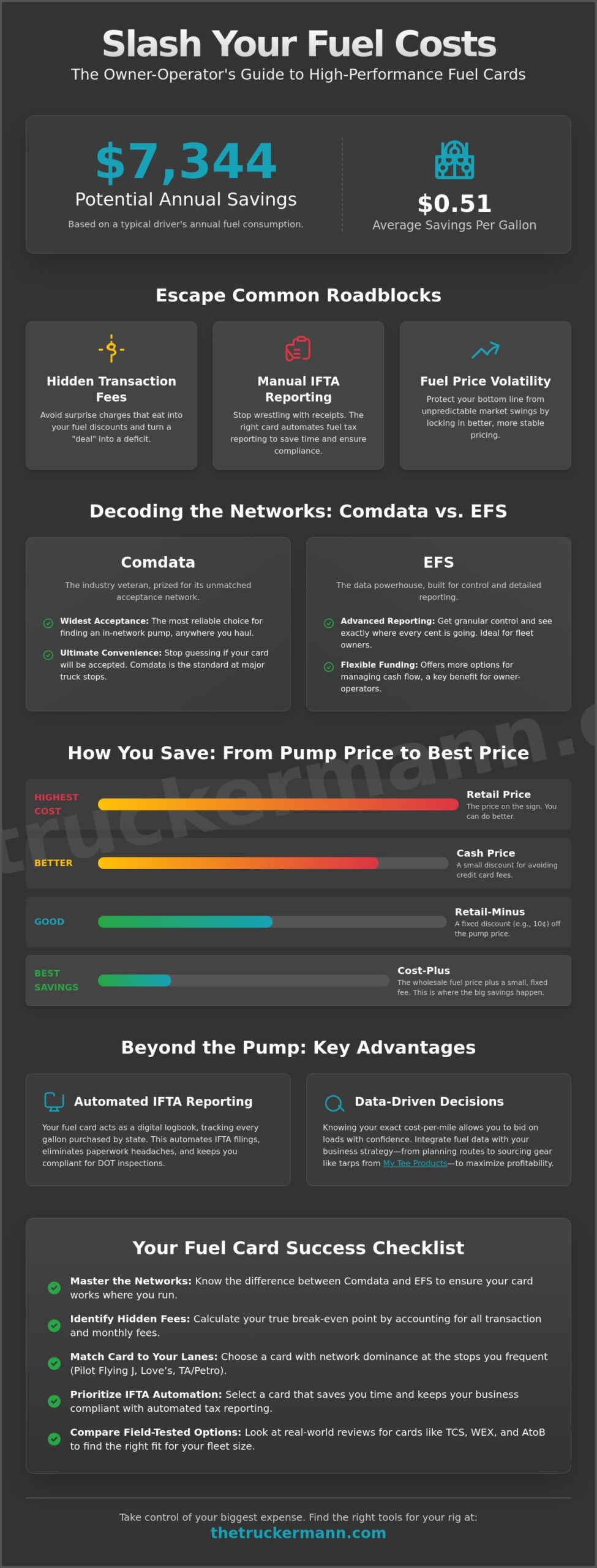
Hello, road warrior. Did you know that switching to a high-performance fuel card could save you upwards of $7,344 a year just by trimming $0.51 off every gallon? In this business, every cent counts, and leaving money at the pump is like letting air leak from your tires; it’s a slow drain on your hard-earned profit. Finding the right fuel cards for truckers is about more than just a quick discount. It’s about protecting your livelihood from the volatility of the energy market and the grit of the daily haul.
You’ve likely felt the frustration of hidden transaction fees that turn a “deal” into a deficit, and nobody wants to spend their limited downtime wrestling with manual IFTA reporting. You deserve a clear view of your expenses without the corporate headache. This guide breaks down how to slash your diesel costs using heavy hitters like the Truckstop Fuel Card, the AtoB Fuel Card, and the Triumph Fuel Card. We’ll compare the net savings, look at the real-world fees, and help you pick the tool that keeps your cash flow steady and your tanks full.
Key Takeaways
- Stop guessing which stops will take your card by mastering the differences between the Comdata and EFS processing networks.
- Protect your margins by identifying hidden transaction fees and calculating the exact break-even point for your monthly fuel spend.
- Optimize your haul by matching your specific freight lanes to the network dominance of Pilot Flying J, Love’s, and TA/Petro.
- Secure the best fuel cards for truckers to automate tedious IFTA reporting and keep your business compliant without the manual paperwork.
- Compare field-tested options like the TCS Fuel Card and the WEX Fleet Card to find the right fit for your specific fleet size.
Why Fuel Cards for Truckers are Essential in 2026
Diesel prices in 2026 have become a volatile beast. One week you’re coasting on a decent rate; the next, a global shift sends the pump price soaring. For an owner-operator, these swings aren’t just news headlines. They are direct hits to your bottom line. Using the right fuel cards for truckers is no longer a luxury for the big fleets. It’s a survival tactic for anyone behind the wheel who wants to keep their profit in their pocket rather than handing it over at the station. Listen, brother, the road doesn’t care about your overhead, but we do.
You might think your standard cash-back credit card is doing the job. It isn’t. A professional Fuel card is a specialized tool designed for the grit of the industry. It opens doors that retail plastic simply can’t touch. These cards provide access to wholesale pricing and specialized networks that understand the unique needs of a 53-foot trailer and the person driving it. Beyond the price, they offer a sense of camaraderie. When you’re part of a network like the Truckstop Fuel Card, you’re tapping into a community that knows where the best stops and lowest prices are located in real-time.
To better understand how these tools can transform your operation, watch this helpful video:
Think of your card as a digital sentinel. It acts as your mobile office, turning every transaction into a data point that helps you track fuel efficiency and spending patterns across different states. This isn’t just about saving a few cents. It’s about data-driven decision-making. When you’re looking for your next load on 123Loadboard, knowing your exact fuel cost per mile allows you to bid with confidence and protect your margins. Even your maintenance and gear, like the tarps and straps you get from My Tee Products, become part of a larger, more profitable business strategy.
The Difference Between Cash Price and Card Price
Truck stops operate on a two-tier system. The price you see on the big glowing sign is the retail price, but professional drivers rarely pay that. Many stations offer a cash price to avoid credit card processing fees, but high-volume diesel users get even better deals. You’ll encounter retail-minus, where you get a flat discount off the pump price, or cost-plus, which is based on the wholesale price plus a small margin. Programs like the TCS Fuel Card often leverage these models to save you significantly more than a cash payment ever could.
IFTA Automation: The Secret Benefit
Tax season shouldn’t be a nightmare of faded thermal receipts and coffee-stained logs. Modern fuel cards for truckers automate the heavy lifting of IFTA reporting by tracking every gallon and the state where it was purchased. This level of detail is a lifesaver if you’re ever pulled in for a review. Having clean, automated records makes it much easier to satisfy a DOT inspection level 1 checklist. When your fuel data integrates with your ELD, compliance becomes a background process, letting you focus on the next delivery.
Decoding the Major Fuel Card Networks: Comdata vs. EFS
Think of a fuel network as the invisible plumbing that makes your card work. When you swipe at the pump, you aren’t just paying for diesel; you’re triggering a processing engine that dictates where you can stop and what you’ll pay. The Comdata Fuel Card is the industry veteran, holding the title for the widest acceptance across major truck stops. It’s the reliable choice for drivers who prioritize convenience over everything else. If you see a diesel pump, there’s a high probability it accepts Comdata without a hitch.
On the other side of the coin, the EFS Fuel Card is known for its advanced data reporting and flexible funding options. It’s a favorite for fleet owners who need granular control over spending or owner-operators who want to see exactly where every cent is going. Newer players are now shaking things up with hybrid models. The AtoB Fuel Card and the Mudflap Fuel Card are bridging multiple networks to offer even better coverage. Keeping an eye on the U.S. Energy Information Administration (EIA) weekly updates helps you see how these network discounts stack up against the national average. It’s about staying one step ahead of the market and protecting your margins.
In-Network vs. Out-of-Network Savings
Staying in-network is the difference between keeping your profit and handing it back to the pump. When you use your card at a preferred stop, you get the deep discounts you signed up for. Fuel up out-of-network, and you might get hit with a “convenience fee” that wipes out your savings. Most modern programs offer a “Fuel Finder” app to help you stay within your discount zone. If you’re forced to use an out-of-network station, be prepared for a higher price and a possible transaction fee. It’s always better to plan your route using tools like 123Loadboard to find high-paying freight near your preferred stops.
Credit-Based vs. Cash-Secured Cards
For new owner-operators, credit history can be a major roadblock. Credit-based cards often require a solid score and a history of business operations. However, cash-secured options like the TCS Fuel Card provide an immediate workaround. You load your own funds onto the card, which gives you access to the same deep discounts as the big fleets without the credit check. This is a smart way to build business credit while keeping your overhead low. Whether you choose the Triumph Fuel Card or the Truckstop Fuel Card, picking the right funding model ensures you never run dry when the road gets tough.
Decoding Fees: The True Cost of ‘Saving’ at the Pump
Don’t let a flashy discount sign lead you into a financial trap. In this industry, a “discount” is only real if it survives the gauntlet of hidden charges. When you’re scouting for fuel cards for truckers, you have to look past the per-gallon headline and dig into the fee schedule. Transaction fees are the silent killers of your profit margins, especially if you’re an owner-operator who prefers to top off frequently. If you’re paying a $3 fee on a 50-gallon splash, you just added six cents to every gallon. That “savings” just went up in smoke. We’ve seen it happen to the best drivers, and it’s why we advocate for total transparency.
The “Zero Fee” model is gaining traction, but you should understand how it works. Companies like the Truckstop Fuel Card or the Mudflap Fuel Card often eliminate setup and maintenance costs, making their money through merchant partnerships instead of your pocket. Contrast that with the Comdata Fuel Card, which might carry an $8 monthly fee and a $50 setup charge. Neither is inherently bad, but they serve different needs. If you’re running a high-volume operation, an $8 fee is a drop in the bucket. If you’re a seasonal hauler, that fee keeps ticking even when your truck is parked. You’re the captain of your ship; choose the tool that fits your rhythm.
Hidden Charges Every Driver Should Know
Watch out for the surcharges that hide in the fine print. Out-of-network fees are the most common, often hitting you with a $3 penalty if you stray from preferred stops. Then there are the “funding fees.” If you’re using a cash-secured option like the TCS Fuel Card, check what it costs to move your money from your business bank account to the card. Even small things like account inactivity fees can bite you during a slow month. And please, don’t use your fuel card at an ATM. The cash advance fees are usually much steeper than a standard bank card, draining your cash flow before you even hit the highway.
Calculating Your Net ROI
To find your true savings, use this simple formula: (Total Gallons x Discount) minus (Monthly Fees + Transaction Fees). A card offering a 5-cent discount with zero fees often beats a 10-cent discount saddled with high monthly costs. For example, the AtoB Fuel Card Flex plan charges $15 a month for up to five cards, while the Triumph Fuel Card offers deep savings but is often bundled with factoring services. Factor in the time value too. If a card automates your IFTA reporting, it saves you hours of paperwork. That’s time you could spend booking your next high-paying haul on 123Loadboard instead of wrestling with a shoebox of receipts.
Strategic Route Planning: Matching Your Card to Your Lanes
Picking the right fuel cards for truckers is a lot like choosing the right rig for a specific haul. You wouldn’t take a day cab on a cross-country run; similarly, you shouldn’t carry a regional card if you’re crossing ten state lines a week. Your lane is your lifeline. If you’re hammering the I-95 corridor, you need a card with deep roots in the East Coast stops. If you’re a long-haul veteran, you want a card that’s welcomed at every Pilot Flying J, Love’s, and TA/Petro across the Lower 48. These ‘Big Three’ dominate the landscape with massive networks, but don’t overlook the independent ‘Mom and Pop’ stops. Sometimes, the best diesel prices are found at smaller stations that newer players like the AtoB Fuel Card or Mudflap Fuel Card specialize in. Acceptance matters just as much as the discount.
Think about where you actually stop. A card that offers 50 cents off at a station 20 miles off your route isn’t saving you anything once you factor in the out-of-route miles and lost time. You need to align your card’s network with your primary freight lanes. If you find yourself frequently hauling flatbed loads, you might want to plan your stops near major gear retailers. Stopping near My Tee Products locations allows you to restock on essential securement tools while you fill your tanks, maximizing your efficiency on every trip. It’s about making every minute of your downtime work for your business.
Regional vs. National Coverage
Your business model dictates your network needs. If you operate within a single state, your tax strategy and fuel needs differ wildly from those crossing state lines. Understanding the nuances of interstate vs intrastate trucking is vital for managing your IFTA obligations and choosing a card that supports your specific footprint. National haulers should look for cards like the OTR Fuel Card, which is accepted at more than 8,000 stations nationwide. Meanwhile, those focused on logistics securement should always keep their best flatbed trucking gear updated by visiting My Tee Products during their planned stops.
Amenities and Driver Loyalty Points
Fueling isn’t just about the truck; it’s about the driver. The best strategy involves stacking your fuel card discounts with truck stop loyalty programs. This is how you earn free showers, meals, and reserved parking. When you’re out there for weeks at a time, the ‘Cleanliness Factor’ and parking availability become just as important as the price per gallon. A clean facility and a safe place to sleep are essential for your long-term health and focus. Before you book your next load on 123Loadboard, check your card’s app to see which stops offer the best amenities for your reset. Staying healthy and rested is what keeps you profitable over the long haul.
Ready to maximize your earnings on every mile? Find high-paying loads that match your fuel network today.
The Top Fuel Cards for Truckers in 2026: Our Field-Tested Picks
Best for Owner-Operators: The TCS Fuel Card
If you’re running solo, you need a card that doesn’t nickel and dime you. The TCS Fuel Card has become a favorite in the community because of its transparent $0 transaction fee model at more than 2,300 locations nationwide. This transparency is vital when every cent of your margin is on the line. Their mobile app is a powerhouse, allowing you to hunt for the best real-time prices along your route so you never overpay for a fill-up. The TCS Fuel Card is the ultimate straight-shooter choice for solo drivers who want maximum savings without the corporate headache.
Best for Mixed Fleets: WEX and Comdata Solutions
As your business grows, you need more than just a discount; you need control. The WEX Fleet Card is often considered the gold standard for growing fleets because of its robust security features. You can set customizable spending limits to prevent unauthorized purchases and protect your business from driver fraud. Integrating the WEX Fleet Card or a Comdata Fuel Card with your ELD creates a total tech stack that simplifies management. These advanced reporting tools give fleet managers a clear view of fuel efficiency across multiple units, making tax season a breeze.
Equipping for the Long Haul
The money you save at the pump shouldn’t just sit there. Smart operators reinvest those savings into the safety and longevity of their rig. Protecting your load is just as important as the fuel in your tanks. We recommend using your extra margin to upgrade your securement gear. You can find high-quality tarps and straps at My Tee Products to ensure your freight stays put. For essential flatbed tools and recovery equipment, Truck n Tow offers a comprehensive selection that keeps your rig ready for any challenge the road throws at you. Keeping your gear in top shape with Truck n Tow and My Tee Products is a badge of identity for the serious professional.
Get the best rates on trucking gear at My Tee Products
Master Your Margins and Own the Road
You’ve got the tools now to stop the bleed at the pump. Choosing between the Comdata and EFS networks isn’t just a technicality; it’s a strategic move to keep your cash flow healthy. By looking past the advertised discounts and doing the math on transaction fees, you’re operating like a business owner, not just a driver. Remember that the right fuel cards for truckers are the ones that actually show up where you haul, matching your lanes with the best stops available.
We’re dedicated to bringing you veteran-owned insights and field-tested equipment recommendations that actually hold up under the pressure of the road. When you save on diesel, you can reinvest in the safety of your rig. Whether you need direct links to the industry’s most trusted networks or you’re ready to Secure your load with professional gear from My Tee Products, we’ve got your back. Head over to thetruckermann.com for more guides on mastering your career. Keep it safe out there, and keep those wheels turning.
Frequently Asked Questions
Do fuel cards for truckers really save money compared to cash?
Yes, fuel cards provide significantly better net savings than cash by granting you access to wholesale or “cost-plus” pricing that isn’t available to the general public. While paying cash might help you avoid some retail credit card surcharges, it doesn’t touch the deep network discounts offered by professional fuel cards for truckers. These programs can save you an average of $0.50 per gallon, which adds up to thousands of dollars in profit over a year of long-haul driving.
Can I get a fuel card with bad credit or as a new owner-operator?
You can absolutely secure a card even with a limited credit history or a low score by opting for a cash-secured or prepaid plan. The AtoB Fuel Card Unlimited plan, for instance, requires no credit check and allows you to access professional discounts immediately. These cards are designed to help you build business credit while keeping your rig moving, making them the perfect entry point for those just starting their journey in the industry.
How do fuel cards help with IFTA reporting and tax compliance?
Fuel cards automate the tedious process of tracking every gallon purchased and the specific state where the transaction occurred. This digital trail replaces the old shoebox of receipts and drastically reduces the time you spend on quarterly IFTA filings. By providing clean, timestamped data, these cards ensure you’re always prepared for a potential audit and help you maintain compliance without the manual headache of paper logs.
What is the difference between a fleet card and a commercial fuel card?
The terms are often used interchangeably, but fleet cards usually offer more granular controls for managers overseeing multiple drivers and units. A fleet card allows you to set specific spending limits, track driver-level performance, and prevent unauthorized purchases like snacks or lottery tickets. Commercial cards are geared toward business use but might offer fewer administrative tools, making them a simpler choice for solo owner-operators who don’t need to manage a crew.
Are there hidden fees associated with ‘free’ fuel cards?
Many “free” cards make their money through transaction fees, funding surcharges, or account inactivity penalties that aren’t always obvious at first glance. You might save $0.10 at the pump but get hit with a $3 fee for the transaction, which can wipe out your savings on smaller fills. It’s vital to read the fee schedule for any program, including the AtoB Fuel Card or others, to ensure the net ROI actually keeps more money in your pocket.
Can I use my fuel card for maintenance, tires, and roadside assistance?
Most professional fuel cards allow you to pay for essential maintenance and emergency roadside services at participating vendors within their network. This helps you keep all your business expenses in one place for easier accounting at the end of the month. If you need to pick up new securement gear like tarps or straps, you can use your fuel savings to shop at My Tee Products to keep your load safe and your rig compliant.
What happens if my fuel card is lost or stolen while I’m on a haul?
You can immediately freeze your card through the provider’s mobile app or by calling their 24/7 emergency support line to prevent unauthorized use. Most major networks offer rapid card replacement services, and some can even authorize a temporary “cardless” transaction so you aren’t stranded without fuel. It’s a good idea to keep the customer service number saved in your phone and have a backup payment method ready for emergencies.
How do I stack fuel card discounts with truck stop loyalty points?
You stack savings by swiping your fuel card for the per-gallon discount and then scanning your truck stop loyalty app to earn points for showers and meals. These are two separate systems, so you don’t have to choose one over the other. By using your card at a preferred stop like Pilot or Love’s, you get the lower price on diesel while simultaneously racking up points that cover your daily living expenses on the road.
Disclaimer
The information provided on The TruckerMann is for general informational and educational purposes only. While every effort is made to ensure the accuracy and reliability of the content, trucking laws, FMCSA regulations, DOT requirements, safety standards, and industry policies can change at any time. Readers are encouraged to verify all information with official government agencies, professional advisors, or qualified industry professionals before making business, legal, financial, safety, or compliance-related decisions.
The content shared on this website reflects personal opinions, experiences, research, and commentary and should not be considered legal, financial, medical, tax, or professional advice. The TruckerMann and its owners, contributors, affiliates, or representatives are not responsible for any losses, damages, violations, penalties, or liabilities resulting from the use or misuse of information found on this website.
Some content on this website may contain affiliate links, sponsored content, or promotional material. This means we may earn a commission at no additional cost to you if you choose to purchase through certain links.
By using this website, you agree that you do so at your own discretion and risk.