Last Tuesday, a rookie named Miller discovered just how small a Chicago alleyway feels when the sun is dropping and his ELD is screaming about a closing 14-hour window. We’ve all been there, white-knuckling the wheel while wondering if this career choice was a massive mistake. It’s no secret that your rookie season is the hardest thing you’ll ever do, especially with the FMCSA cracking down on digital compliance and the May 12-14, 2026, International Roadcheck looming. Getting the right advice for a trucker’s first year is the difference between a long, profitable career and a short, expensive lesson in frustration.
We understand the weight on your shoulders, from the fear of a failed roadside inspection to the quiet ache of missing home. This guide promises to transform that anxiety into professional confidence by giving you the veteran-backed strategies you need to master the road. We will preview the latest 2026 regulations, including the mandatory electronic MEC verification and the new ELD compliance deadlines that took effect this April. You’ll also learn how to rig your equipment for peak efficiency, manage your clock like a pro, and keep your driving record spotless through the toughest 12 months of your life.
Key Takeaways
- Reframe the first-year grind as a high-stakes training period, learning to navigate the tight urban docks and night shifts that define a rookie’s early schedule.
- Implement a disciplined pre-trip routine to stay ahead of inspectors, utilizing our veteran-backed advice for a trucker’s first year to maintain a spotless driving record.
- Invest in pro-grade securement and safety gear that goes beyond company-issued basics to prevent cargo claims and ensure your equipment is always road-ready.
- Protect your mental health and family relationships by establishing digital communication routines that bridge the gap between the cab and the home front.
- Transition into an entrepreneurial mindset by using 123loadboard to analyze freight lanes and prioritize profit-per-load over simple mileage.
Navigating the Rookie Reality: Schedules, Parking, and Expectations
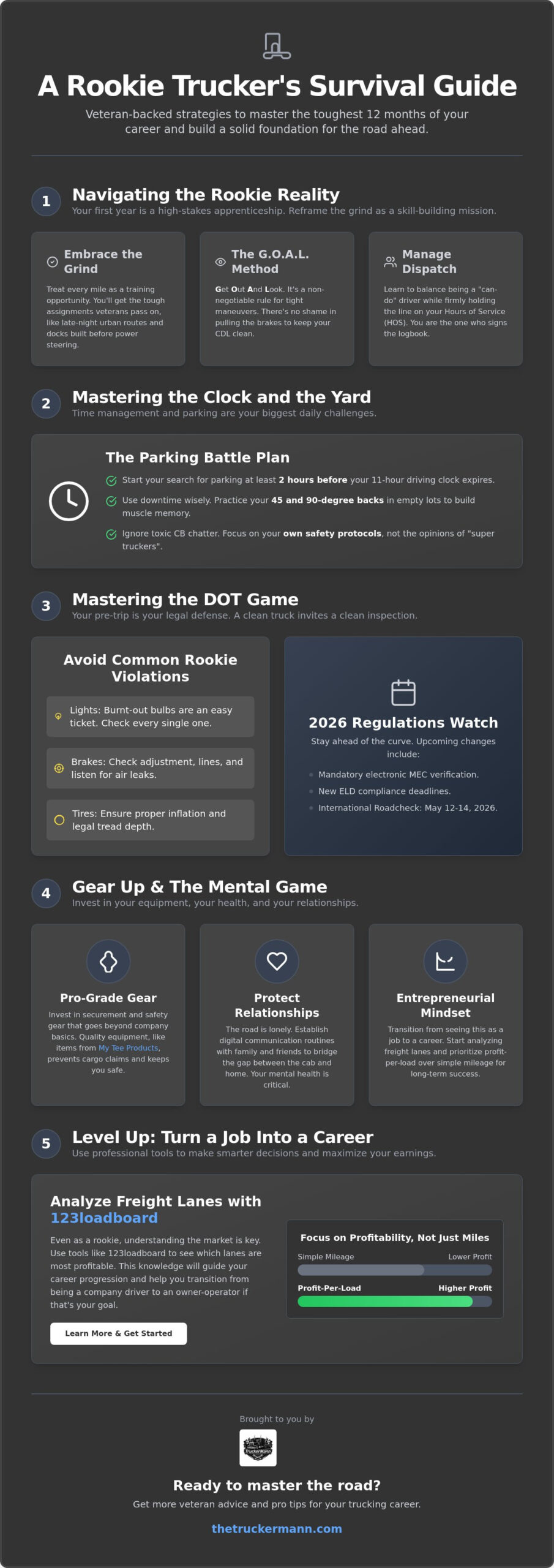
Welcome to the driver’s seat. Your first year behind the wheel isn’t just about moving freight; it’s a high-stakes apprenticeship where the lessons are written in diesel and sweat. Many newcomers view the early months as simple labor, but the best advice for a trucker’s first year is to treat every mile as a skill acquisition phase. You’re going to get the assignments the veterans pass on. This often means late-night urban routes where the streets are narrow and the docks were built before power steering existed. Understanding the gritty reality of life as a truck driver starts with accepting that you are a student for at least the first 365 days.
To better understand this concept, watch this helpful video:
Preparation is your only defense against the stress of urban deliveries. When you’re pulling into a tight receiver at 3:00 AM, the “GOAL” method (Get Out And Look) is your best friend. There is no shame in pulling the brakes and walking around your trailer. In fact, it’s a non-negotiable rule if you want to keep your CDL clean. Your relationship with your dispatcher will also be tested early on. They have loads to move, but you have a license to protect. Learn the balance of being a “can-do” driver while firmly holding the line when your Hours of Service (HOS) limits are reached. A dispatcher might push, but you’re the one who signs the logbook.
Mastering the Clock and the Yard
Parking is a battle of its own in 2026. While the U.S. Department of Transportation now requires states to include truck parking in their freight plans, the reality on the ground remains tight. You must start looking for a spot at least two hours before your 11-hour clock expires. Use your downtime wisely. If you find yourself in an empty lot, don’t just sit in the sleeper. Set up some cones or use the lines on the pavement to practice your 45 and 90-degree backs. You’ll also need to develop a thick skin. The CB chatter can be toxic, so ignore the “super truckers” and focus on your own safety protocols. Even using quality equipment from My Tee Products can draw comments from old-timers, but if it keeps your load secure and your hands safe, their opinion doesn’t matter.
Choosing Your Path Early
The road you choose now dictates your lifestyle for years to come. Over-the-road (OTR) trucking offers the biggest adventure and often the highest initial mileage, but it takes a heavy toll on your home life. Local routes might offer more time with family, but they often require more frequent, difficult backing maneuvers in congested areas. Think about your long-term financial goals before committing to a specific lane. If you’re still weighing the pros and cons of staying close to home versus seeing the country, check out our guide on Interstate vs. Intrastate Trucking: The 2026 Guide to Choosing Your Path. Even as a rookie, keeping an eye on market trends through tools like 123loadboard can help you understand which freight lanes are most profitable as you plan your career progression.
Mastering the DOT Game: Inspections and Pre-Trip Discipline
The moment you pull into a weigh station, you’re being graded. A DOT officer’s psychology is simpler than you think. They are looking for reasons to dig deeper. A clean truck is a silent communicator that says you’re a professional who respects the machine. If your dash is covered in trash and your paperwork is a crumpled mess, you’re essentially inviting a full-scale audit of your entire operation. The best advice for a trucker’s first year is to treat your pre-trip as a legal defense. You aren’t just checking lights; you’re ensuring that a roadside inspector finds nothing but a boring, compliant rig.
Common rookie violations often involve the “big three”: lights, brakes, and tire tread depth. You can spot a flickering marker light or a thinning steer tire in less than two minutes if you’re disciplined. This discipline is critical as we approach the CVSA International Roadcheck 2026, scheduled for May 12-14. This year, inspectors have a razor-sharp focus on cargo securement and false records of duty status or ELD tampering. With the FMCSA recently decertifying multiple ELD devices in early 2026, ensuring your hardware is still on the approved list is no longer optional; it’s a survival requirement.
The Pre-Trip Ritual
Consistency is your shield. A professional-grade pre-trip inspection follows the same path every single morning, from the driver’s side fuel tank to the rear impact guard. Don’t just kick the tires and hope for the best. Use digital tools to log maintenance issues the moment they appear so your company can’t claim they didn’t know about a faulty air line. For a detailed breakdown of what to look for under the hood and along the chassis, follow our CDL Pre Trip Inspection Checklist: The 2026 Master Guide.
Surviving the Roadside Level 1
A North American Standard Level 1 Inspection is a comprehensive 37-step procedure that includes an examination of both the driver’s credentials and the vehicle’s mechanical fitness, often requiring the inspector to get under the trailer. When the lights go on, stay calm. Hand over your documents with professional courtesy. Accuracy on your Driver Vehicle Examination Report is vital for your CSA score. If you want to know exactly what the officer is looking for while they’re under your rig, study The Ultimate DOT Inspection Level 1 Checklist: 2026 Driver’s Guide.
Training for the Long Haul
The regulations change fast. Between the new electronic MEC verification requirements and shifting ELD standards, you can’t rely on what you learned in CDL school six months ago. Continuous education is the hallmark of a high-earning professional. Given the positive truck driver job outlook, investing in yourself pays massive dividends. Many top-tier rookies use DLA Academy to stay ahead of FMCSA shifts and master the business of the road. You can find more resources to sharpen your skills at thetruckermann.com.
Gear Up Like a Pro: Essential Equipment for Your First Year
Most fleets hand you a basic starter kit and a set of keys, but that company-issued gear is often the bare minimum required to get the wheels turning. If you want to survive a brutal winter in the Rockies or keep your cargo intact through a tropical storm, you need pro-grade tools that won’t fail when the pressure is on. The best advice for a trucker’s first year is to invest in yourself by upgrading your kit early. High-quality gear isn’t just a luxury; it’s a safeguard against cargo claims, injuries, and the physical toll of the road. You can find official safety standards and compliance guides at the FMCSA Driver Resource Hub to ensure your personal setup meets federal expectations.
Personal protective equipment (PPE) is your first line of defense. Don’t rely on the cheap, thin gloves provided by the warehouse. You need heavy-duty, impact-resistant gloves that can handle frozen chains and grease-slicked fifth wheels. Steel-toed boots are a non-negotiable requirement at most docks, but comfort is just as vital for those long hours on the pedals. Inside the cab, your environment dictates your health. A high-wattage power inverter allows you to run a slow cooker or an air fryer, helping you avoid the “truck stop diet” that sidelines so many rookies. Ergonomic seating cushions are also essential for preventing the chronic back pain that often starts in the first 12 months.
Professional Load Securement
If you’re pulling a flatbed, your securement gear is the only thing standing between a successful delivery and a highway catastrophe. Veterans in the industry trust My Tee Products for durable flatbed equipment because they know the grit of the field requires hardware that can take a beating. Selecting the right winch straps and edge protectors from My Tee Products ensures your load stays stable through sharp turns and emergency braking. While your company might provide basics, Truck n Tow offers the heavy-duty recovery gear and specialized towing accessories that rookies often forget until they’re stuck in a muddy lot or facing a mechanical breakdown.
Weatherproofing and Tarping
Mastering the tarping game is a rite of passage. Tarping a load in 40-mile-per-hour winds or freezing temperatures is a test of character and equipment. Using heavy-duty tarps from My Tee Products allows you to protect high-value cargo from road salt, grime, and moisture without worrying about tears or grommet failures. Proper maintenance of this gear is also a regulatory necessity. Check your straps for frays and your chains for rust every morning. Keeping your securement kit from My Tee Products in top shape ensures you pass DOT inspections every time while projecting the image of a seasoned professional.
The Mental Game: Managing Family, Health, and the Road
The white lines can get lonely after fourteen days on the road. While the paycheck for a rookie ranges from $50,000 to $82,000 annually, with an average hourly rate of $27.09 as of June 2026, no amount of money fixes the ache of missing a child’s bedtime story or a spouse’s birthday. The #1 reason drivers hang up their keys in the first twelve months isn’t a bad engine; it’s the mental weight of isolation. The most vital advice for a trucker’s first year is to treat your mental health with the same discipline you apply to your pre-trip inspection. You aren’t just a driver; you’re the CEO of your own well-being. If you’re feeling overwhelmed by mechanical worries, having a plan with Truck n Tow for emergency recovery can provide the peace of mind you need to focus on the drive.
Staying Connected to Home
Involving your family in the journey makes them feel like part of the team rather than an afterthought. Show them your route on 123loadboard so they can track your progress and see the places you’re visiting. When you do get home, set hard boundaries. Your 34-hour reset should be a time for genuine recovery, not just catching up on sleep. Use this time for mental reset techniques like meditation or simply disconnecting from industry news to ensure you return to the cab with a clear head.
Healthy Habits for the Highway
The “Truck Stop Trap” is real and dangerous. When your only options at 2:00 AM are greasy burgers or heat-lamp hot dogs, your health will decline fast. Investing in a 12V cooler and a portable oven allows you to meal prep for the week, saving you thousands while keeping your energy levels stable. Simple in-cab exercises, like using resistance bands or doing bodyweight squats during a 30-minute break, can counteract the effects of sitting for 11 hours. Managing the rhythmic cadence of the road is also crucial to avoid highway hypnosis. Keep your mind active with educational podcasts or audiobooks from DLA Academy to turn your cab into a classroom. Learn how to balance your life and your logbook at thetruckermann.com.
Leveling Up: Turning a Job into a Career with 123loadboard
By mid-2026, the market has become even more data-driven. You can’t just wing it and hope for a good load at the fuel island. You need to understand freight capacity and seasonal shifts before you commit to a lane. If you’ve been sharpening your skills through DLA Academy, you already have the regulatory knowledge to avoid costly fines. Now you just need the right platform to find the work that actually makes sense for your bottom line. Transitioning to a career mindset means looking at the big picture of the logistics industry.
Mastering the Load Board
Smart rookies use 123loadboard to eliminate deadhead miles and find high-paying backhauls. With access to over 123,000 daily loads, 123loadboard gives you the leverage to vet brokers and shippers before you ever back into their dock. If you’re thinking about buying your own truck, the market data on 123loadboard is essential for planning your transition to owner-operator status. You can see which lanes are hot and which ones will leave you sitting for days. Using 123loadboard consistently helps you build a network of reliable brokers who know you deliver on time and without drama.
Professional Growth and Networking
Your reputation is built in the small moments, like how you handle a delay at a receiver or a breakdown in the middle of the night. Having a plan with Truck n Tow for recovery shows you’re prepared for anything. This year is about building a foundation of trust with everyone you meet, from the gate guard to the fleet manager. Final veteran advice: this profession is a lifestyle, not just a job. If you protect your license and use quality equipment from My Tee Products, you’ll find that the road offers more than just a paycheck; it offers a future. Keep your eyes on the horizon and your paperwork in order.
Own the Road and Secure Your Future
The first 365 days in the cab are about more than just moving freight; they’re a high-stakes apprenticeship where your reputation is forged in diesel and discipline. Success requires a relentless focus on the fundamentals, from mastering the 2026 electronic MEC verification requirements to maintaining the mental resilience needed for long-haul isolation. This veteran-tested advice for a trucker’s first year is your roadmap to a clean MVR and a career that pays dividends for decades. By integrating the latest regulatory updates and professional load securement techniques, you transition from a rookie driver to an essential professional who commands respect at every dock.
You’ve navigated the urban tight spots and survived the night shifts. Now, it’s time to ensure your equipment is as professional as your mindset. Having direct access to DOT-compliant gear ensures you stay on the road and out of the inspection bay. Master your first year with the right gear and professional insights that turn this job into a lifelong mission. Don’t just settle for surviving the grind when you have the tools to dominate it. Check out the full selection of professional equipment at My Tee Products and keep your wheels turning toward a profitable future. You’ve got this, driver.
Frequently Asked Questions
How do I handle the stress of backing into tight docks as a rookie?
Utilize the GOAL (Get Out And Look) method every single time you lose sight of your trailer’s path or feel uncertain. It’s better to be the slow driver who gets out three times than the fast driver who takes out a hood or a dock door. Take your time and ignore the pressure from other drivers on the CB. Your CDL is more important than their five minutes of saved time; professional drivers respect a rookie who prioritizes safety over speed.
What is the best way to stay healthy while living in a truck?
Invest in a 12V cooler and a portable oven to prepare your own meals instead of relying on truck stop fast food. Consistent meal prepping is the best advice for a trucker’s first year health. Small habits, like drinking a gallon of water daily and doing fifteen minutes of bodyweight exercises during your 30-minute break, will prevent the weight gain and fatigue common in your rookie season. Your health is your most valuable asset on the road.
How often should I perform a pre-trip inspection during my first year?
You must perform a full pre-trip inspection before every shift and every time you pick up a new trailer or piece of equipment. This isn’t just a suggestion; it’s a legal requirement to ensure the vehicle is safe for public roads. During your rookie year, extra vigilance helps you identify wear and tear on brakes and tires before they become out-of-service violations during a roadside audit. Catching a small air leak now saves you a massive headache later.
Can I fail a DOT inspection for a dirty truck or disorganized cab?
Yes, an officer can cite you for a messy cab if debris interferes with the safe operation of the vehicle or blocks your view of the mirrors. More importantly, a filthy truck is a red flag that suggests you might be neglecting mechanical maintenance. Keeping a clean rig signals to the inspector that you are a professional, which often leads to a faster and less intrusive Level 1 inspection. Professionalism starts with the appearance of your equipment.
What are the most common mistakes rookie truckers make with their ELD?
Forgetting to log out of the device or failing to verify daily logs are the most frequent errors that lead to violations. In 2026, the FMCSA has decertified several devices, so you must ensure your hardware is still on the approved list before the April 14, 2026 deadline. Operating with a non-compliant or uncertified device is treated the same as having no logbook at all. Always double-check your status before you pull out of the yard.
How do I manage my 14-hour clock when facing unexpected shipper delays?
Communicate with your dispatcher immediately and document the delay in your ELD notes to provide a clear paper trail for the delay. While the 14-hour clock is a hard limit, knowing how to use the split-sleeper berth rule can offer some flexibility when you’re stuck at a dock. Always plan your day with a two-hour buffer to account for the congestion often found at urban receivers. Proper time management is a skill that takes months to master.
Is it better to stay with one company for the entire first year?
Staying with your first carrier for a full twelve months shows future employers that you are reliable and capable of handling the grind. Job-hopping during your rookie season can make you look like a high-risk hire to insurance companies. This stability is the best advice for a trucker’s first year if you want to qualify for specialized, higher-paying contracts in your second year. Build your reputation first, then look for the bigger paychecks.
What gear should I buy myself versus what the company provides?
Your company usually provides basic safety equipment, but you should buy your own high-quality securement tools and personal comfort items. Professional-grade straps and tarps from My Tee Products are more durable than the cheap versions often found in company shops. Investing in your own gear from My Tee Products ensures you have reliable equipment that won’t fail during a critical load. Don’t skimp on the tools that protect your cargo and your career.
Disclaimer
The information provided on The TruckerMann is for general informational and educational purposes only. While every effort is made to ensure the accuracy and reliability of the content, trucking laws, FMCSA regulations, DOT requirements, safety standards, and industry policies can change at any time. Readers are encouraged to verify all information with official government agencies, professional advisors, or qualified industry professionals before making business, legal, financial, safety, or compliance-related decisions.
The content shared on this website reflects personal opinions, experiences, research, and commentary and should not be considered legal, financial, medical, tax, or professional advice. The TruckerMann and its owners, contributors, affiliates, or representatives are not responsible for any losses, damages, violations, penalties, or liabilities resulting from the use or misuse of information found on this website.
Some content on this website may contain affiliate links, sponsored content, or promotional material. This means we may earn a commission at no additional cost to you if you choose to purchase through certain links.
By using this website, you agree that you do so at your own discretion and risk.