Welcome back to the yard. Tire issues are currently the second most common out-of-service violation found during roadside inspections, trailing only behind brake failures. When you’re staring down a Level 1 inspection, the last thing you want is a DOT officer measuring a 2/32 tread depth on your drive tires or spotting a separation you missed during your pre-trip. Finding the best tires for long haul trucking isn’t just about brand loyalty; it’s about protecting your livelihood from the 8% price hikes that hit the market in May 2026. You’ve felt the squeeze at the pump and the parts counter, and you know every mile counts toward your bottom line.
We agree that the cheapest tire on the rack often ends up being the most expensive one on the road once you factor in rolling resistance. This guide will help you master the economics of your rubber by choosing tires that slash fuel costs and keep the inspectors off your back. We’ll break down the top-rated SmartWay verified models for this year, explain the recent FMCSA rule change regarding sidewall markings, and show you how to calculate true cost-per-mile. Because for us, the road isn’t just a job; it’s a lifestyle.
Key Takeaways
- Identify the specific performance demands for steer, drive, and trailer positions to maximize safety and tread life across every axle.
- Navigate the science of rolling resistance and SmartWay verification to significantly reduce your rig’s second-highest operating expense.
- Stay ahead of DOT inspectors by mastering the 4/32 and 2/32 tread depth rules alongside critical out-of-service criteria like bulges and exposed cords.
- Secure your bottom line by selecting the best tires for long haul trucking that offer high-quality casings for future retreading and long-term CPM savings.
- Implement a rigorous maintenance schedule focused on alignment and rotation to protect your rubber from premature wear and high thermal loads.
The High Stakes of Long-Haul Rubber: Why Your Choice Matters
Long-haul trucking isn’t just about moving freight from point A to point B. It’s about managing a rolling laboratory of physics. When you’re cruising at 70 mph for ten hours straight, your tires aren’t just touching the road; they’re fighting it. The best tires for long haul trucking are engineered specifically for this high-speed, high-stress environment where constant friction creates massive thermal loads. Unlike regional work where you’re constantly turning and scrubbing tread, long-haul rubber needs to stay cool while maintaining a steady footprint on the open interstate.
Tires rank as your second largest operating expense, sitting right behind fuel. With the price increases of up to 8% seen in May and June 2026 from major manufacturers, a bad choice doesn’t just hurt your ride; it bleeds your bank account. Choosing a regional tire for interstate work is a common rookie mistake. Regional tires have thicker sidewalls and compounds designed for tight turns, but those same features trap heat on the highway. This leads to tread separation and premature casing failure. The 2026 outlook is further defined by the March 23, 2026 FMCSA amendment that removed the requirement for tire load restriction markings on sidewalls, shifting more responsibility onto you to verify your equipment’s limits during pre-trip inspections.
Heat: The Silent Killer of Long-Haul Tires
Sustained highway speeds are the primary enemy. As the tire rotates, it flexes, a process known as hysteresis. This flexing generates internal heat. If that energy isn’t dissipated, the bond between the tread and the casing begins to break down. Modern Tire technology and manufacturing focuses on specialized compounds that stay stable at higher temperatures. Cheap rubber lacks these advanced polymers, meaning the tire gets greasy and wears unevenly. Worse, the casing fatigues so much that it becomes ineligible for a retread. You’re effectively throwing away a valuable casing credit because you tried to save a few bucks on the initial purchase.
Understanding Cost-Per-Mile (CPM) Calculations
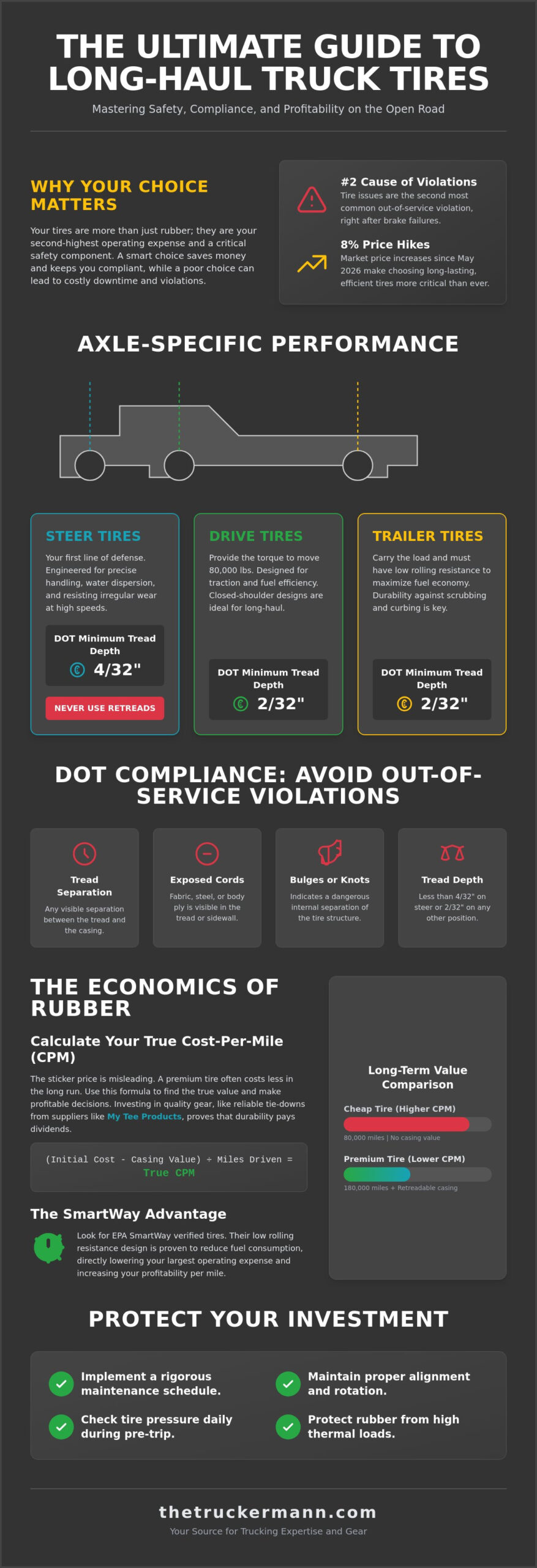
We need to stop looking at the sticker price at the service center. A cheaper tire that lasts 80,000 miles is significantly more expensive than a premium tire that gives you 180,000 miles and a solid casing. To calculate your true value, use this formula: (Initial Cost minus Casing Value) divided by Miles Driven. If you’re using high-quality gear from suppliers like My Tee Products to secure your loads and protect your equipment, you already understand that quality pays for itself. Cost-per-mile is the ultimate metric for measuring the long-term profitability and durability of your equipment investment. By tracking this, you can see exactly which brands are surviving the latest efficiency standards and which are failing the test of the open road.
Axle-Specific Performance: Steer, Drive, and Trailer Positions
Don’t treat your rig like a passenger car where you just rotate four identical tires and call it a day. In our world, every axle has a specific mission, and a truck is only as reliable as its weakest wheel position. The best tires for long haul trucking are designed to handle the distinct physics of steering, driving, and trailing. If you mix them up, you aren’t just wasting money; you’re creating a safety hazard that could end your career or land you with a massive fine during a roadside inspection.
Steer Tires: Your First Line of Defense
Your steer tires are the only thing standing between you and a ditch. They need to provide precise handling and resist the irregular wear patterns common on the interstate, like river wear and cupping. Look for designs with decoupling grooves. These thin slots on the outer edge of the tread help the tire flex without distorting the footprint, which keeps your steering stable at high speeds. Never, under any circumstances, run a retread on your steer axle. It’s a risk that seasoned veterans won’t take, regardless of what the regulations might allow. You need a virgin casing for that 4/32-inch minimum tread depth to ensure you can handle a sudden downpour or a quick lane change.
Drive and Trailer Tire Dynamics
Drive tires provide the torque to move 80,000 pounds, but they also contribute heavily to your fuel bill. For long-haul routes, closed-shoulder designs are the gold standard for the best tires for long haul trucking on the drive axle. They offer a continuous rib on the edge that promotes even wear and reduces rolling resistance compared to the aggressive, open-shoulder lugs you’d see on a logging truck. Many fleets in 2026 are switching to wide-base singles, or “super singles,” to shed weight and improve MPG. When selecting these, check the EPA SmartWay Standard to ensure you’re getting the 3% fuel savings these tires promise.
Trailer tires might seem like an afterthought because they just follow the leader, but they face brutal scrubbing during tight maneuvers. They need reinforced sidewalls to handle lateral stress. Even though the DOT only requires 2/32-inch tread depth on trailers, running them that low on a cross-country haul is asking for a blowout. When you’re inspecting your trailer, make sure you’ve got high-quality equipment from My Tee Products to keep everything tight and secure. If you’re looking for better loads to pay for that new set of drive tires, you might want to check out 123loadboard for the latest high-paying freight.
Fuel Efficiency and the SmartWay Standard
Fuel isn’t just a line item on your settlement; it’s the monster that eats your profit every single week. If you’re looking to starve that monster, you need to understand the EPA SmartWay Program. This isn’t just a government sticker for the sake of bureaucracy. It’s a verified standard that proves a tire can actually keep money in your pocket by reducing rolling resistance. The best tires for long haul trucking are engineered to minimize tread deformation, which is the energy lost as the rubber bends and snaps back into shape while rolling under a 40,000-pound trailer load.
Think about it. Every time that tire flexes, it’s taking a bite out of your momentum. While deep-tread “mileage” tires might look like they’ll last forever, their extra rubber often generates more heat and resistance, costing you more at the pump than you save on the tread. A 3% reduction in rolling resistance might sound small, but over 100,000 miles, that’s thousands of dollars back in your maintenance fund. It’s the difference between barely scraping by and having the capital to upgrade your rig with high-quality gear from My Tee Products. When you choose the best tires for long haul trucking, you’re choosing to keep that money in your own pocket instead of handing it to the fuel desk.
The 2026 SmartWay Verified Advantage
Look for the logo on the sidewall before you sign the work order at the service center. In 2026, the updated standards for low rolling resistance (LRR) tires ensure that you aren’t sacrificing as much tread life as you used to in the past. Modern compounds have narrowed the gap between “fuel tires” and “mileage tires” by using advanced polymers that resist wear while staying flexible. You’re getting the efficiency without the headache of frequent tire swaps. It’s a win for your CPM and a win for your uptime.
Aerodynamics and Tires
The synergy between your tire choice and your trailer’s aerodynamic profile is often overlooked. If you’re running wide-base singles, you’re reducing the churning air between duals, which complements your trailer skirts and tail fairings. This total-system approach is how veterans stay profitable in a volatile market. It’s about more than just the rubber; it’s about how that rubber interacts with the air and the road. While you’re dialling in your efficiency, don’t let a simple inspection catch you off guard. You should check out The Ultimate DOT Inspection Level 1 Checklist to make sure your fuel-efficient setup is also 100% compliant before you roll through the scales. Keeping your rig tight with accessories from My Tee Products ensures that your focus stays on the road, not on potential violations.
DOT Compliance: Keeping Your Tread Legal and Safe
Roadside inspections are the ultimate test of your maintenance routine. While you’re chasing the best tires for long haul trucking to save on fuel, the DOT is looking for specific reasons to put you out of service. The Federal Motor Carrier Safety Regulations, specifically 49 CFR §393.75, are very clear on the minimums. You need at least 4/32 of an inch of tread depth on your steer tires and 2/32 on everything else. If you roll through a scale with a 3/32 steer, you aren’t just getting a ticket; you’re getting a violation that hits your CSA score and your company’s reputation.
Inspectors also check for structural failures during a Level 1 check. Any tire with an audible air leak, a bulge, or a knot that indicates sidewall separation is an immediate out-of-service violation. If they see exposed body ply or belt material, you’re staying parked until a service truck arrives. When you’re securing your load with high-quality straps from My Tee Products, take an extra minute to look at your sidewalls for these defects. Mismatched duals are another common trigger. If one tire is significantly smaller or has a different tread pattern than its partner, it causes uneven loading. This leads to overheating and can alert an observant officer that your maintenance isn’t up to par.
The Tire Inspection Checklist for Drivers
Don’t rely on a “thumper” to tell you if your rubber is good. Use a real tread depth gauge and check at least three spots across the tire’s width. Check for toe-in or toe-out wear; if the inner or outer edge is feathering, your front end needs work before it ruins a premium steer tire. After an emergency braking event, inspect your drives for flat spots. These cause vibrations that destroy your wheel seals and cabin comfort, eventually leading to a failure that an inspector will certainly notice.
Pressure Management: The Secret to Compliance
Under-inflation is the leading cause of tire-related violations. When a tire is low, the sidewalls flex excessively, creating the same internal heat we discussed earlier. By 2026, Automatic Tire Inflation Systems (ATIS) have become standard for many trailers, but they don’t replace a manual check. You need to verify your pressures every morning before you pull out of the yard. Use high-quality tire gauges found at Truck n Tow to ensure your readings are accurate and consistent.
Keeping your rig compliant means more than just having deep tread; it’s about the total package. If you want to master your pre-trip and avoid the “red tag” at the weigh station, download our full Level 1 inspection guide to stay road-ready. When you combine the best tires for long haul trucking with a vigilant inspection routine, you ensure that your profit stays in your pocket instead of going toward fines.
Sourcing and Maintaining Your Investment
Buying the best tires for long haul trucking is only half the battle. You’ve got to protect that investment through the entire lifecycle to see a real return. When you’re comparing brands at the dealer, look beyond the initial tread and check the casing guarantee. A high-quality casing that can handle two or three retreads is what separates a professional operation from a rookie mistake. Most premium manufacturers in 2026 offer warranties that cover the casing for up to seven years. If a manufacturer won’t stand behind their casing, they don’t deserve your hard-earned money.
Regular maintenance keeps your CPM low and your rig out of the repair shop. You should rotate your drive tires every 40,000 to 50,000 miles to ensure they wear evenly across the tandem. Alignment is just as critical. A truck that pulls even slightly to one side is literally scrubbing dollars off your steer tires with every revolution. While you can handle basic pressure checks yourself, trust a professional service center for alignments and high-speed balancing. They have the laser-guided equipment to ensure your rig tracks straight and true down the interstate.
Where the Professionals Gear Up
Having the right tools on your truck can be the difference between a quick fix and a long night on a dangerous shoulder. For specialized securement gear and tire maintenance tools, many veterans rely on My Tee Products. They provide the grit-tested equipment needed to keep your load stable and your rig moving. If you’re looking for reliable roadside tools to handle minor tire issues or pressure adjustments, Truck n Tow is a staple for the community. Beyond just hardware, mastering the business side of trucking is essential for long-term survival. The DLA Academy offers professional training that helps owner-operators and fleet managers navigate the complex economics of equipment and maintenance. Using gear from My Tee Products ensures your cargo stays put while your rubber stays on the pavement.
To find additional tools and high-quality accessories for your rig, you can explore Affiliate Product Referrals through MG Affiliate Store.
Final Pre-Trip Tire Ritual
Your pre-trip isn’t just a regulatory chore; it’s your daily insurance policy. Integrating a deep tire check into your CDL Pre Trip Inspection ensures you catch small problems before they turn into catastrophic blowouts. A five-minute walk-around with a gauge and a flashlight can save you five hours of downtime and a thousand-dollar road call. Remember, when you’re looking for the best tires for long haul trucking, you’re looking for a partner for the long road ahead. Your tires are the only thing between your load and the road, so treat them right and they’ll keep your settlement checks looking healthy.
Master the Road with Every Revolution
Success in the long-haul game isn’t just about the miles you’ve covered; it’s about the miles you have left in your rubber. We’ve walked through the vital importance of axle-specific selection, the fuel-saving power of the SmartWay standard, and the hard numbers behind cost-per-mile calculations. Choosing the best tires for long haul trucking is a commitment to your business’s future and a shield against the rising costs we’ve faced in 2026. By staying vigilant with your pre-trip inspections and respecting the physics of heat and load, you keep your rig compliant and your settlement checks where they belong.
You don’t have to navigate these economic shifts alone. Our veteran-owned insights and updated regulatory guidance are here to act as your sentinel on the open interstate. It’s time to take control of your maintenance and turn your tires from an expense into a competitive advantage. Equip your rig with the best gear from My Tee Products and Truck n Tow today. Stay safe, stay profitable, and we’ll see you at the next fuel stop.
Frequently Asked Questions
What is the best tread depth for long-haul steer tires?
You need a minimum of 4/32 of an inch to stay legal, but most veterans pull them at 6/32 of an inch. This ensures you maintain enough grip to handle sudden heavy rain or standing water on the interstate. Running them down to the legal limit increases your risk of hydroplaning and makes the truck feel flighty in the wind. It’s better to swap early than to risk a jackknife in a summer downpour.
Can I use retreaded tires on my drive axles for long-haul routes?
Yes, you can legally use retreads on everything except the steer axle. While some drivers prefer virgin rubber for all positions, modern retreading technology has come a long way in terms of reliability. If you’re managing your CPM closely, a high-quality retread on a premium casing is a smart way to get more life out of the best tires for long haul trucking without compromising your safety or your schedule.
How often should I check my tire pressure on cross-country trips?
You should check your pressure every single morning during your pre-trip inspection while the tires are still cold. Heat from the road causes pressure to rise, which can give you a false reading if you check them mid-day. Using a reliable gauge from a supplier like My Tee Products ensures you get an accurate reading every time. Consistent pressure is the only way to prevent irregular wear and maximize your fuel efficiency.
Are wide-base single tires better than duals for fuel efficiency?
Wide-base singles typically offer a 3% improvement in fuel efficiency compared to standard dual setups. They reduce the total weight of the rig and have less sidewall flex, which lowers rolling resistance. You have to weigh these savings against the fact that a single blowout on a wide-base tire leaves you stranded on the shoulder. Duals give you a limp-home option that singles simply don’t provide.
What does a DOT inspector look for on tire sidewalls?
Inspectors are hunting for bulges, knots, deep cuts, or any sign that the internal structure of the tire is failing. They also listen for audible air leaks and look for exposed cords or belt material. As of March 23, 2026, load restriction markings are no longer required on the sidewalls, but they’ll still check for general integrity and matching sizes on the same axle to ensure the rig is safe.
How many miles should a set of premium long-haul drive tires last?
A set of premium drive tires should last between 180,000 and 250,000 miles if you stay on top of your rotations and alignment. Your specific route and load weight play a huge role in this number. If you’re running heavy over the Rockies, you’ll see faster wear than someone hauling light loads across the flat plains. Proper maintenance is the only way to reach those higher mileage targets.
What is the “SmartWay” certification for truck tires?
SmartWay is an EPA program that verifies specific tire models for low rolling resistance. When you buy a SmartWay verified tire, you’re getting a product that has been tested to reduce fuel consumption by at least 3%. It’s a reliable shortcut for finding the best tires for long haul trucking when your primary goal is slashing your weekly fuel bill and reducing your overall operating costs.
Does tire alignment really affect my fuel mileage?
Yes, a misaligned truck can drop your fuel mileage by as much as 2% because your tires are essentially being dragged sideways down the road. This creates extra friction and heat, which kills your tread life and forces the engine to work harder. Keeping your axles square is one of the cheapest ways to protect your rubber and your profit margins. A simple alignment check can save you thousands over a year.
Disclaimer
The information provided on The TruckerMann is for general informational and educational purposes only. While every effort is made to ensure the accuracy and reliability of the content, trucking laws, FMCSA regulations, DOT requirements, safety standards, and industry policies can change at any time. Readers are encouraged to verify all information with official government agencies, professional advisors, or qualified industry professionals before making business, legal, financial, safety, or compliance-related decisions.
The content shared on this website reflects personal opinions, experiences, research, and commentary and should not be considered legal, financial, medical, tax, or professional advice. The TruckerMann and its owners, contributors, affiliates, or representatives are not responsible for any losses, damages, violations, penalties, or liabilities resulting from the use or misuse of information found on this website.
Some content on this website may contain affiliate links, sponsored content, or promotional material. This means we may earn a commission at no additional cost to you if you choose to purchase through certain links.
By using this website, you agree that you do so at your own discretion and risk.