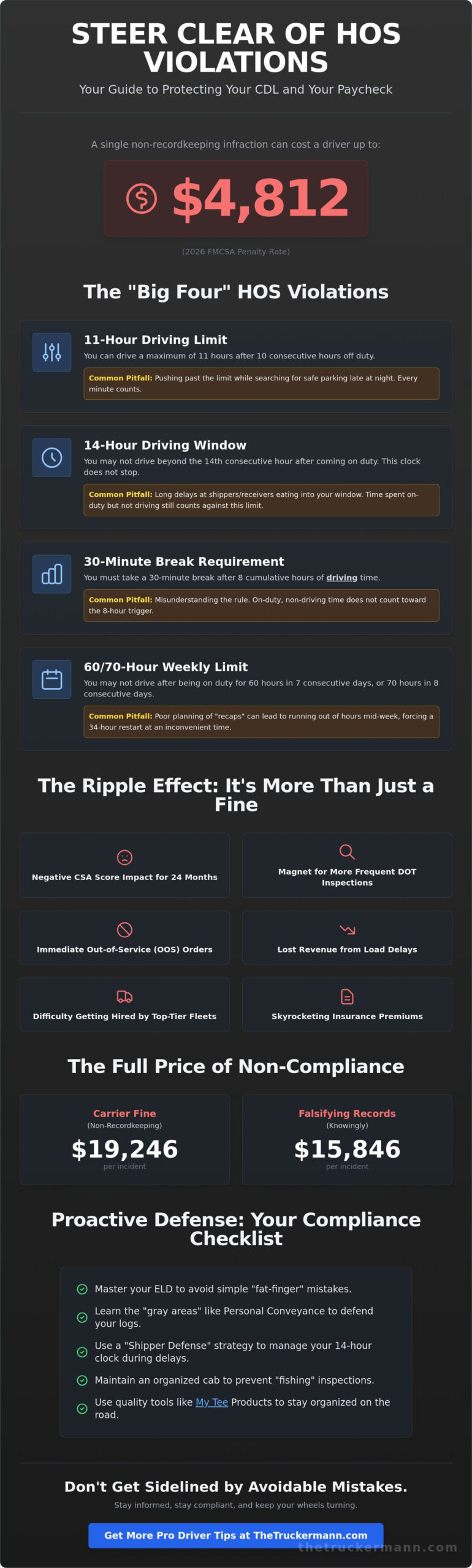
Hey there, driver. Would you hand over nearly five thousand dollars to a DOT officer just because you hit the wrong button on your tablet? In 2026, a single driver non-recordkeeping infraction can cost you up to $4,812; it’s a price tag that proves the government isn’t playing games with your livelihood. You’ve felt the heat when a receiver drags their feet while your 14-hour clock ticks away, and we all know the headache of trying to explain Personal Conveyance to an inspector who’s having a bad day. These common hours of service violations aren’t just paperwork errors. They are direct threats to your CDL and your ability to pull high-paying loads in a competitive market.
I understand the grind, and I’m here to make sure you don’t get sidelined by avoidable mistakes or aggressive enforcement. This guide delivers the veteran tactics you need to master your ELD, including how to leverage the latest sleeper berth pilot programs and manage shipper delays without catching an OOS order. We’ll also look at how resources like My Tee can help you stay organized and compliant on the road. By the time you finish reading, you’ll have a clear roadmap to protecting your CSA score and keeping your wheels turning legally.
Key Takeaways
- Understand the heavy financial stakes of HOS non-compliance in 2026 to keep your career on track and your record clean.
- Identify and master the “Big Four” common hours of service violations that lead to the most frequent roadside out-of-service orders.
- Learn how to navigate the “gray areas” of Personal Conveyance and ELD data entry to avoid being penalized for simple technicalities.
- Use the “Shipper Defense” strategy to manage your 14-hour clock effectively when facing long delays at the loading dock.
- Discover how maintaining an organized cab and professional mindset can prevent “fishing” inspections and protect your CSA score.
The Real Cost of Common Hours of Service Violations
When you’re out on the slab, your clock is as vital as your fuel gauge. Failing to comply with FMCSA Part 395 regulations, better known as Hours of service (HOS) regulations, isn’t just a minor clerical error. It’s a direct hit to your livelihood. We look out for each other on the road because we know that fatigue doesn’t just put your CDL at risk; it puts your brothers in the neighboring lanes in danger. These common hours of service violations serve as a red flag to enforcement, signaling that a driver or a carrier might be cutting corners on safety. When you catch a violation, it sticks to your CSA score like road tar for 24 months, making you a magnet for every weigh station scale from here to the coast.
Getting hit with an Out-of-Service (OOS) order is the ultimate momentum killer. It’s not just the fine you have to worry about; it’s the lost revenue from a load that’s now sitting still, the potential towing fees if you’re in a bad spot, and the nightmare of a forced restart under the watchful eye of an inspector. To better understand how these infractions impact your day-to-day, watch this helpful breakdown:
Why the DOT Prioritizes HOS Enforcement
Safety officials aren’t just being difficult when they scrutinize your logs. Their data shows a straight line between HOS non-compliance and fatigue-related accidents. If an officer spots a trend of common hours of service violations in a carrier’s history, they’re much more likely to pull you in for a full DOT inspection level 1 checklist screening. While ELDs were supposed to make life easier, they’ve actually made violations harder to hide. Every “fat-finger” mistake or missed status change is recorded in digital ink, giving inspectors a roadmap to your errors.
Financial and Career Consequences
The ‘Big Four’: Breaking Down Frequent HOS Infractions
Success on the road isn’t just about how fast you can turn a mile; it’s about how well you manage your energy and your compliance. Most common hours of service violations stem from the “Big Four” rules that every driver knows but many struggle to execute perfectly under pressure. The 11-hour driving limit is the most straightforward, yet it’s often the first thing to break when you’re searching for safe parking late at night. You’ve got exactly 11 hours to move that freight after 10 consecutive hours off-duty, and once that clock hits zero, you’re a sitting duck for a violation if your wheels are still turning.
Then there’s the 30-minute break requirement. You must take a half-hour breather after 8 cumulative hours of driving time. It sounds simple, but drivers often trip up by forgetting that on-duty, non-driving time doesn’t trigger the break; only actual time behind the wheel does. For a complete look at the technicalities, the FMCSA provides a solid summary of the HOS regulations that every driver should keep bookmarked. Managing your 60/70-hour weekly limit is another balancing act, especially when you’re running “recaps” and trying to avoid a full 34-hour restart just to stay moving.
Mastering the 14-Hour Clock
The 14-hour clock is the silent killer of many clean inspections because, unlike your driving clock, it never stops ticking once you’ve come on duty. Whether you’re stuck at a receiver’s gate or grabbing a quick sandwich, that window is closing. Drivers often lose track of this during long unloads, only to realize they’ve run out of time to find a legal spot for the night. The 14-hour rule is a non-extendable daily limit that strictly governs your window of opportunity to drive.
Using the Split Sleeper Berth Provision Correctly
If you want to play the game like a pro, you have to master the split sleeper berth provision. Current rules allow you to split your 10-hour rest into 7/3 or 8/2 periods, provided one period is at least 7 hours in the sleeper. In 2026, we’re even seeing pilot programs testing 6/4 and 5/5 splits, which shows the industry is finally moving toward more flexibility. When used correctly, these splits “pause” your 14-hour clock, giving you back the time you lost at a slow dock. The danger lies in the math; one wrong calculation on your ELD can lead to an OOS order. Keeping your logs straight is easier when you’re comfortable, so make sure your sleeper is rigged with quality gear from My Tee to get the rest you need. If you’re struggling to find freight that fits your remaining hours, you can find loads that respect your clock and keep you legal.
ELD Technicalities and the ‘Gray Area’ Violations
Digital logs were supposed to end the “comic book” era of paper logs, but they’ve introduced a whole new set of common hours of service violations that can catch even a seasoned pro off guard. These aren’t always about how many miles you’ve turned; they’re often about the “small” stuff that an inspector can spot in seconds. Form and Manner violations, like missing trailer numbers or shipping document IDs, are easy wins for a DOT officer. They might seem like minor clerical errors, but they signal to an inspector that you aren’t paying attention to the details, which usually leads them to dig deeper into your status changes.
Yard Move mistakes are another frequent trap for the unwary. If you’re shuffling trailers in a terminal and forget to switch back to ‘Driving’ mode when you hit the public road, your log is instantly inaccurate. Similarly, ignoring unidentified driving time prompts on your ELD creates a digital mess that an inspector will expect you to explain. Every second the wheels move without a driver assigned is a red flag. If you want to stay ahead of these technicalities, you need to understand the foundational FMCSA Hours of Service Rules that govern every status toggle on your screen.
Personal Conveyance: Use It, Don’t Abuse It
Personal Conveyance (PC) is perhaps the most misunderstood “gray area” on the road. The #1 reason PC is rejected by the DOT is “moving in the direction of a load.” If you’re using PC to get closer to your next pickup or to advance toward a delivery, you’re asking for an OOS order. PC is strictly for personal use, like finding food or a safe haven for parking when a shipper kicks you off their property. Be specific in your ELD annotations to justify why you’re off-duty. For more tips on setting up your device to handle these modes correctly, check out our ELD compliance guide.
The ‘Fat-Finger’ Factor: Correcting ELD Errors
We’ve all been there; you walk into a truck stop and forget you’re still on-duty, or you accidentally hit the wrong button during a fueling stop. These “fat-finger” errors don’t have to result in a violation if you handle them with transparency. Annotations are your best friend. Use the comment section of your logs to explain legitimate discrepancies in real-time. You must also certify your logs every 24 hours to avoid a technical violation that’s as easy to prevent as it is to catch. Keeping your cab organized with tools from My Tee ensures you have your shipping docs and trailer numbers ready, so you don’t make those rushed entry mistakes that lead to common hours of service violations. Stay vigilant, certify your logs, and never let a technicality be the reason you lose a day’s pay.
Proactive Clock Management: Beating the 14-Hour Deadline
Veterans know the battle isn’t won on the open interstate. It’s won in the cab before you ever release the air brakes. If you plan your day based on having a full 11 hours of driving time, you’re setting yourself up for a failure that leads straight to common hours of service violations. Real life on the road involves traffic jams, construction, and the inevitable “black hole” of a slow receiver. Mastering your clock means staying two steps ahead of these obstacles and knowing exactly when you can legally lean on the regulations to protect your livelihood.
One of the most powerful tools in your kit is the Adverse Driving Conditions Exception. In 2026, the FMCSA continues to allow you to extend both your 11-hour driving limit and your 14-hour window by up to two hours when you hit unexpected weather or road closures that weren’t known before you started your trip. This isn’t a “get out of jail free” card for rush hour traffic you see every day; it’s for the genuine surprises. To satisfy an inspector, you must document the specific cause of the delay in your ELD remarks, noting the location and nature of the weather or incident that slowed you down.
Trip Planning for the Modern Road
Smart trip planning requires a 2-hour buffer. If a run should take nine hours, plan as if it will take 11. This cushion protects you when a dock worker decides to take an unscheduled break while you’re half-loaded. You should also identify “safe havens” along your route before you even start the engine. Knowing where the reliable truck stops or industrial areas with legal street parking are located can save you from a desperate, illegal move when your clock hits the red. Keeping your cab stocked with essentials from My Tee ensures you’re prepared to hunker down anywhere if the clock runs out.
Handling Shipper and Receiver Delays
The “Shipper Defense” strategy starts the moment you hit the gate. Always ensure your “In” and “Out” times are clearly stamped on your bills of lading (BOLs). This paperwork is your shield if you ever need to prove why you were forced into a violation. If you’re stuck at a dock, use the sleeper berth provision to pause your 14-hour window. As we discussed earlier, a qualifying break in the sleeper can keep you legal when a receiver eats up four hours of your day. You have to know when to “call it.” If a receiver is dragging and you’re down to your last hour, don’t hope for a miracle. Start looking for parking immediately. If you’re tired of shippers who don’t respect your time, you can search for higher-quality freight that keeps your wheels turning and your logs clean.
Protecting Your CDL: Essential Tools and Resources
Compliance starts with the right mindset and the right equipment. If your cab looks like a disaster zone, an inspector is going to assume your logs are a mess too. A clean dash and organized paperwork are your first line of defense against “fishing” inspections where officers look for any reason to dig into your status history. Avoiding common hours of service violations is much easier when you aren’t scrambling to find a BOL or a trailer number while the DOT is standing at your window. Professionalism in your workspace projects an air of authority that often keeps an inspection from turning into a deep dive.
Staying sharp is a career-long commitment that separates the steering wheel holders from the true professionals. I always recommend using resources like the CDL pre-trip master guide to keep your inspection skills at a professional level. When you know your rig inside and out, you’re more confident during roadside checks. High-quality gear from My Tee Products ensures you spend less time wrestling with securement and more time actually driving. This keeps your stress levels down and your focus on the clock where it belongs.
Gear for the Long Haul
Physical fatigue is a major contributor to common hours of service violations. If you’re exhausted from fighting with cheap straps or rusted chains, you’re more likely to make a mistake on your ELD. Reliable securement tools from My Tee Products reduce that physical toll and save you precious minutes on every stop. You also need a rock-solid ELD mount and charging solution so your device doesn’t go dark right before a scale. Finally, don’t overlook personal care gear. A comfortable sleeper setup is the only way to ensure you’re getting quality rest during that 10-hour break; it prevents the mental fog that leads to the “fat-finger” errors we discussed earlier.
The Veteran’s Final Word on Compliance
Think of your ELD as a tool for your protection, not just a “snitch” in the cab. It’s your proof of work and your shield against unfair claims. My final piece of fraternal advice is simple: never let a dispatcher or a broker pressure you into an OOS violation. They aren’t the ones who will lose their CDL or pay the heavy fines if you’re caught. You are the captain of that ship. Stand your ground, manage your time, and keep your equipment in top shape. You can check out more logistics gear at My Tee Products to stay road-ready and professional, or browse premium lifestyle accessories from Insomnia Smoke to help you unwind during your off-duty hours. Stay safe out there, and I’ll see you at the next stop.
Master the Clock and Protect Your Future
Your CDL is your livelihood, and in 2026, the margin for error has never been thinner. Staying clear of common hours of service violations isn’t just about following rules; it’s about outsmarting the daily challenges that try to push you out of compliance. By utilizing the “Shipper Defense” strategy and keeping your cab organized with professional gear from My Tee Products, you take control of your career. We’ve laid out the veteran strategies to handle everything from split sleeper math to adverse weather delays, giving you the edge needed to maintain a pristine CSA score.
Take these lessons from the field and apply them every time you pre-trip. You can find more expert advice from seasoned drivers and comprehensive regulatory updates by staying connected with our community. Gear up for safety and compliance at My Tee Products and keep your wheels turning legally. This lifestyle isn’t for everyone, but for those of us who live it, preparedness is the only way to win. Keep your eyes on the horizon and your logs in the green.
Frequently Asked Questions
What is the most common HOS violation during a Level 1 DOT inspection?
The most frequent issues flagged by inspectors are exceeding the 11-hour driving limit and failing to take the required 30-minute break after 8 hours of driving. These common hours of service violations are easily spotted by digital logs. Officers also prioritize “form and manner” errors, such as missing shipping document numbers, which can lead to deeper scrutiny of your entire log history.
Can I drive past my 14-hour limit if I can’t find safe parking?
No, driving past the 14-hour window is a violation, but you can use Personal Conveyance to reach the nearest safe parking area if you are forced to leave a shipper’s property. You must be fully relieved of duty and annotate your ELD clearly to explain the move. Pushing the limit just to get closer to home can result in an OOS order and a driver fine of up to $4,812.
How does Personal Conveyance work under the 2026 FMCSA rules?
Personal Conveyance (PC) remains strictly for personal use where the movement does not advance the load or benefit the carrier’s business. In 2026, enforcement officials are more sophisticated, often comparing ELD data with toll records and fuel receipts to catch drivers “cheating” the clock. If you’re under dispatch or moving toward a terminal for work, it’s not PC; it’s driving time.
What happens if my ELD malfunctions while I’m on the road?
You must immediately switch to paper logs and notify your carrier in writing within 24 hours of the failure. You are allowed to use paper logs for a maximum of 8 days while the device is being repaired or replaced. Keeping a backup logbook and a professional pen from My Tee ensures you stay legal until the tech is fixed.
Does ‘Yard Move’ count toward my 11-hour driving limit?
Yard Move does not count against your 11-hour driving limit because the FMCSA categorizes it as On-Duty, Not Driving. However, it still counts against your 14-hour daily window. You must remain on private property while using this status; once your tires hit a public road, the ELD must switch back to ‘Driving’ mode to avoid a falsification charge.
How many hours of rest are required for a 34-hour restart?
You must take exactly 34 consecutive hours of off-duty time or sleeper berth time to reset your weekly 60/70-hour clock. This reset allows you to start a fresh 7 or 8-day period without worrying about recaps. It is the most straightforward way to clear your record and stay ahead of common hours of service violations during busy freight seasons.
Can a carrier be fined if I commit an HOS violation?
Yes, carriers face significantly higher financial penalties than drivers, with fines reaching up to $19,246 for non-recordkeeping violations. If a carrier knowingly permits a driver to violate an Out-of-Service order, the fine can skyrocket to $23,647 per incident. This is why most safety departments monitor ELD alerts in real-time to prevent costly legal exposure.
How do I use the Adverse Driving Conditions exception correctly?
You can extend your 11-hour driving limit and 14-hour window by up to two hours when you encounter unexpected weather or road closures. This exception only applies if the conditions were not known before you began your trip. You must document the specific nature of the delay in your ELD remarks, such as a sudden blizzard or a major accident that closed the interstate.
Disclaimer
The information provided on The TruckerMann is for general informational and educational purposes only. While every effort is made to ensure the accuracy and reliability of the content, trucking laws, FMCSA regulations, DOT requirements, safety standards, and industry policies can change at any time. Readers are encouraged to verify all information with official government agencies, professional advisors, or qualified industry professionals before making business, legal, financial, safety, or compliance-related decisions.
The content shared on this website reflects personal opinions, experiences, research, and commentary and should not be considered legal, financial, medical, tax, or professional advice. The TruckerMann and its owners, contributors, affiliates, or representatives are not responsible for any losses, damages, violations, penalties, or liabilities resulting from the use or misuse of information found on this website.
Some content on this website may contain affiliate links, sponsored content, or promotional material. This means we may earn a commission at no additional cost to you if you choose to purchase through certain links.
By using this website, you agree that you do so at your own discretion and risk.