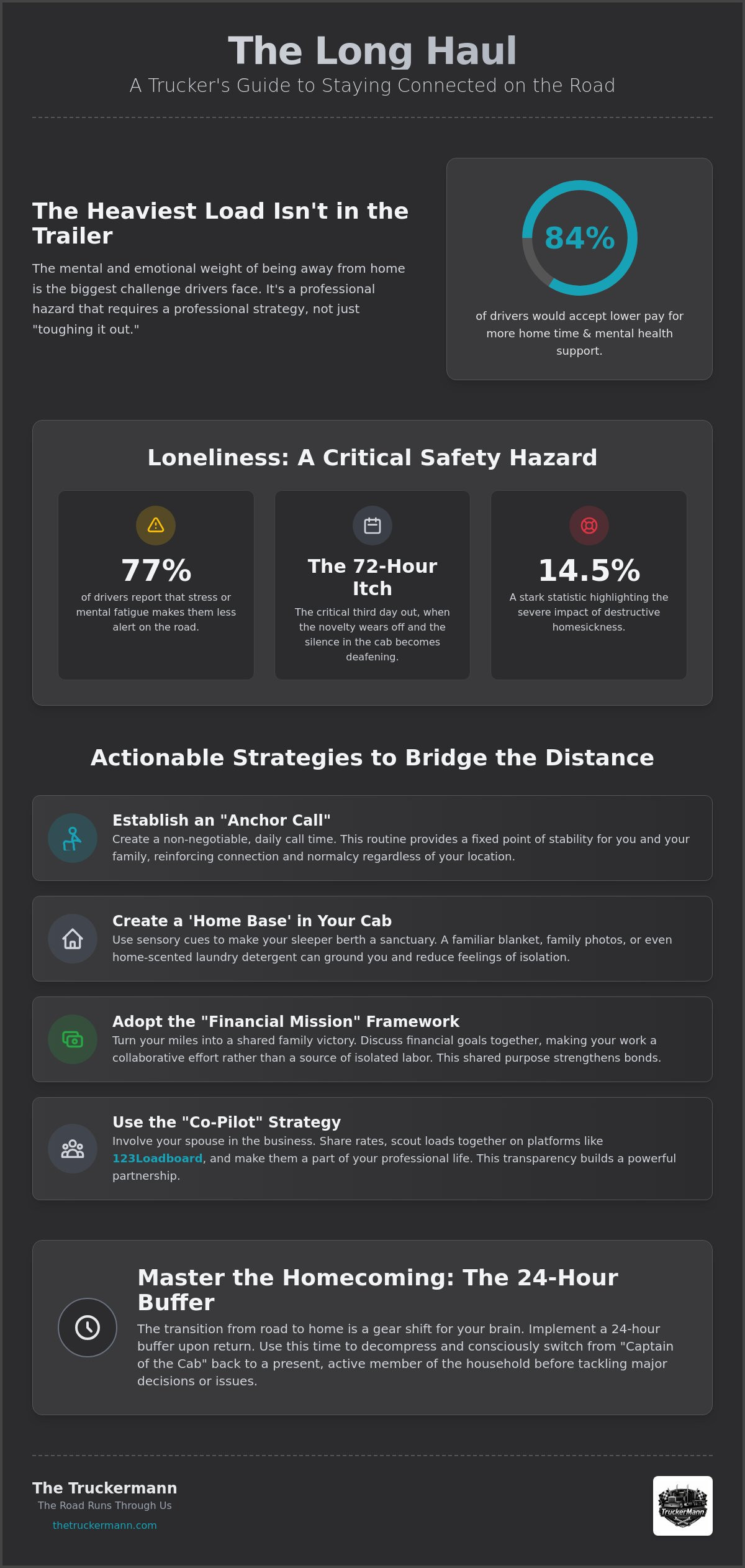
Did you know that 84% of drivers would actually accept lower pay if it meant more time at home and better mental health support? It’s a staggering number that proves what we already know in our gut: the hardest part of this job isn’t the 11-hour driving rule or the tight 14-hour window; it’s the empty passenger seat. When you’re out there for weeks, coping with being away from family as a trucker becomes a heavy load that no tandem can balance. You feel the guilt of missing a daughter’s recital or the strain on your marriage as the miles pile up. We’ve all felt that emotional fog where the road starts to feel like a cage rather than a career.
We agree that the mental toll is just as real as the wear on your tires, but it doesn’t have to stall your career. This guide treats loneliness like any other logistics challenge on your manifest. You’re going to discover hard-won strategies from the road to maintain family bonds, manage isolation, and make every home-time hour count. We will walk through actionable communication routines, mental frameworks for the long stretches, and the specific steps you need to switch from driver mode back to dad mode the moment you hit the driveway.
Key Takeaways
- Reframe loneliness as a logistics challenge that requires the same level of precision and planning as a Level 1 inspection.
- Master the art of coping with being away from family as a trucker by establishing an “Anchor Call” to provide your loved ones with a fixed point of daily stability.
- Use sensory cues like home-scented laundry detergent to transform your sleeper berth into a familiar sanctuary that keeps you grounded.
- Adopt the “Financial Mission” framework to turn your miles into a shared family victory rather than a source of isolated labor.
- Implement a 24-hour buffer upon returning home to successfully transition from being the captain of the cab to a present, active member of the household.
Understanding the Mental Load of Long-Haul Trucking
Listen, we’ve all felt it. That heavy weight in your chest when the GPS shows you’re crossing the state line, moving further from the driveway where your kids were waving goodbye. It is what veteran drivers call “the pull.” It’s a physical sensation, like a tether stretching until it’s thin enough to snap. This isn’t just sentimentality; it is the beginning of the mental load that every OTR driver carries. Successfully coping with being away from family as a trucker starts with acknowledging that this weight is real and that ignoring it only makes the load heavier.
They call us “lone wolves,” but that’s a load of bunk. Humans aren’t wired for total isolation, and professional drivers are no different. In fact, studies show that 77% of drivers report that stress or mental fatigue makes them less alert on the road. When you’re isolated, your brain starts to wander, and that’s when distractions or poor decision-making creep in. Loneliness isn’t just a personal issue; it’s one of the major challenges of the trucking profession that directly impacts your safety and the safety of everyone sharing the asphalt with you. You have to watch out for the “72-hour itch,” which is that third day out when the novelty of the trip vanishes and the silence in the cab starts to feel deafening.
To better understand the reality of this emotional distance, watch this helpful video:
The Military-to-Trucking Parallel
Many of us came into this industry after serving, and the transition can be tricky. In the service, you’re in a “deployment” mindset where the mission is everything and home is a distant memory. In trucking, you’re in an “employment” mindset where you’re constantly oscillating between the road and the dinner table. This can lead to the “tough guy” trap, where you think you’re too hardened to need a nightly phone call. Veterans find the most success when they apply mission-focused discipline to family time. Treat your communication window with your spouse like a mandatory briefing. It’s not a sign of weakness; it’s tactical maintenance for your most important relationship.
Identifying Your Personal Triggers
You need to recognize the difference between healthy “missing home” and destructive homesickness. Healthy missing home keeps you motivated to finish the run safely. Destructive homesickness leads to 14.5% of drivers reporting suicidal thoughts, a statistic we cannot ignore. Triggers often strike during “deadhead” miles or when you’re stuck at a receiver for six hours with nothing to do but stare at the dash. Fatigue magnifies these emotions ten times over. When you’re exhausted, your brain loses its ability to filter out the “what-ifs” and the guilt. Keeping your environment sharp helps; many drivers find that using high-quality gear from My Tee Products to keep their cab organized prevents that “cluttered mind” feeling that feeds into isolation. If you’re using 123loadboard to find your next haul, keep your focus on the goal of getting back to the yard, rather than the miles separating you from it.
Leveraging Technology and Routine to Bridge the Distance
Routine isn’t just for your logs or your pre-trip inspections. It is the most powerful tool you have for maintaining a sense of normalcy at home. Establishing an “Anchor Call” is the single most effective way to handle coping with being away from family as a trucker. When your kids know the phone will ring at exactly 7:00 PM every night, it provides a sense of security that the road hasn’t changed who you are. It gives your spouse a fixed point in a day that might otherwise feel like a solo marathon. These calls shouldn’t just be about the weather or traffic; they are your primary way of staying woven into the fabric of your family’s daily life.
Don’t just talk about the work; bring them into the business. Use the “Co-Pilot” strategy by involving your spouse in the logistics of your week. Show them the rates you are seeing or let them help you scout your next haul using 123Loadboard. When they see the effort that goes into finding a high-paying load, the time you spend away feels less like a sacrifice and more like a shared mission toward a financial goal. You can even use shared digital spaces, like a family calendar or a grocery list app, to stay involved in the small, daily decisions that happen while you’re rolling through another time zone. For more ways to streamline your operation and protect your home time, you can find expert advice at The Truckermann.
Smart Tech for the Sleeper Berth
High-quality video calls are a lifeline, but they require a stable Wi-Fi environment. Don’t rely on spotty truck stop signals that drop the moment you start talking. As of June 2026, a dedicated in-cab Wi-Fi system costs approximately $59 per month, which is a small price to pay for a connection that doesn’t lag during a “Virtual Dinner.” This technique, where you prop up your tablet and eat at the same time as your family, bridges the physical gap in a way a quick voice call can’t. You can also set up digital photo frames in your berth that your family can update with new pictures remotely, giving you a fresh look at home every morning when you wake up.
Asynchronous Connection Strategies
Sometimes the hours don’t align. If you’re driving the graveyard shift, use asynchronous strategies to stay present without waking anyone up. Record yourself reading a bedtime story so your kids can hear your voice before they sleep. Send “video postcards” of unique landmarks or sunrises you see on your route. Sharing your GPS location or ELD logs can also help; it lets your family “travel” with you on the map, turning your 2,000-mile run into a shared journey. If you want to use your downtime to build a more sustainable career path, you might consider looking into the specialized training offered by DLA Academy to help you transition into roles with more home time.
Creating a ‘Home Base’ Inside Your Sleeper Berth
Your cab is your office, but your sleeper berth must be your sanctuary. When you are rolling OTR, the line between work and life blurs until it disappears completely. One of the most effective sensory tricks for coping with being away from family as a trucker is using the exact same laundry detergent and fabric softener your spouse uses at home. It sounds simple, but that familiar scent of home on your pillowcase tells your nervous system that you are safe. It lowers your cortisol and helps you decompress after a grueling 11-hour shift on the interstate.
A cluttered cab leads to a cluttered mind. If you’re stepping over trash or fumbling through disorganized gear, your brain stays in a state of low-level stress. Investing in high-quality storage solutions and custom organizers from My Tee Products allows you to claim your space. When everything has a designated spot, the cab feels permanent rather than temporary. This sense of order is the foundation of mental health on the road. You aren’t just “living in a truck”; you are managing a mobile residence that reflects your standards and your connection to home. Using gear from My Tee Products ensures your essentials are always within reach, reducing the daily friction that wears you down over a three-week run.
Sleep is not a luxury; it is a safety requirement. High-quality bedding and a supportive mattress topper are investments in your sanity. If you’re waking up sore and exhausted, you don’t have the emotional bandwidth to handle a difficult call from home. You need restorative rest to remain the rock your family needs you to be.
Customizing for Comfort and Connection
Create a dedicated “family wall” in your sleeper. Use physical photos, sticky notes from your kids, or their latest drawings. Seeing these faces every time you crawl into the bunk reminds you why you’re out here. To keep your environment stable, use heavy-duty securement gear from Truck n Tow to ensure your personal electronics and mementos don’t shift during transit. There’s nothing more demoralizing than a messy cab after a hard day. Reliable hardware from Truck n Tow keeps your “home base” intact, no matter how rough the secondary roads get.
The ‘Cab Ritual’ Framework
Develop a strict “pre-shift” and “post-shift” ritual. Before you start your clock, do a quick family check-in to bridge the gap. Then, use a specific scent, like a diffuser with a “home” blend, to signal that it’s time to rest. Keep a small “treasure box” of mementos that you only open on the really tough nights. This box serves as a physical link to the people waiting for you at the end of the route, providing a much-needed morale boost when the isolation feels heavy.
Strengthening Family Bonds from the Driver’s Seat
Trucking isn’t a solo act; it is a family business. If you want to master the art of coping with being away from family as a trucker, you have to stop viewing your time OTR as “lost time” and start viewing it as a “shared mission.” This begins with the Financial Mission framework. Sit down with your spouse and kids to define exactly what those miles are buying. Whether it is a down payment on a house, a college fund, or a specific summer vacation, having a concrete goal turns your absence into a collective effort. When the kids see you pull out of the driveway, they shouldn’t just see Dad leaving; they should see the family moving one step closer to a shared victory.
You also need to respect the “Home Commander.” One of the fastest ways to create friction is trying to micromanage the household from the sleeper berth. Your spouse is the boots-on-the-ground leader while you’re away. Respecting their autonomy and the routines they’ve established prevents the “re-entry shock” that happens when you return. Instead of critiquing how things are run, look for ways to be an educational resource. Teach your kids about geography and the backbone of the economy by explaining your routes. You can even walk them through the complexities of flatbed gear and how securement works. It turns a boring “where are you?” phone call into a lesson on logistics and physics.
Marriage Maintenance on the Road
Distance can amplify small misunderstandings into major conflicts. Establish a “No-Fly Zone” for arguments: never, under any circumstances, hang up the phone while you are angry. If a conversation gets heated, agree to a 30-minute cooling-off period before calling back. Schedule “Date Nights” via video call where talk about the truck, the dispatcher, or the bills is strictly prohibited. Focus entirely on your spouse. Practice active listening by remembering the small details of their day. If they mentioned a broken sink or a neighbor’s dog on Tuesday, ask for an update on Wednesday. It proves you are mentally present, even when you are 1,500 miles away.
Involving the Family in Professional Growth
Show your family the value of hard work by involving them in your career milestones. Walk your kids through your CDL pre-trip inspection checklist over video; let them “help” you check off the items. If you are looking to level up your income, use DLA Academy resources to study for new endorsements. You can even turn it into a family project where your spouse or older kids quiz you on the material. When you succeed, it becomes a family win. If you’re ready to take that next step in your career together, get more veteran-led insights at The Truckermann to see how specialized training can increase your home-time options.
Mastering the ‘Homecoming’: Making Every Minute Count
The moment you park the rig and grab your duffel bag, the clock starts. But the biggest mistake most drivers make is trying to sprint the second they hit the driveway. Success in coping with being away from family as a trucker depends heavily on how you handle this “re-entry” phase. You’ve spent weeks as the “Captain of the Cab,” making every decision from your meal times to your sleep schedule. Transitioning back to being a “Member of the Household” requires a deliberate shift in gears. Your spouse has a routine that has been running without you; don’t walk in and try to overhaul the system. Respect the flow of the house and wait for your invitation to lead.
Implement a strict “24-Hour Buffer.” Resist the urge to jump into major home projects or heavy maintenance the minute you get home. Your family doesn’t need a handyman; they need a father and a partner who is mentally present. Prioritize presence over presents. While a souvenir from a unique truck stop is a nice gesture, your undivided attention is the real currency your family craves. Before you head back out for the next run, conduct a brief “Exit Interview” with your spouse. Talk through any friction points from the week and clear the air so you don’t carry resentment into your next 11-hour shift.
The First 24 Hours: Decompressing Correct
You’re likely carrying a massive sleep debt, but your family is carrying a “presence debt.” Finding the balance is tricky. Instead of retreating to the bedroom for 12 hours, try to stay engaged in low-energy activities like a family movie or a shared meal. Let the family “catch you up” on their lives first. Listen to the stories about school or the neighbors before you start sharing your road adventures. This validates their experience and shows that their world matters to you. Finally, set firm boundaries with friends or extended family. Your home time is a limited resource. Protect it fiercely so your core family gets the best version of you, not the leftovers.
Creating High-Impact Memories
Keep the Wheels Turning and the Heart Full
The road doesn’t have to be a wall between you and the people you love. By treating your communication like a mission and your sleeper berth like a sanctuary, you turn a high-stakes job into a sustainable lifestyle. We’ve covered why the “Anchor Call” provides stability and how the 24-hour homecoming buffer protects your peace. Remember, coping with being away from family as a trucker is a logistics challenge that requires the same precision as a heavy-haul route. You aren’t just a driver; you’re the provider and the protector of your household, even from 1,500 miles away.
This guide was built from the grit of real OTR experience, offering practical strategies that you won’t find in any corporate HR manual. It is advice trusted by a community of thousands of logistics professionals. For more veteran insights and the highest quality road-tested gear, visit The Truckermann for more veteran tips and the best road-tested gear. Keep your head up, your eyes on the horizon, and your heart focused on the driveway waiting for you. We’ll see you out there on the blacktop.
Frequently Asked Questions
How do I explain my long absences to young children who don’t understand time yet?
Use physical visual aids like a “countdown jar” with marbles or a paper chain in their bedroom. Each marble represents one day until you park the rig in the driveway. This gives them a tangible way to see time moving toward your return. Avoid saying you will be home “soon,” as that is a vague concept to a toddler. Instead, relate your return to a specific event, like “after three Saturday morning cartoons.”
What are the best apps for truck drivers to stay connected with family in 2026?
Marco Polo and WhatsApp remain the industry standards for quick video messaging and check-ins. For 2026, many professionals are using private digital spaces like “Between” to share photos and calendars away from public social media. These tools are vital for coping with being away from family as a trucker because they ensure you don’t miss the small, daily updates that often get lost in a standard phone call.
Is it normal to feel lonely even when I’m talking to my family every day?
Yes, it is completely normal because a digital screen cannot replace physical presence or shared sensory experiences. You are missing the “background noise” of home life, which a 20-minute video call cannot replicate. Acknowledge that this feeling isn’t a sign of a failing relationship; it is a natural reaction to the isolation of the cab. Focus on the quality of your conversations rather than just the frequency of the calls.
How can I help my spouse manage the household alone while I’m OTR?
Handle the administrative load from the road so they can focus on the physical day-to-day tasks. You can manage the bills, schedule home repairs, and order groceries for delivery from your sleeper berth during your 10-hour break. This reduces their mental load and makes you an active partner in the household’s success. It proves you are contributing to the home even when you are three time zones away.
Should I bring my family on the road with me? What are the pros and cons?
Bringing the family can strengthen bonds but requires a massive adjustment to cabin life and logistics. The pros include shared memories and a total elimination of loneliness; however, the cons involve cramped quarters and disrupted schooling for children. Most veterans suggest a “trial run” during a summer break before making any permanent changes. Always ensure your company’s passenger policy is clear and your insurance covers everyone in the cab.
How do I handle the ‘post-home-time blues’ when I have to head back out on the road?
Establish a “departure ritual” that focuses on the next reunion rather than the current goodbye. Leave a hidden note for your spouse or a small surprise for the kids to find after you have left the yard. This shifts the family’s focus from the pain of leaving to the excitement of a future discovery. Remind yourself that the first 24 hours back on the road are always the hardest for every driver.
Does the loneliness of being away from family ever get easier with more years of experience?
It doesn’t necessarily get easier, but you do get better at managing the logistics of connection. Experienced drivers develop thicker skin and more robust routines for coping with being away from family as a trucker. You learn to recognize your emotional triggers and how to bypass them before they lead to a mental slump. Experience gives you the perspective to know that every run eventually ends at your front door.
What should I do if the isolation is starting to affect my mental health or driving safety?
Park the truck and speak to a professional or a trusted peer immediately. If you are losing focus or feeling overwhelmed, you are a hazard to yourself and everyone else on the asphalt. Only 7% of drivers have access to employer-backed counseling, but many industry groups offer confidential support. Don’t let the “tough guy” myth prevent you from seeking help; your life and your career depend on your mental clarity.
Disclaimer
The information provided on The TruckerMann is for general informational and educational purposes only. While every effort is made to ensure the accuracy and reliability of the content, trucking laws, FMCSA regulations, DOT requirements, safety standards, and industry policies can change at any time. Readers are encouraged to verify all information with official government agencies, professional advisors, or qualified industry professionals before making business, legal, financial, safety, or compliance-related decisions.
The content shared on this website reflects personal opinions, experiences, research, and commentary and should not be considered legal, financial, medical, tax, or professional advice. The TruckerMann and its owners, contributors, affiliates, or representatives are not responsible for any losses, damages, violations, penalties, or liabilities resulting from the use or misuse of information found on this website.
Some content on this website may contain affiliate links, sponsored content, or promotional material. This means we may earn a commission at no additional cost to you if you choose to purchase through certain links.
By using this website, you agree that you do so at your own discretion and risk.