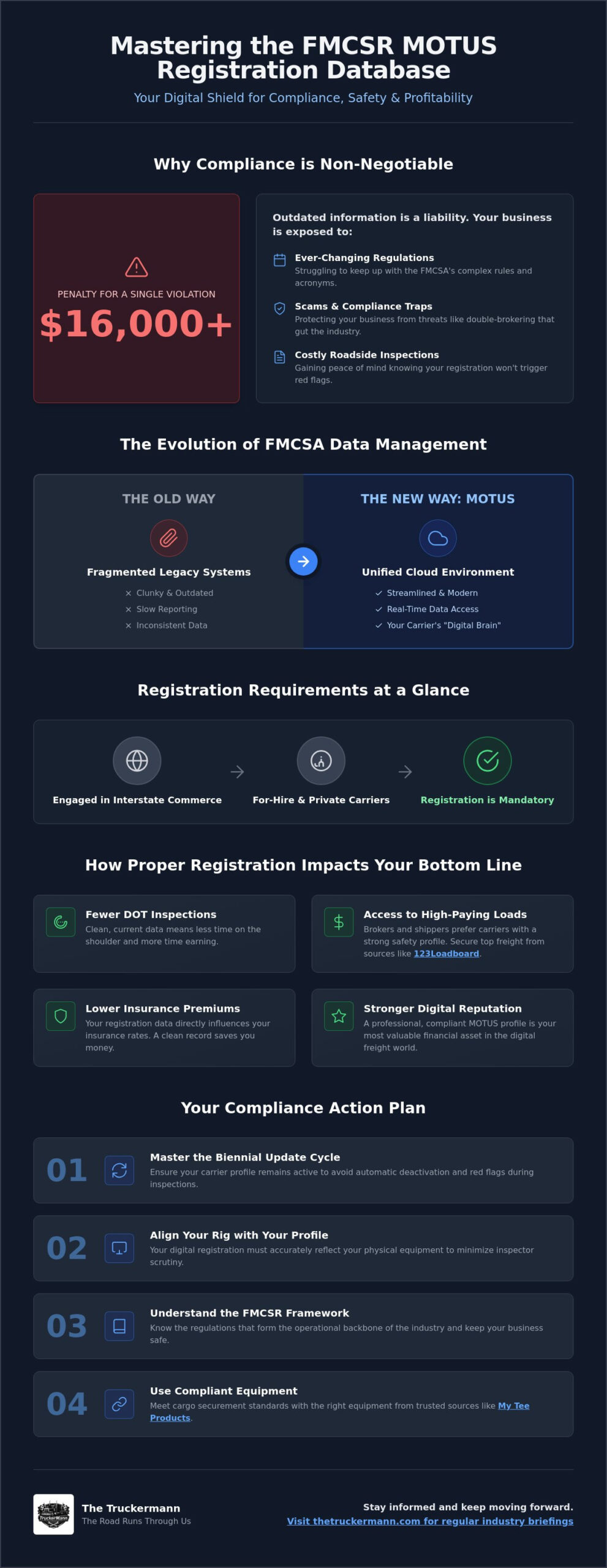
Think of the new MOTUS system not as another piece of red tape, but as the digital shield protecting your business from the double-brokering scams and compliance traps currently gutting the industry. We all know the headache of trying to keep up with the FMCSA’s ever-changing acronyms while you’re focused on moving freight and keeping your rigs on the road. It’s frustrating to see outdated portal information when your livelihood depends on being right. Making sense of the FMCSR MOTUS Registration Database often feels like trying to read a map in a blinding storm, especially when the stakes for a single violation have climbed to $16,000 or more.
I’ve been in the trenches long enough to know that peace of mind during a roadside inspection is worth its weight in gold. That’s why I’m going to help you master these complexities and ensure your fleet stays on the right side of the law. We’ll dive into the critical differences between the legacy URS and the new MOTUS requirements, walk through the 2026 fee schedules, and look at the recent deregulation moves that actually make your life easier. By the time we’re done, you’ll have a clear, step-by-step plan to keep your registration current and your business moving forward.
Key Takeaways
- Understand the fundamental framework of the Federal Motor Carrier Safety Regulations and why they serve as the operational backbone for every professional on the interstate.
- Learn how the FMCSR MOTUS Registration Database has replaced fragmented legacy systems with a unified cloud environment to streamline your compliance reporting.
- Identify exactly which for-hire and private carriers are required to register to avoid the heavy fines associated with operating without proper authority.
- Master the biennial update cycle to ensure your carrier profile remains active and doesn’t trigger red flags during random inspections.
- Discover how to align your physical rig with your digital registration profile to minimize inspector scrutiny and keep your wheels turning.
Decoding FMCSR and the Federal Registration Framework
If you’ve spent any time behind the wheel or managing a fleet, you know that the Federal Motor Carrier Safety Regulations (FMCSR) are the “Bible” of the road. These aren’t just suggestions; they’re the mandatory standards for everyone involved in interstate commercial vehicle operations. The primary mission of these rules is simple: reduce crashes and save lives through standardized data collection. When you enter the FMCSR MOTUS Registration Database, you aren’t just filling out a form. You’re stepping into a massive safety ecosystem designed to monitor every move on the highway.
The Federal Motor Carrier Safety Administration (FMCSA) uses this data to separate the professionals from the fly-by-night operators. Registration is your first official handshake with the federal government. It’s how they track your safety performance, financial responsibility, and driver qualifications. If you want to keep your authority, you’ve got to play by these rules from day one. It’s about more than just paperwork; it’s about the grit and discipline required to keep this industry moving safely.
To better understand how this new system looks in practice, watch this helpful video:
The Role of the FMCSA in 2026
As of 2026, the agency acts as a high-tech regulatory sentinel for over four million CDL holders. They’ve moved away from the clunky, fragmented systems of the past to embrace a more streamlined future. Today, they’re overseeing a massive shift toward modernized digital databases to ensure real-time accuracy. This isn’t just about enforcement; it’s about modernization. They’re tightening the screws on financial responsibility and driver standards to ensure that only qualified, insured carriers are hauling the nation’s freight. They’re watching the data closely to spot trends before they become tragedies on the asphalt.
Why Proper Registration Impacts Your Bottom Line
Your registration status isn’t just a legal requirement; it’s a financial asset. Inaccurate or outdated data in the FMCSR MOTUS Registration Database can trigger a cascade of expensive problems. For starters, messy records are a magnet for unnecessary DOT inspections that eat up your clock and your patience. Every minute you’re parked for an inspection is a minute you aren’t making money.
Beyond the roadside, your digital reputation determines your access to quality freight. Brokers and shippers look at your safety profile before they ever pick up the phone. Clean registration records are essential for securing high-paying loads on 123Loadboard. Even your insurance agent is watching. Premiums are directly tied to the safety data housed in these databases. If your registration is a mess, or if you lack the right equipment from My Tee Products to meet cargo securement standards, you’re going to pay for it in cold, hard cash through higher rates and lost opportunities.
What is the MOTUS Registration Database?
Let’s pull back the curtain on the technology that’s actually running the show. MOTUS, or the Modernized Online Tracking and Utility System, is the backend engine for all FMCSA data. It represents a massive shift from the fragmented, clunky databases we used to struggle with. Now, everything lives in a unified cloud environment. Think of the FMCSR MOTUS Registration Database as the “brain” that stores your carrier’s digital identity. It’s not just a digital file cabinet; it’s a living system that tracks everything from your USDOT number to your safety rating in real-time. When an officer pulls you over, they aren’t looking at a paper folder. They’re tapping into this system to see exactly who you are and how you’ve been running.
If you want to stay sharp on these technical shifts, you can follow our regular industry briefings to keep your business moving forward without the headache. Staying informed is the best way to protect your livelihood on the asphalt.
MOTUS vs. The Unified Registration System (URS)
You might hear the terms URS and MOTUS tossed around like they’re the same thing. They aren’t. The Unified Registration System (URS) is the public-facing FMCSA Registration Portal where you actually enter your carrier information. MOTUS is the backend powerhouse that validates, stores, and shares that data with law enforcement. When you hit “submit” on your application, MOTUS is the system doing the heavy lifting to ensure you’re who you say you are. Understanding this split helps when you’re staring at a registration delay. If the frontend looks fine but your authority hasn’t updated, the hiccup is usually happening in the MOTUS backend where identity verification and data validation occur.
Key Data Points Stored in the MOTUS System
What’s actually sitting in this digital vault? It’s a comprehensive file on your business that law enforcement uses to judge your operation. It holds your MCS-150 data, including your cargo types and power unit counts. It tracks your biennial update history to ensure you haven’t gone ghost on the feds. You’ll also find your Safety Measurement System (SMS) scores and every inspection result from the last 24 months. Beyond safety, it houses your proof of insurance and your BOC-3 process agent designations. It even logs your financial compliance, like your Unified Carrier Registration (UCR) payments, which for a small fleet of 0-2 vehicles remains at $46 for 2026. Keeping this digital profile clean is just as vital as keeping your load secured with reliable equipment from My Tee Products.
Who Needs to Register? Breaking Down the Requirements
Interstate vs. Intrastate Registration Triggers
Crossing state lines is the big red button for federal oversight. As soon as your tires touch the asphalt of a neighboring state, you’ve officially entered interstate commerce and triggered the requirement for FMCSA’s Motus Registration System. However, don’t think you’re in the clear just because you stay within one state. Many jurisdictions now require a federal DOT number even for intrastate trucking. It’s a complex patchwork of rules that can vary wildly. To stay compliant, you’ve got to ensure your paperwork is as solid as the gear you get from My Tee Products for your daily hauls.
The “CMV” Weight Thresholds for 2026
What defines a CMV in 2026? It’s not just the eighteen-wheelers. First, any vehicle with a Gross Vehicle Weight Rating (GVWR) or Gross Combination Weight Rating (GCWR) of 10,001 pounds or more falls under this umbrella. This includes many hotshot setups and heavy-duty pickups. Second, if you’re hauling people, the numbers are specific. You need to be in the FMCSR MOTUS Registration Database if your vehicle is designed to transport more than 8 passengers for compensation, or more than 15 passengers if you’re a private, non-compensated operator. Finally, there’s the hazardous materials rule. If you’re carrying anything that requires a placard, weight doesn’t matter. You’re a CMV in the eyes of the law from the moment that cargo is loaded, and you’d better have your registration squared away before you hit the road.
Maintaining Your Registration and Avoiding Common Pitfalls
Don’t think for a second that hitting “submit” on your initial application means you’re finished with the feds for good. Registration is not a “one and done” task. It’s a living record that requires active maintenance to keep your business running. The FMCSR MOTUS Registration Database is designed to flag carriers who let their information go stale. If you fail to perform your biennial updates, the system will eventually move your status to “Inactive,” which is a polite way of saying you’re sidelined until further notice. Beyond just staying active, you have to be accurate. Inaccurate mileage or power unit counts will skew your safety percentages. If the system thinks you’re running fewer miles than you actually are, every minor incident carries more weight, making your safety profile look much worse than it is in reality.
To avoid these costly administrative traps, you should subscribe to our compliance updates to stay one step ahead of regulatory shifts. Keeping your physical address and contact info current ensures you actually receive the alerts that matter before they become fines.
The MCS-150 Biennial Update Process
Your filing schedule isn’t a mystery; it’s baked right into your USDOT number. You can identify your deadline by looking at the last two digits of your number. The very last digit tells you the month you’re due, while the second to last digit tells you if you file in an even or odd year. You’ve got to log into the URS portal to verify your current fleet size and operations. Even if absolutely nothing has changed in your business over the last two years, you still have to submit the update. Failing to do so is one of the fastest ways to see your authority revoked. It’s a simple step, but it’s the foundation of a professional operation. Just like you wouldn’t hit the road without checking your straps from My Tee Products, you shouldn’t let your federal profile go unverified.
Common Violations That Trigger Database Red Flags
The MOTUS system is built to spot inconsistencies. One of the biggest red flags is a mismatch between the insurance data in the FMCSR MOTUS Registration Database and what your provider reports. If your policy cancels or changes and the database isn’t updated, you’re looking at an immediate target on your back. Another common pitfall is failing to register a new process agent after a business move. Your BOC-3 filing must be ironclad. Operating after a “Failure to File” status has been issued is a high-stakes gamble that rarely pays off. These digital red flags often lead to more frequent roadside stops and more intrusive audits. If you want to keep the inspectors moving past your rig, keep your digital house as clean as the equipment you source from My Tee Products.
Equipping Your Rig for FMCSR Compliance
Digital compliance in the FMCSR MOTUS Registration Database is only half the battle for a professional operator. You can have the cleanest digital record in the country, but if your rig is a rolling disaster, that database profile will change in a heartbeat. Think of your MOTUS profile as the scout that goes out before you. When an inspector pulls your USDOT number, they’re looking at your history to decide exactly which parts of your rig to scrutinize. If you’ve got a history of securement issues or lighting failures, they’re going to be climbing all over your trailer before you even get your logbook open. The data in the system and the iron on the road have to tell the same story of professionalism and grit.
High-quality gear is your best defense against unwanted attention. It’s the difference between a quick “move along” and a permanent black mark on your record. When you invest in trusted brands, you’re ensuring your load securement meets the strict requirements of FMCSR Part 393. It’s about more than just passing an inspection; it’s about protecting your livelihood and the people sharing the asphalt with you. Every piece of equipment you use is an investment in your business’s reputation within the federal safety ecosystem.
Essential Gear for the Professional Flatbedder
To keep your profile in the FMCSR MOTUS Registration Database green, you need ironclad securement every time you pull out of a yard. Use heavy-duty straps and chains from My Tee Products to prevent load shifts that catch an inspector’s eye from a mile away. It’s equally important to ensure all tarps and edge protectors from My Tee Products are in good repair to avoid those “unsafe load” citations that tank your SMS scores. I always tell guys to keep a backup supply of securement tools from Truck n Tow in your side box. Having a spare ratchet binder or a fresh coil rack can save your skin when a roadside check reveals a piece of gear that’s seen better days and needs immediate replacement.
Safety and Visibility Standards
Your lighting system is often the first thing an officer notices when you roll into a scale. Inspect your lights daily to ensure they match the operational standards tracked in the federal systems. Beyond the lights, you need the basics for when things go sideways. Keep high-visibility vests and emergency triangles from Truck n Tow accessible for roadside safety. Adhering to FMCSR Part 393 is the only way to survive the 2026 roadside inspection standards, where any equipment failure from lighting to securement is instantly logged against your digital profile. Don’t let a simple piece of safety gear from Truck n Tow be the reason your authority gets flagged in the system and your insurance rates start to climb.
Take Control of Your Digital Reputation and Roadside Reality
I’ve spent years in the driver’s seat. I’ve seen how quickly a messy file or a frayed strap can end a profitable week. You can trust this expert advice because it’s built on the grit of the field. Stay compliant and gear up for the road; check out the latest securement gear and veteran advice to keep your business moving. You should also check out the latest securement gear at My Tee Products for direct access to FMCSR-compliant equipment trusted by thousands of professional drivers. Keep your head up and your paperwork current. You’ve got the tools to navigate these changes, and I’m here to help you keep those wheels turning safely.
Frequently Asked Questions
What is the difference between MOTUS and the USDOT Number?
Your USDOT number is the unique identification digit assigned to your business, while MOTUS is the backend system that validates and stores that ID. Think of the USDOT number as your social security number and the FMCSR MOTUS Registration Database as the federal vault where your entire history is kept. You use the number to identify yourself, but the MOTUS system tracks your safety scores and compliance data.
How do I check my carrier status in the FMCSR registration database?
You can check your status by visiting the official FMCSA search portal and entering your USDOT or MC number. The system will immediately display whether your authority is “Active” or “Inactive” and show your current safety rating. It’s a good habit to check this regularly to ensure no administrative errors have flagged your account. Keeping your status green is just as important as keeping your rig equipped with gear from My Tee Products.
Does a private carrier need to register in the MOTUS system?
Yes, private carriers must register if they operate vehicles over 10,001 pounds or transport hazardous materials in interstate commerce. Even if you don’t haul for hire, the feds still want you in the system to track your safety performance. Many folks think staying private keeps them off the radar, but the registration requirements apply to anyone moving significant weight across state lines. Don’t risk a fine by assuming you’re exempt.
What happens if I miss my biennial MCS-150 update?
If you miss the deadline, the FMCSA will eventually deactivate your USDOT number and may issue a “Failure to File” fine. You’ll be prohibited from operating in interstate commerce until the update is completed. This can lead to your trucks being placed out of service during a roadside inspection, which kills your schedule and your profit. It’s a simple update, so don’t let a calendar oversight ground your entire operation.
Is there a fee for registering in the Unified Registration System in 2026?
Applying for a USDOT number is free, but filing for Motor Carrier (MC) authority requires a one-time fee of $300 per authority type. You also need to account for your annual Unified Carrier Registration (UCR) fees, which for a small fleet of 0-2 vehicles stay at $46 for 2026. While the registration itself might be cheap, the cost of non-compliance is always much higher. Budget for these fees to keep your authority ironclad.
Can I update my MOTUS registration information via a mobile app?
Currently, there isn’t a dedicated mobile app for updating your FMCSR MOTUS Registration Database profile. You must use a standard web browser to access the URS or MOTUS portals. While the websites are mobile-responsive, it’s usually safer to handle these filings on a laptop to ensure you don’t miss any critical data fields. Accuracy is key when you’re dealing with federal records, so take the time to do it right.
How long does it take for a new registration to show up in the database?
A new USDOT number usually appears in the system within 24 to 48 hours after a successful filing. However, if you’re applying for operating authority (MC number), there’s a mandatory 21-day protest period before your status becomes active. You can’t turn a wheel for profit until that clock runs out and your insurance is verified. Patience is part of the game when you’re dealing with government processing times.
What documents do I need to complete my FMCSR registration?
You’ll need your Federal Tax ID (EIN), a detailed count of your power units, and a list of the cargo types you intend to haul. You also must have your proof of insurance and a designated process agent (BOC-3) ready for filing. Having these documents organized before you start the process will save you from a massive headache. It’s all about preparation, much like checking your load securement with gear from My Tee Products.
Disclaimer
The information provided on The TruckerMann is for general informational and educational purposes only. While every effort is made to ensure the accuracy and reliability of the content, trucking laws, FMCSA regulations, DOT requirements, safety standards, and industry policies can change at any time. Readers are encouraged to verify all information with official government agencies, professional advisors, or qualified industry professionals before making business, legal, financial, safety, or compliance-related decisions.
The content shared on this website reflects personal opinions, experiences, research, and commentary and should not be considered legal, financial, medical, tax, or professional advice. The TruckerMann and its owners, contributors, affiliates, or representatives are not responsible for any losses, damages, violations, penalties, or liabilities resulting from the use or misuse of information found on this website.
Some content on this website may contain affiliate links, sponsored content, or promotional material. This means we may earn a commission at no additional cost to you if you choose to purchase through certain links.
By using this website, you agree that you do so at your own discretion and risk.