Hey there, driver. Every time you hand over ten percent of your gross to a middleman, you are not just paying for a service; you are handing over the keys to your own financial freedom. With diesel prices hitting $5.94 this quarter and insurance premiums for new authorities reaching as high as $22,000, that dispatcher fee is often the difference between a profitable haul and just spinning your wheels. You have likely wondered how to find loads without a dispatcher so you can keep that hard-earned cash in your own pocket where it belongs.
It is exhausting to sit at a truck stop waiting for a phone call while the best freight disappears from the board. We agree that nobody cares about your bottom line or your family time more than you do. This guide will teach you the exact strategies veteran owner-operators use to cut out the middleman, master the spot market, and book high-paying freight directly. We will walk through the 2026 self-dispatching toolkit, from navigating load boards to building direct shipper relationships, so you can take full control of your route and your future.
Key Takeaways
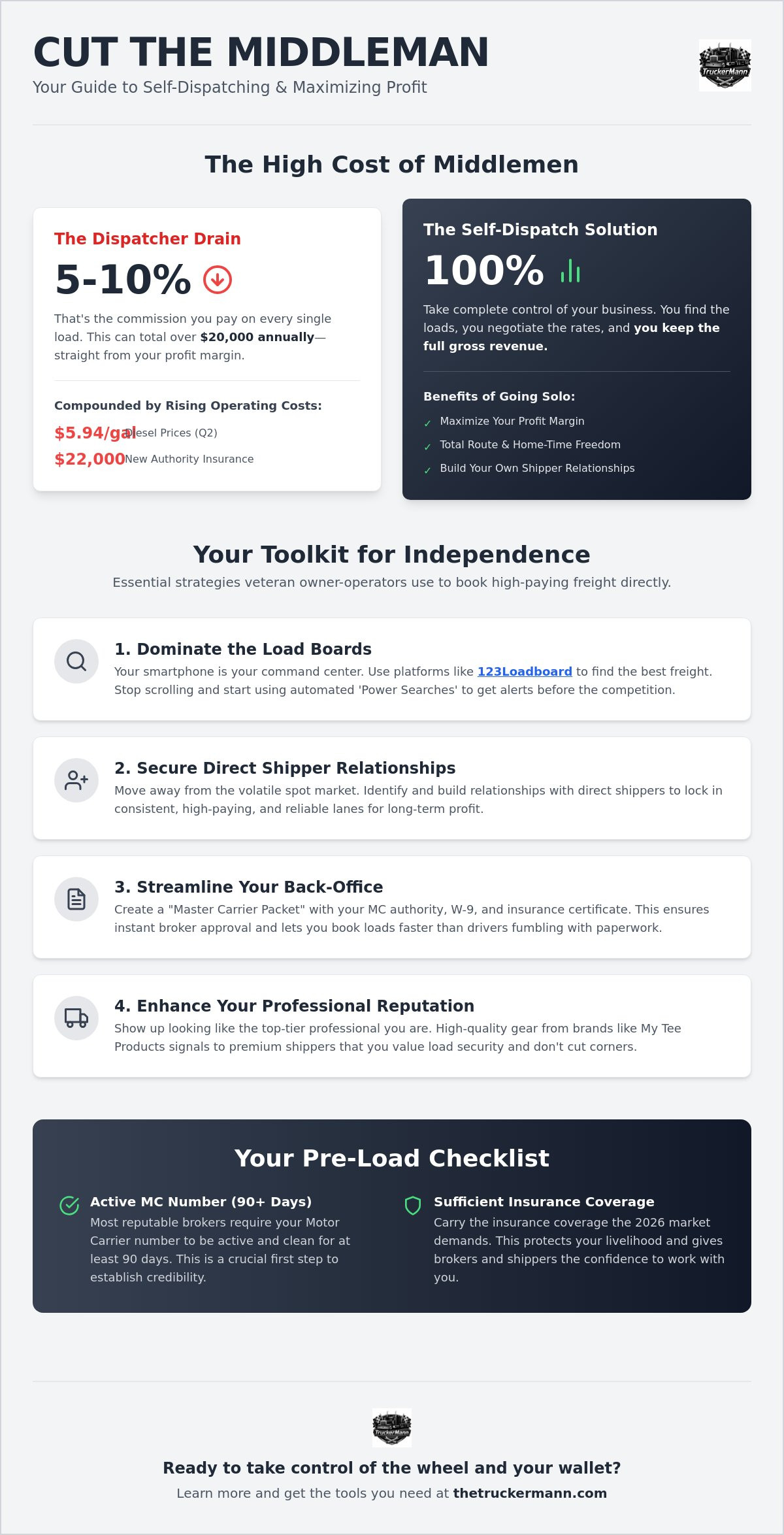
- Calculate the true financial impact of reclaiming the 5-10% commission typically lost to middlemen to boost your annual profit.
- Master how to find loads without a dispatcher by utilizing 123Loadboard to set up automated power searches for the best freight.
- Identify and secure direct shipper relationships to move away from the volatile spot market and lock in consistent, high-paying lanes.
- Streamline your back-office work with a Master Carrier Packet that ensures instant broker approval and faster load booking.
- Enhance your professional reputation and load security with top-tier gear from My Tee Products to stand out to premium shippers.
Why Drivers are Ditching Dispatchers: The Reality of Self-Dispatching
Let’s be honest about the money you are leaving on the table. Self-dispatching is the process of managing your own freight booking, negotiating your rates, and handling your own compliance. It is the ultimate move for an Owner-operator who wants to stop being a ‘steering wheel holder’ and start being a true business owner. When dry van spot rates are averaging $2.85 per mile, that 5 to 10 percent commission you pay a dispatcher can total $20,000 or more annually. That is not just a fee; it is your profit margin being siphoned off by a middleman who isn’t the one dealing with the road or the rig.
The 2026 market doesn’t leave much room for error. Geopolitical shifts drove diesel prices to a staggering $5.94 per gallon in the second quarter, and insurance costs for new authorities are sitting between $12,000 and $20,000. When the industry is facing a shortage of 175,000 drivers, the power should be in your hands. Learning how to find loads without a dispatcher allows you to cut the dead weight and keep your business agile during these volatile times. You are the one in the cab; you should be the one calling the shots on which lanes are worth your time.
The Pros and Cons of Going Solo
Going solo offers complete route freedom and the ability to prioritize your home time, but it comes with a reality check. You will trade your downtime for screen time. While your profit margins will climb, you must be organized enough to handle the back-office grind yourself. If you are a straight-shooter who can manage a calendar and a phone while staying compliant, the rewards are massive. However, if you hate paperwork and negotiation, you might find the ‘free’ money isn’t worth the extra headache of managing every detail alone.
Essential Prerequisites: MC Numbers and Insurance
Before you book that first load on 123Loadboard, your foundation must be solid. Most reputable brokers won’t even look at you until your MC number has been active and clean for at least 90 days. You also need to carry the insurance coverage the 2026 market demands to protect your livelihood. Professionalism is your currency here. Presenting a clean DOT inspection level 1 checklist and showing up with high-quality gear from My Tee Products signals to shippers that you are a top-tier professional who doesn’t need a middleman to hold your hand.
Dominating the Load Boards: Mastering the Digital Marketplace
Your smartphone is no longer just for checking the weather or calling home; it is your command center. When you are learning how to find loads without a dispatcher, your first and most vital tool is a high-performance load board. While some drivers jump between every app on the market, seasoned pros use 123Loadboard as their foundation. It is budget-friendly, with monthly costs ranging from $35 to $50, which is a drop in the bucket compared to the thousands you would pay a dispatcher over a year. The real secret isn’t just having the app; it is knowing how to make it work for you while others are still scrolling through yesterday’s news.
Never leave your driveway without a plan for the return trip. The ‘Backhaul First’ strategy is what separates the high-earners from those just getting by. Before you even confirm your outbound rate, you should be booking your return load. This ensures you aren’t stuck in a dead zone or forced to take a cheap ‘fuel money’ load just to get home. It’s about protecting your per-mile average across the entire trip and ensuring your wheels are always turning for a profit.
Filtering for High-Value Freight
The digital marketplace is full of ‘ghost loads’ and bait-and-switch tactics. These are postings meant to fish for trucks or drive down market rates. Use the ‘Rate Check’ feature on 123Loadboard to see what similar lanes are actually paying in real-time. If a broker offers significantly less than the market average of $2.85 per mile for dry van, use that data as your leverage. Set your alerts for specific weight and equipment types so you only see the freight that fits your rig. If you want to sharpen your negotiation edge, consider investing in dispatching and logistics training to master the back-office game.
Leveraging Mobile Tech on the Road
Efficiency is the name of the game when you are running solo. You need real-time notifications for ‘hot’ loads so you can pounce while your competition is sleeping. Managing your documents through your phone speeds up the QuickPay process, which is essential when diesel is pushing $6.00 a gallon. Integration is key; make sure your board talks to your ELD for seamless tracking. Staying compliant with the July 2026 ELD upgrades isn’t just about avoiding fines; it is about showing shippers you are a tech-forward professional they can trust with their most valuable cargo.
The Hunt for Direct Shippers: Building Long-Term Profit
Load boards like 123Loadboard are essential for keeping your wheels turning, but the real wealth in this industry is built on direct relationships. If you want to truly master how to find loads without a dispatcher, you have to step out of the digital marketplace and into the offices of the people who actually manufacture the freight. Brokers serve a purpose, but they are ultimately taking a cut of the rate that should be yours. When you deal directly with a shipper, you eliminate the middleman and secure a higher per-mile rate that stays in your pocket. In a world where trucks move 72.7% of the nation’s freight by weight, there is no shortage of companies desperate for a reliable partner who actually shows up on time.
Start by mapping out the manufacturing and distribution hubs located along your preferred lanes. You are looking for consistency. When you make that first ‘cold call’ to a shipping manager, keep it professional and punchy. You aren’t just a driver; you are a solution to their capacity problems. Tell them you are an independent owner-operator with a clean safety record and a rig that is ready to work. With the industry facing a massive shortage of 175,000 drivers, shipping managers are often relieved to find a straight-shooter who can handle a dedicated lane without the communication delays of a large brokerage.
Networking at the Loading Dock
Every delivery you make is a live job interview. Don’t just sit in the cab; get out and talk to the dock supervisors and shipping clerks. Ask them which lanes they struggle to cover or if they have recurring ‘hot’ loads that need a reliable hand. Your physical presentation is your resume. A clean truck and proper gear from My Tee Products signal that you value their cargo. Hand out a professional business card and a one-page carrier profile to every contact you make. This is how you turn a one-time spot load into a dedicated contract that keeps you profitable regardless of market swings.
Researching Shippers in Your Lane
Use Google Maps to scout industrial parks and warehouse districts along your frequent routes. If you see a parking lot full of specialized trailers or high-volume activity at the loading bays, you’ve found a lead. Pay attention to ‘Cycle Logistics’ trends. Some shippers have massive needs during harvest seasons or retail holidays, while others move steady volume year-round. A veteran tip is to monitor the industrial directories in your local area to find manufacturing plants that might be flying under the radar of the big carriers. It takes a bit of legwork, but the payoff is a stable business that doesn’t rely on anyone else’s permission to succeed.
Managing the Back-Office: Paperwork and Negotiation
Finding a high-paying load on 123Loadboard is only half the battle. Once you have the lead, you have to close the deal before another driver beats you to it. When you are learning how to find loads without a dispatcher, your speed on the phone and your organization behind the scenes are what define your success. You need a ‘Master Carrier Packet’ ready to send in seconds. This digital folder should contain your MC Authority, a signed W-9, and your Certificate of Insurance (COI) with the broker listed as the certificate holder. If you are fumbling for files while the broker is on the line, you have already lost the load.
Negotiation is where you actually earn your profit. Don’t just accept the first number a broker throws out. The 5-step process is simple: start with a professional introduction, get the specific load details like weight and tarping requirements, present your rate based on current market data, use the power of silence, and then secure the Rate Confirmation. If you need to upgrade your professional image during these talks, having high-quality gear from My Tee Products gives you the confidence to ask for premium rates because you know you can deliver elite service. Use digital invoicing tools to track your Bill of Lading (BOL) and receipts so you never fall into the ‘lost paperwork’ trap that delays your pay.
The Art of the Phone Negotiation
You must know your ‘Floor Rate’ before you ever dial a broker’s number. This is your Cost Per Mile (CPM), and it includes everything from your truck payment to that $5.94 per gallon diesel price we saw earlier this year. If the rate doesn’t cover your costs plus a healthy profit, walk away. When a broker says, ‘That’s our best price,’ don’t blink. State your number and stop talking. The first person to speak after a quote is usually the one who budges. If you want to master these high-stakes conversations, the experts at DLA Academy can help you sharpen your edge.
Compliance and Record Keeping
Running your own back-office means you are the safety officer too. Keep your files organized so you are always ready for a surprise DOT inspection. You are responsible for managing your own IFTA filings and fuel receipts, which can be a nightmare if you let them pile up. Staying compliant with the latest July 2026 regulations is non-negotiable for an independent hauler. We recommend using resources like DLA Academy to stay ahead of regulatory shifts so you can focus on the road instead of worrying about the FMCSA knocking on your door.
Ready to take the next step in your career? Check out these professional training resources to ensure your business foundation is unbreakable.
Essential Gear and Tech for the Independent Hauler
Your equipment is the most visible part of your business identity. When you are mastering how to find loads without a dispatcher, you have to realize that shippers aren’t just buying your driving skills; they are buying the peace of mind that comes with secure cargo. If you roll onto a yard with frayed straps and rusted chains, you are signaling that you cut corners. Investing in professional-grade gear from My Tee Products is a strategic move that builds immediate trust with shipping managers who have seen too many carriers fail. High-quality securement hardware from Truck n Tow acts as a hardware handshake, proving you are a professional who prevents cargo claims and safety violations before they start. The return on investment for high-quality straps, chains, and tarps is measured in the direct contracts you keep and the insurance claims you never have to file.
Securement Gear that Wins Direct Contracts
Shippers, especially those moving specialized or heavy freight, look for drivers who treat cargo like their own. Using heavy-duty, high-visibility straps from My Tee Products makes the loader’s job easier and shows the inspector you aren’t messing around. Shippers often prefer drivers who carry specialized equipment like edge protectors and coil racks from Truck n Tow because it demonstrates a deeper level of industry expertise. You should maintain your gear with the same discipline you apply to your engine. Avoiding “Equipment Failure” notations during your pre-trip inspection is critical for keeping your CSA score clean. A clean record is your best marketing tool when negotiating how to find loads without a dispatcher and moving into high-value lanes.
The Independent Driver’s Tech Stack
Efficiency on the road requires a lean, mean tech stack. Combine the power of 123Loadboard with a reliable CRM or even a simple spreadsheet to manage your shipper contacts. When you self-dispatch, you are the CFO too. You must manage your cash flow carefully by utilizing fuel cards and factoring services that keep your liquidity high when diesel prices spike. It is about staying agile and prepared for any market shift. Final Word: the My Tee Products you carry and the hardware from Truck n Tow you use define your professional reputation. Don’t let a cheap strap be the reason you lose a million-dollar relationship. Carry the best, work the hardest, and keep every cent of that rate for yourself.
Grab the Wheel of Your Financial Future
You have the roadmap; now it is time to put the truck in gear. Reclaiming your independence is about much more than just saving a commission fee. It is about the complete control over your schedule and the professional pride that comes from building direct shipper relationships on your own terms. By mastering how to find loads without a dispatcher, you are evolving from an operator into a savvy business owner who answers to no one but the customer. Keep your back-office organized, your negotiation sharp, and your rig secured with the best gear from My Tee Products to ensure you stay at the top of every premium shipper’s list.
Success in the 2026 market belongs to the drivers who stay prepared, tech-savvy, and fiercely independent. Join over 325,000 transportation professionals who use real-time rate and credit data to keep their profits high and their deadhead low. You’ve got the grit to handle the road; now use the tools to master the market. Start your 123Loadboard free trial and take control of your freight today! We are here to help you navigate every mile of this journey with veteran-owned and driver-focused advice. Safe travels, and we’ll see you out there on the blacktop.
Frequently Asked Questions
Is it hard to find loads without a dispatcher?
It isn’t necessarily hard, but it requires more discipline and time than letting a middleman handle your schedule. You have to be proactive on boards like 123Loadboard and vet every broker yourself. Once you build a routine and understand market cycles, it becomes a standard part of your daily pre-trip process.
How much does a load board like 123Loadboard cost?
Monthly costs for 123Loadboard range between $35 and $50 depending on the specific features you need for your operation. This is a small investment compared to the thousands you’d pay a dispatcher over a year. It’s a tool that usually pays for itself with the very first load you book solo.
What is the best load board for owner-operators in 2026?
While “best” depends on your lanes, 123Loadboard is the top budget-friendly choice for independent drivers. Other major players include DAT, with tiers from $49 to $199, and Truckstop, which ranges from $45 to $175 per month. Most successful pros use a combination of these tools to ensure they never see an empty mile.
Do I need a special license to book my own freight?
No, you don’t need a special license beyond your CDL and active MC Authority to book freight. However, you do need to be registered as a motor carrier with the FMCSA and have your insurance in place. Learning how to find loads without a dispatcher is a professional business skill that you’ll sharpen with every phone call you make.
Can I find direct shippers without an MC number?
No, you cannot legally transport freight for a direct shipper without an active MC number and the proper insurance filings. Shippers and brokers will verify your authority through the FMCSA portal before they ever sign a contract. You must have your own authority to operate as a truly independent business owner in the 2026 market.
How much can I save by self-dispatching?
You can save between 5% and 10% of your gross revenue on every single load by cutting out the middleman. If you’re grossing $250,000 a year, that’s an extra $12,500 to $25,000 back in your own pocket. These savings can easily cover your annual insurance premiums or high-quality securement gear from My Tee Products.
What documents do I need to send a broker to book a load?
You’ll need a “Carrier Packet” that includes your MC Authority letter, a signed W-9, and your Certificate of Insurance (COI). Most brokers also want to see a clean safety record and references from previous hauls. Having these files ready to email instantly is the secret to winning the best loads on the spot market.
Is self-dispatching worth the extra time and effort?
Yes, it’s absolutely worth it for drivers who value financial freedom and route control over convenience. While it takes extra time to search for freight and handle the paperwork, the financial gain is significant. It’s the fastest way to grow from just being a driver into a successful, independent business owner who answers to no one.
Disclaimer
The information provided on The TruckerMann is for general informational and educational purposes only. While every effort is made to ensure the accuracy and reliability of the content, trucking laws, FMCSA regulations, DOT requirements, safety standards, and industry policies can change at any time. Readers are encouraged to verify all information with official government agencies, professional advisors, or qualified industry professionals before making business, legal, financial, safety, or compliance-related decisions.
The content shared on this website reflects personal opinions, experiences, research, and commentary and should not be considered legal, financial, medical, tax, or professional advice. The TruckerMann and its owners, contributors, affiliates, or representatives are not responsible for any losses, damages, violations, penalties, or liabilities resulting from the use or misuse of information found on this website.
Some content on this website may contain affiliate links, sponsored content, or promotional material. This means we may earn a commission at no additional cost to you if you choose to purchase through certain links.
By using this website, you agree that you do so at your own discretion and risk.