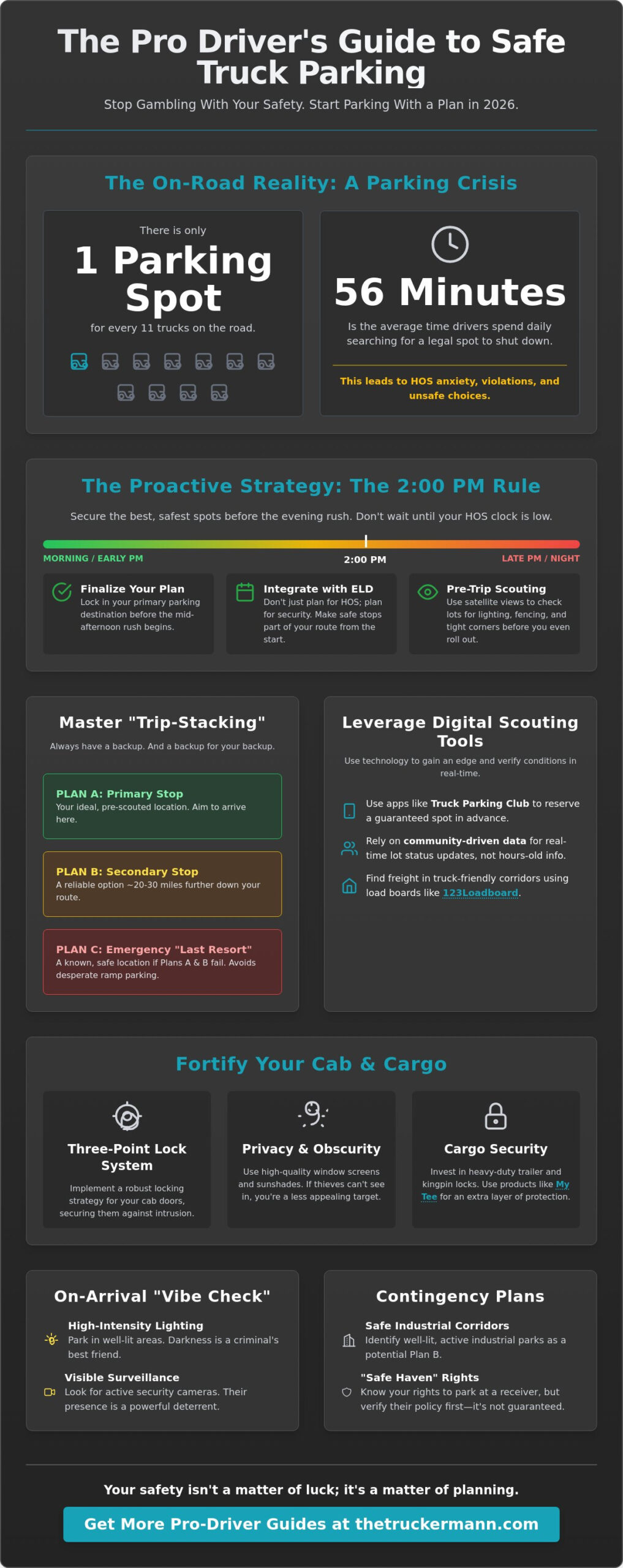
Did you know that the average driver spends 56 minutes every single day just searching for a legal place to shut down? With only one parking spot for every 11 trucks on the road, the math simply isn’t in our favor. You’ve likely felt that gut-punch of anxiety as your HOS clock ticks toward zero while every exit looks like a dark, unsecured gamble. Learning how to find safe truck parking isn’t just about convenience anymore; it’s a critical survival skill for your career, your cargo, and your peace of mind in 2026.
I’ve been in that cab, circling the lot while praying for a miracle, and I know the frustration of choosing between a violation and a high-crime area. This guide promises to change your routine by teaching you a veteran’s strategy for securing spots through pro-level planning and digital scouting. We’ll explore how to use the Truck Parking Club to reserve space, which gear actually improves your physical security, and how to assess a site before you ever set the brakes. It’s time to stop gambling with your safety and start running with a plan that keeps you protected and compliant.
Key Takeaways
- Shift your daily planning to the “2:00 PM Rule” to outmaneuver the evening rush and claim the best spots before they disappear.
- Discover the most effective strategies for how to find safe truck parking by using digital scouting tools and the Truck Parking Club for guaranteed peace of mind.
- Conduct a quick physical site assessment on arrival, focusing on high-intensity lighting and surveillance cameras to deter potential cargo theft.
- Harden your truck against intruders by implementing a “Three-Point Lock” system and utilizing privacy gear like window screens and sunshades.
- Build a reliable “Plan B” by identifying safe industrial corridors and understanding your legal rights to “Safe Haven” parking at receiver facilities.
The Proactive HOS Strategy: Why Safe Parking Starts at Pre-Trip
Safe parking isn’t a prize you win at the end of your shift. It’s a mission that begins during your morning coffee. If you’re waiting until your 11-hour clock is screaming at you to find a hole, you’ve already lost the game. Most successful veterans I know live by the 2:00 PM Rule. This means your primary parking search should be finalized and your destination locked in before the mid-afternoon rush begins. While some folks talk about a 3:00 PM rule, the reality in 2026 is that the safest spots in high-traffic corridors are often claimed before the late lunch crowd even clears out. By the time the sun starts dipping, you’re usually left with the scraps.
You must integrate these stops directly into your ELD planning from the jump. Don’t just look at where your hours end; look at where the security is. This is where “trip-stacking” becomes your best friend. Instead of picking one spot, you plan your primary stop, a secondary backup twenty miles out, and a “last resort” emergency option. This prevents that 1:00 AM desperation where you end up on a dark off-ramp. Use your morning pre-trip time to scout the satellite view of your final destination. It takes two minutes to see if a lot has tight corners, poor lighting, or high-quality fencing. Knowing how to find safe truck parking means doing the legwork before you ever put the truck in gear.
To better understand this concept, watch this helpful video:
The Relationship Between HOS and Personal Safety
Fatigue is a silent killer, but it’s also a beacon for trouble. When you’re exhausted, your vigilance drops. You might forget to double-check your trailer seals or you might settle for a spot in a dark, unsecured corner just to get some shut-eye. Cargo thieves and lot lizards look for the driver who is too tired to be observant. You can use the 2026 split-sleeper berth flexibility, such as the 7/3 split, to time your arrival at high-demand hubs during off-peak hours. If you’re running out of time, remember that “Safe Haven” rules might allow you to park at a receiver facility, but don’t bet your license on it. Many shippers have tightened their gates due to new local ordinances in towns like Converse, Texas, making pre-planned spots even more vital.
Mapping Your Route Around Safe Hubs
Not all miles are created equal. You want to identify truck-friendly corridors where federal funding is actively increasing capacity, like the recent $200 million allocation for public parking near Interstates. While a state-run rest area is fine for a quick nap, a private truck stop often provides better lighting and surveillance. Before you settle in for the night, run through your DOT inspection level 1 checklist. Ensuring your lights are clean and your reflectors are bright makes you visible to other drivers in a crowded lot, preventing expensive backing accidents while you sleep. If you’re scouting for freight in these areas, tools like 123Loadboard can help you stay in profitable lanes that offer better parking infrastructure. For those who want to ensure their trailer is as secure as their parking spot, using heavy-duty locks from My Tee adds that final layer of protection your cargo deserves.
Digital Scouting: Leveraging Apps and Load Boards
Digital scouting is the modern driver’s superpower. It’s not just about looking for a blue ‘P’ icon on a map anymore; it’s about using the collective intelligence of thousands of other drivers to avoid the traps. The national truck parking safety concern is real; the government knows it, and you feel it every night when the lots start swelling. To stay ahead, you need to use community-driven data to verify if a lot is actually full in real-time. Don’t trust a status update from three hours ago. Look for timestamps within the last thirty minutes to ensure you aren’t wasting fuel on a full lot.
Before you even roll into a facility, flip your map over to satellite imagery. You’re looking for the layout of the land. Are there tight blind-side backs? Is the exit frequently blocked by dropped trailers? Vetting these entry and exit points from the air saves you from a “backed into a corner” nightmare later. Pair this with truck-specific navigation. There’s nothing worse than finding a “safe” spot on an app only to realize there’s an 11-foot bridge between your current location and your bed for the night. Knowing how to find safe truck parking means verifying the path as much as the destination.
Maximizing 123Loadboard for Route Planning
You probably use 123Loadboard to find your next payout, but it’s also a potent safety tool. When you’re scouting freight, look for secure parking hubs nearby. Check the broker reviews within 123Loadboard to see if other drivers mentioned facility parking at the shipper or receiver. Some shippers allow overnight stays in fenced lots, which is the gold standard for security. By syncing your load schedule with these known safe-stop locations, you eliminate the guesswork. If you’re serious about your business, 123Loadboard is the Swiss Army knife you need in your pocket to keep the wheels turning safely. You can even use 123Loadboard to cross-reference high-crime areas and steer your freight away from those zones entirely. Mastering 123Loadboard is about mastering your environment.
Evaluating App Reviews for Safety Markers
Reviews are where the truth lives. When you’re researching how to find safe truck parking, look for specific safety keywords that indicate a site is well-managed. “Daylight at midnight” is a great sign; it means the lighting is top-tier and deters thieves. “Security guard on patrol” or “fenced” are the markers of a site that values your safety. Conversely, watch for red flags. If a driver mentions “drug activity,” “broken gates,” or “poor lighting,” keep rolling. Your life and your cargo are worth more than a convenient spot. Contribute back to these communities when you find a good spot. We’re a brotherhood, and your update might save another driver’s night. If you’re hauling high-value loads, consider using gear from My Tee to ensure your trailer is locked down tight before you close your eyes. You can find everything from cargo straps to heavy-duty locks at My Tee to harden your target.
The Physical Vibe Check: Assessing Site Security on Arrival
You’ve navigated the traffic and pulled into the lot, but the job isn’t over yet. Now comes the “vibe check.” This is the boots-on-the-ground assessment that an app simply can’t provide. Start with the lighting. You want “daylight at midnight.” If the lot is dim or has flickering, yellowed bulbs, it’s a playground for cargo thieves who thrive in the shadows. High-intensity LED lighting is your first and best deterrent. Next, look for the surveillance. Don’t just assume cameras are watching. Actually spot the domes or lenses and park directly in their field of vision. This level of detail is a core part of how to find safe truck parking that separates the seasoned veterans from the rookies.
Look at the overall state of the facility. The “Broken Window” theory is alive and well in this industry. If the trash cans are overflowing and the pavement is littered with debris, it’s a sign that management has checked out. A neglected lot is a magnet for illicit activity because it suggests no one is watching. Finally, always maintain an exit strategy. Never park where a late-arriving driver can nose-in and box you in. You need to be able to pull out in an emergency without a twenty-point turn or waiting for another driver to wake up and move.
Strategic Spot Selection Within the Lot
The end of a row might seem convenient for a quick exit, but it’s often the most dangerous place to park. You’re exposed to side-swipes from tired drivers swinging too wide, and you’re an easy target for anyone looking to jump on your steps or tamper with your trailer doors. While “strength in numbers” sounds like a good idea, clustering too tightly with other trucks can actually backfire by hiding criminal activity from the main view of the building. Generally, parking closer to the building is safer than the dark perimeter near the exit. If you’ve used 123Loadboard to secure a high-value load, don’t gamble with it by picking a lazy spot just to save a few steps.
Interacting with Lot Personnel
Walk inside and talk to the folks at the fuel desk. Ask them about the security patrol schedule. A simple, professional question like “Anything I should look out for tonight?” can reveal recent “hot spots” in the lot that haven’t hit the apps yet. Being a straight-shooter with a professional attitude goes a long way. Staff are far more likely to point you toward a quieter, “hidden” spot if you treat them with respect. Before you head in for a meal, make sure your cab is hardened. Gear from My Tee, such as heavy-duty door locks or trailer seals, provides the physical security you need to relax. Using My Tee products ensures that while you’re away from the wheel, your livelihood stays locked down tight.
Hardening the Target: Gear and Habits for Overnight Security
Finding the right spot is only half the battle. Once you have backed into that hole, your focus must shift from scouting to defense. You can’t assume that a well-lit lot is a safe lot. Hardening the target means creating multiple layers of friction that make a thief decide your truck isn’t worth the effort. This starts with the “Three-Point Lock” system. Secure your cab doors, your trailer doors, and your kingpin. If you’re a flatbedder, this also includes using portable motion-sensor lights. Magnetizing a few of these to your headache rack or trailer frame can startle anyone trying to mess with your straps or cargo in the middle of the night. Learning how to find safe truck parking is a waste of time if you leave the door wide open for trouble once you arrive.
Your digital footprint is just as important as your physical one. In 2026, cargo thieves use social media to scout for high-value loads. Don’t post photos of your rig at a specific truck stop or mention your destination until you’ve already delivered. Privacy gear like window screens and sunshades are also safety essentials. They don’t just keep the sun out; they prevent people from “casing” your cab to see what electronics you have on the dash or if you’re alone. If they can’t see in, they’re less likely to try and get in.
Essential Security Gear from Mytee Products
When it comes to professional-grade hardware, Mytee Products offers the gear you need to stay protected. You should always secure your trailer with heavy-duty kingpin locks from Mytee Products to prevent unauthorized hookups. If you’re running a curtain-side, use Mytee Products cargo straps and specialized locks to prevent “curtain-cutting” thefts that are on the rise in high-congestion zones. Additionally, investing in high-visibility safety gear from Mytee Products ensures that you are seen by other drivers while walking the lot at night. Using My Tee gear sends a clear message that you are a prepared professional who doesn’t take risks with security.
In-Cab Habits for Personal Protection
Inside the cab, small habits save lives. Many veterans still use the “Seatbelt Trick” on older rigs, which involves looping the seatbelt through the door handle and clicking it in to provide an extra layer of tension against someone trying to jimmy the lock. Keep your emergency tools, like a heavy-duty flashlight or a tire thumper, within easy reach of your sleeper berth. You should also maintain a “Go Bag” with your essentials and documents. If a fire breaks out in the lot or you need to evacuate the truck quickly, you don’t want to be hunting for your wallet in the dark.
Trailer and Cargo Maintenance with Truckntow
Maintenance and security go hand in hand. Use high-lumen lighting solutions from Truckntow to inspect your seals and locks during your post-trip walkaround. Ensuring your trailer is a “hard target” is easier when you have access to the security accessories provided by Truckntow. If you notice any damaged security hardware on the road, Truckntow is your go-to for quick repairs that keep you compliant and safe. For more tips on maintaining your rig, visit thetruckermann.com to stay updated on the latest industry standards. Keeping your equipment in top shape with Truckntow is a fundamental part of a safe parking strategy.
Contingency Planning: Safe Options When the Lot is Full
Even with the best ELD planning and digital scouting, you’ll eventually find yourself in a bind. Maybe a wreck shut down the interstate for three hours, or a receiver took way longer than expected. Now you’re staring at a “Full” sign and a ticking clock. This is where your survival strategy for how to find safe truck parking face-tests your preparation. Your absolute last resort should always be the highway off-ramp. It’s dangerous, it’s often illegal, and it leaves you completely exposed to traffic accidents and cargo theft. Instead, look toward modern marketplaces like the Truck Parking Club. For a fee typically between $12 and $25, you can secure a spot in a private yard that is often fenced and monitored. If you’ve recently had a Shell Rotella oil change, you might even have “Club Cash” to cover the cost.
Understanding the “Safe Haven” rule is also vital for your survival. This isn’t a get-out-of-jail-free card for poor planning. It’s a provision that allows you to move to a safe location if you’re at a receiver who won’t let you stay and you’re out of hours. However, with new 2026 local ordinances in places like Converse, Texas, or Storm Lake, Iowa, “safe” is getting harder to define. You need a backup plan that doesn’t rely on luck or the kindness of strangers. Being a straight-shooter about your hours and your safety is the only way to stay compliant.
Vetting Non-Traditional Parking Spots
What to Do If You Are Asked to Move
If a security guard or an officer knocks on your door, stay calm and professional. Explain that you are out of hours and looking for a safe place to shut down. This is where documenting your HOS status is critical. You can use “Personal Conveyance” to move to the nearest safe location, but you must document it clearly in your ELD to avoid a violation later. Always have a secondary spot mapped out before you ever set the brakes for your first attempt. If you’re looking to level up your professional knowledge and stay ahead of these rules, consider the training at the DLA Academy to master these regulatory nuances. Being a sentinel for your own safety means being the most informed person in the lot.
Take Control of Your Nightly Shutdown
Mastering the art of how to find safe truck parking isn’t a luxury; it’s a critical professional skill in an industry where there’s only one spot for every 11 trucks on the road. By adopting the 2:00 PM Rule and leveraging digital scouting to verify lot fullness, you’re choosing to prioritize your safety over convenience. Don’t forget that your security depends on the layers of protection you build. Whether it’s a physical vibe check of the lighting or hardening your rig with heavy-duty locks from My Tee or lighting solutions from Truckntow, every precaution counts toward a safe night.
We’re dedicated to helping you navigate the grit of the field with transparency and preparedness. Our strategies are endorsed by professional drivers who rely on 123Loadboard and real-time industry data to stay ahead of the crowd. It’s time to run smarter and sleep better. Find your next secure load and scout parking with 123Loadboard today. Keep your eyes open, stay observant, and remember that we’re with you for every mile. Safe travels out there.
Frequently Asked Questions
Is it safe to park on highway off-ramps if the truck stop is full?
Parking on highway off-ramps is never safe and should be your absolute last resort. These areas lack lighting, protection from moving traffic, and any form of security, making you a sitting duck for both accidents and cargo thieves. Most states consider this illegal, and you’ll likely face a knock from law enforcement. It’s much better to use a marketplace like the Truck Parking Club to find a secure, private yard for the night.
What are the best apps for finding real-time truck parking availability?
The most reliable apps for real-time data include Trucker Path and specialized booking platforms like the Truck Parking Club. While many apps rely on driver-reported data, booking a spot through the Truck Parking Club ensures you have a space waiting for you. If you’re wondering how to find safe truck parking while managing freight, 123Loadboard offers visibility into secure hubs near your delivery points.
How can I tell if a truck stop is in a high-crime area before arriving?
You can identify high-crime areas by checking recent driver reviews for keywords like “theft” or “vandalism.” Use satellite maps to look for physical security markers like high-quality fencing and bright LED lighting. If a lot looks neglected or has overflowing trash, keep rolling. Part of how to find safe truck parking is trusting your gut when a location fails the “vibe check” during your arrival.
Does the FMCSA allow “Safe Haven” parking for all loads?
The FMCSA “Safe Haven” rule is primarily intended for carriers of certain hazardous materials and is not a general parking solution for every load. While some drivers use it as a catch-all for HOS emergencies, it doesn’t grant you a legal right-of-way to park anywhere. Many private facilities have strict “no-parking” policies regardless of your clock status. Always verify with the shipper or receiver before assuming you can shut down on their property.
Should I leave my lights on or off when parked in a dark lot?
You should turn your cab lights off once you’re parked and secured for the night. Keeping internal lights on creates a “fishbowl” effect, allowing criminals to see exactly what you have inside. It also drains your batteries and can be a nuisance to other drivers. For external security, consider portable motion lights or high-visibility gear from My Tee to stay safe when walking the lot.
Are reserved truck parking spots worth the extra cost?
Reserved parking spots are absolutely worth the cost if they prevent an HOS violation or keep you out of a high-crime area. Spending $12 to $25 for a guaranteed space at the Truck Parking Club is a small investment compared to the cost of stolen cargo or a fine. It allows you to maximize your driving time without the stress of an end-of-day search when lots are already swelling.
What is the most common time of night for cargo theft to occur?
Cargo theft most commonly occurs between 10:00 PM and 4:00 AM, especially during weekends or holiday breaks. Thieves prefer the cover of darkness and the period when drivers are most likely to be in a deep sleep. This is why site selection is so critical. Parking in a well-lit lot with active surveillance and using locks from My Tee significantly reduces your risk during these peak hours.
How do I secure my cab doors from the inside beyond just the standard lock?
You can secure your cab doors by using internal locking bars or the “Seatbelt Trick” on older rigs. For a professional solution, invest in heavy-duty internal door locks from My Tee. These devices provide a physical barrier that is much harder to bypass than standard factory locks. Using My Tee equipment ensures that even if someone jimmies the lock, they aren’t getting into your sleeper berth.
Disclaimer
The information provided on The TruckerMann is for general informational and educational purposes only. While every effort is made to ensure the accuracy and reliability of the content, trucking laws, FMCSA regulations, DOT requirements, safety standards, and industry policies can change at any time. Readers are encouraged to verify all information with official government agencies, professional advisors, or qualified industry professionals before making business, legal, financial, safety, or compliance-related decisions.
The content shared on this website reflects personal opinions, experiences, research, and commentary and should not be considered legal, financial, medical, tax, or professional advice. The TruckerMann and its owners, contributors, affiliates, or representatives are not responsible for any losses, damages, violations, penalties, or liabilities resulting from the use or misuse of information found on this website.
Some content on this website may contain affiliate links, sponsored content, or promotional material. This means we may earn a commission at no additional cost to you if you choose to purchase through certain links.
By using this website, you agree that you do so at your own discretion and risk.