Your CB radio is either your most reliable partner on a long haul or a box of expensive static that does nothing but clutter your cab. Most drivers have felt that sting of frustration, staring at a dashboard of knobs while a wall of white noise drowns out the very road alerts they need to hear. It is a common hurdle; nobody wants to sound like a rookie or miss a critical warning about a backup five miles ahead just because their settings were off. You deserve to feel like a seasoned veteran every time you key the mic, knowing your voice is getting through loud and clear.
This guide is here to ensure you master how to use a cb radio effectively by breaking down the technical tuning, the professional etiquette, and the essential lingo of the road. We will show you how to cut the interference, talk with confidence, and stay on the right side of the law. We are diving into everything from the 2026 FCC ban on roger beeps to the best ways to use Channel 9 for emergencies; giving you the tools to turn that radio into a true competitive advantage. By the time you finish reading, you will have the professional confidence to command the airwaves and hear traffic alerts miles before they become your problem.
Key Takeaways
- Select a high-quality transceiver and noise-canceling microphone to ensure your signal cuts through engine noise every time you key the mic.
- Master the balance between Squelch and RF Gain to filter out constant static while keeping your lifeline to other drivers open.
- Learn how to use a cb radio effectively by adopting the professional lingo and etiquette that earns respect from the veterans on the airwaves.
- Turn your radio into a true early-warning system by decoding real-time traffic alerts and “Bear reports” miles before you hit the brakes.
- Make your radio a priority during your pre-trip inspection to catch loose connections and weather damage before they silence your signal.
Master Your CB Setup
Your rig is your office; your radio is your eyes and ears. To understand how to use a cb radio effectively, you have to start with the hardware. A cheap box might get you across the yard, but it won’t get you across the state line when a pile-up is brewing. The Citizens Band (CB) radio service is a 40-channel lifeline regulated by the FCC. It’s designed to keep the community connected without a license, but it only works if your gear is up to the task.
To better understand this concept, watch this helpful video:
Essential Components for Pros
A professional setup relies on a solid trinity: the transceiver, the coaxial cable, and the mount. The transceiver handles the logic, but the coaxial cable is the nervous system. If your coax is pinched or cheap, your signal dies before it hits the air. You need heavy-duty mounts that can handle the wind resistance at 70 miles per hour. Sourcing your gear from veteran suppliers like Truckntow ensures you aren’t buying hobbyist junk that will fail after the first winter storm. It’s an investment in your safety and your sanity.
Antenna Tuning and SWR
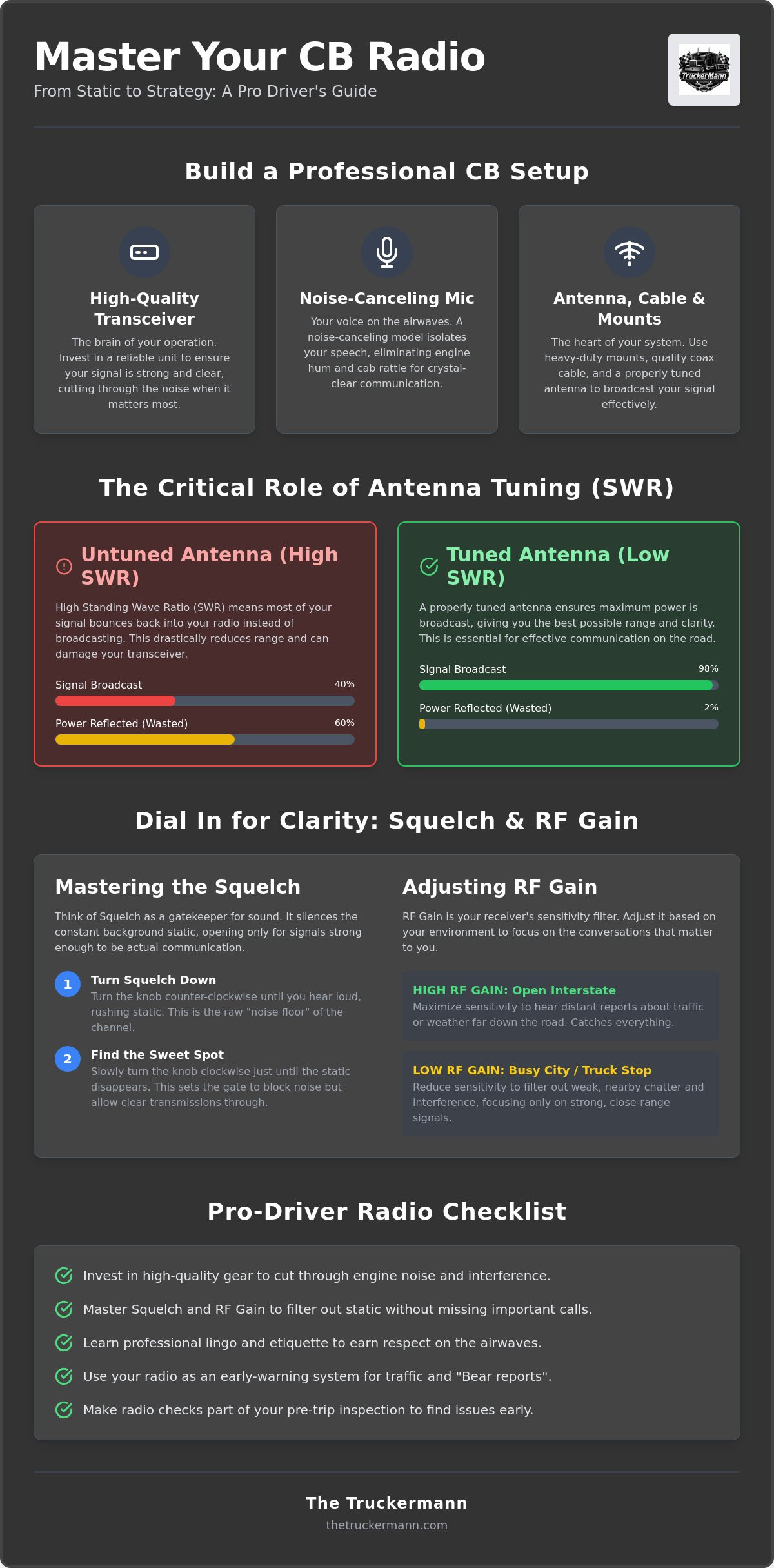
The antenna is the true heart of your system. It doesn’t matter how much you spend on the radio if the antenna isn’t tuned. Standing Wave Ratio (SWR) measures how much of your signal is actually leaving the truck versus how much is bouncing back into the radio. High SWR doesn’t just reduce your range; it literally cooks the internal components of your transceiver. Learning how to use a cb radio effectively means realizing that your setup is unique to your vehicle. You must tune your antenna specifically to your truck because the metal of your cab and trailer acts as a ground plane. A tuned antenna concentrates your 4 watts of power into a focused beam, while an untuned one wastes that energy as heat and static. It’s the difference between being a voice in the wilderness and a leader on the airwaves.
Dial in Squelch and RF Gain
A 10-hour haul is long enough without listening to a beehive in your ear for five hundred miles. Your radio is a lifeline, but only if you can hear the signal over the noise. Learning how to use a cb radio effectively means mastering the dance between the dials. If you leave them wide open, the constant static becomes a distraction that wears you down, turning a vital tool into a source of fatigue. You are looking for the noise floor, which is the baseline level of atmospheric hiss that exists everywhere. A poorly tuned radio is just noise; a masterfully tuned one is a tactical advantage.
The Art of the Squelch
Think of the squelch as a security guard for your speakers. It keeps the noise out until someone with a strong enough signal shows up to talk. To set it right, follow these simple steps:
- Step 1: Turn the squelch knob all the way to the left. You will hear a loud, rushing static. That is the raw noise of the airwaves.
- Step 2: Slowly turn the knob to the right until that static just barely clicks off.
That is your sweet spot for most highway travel. However, if you are in a remote stretch of the desert or dealing with an emergency, you might want to open the squelch back up. Sometimes a faint, scratchy voice is the only warning you get before a road closure. Keeping your signal clear is just as important as any other part of your routine. If you want to stay ahead of the curve, check out the latest industry insights at thetruckermann.com to keep your professional edge sharp.
Manage RF Gain and Mic Gain
While squelch is a gate, RF Gain is a filter. It controls the sensitivity of your receiver. When you are on the open interstate, you want it wide open to catch every skip and distant report. But in a crowded city or a busy truck stop, the air is thick with local interference. Turning down the RF Gain lets you ignore the weak, distant chatter so you can focus on the driver three trucks ahead of you. It keeps your ears fresh and your mind on the road where it belongs.
Don’t forget your Mic Gain, often called Dynamike. This controls how much of your voice goes out to the world. If you have it cranked too high, you will clip and sound like a distorted mess to everyone else. You want to sound like a professional, not a garbled recording. Aim for a level where your voice is full and clear without hitting the red on your signal meter. Getting these settings right is a core part of learning how to use a cb radio effectively. Mastering these dials ensures that when you speak, people listen, and when the road talks, you hear it.
Professional Etiquette and Lingo
The airwaves are a shared space, a digital campfire that stretches across the interstate. It is where the fraternal bond of the road is forged. If you want the best intel from the veterans who have seen it all, you have to sound like you belong. Mastery of how to use a cb radio effectively involves more than just turning knobs; it requires an understanding of the unwritten “Driver’s Code.” Veterans will often ignore a rookie who clutters the air with nonsense, but they will go out of their way to help a professional who knows the protocol. Sound like a pro, and you will be treated like one.
Keep in mind that the CB is a tool for business and safety first. While the FCC does not require a license to operate, they still monitor for misuse. Channel hogging, broadcasting music, or using prohibited “Roger beeps” (which were officially banned in early 2026) can lead to serious trouble under the United States Code. Use the radio to stay safe, stay informed, and stay connected; but always keep your transmissions purposeful. Your reputation on the air is just as valuable as your driving record.
Essential Channels and Lingo
Understanding the landscape of the 40 channels is vital. Channel 19 is the “Highway” channel for most of the United States, acting as the primary artery for road reports and general chatter. In contrast, Channel 9 is strictly for emergency use and traveler assistance. FCC regulations demand that all operators give priority to emergency calls on this channel. To communicate like a veteran, you should also know the basic lingo. A “Bear” is a police officer, the “Hammer” is your accelerator, and “10-4” simply means you have received and understood the message. Using these terms correctly shows you are part of the community.
Breaking and Radio Ethics
Knowing when to talk is just as important as knowing what to say. If you need to join a conversation, wait for a natural pause and say “Break” or “Break 1-9.” It is the verbal equivalent of a polite knock on the door. If you are unsure if your gear is working after a long stretch of silence, use the radio check protocol. Simply say, “Break 1-9 for a radio check,” and wait for a response like “You’re getting out loud and clear” or “Five by five.” Brevity is the hallmark of a seasoned professional driver. Say what you need to say, deliver the facts, and get off the mic to keep the channel open for others. This level of discipline is a core part of how to use a cb radio effectively and ensures the airwaves remain a reliable tool for everyone on the road.
Using CB for Road Intel
Cellular apps are fine when you have a signal, but they often lag behind the reality of the pavement. A CB radio is the only tool that gives you a live, unfiltered feed of what is happening five miles ahead of your bumper right now. While smartphones rely on towers that can disappear in deep valleys or high mountain passes, your radio works wherever your truck goes. Mastering how to use a cb radio effectively is about more than technical skill; it is about building situational awareness. You aren’t just reacting to brake lights; you are anticipating the wreck, the road closure, or the sudden patch of black ice before you even see it. This proactive approach is what keeps your driving record clean and your freight moving.
Traffic and Weather Alerts
When you see a line of brake lights or a sudden wall of fog, don’t wait for your GPS to update. Key the mic and ask for a “Westbound report” or “Eastbound report” depending on your direction. Other drivers will tip you off to “gators” (shredded tire treads) in the middle of the lane or “black ice” on a bridge deck. This real-time intel is especially critical when you are weatherproofing your load for a winter run through the Rockies. Knowing that a pass is closing or that the wind is picking up allows you to find a safe place to park before you are forced into a dangerous situation.
DOT and Scale Reports
The CB is your best defense against unexpected roadside delays. Drivers ahead of you will often report if the scales are open or if the DOT is out doing “creepers” (portable inspections) on a specific shoulder. This information isn’t about breaking the law; it is about being prepared. Hearing that a CVSA Roadcheck is in progress gives you that extra moment to double-check your paperwork and securement. This real-time coordination can help you avoid the stress of a surprise DOT Level 1 Inspection by ensuring everything is in order before you reach the checkpoint. If you want to stay ahead of the game, you should stay informed with the latest road intel regularly.
By listening to the chatter, you learn the rhythm of the road. You begin to recognize which reports are reliable and which are just noise. This level of professional intuition is a core part of learning how to use a cb radio effectively. It turns a simple communication device into a tactical early-warning system that protects your livelihood and your equipment. When you know what is coming, you are never caught off guard.
Maintain Your Radio Lifeline
A radio that fails when you need it most is worse than no radio at all. It provides a false sense of security that vanishes the moment you try to key the mic during a blizzard. To master how to use a cb radio effectively, you must adopt a preventative maintenance mindset. Professionalism on the road is not just about how you drive; it is about how you care for the tools that keep you safe. Treat your transceiver and antenna system as a critical line item on your CDL pre-trip inspection. If you wouldn’t roll with a frayed air line, you shouldn’t roll with a loose antenna mount.
The environment of a Class 8 truck is brutal on electronics. Constant road vibration, extreme temperature swings, and moisture from the road can loosen connections and corrode copper over time. A setup that worked perfectly last month might be losing half its power to a pinched coax cable today. This is why a working radio is a safety requirement, not an optional accessory. It is your primary way to receive immediate, localized warnings that no satellite-based system can match. When the cell towers go down in a remote mountain pass, your radio is the only thing standing between you and total isolation.
Daily Equipment Checks
Your daily routine should include a quick visual and tactile check of your hardware. Look at the microphone cord for frays or exposed wires that can cause a short. Check the antenna mount to ensure it hasn’t vibrated loose; a loose mount ruins your ground plane and spikes your SWR. Ensure your power connection is clean and tight. If you notice a whining sound that matches your engine RPM, you likely have a grounding issue or a dirty power lead. Finally, perform a quick radio check at the start of every shift. A simple “Break 1-9 for a radio check” ensures you are getting out and receiving before you hit the heavy traffic. It is the hallmark of a seasoned veteran who leaves nothing to chance.
Upgrading for the Long Haul
As you gain experience, you might find that a basic entry-level unit no longer meets your needs. Moving to a high-performance model, such as the Bearcat 980 SSB or a classic Cobra 29 LTD, can offer better noise filtering and durability. If you want maximum range, look into Single Sideband (SSB) units. While standard AM is limited to 4 watts, SSB transmissions are legally allowed up to 12 watts, providing much greater reach in open territory. Adding an external speaker is another pro move; it allows you to hear incoming reports clearly over the roar of the engine and wind noise. Staying ahead of the curve means having the right tech for your rig, which you can source through trusted suppliers like Truckntow. Mastering how to use a cb radio effectively is a journey of continuous improvement, ensuring your voice always carries when the stakes are high.
Command the Airwaves
Your radio is more than just a piece of hardware; it is your direct line to the brotherhood of the road. By mastering your setup, tuning those dials to cut through the noise, and speaking the language of a veteran, you transform your cab into a tactical command center. You now have the blueprint for how to use a cb radio effectively to anticipate hazards, navigate DOT scales, and stay ahead of the weather. When the cell towers fail, this is the tool that keeps you moving.
This advice comes from a professional driver with over 5 years of OTR experience. Thousands of your peers already trust us for the latest DOT compliance and safety news that impacts their livelihood. Don’t let a weak signal or poor etiquette keep you in the dark. It is time to take control of your communication and your career.
Upgrade your rig with professional trucking gear today
Keep your ears open and your signal strong. We will see you out there on the 1-9.
Frequently Asked Questions
Do I need a license to use a CB radio in 2026?
No, you do not need a license or a fee to operate a CB radio in the United States. The FCC governs the Citizens Band Radio Service under Part 95 rules, which allow anyone to use the 40 designated channels for personal or business use. You just need to follow the power limits of 4 watts for AM and 12 watts for Single Sideband transmissions.
How far can a standard mobile CB radio transmit?
A standard mobile CB radio typically transmits between 1 and 5 miles depending on your terrain and antenna setup. In flat, open areas with a perfectly tuned antenna, you might reach up to 10 or 15 miles. If you need more distance, switching to a Single Sideband (SSB) radio can significantly extend your reach because it utilizes higher legal power limits.
What is the best channel for truck drivers in the US?
Channel 19 is the universal “highway channel” for truck drivers across most of the United States. It is the best place to hear real-time traffic updates, weather warnings, and road hazard reports from other professionals. Learning how to use a cb radio effectively begins with monitoring this channel to stay connected with the flow of traffic around you.
Why does my CB radio have so much static when the engine is running?
Can I use a CB radio while my ELD is running?
Yes, you can use a CB radio without any interference to your Electronic Logging Device (ELD). CB radios operate on a completely different frequency range than the Bluetooth or cellular signals used by logging hardware. It is actually a smart safety move to keep your radio active so you have a backup communication tool if your digital devices lose their data connection.
What should I do if I hear an emergency call on Channel 9?
If you hear an emergency call on Channel 9, you must give that transmission immediate priority and stay off the air. Channel 9 is strictly reserved for emergency communications and traveler assistance under FCC rules. Unless you are the person reporting the emergency or are in a position to provide direct help, keep the channel clear for first responders.
Is it legal to use a CB radio while driving?
Yes, it is legal to operate a CB radio while you are driving. Most state and federal distracted driving laws specifically exempt two-way radios used by professional drivers and emergency services. While cell phone use is heavily restricted, the one-handed operation of a CB mic is recognized as a necessary tool for road safety and professional coordination.
How do I know if my CB antenna is properly grounded?
The most reliable way to check your ground is to use an SWR meter to measure your Standing Wave Ratio. A high SWR reading is a major red flag that your antenna mount isn’t making proper contact with the truck’s chassis. Mastering how to use a cb radio effectively requires a solid ground plane, so ensure your mount is bolted to bare metal rather than a painted or rusted surface.
Disclaimer
The information provided on The TruckerMann is for general informational and educational purposes only. While every effort is made to ensure the accuracy and reliability of the content, trucking laws, FMCSA regulations, DOT requirements, safety standards, and industry policies can change at any time. Readers are encouraged to verify all information with official government agencies, professional advisors, or qualified industry professionals before making business, legal, financial, safety, or compliance-related decisions.
The content shared on this website reflects personal opinions, experiences, research, and commentary and should not be considered legal, financial, medical, tax, or professional advice. The TruckerMann and its owners, contributors, affiliates, or representatives are not responsible for any losses, damages, violations, penalties, or liabilities resulting from the use or misuse of information found on this website.
Some content on this website may contain affiliate links, sponsored content, or promotional material. This means we may earn a commission at no additional cost to you if you choose to purchase through certain links.
By using this website, you agree that you do so at your own discretion and risk.