What if your living room was seventy square feet, hurtling down the interstate at sixty-five miles per hour, and the only way to double your household income was to never leave your spouse’s side? It’s a question more veterans are asking as they eye the 2026 freight market. You’ve likely wondered if bringing your partner along is a shortcut to financial freedom or a one-way ticket to a relationship roadblock. Understanding the team driving pros and cons for couples is about more than just splitting time at the wheel; it’s about managing a high-stakes business partnership in a space smaller than most walk-in closets.
You already know the road is a demanding mistress, and adding a spouse to the mix changes the dynamic of every mile. This guide will show you how to navigate those shifts while keeping your sanity and your paycheck intact. We’ll break down how the latest 6.5/3.5 sleeper berth splits affect your rest, the reality of sleeping in a moving truck, and the financial roadmap that can push a couple’s combined earnings well over $100,000. You’ll walk away with practical cab life tips and a clear decision on whether to turn your rig into a rolling home for two.
Key Takeaways
- Learn how to leverage the 2026 market recovery to push your combined household income past the $100,000 mark through strategic team scheduling.
- Evaluate the team driving pros and cons for couples to see if the benefit of zero loneliness outweighs the challenge of sleeping in a moving truck.
- Discover how to use updated 6.5/3.5 sleeper berth splits to maintain 24/7 uptime without burning out your partner.
- Professionalize your workflow with high-efficiency My Tee securement gear to cut down on unpaid dwell time and maximize your driving window.
- Use our compatibility checklist and trial run strategy to pressure-test your relationship before you sign a long-term team contract.
What is Team Driving for Couples?
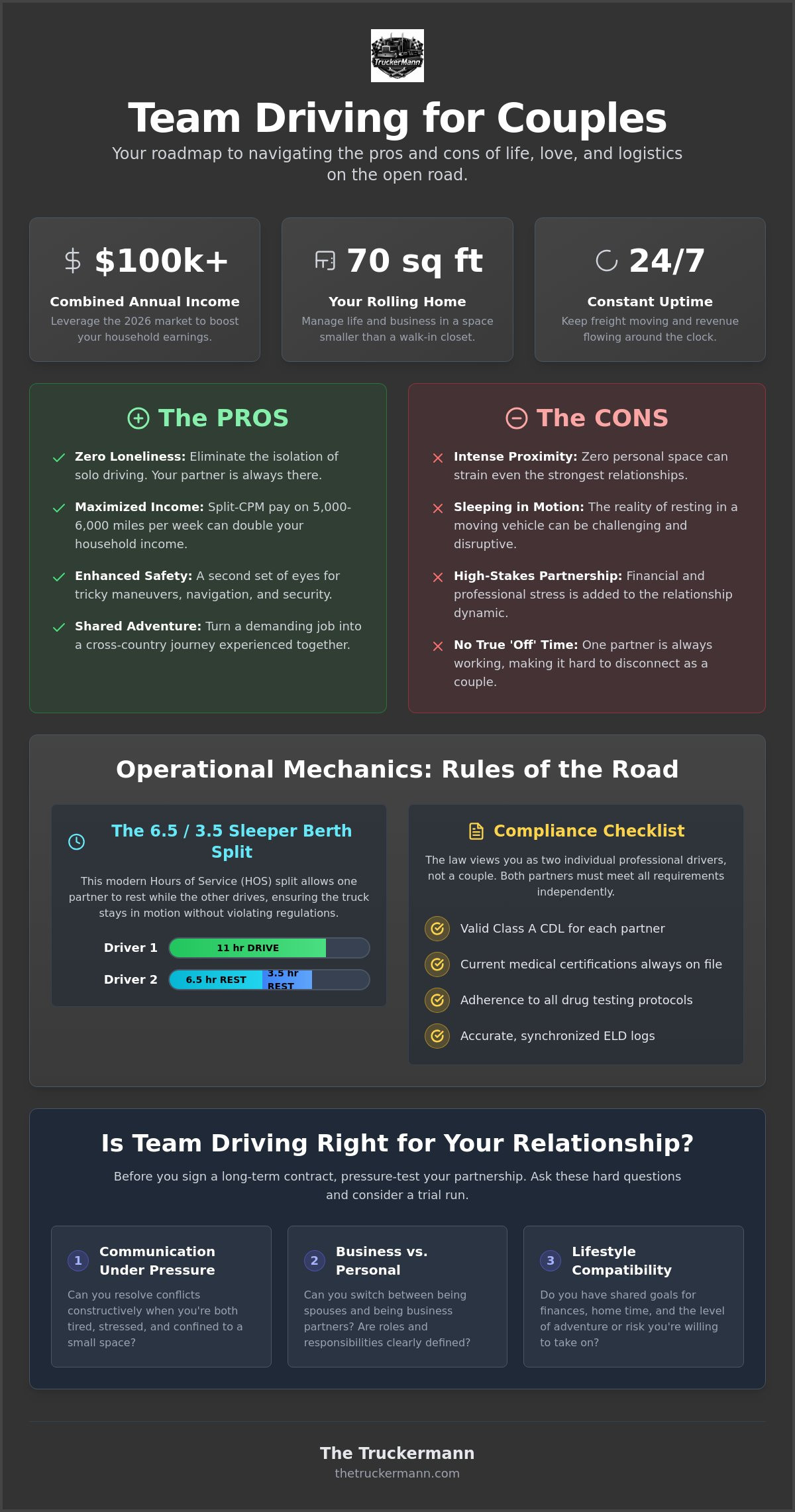
At its core, team driving for couples is a high-stakes business partnership where two people operate the same rig in shifts to keep the wheels turning nearly 24/7. While a solo driver has to shut down for ten hours, a team keeps the freight moving. Team drivers, particularly spouses, are the backbone of the expedited freight world because they maximize the truck’s uptime. It’s a total transition from a traditional house to a rolling home, where your living room, kitchen, and bedroom are all packed into a seventy-square-foot sleeper berth.
2026 is becoming the year of the logistical power couple. With driver availability tightening and spot rates projected to rise between 4% and 6%, carriers are desperate for reliable teams who can handle long-haul OTR routes without the delays of solo rest periods. It’s a unique opportunity to double your household paycheck while navigating the team driving pros and cons for couples together. You aren’t just roommates; you’re co-CEOs of a mobile enterprise.
To better understand this concept, watch this helpful video:
The Mechanics of a Team Shift
Efficiency is the name of the game. Under the 2026 HOS regulations, each driver gets an 11-hour driving limit within a 14-hour window. The real magic happens with the sleeper berth split. You can now use a 6.5/3.5 split, allowing one spouse to rest while the other grinds out the miles. When it’s time to swap, ELD synchronization is critical. Modern devices must sync with the FMCSA gateway by early 2027, so your logs need to be airtight to avoid DOT headaches. Using professional gear from My Tee can make these transitions smoother by keeping your equipment organized and ready for the next shift.
Legal Requirements for Couple Teams
The Pros: Why Couples are Choosing the Open Road
Loneliness is the silent killer of trucking careers, often leading to burnout faster than any mechanical failure. For most solo drivers, the cab is a solitary confinement cell for 11 hours a day, punctuated only by brief exchanges at fuel islands. When you bring your spouse along, that isolation vanishes instantly. You’re no longer counting down the days until home-time because home is sitting in the passenger seat right next to you. This emotional stability is a massive factor when evaluating the team driving pros and cons for couples. Beyond the mental health boost, having two sets of eyes during a tricky back-up at a crowded receiver or a midnight run through a snow-covered pass adds a layer of safety that solo drivers simply can’t replicate.
The adventure aspect of this lifestyle is a powerful draw that many corporate offices can’t match. You get to see the sunrise over the Rockies and the neon lights of the Vegas strip as a shared memory, not a blurry photo sent via a spotty data connection. It turns a grueling job into a life-long road trip where the scenery changes daily. However, staying profitable while exploring requires a disciplined approach to the clock. You need to stay strictly within the FMCSA Hours of Service regulations to ensure your shared journey doesn’t end with a costly DOT violation or a forced shutdown.
Maximizing the Split-CPM Pay
Team pay is where the financial math really starts to favor the couple. While solo drivers might earn a slightly higher rate per mile in some specialized niches, a team truck can easily cover 5,000 to 6,000 miles in a single week. Most carriers offer split-CPM (cents per mile) pay where every single mile the truck moves is paid out to both drivers. This often results in a combined household paycheck that dwarfs what two people could earn in separate solo trucks or traditional 9-to-5 jobs. To keep the revenue high, savvy couples use 123Loadboard to find high-priority, expedited freight that demands the non-stop movement only a team can provide. Equipping your rig with high-quality securement gear from My Tee ensures you spend less time on the ground and more time racking up those paid miles.
Building a Family Business on Wheels
Many couples eventually transition from company drivers to owner-operators, treating their truck as a mobile family business. This setup offers significant tax advantages, such as the ability to deduct shared living expenses and per diem rates that solo drivers might struggle to maximize. It’s about more than just the daily grind; it’s a shared professional mission with a clear endgame. Whether you’re saving for a brick-and-mortar home, funding a child’s education, or building an early retirement nest egg, doing it at double speed creates a professional bond that few other careers can offer. If you’re ready to start this journey, checking out professional resources for drivers is the first step toward mastering the business of the road.
The Cons: The Hard Truths of 24/7 Cab Life
While the paycheck is heavy, the cost of entry is paid in sweat and sanity. You can’t talk about the team driving pros and cons for couples without addressing the “hurricane” in the sleeper berth. Imagine trying to get deep REM sleep while your partner navigates a pothole-ridden stretch of I-80 at sixty miles per hour. The constant vibration and engine hum create a physical toll that solo drivers, who sleep in stationary trucks, never have to face. Over time, this lack of quality rest can lead to a shorter fuse and slower reaction times, making the job more dangerous for both of you.
Then there’s the “Cab-mosphere.” In a seventy-square-foot space, one stray pair of boots or a spilled coffee becomes a major obstacle. Hygiene is a constant battle. Without a daily shower at home, managing smells and clutter requires military precision. If you don’t stay organized, the truck quickly feels like a cage. This environment amplifies the challenges of working with a spouse, as there’s literally no “away” to go when a disagreement flares up. You’re forced to resolve conflicts while looking at the back of your partner’s head or staring at the ceiling of the bunk. Even small tasks like checking your My Tee cargo straps can become a source of irritation if you’re both exhausted.
Managing the Physical Toll
The road is hard on the body. Constant vibration can lead to back issues and joint pain over years of service. When the truck never stops, finding a hot, healthy meal is nearly impossible. You’re often left with whatever is under the heat lamp at the truck stop. Smart couples prep meals in advance to avoid the “trucker spread.” Maintaining a workout routine is equally tough. You’ll find yourself doing push-ups against the trailer tire or walking laps around a dark parking lot just to keep your blood moving. Investing in high-quality gear from My Tee to streamline your outdoor work can save precious minutes for rest.
The Mental Challenge of Constant Motion
Cabin fever is real. After four days of seeing nothing but asphalt and the inside of the cab, your mind starts to wander. It’s vital to set boundaries. Even in a shared space, you need “me-time,” whether that’s wearing noise-canceling headphones or reading a book in the bunk while the other drives. Communication is your only lifeline. You have to learn to speak through fatigue and high-stress traffic without letting the tension boil over into a relationship-ending fight. If you can’t find a way to coexist in that small space, the financial gains won’t matter.
Essential Gear and Regulatory Prep for Teams
Preparation is the line in the sand between a profitable year and a relationship-ending disaster. When you’re weighing the team driving pros and cons for couples, it’s easy to get blinded by the potential for a doubled paycheck, but veterans know it’s the gear in the cab that keeps the peace. Comfort isn’t a luxury in this game; it’s a safety requirement. If the driver in the bunk can’t sleep because of a cheap mattress or a failing climate control system, the driver behind the wheel is eventually going to pay the price. Investing in high-quality bedding and an auxiliary power unit (APU) ensures that the truck remains a sanctuary rather than a stress-box. Noise-canceling headsets are another tech essential, allowing the off-duty partner to disconnect from the road noise and the constant hum of the engine.
Your route strategy is the next piece of the professional puzzle. You need to decide whether your partnership is better suited for interstate or intrastate routes. While interstate OTR work offers the long miles that teams crave, it requires a higher level of logistical prep and a deeper commitment to life on the road. Regardless of the path you choose, your equipment must be up to the task. Using reliable securement gear from My Tee ensures that you spend less time wrestling with loads and more time racking up paid miles.
Flatbed Gear for the Power Couple
If you’re pulling a flatbed, your equipment needs to be a force multiplier. Heavy, water-logged steel tarps can be a nightmare for a two-person team to manhandle, especially during a midnight delivery in the rain. Lightweight tarps from My Tee are essential because they allow both partners to contribute to the securement process without risking injury or exhaustion. You need the best flatbed trucking gear designed for efficiency and ease of use. High-quality winches and straps from My Tee can shave thirty minutes off every load, which translates directly into more driving time and a healthier bottom line.
Logistics and Load Management
Keeping the truck moving means killing the deadhead. Savvy couples use 123Loadboard to find backhauls that keep the wheels spinning and the revenue climbing. However, more miles mean more scrutiny from the DOT. Staying on top of ELD compliance is vital, especially with the 2026 upgrades to communication protocols that require devices to sync with the new FMCSA gateway. You must manage your driver swaps with precision to ensure you never violate HOS rules. The Truckermann’s tip: always have a backup plan for mechanical breakdowns. A failure in the middle of nowhere is the ultimate test of a couple’s patience, so keep a well-stocked tool kit and a clear communication plan with your dispatcher. Stay ahead of the curve by exploring our professional driver resources to master your mobile business.
Is Team Driving Right for Your Relationship?
Before you sign that team contract, you need to have a brutally honest sit-down at the kitchen table. Weighing the team driving pros and cons for couples isn’t just about the money; it’s about whether your relationship can withstand the constant friction of 24/7 proximity. If you argue about the thermostat at home, imagine arguing about it when you’re both exhausted and stuck in a traffic jam outside of Chicago. You need a compatibility test that goes beyond “do we like each other?” and asks “can we work together?” It’s a question of professional temperament as much as personal love.
Never jump into this life without a trial run. Take a week-long OTR trip together before you commit to a long-term contract or sell your stationary home. It’s the only way to see the reality of the road without the rose-colored glasses of a high paycheck. If you can’t stand each other after five days in the cab, five months will be impossible. Also, establish a “Sunset Clause.” This is a pre-negotiated agreement on when you’ll stop team driving, whether it’s after you save $50,000 for a down payment or when a specific date on the calendar hits. Having an exit strategy prevents the road from feeling like a life sentence and keeps your shared goals in focus.
The Communication Audit
How do you handle stress? If a blown tire at 2 AM sends one of you into a tailspin, the other needs to be the anchor. You must define your roles clearly to avoid stepping on each other’s toes. Decide who handles the digital paperwork and who takes the lead on load securement with your My Tee equipment. A Team Contract is a mutual agreement on cab rules that ensures both partners are on the same page regarding daily operations. This document should cover everything from hygiene standards to who gets control of the radio during the midnight shift.
Financial Readiness
Don’t just drive for the sake of driving. Calculate your break-even point to ensure the increased operating costs of a team truck are actually resulting in a higher net profit for your household. For those looking to move into management or specialized logistics, investing in your future with DLA Academy can provide the advanced training needed for long-term career growth. The Truckermann’s final verdict is simple: if you can survive the first 90 days of the team grind, you can survive anything. It’s a hard life, but for the right couple, it’s the ultimate ticket to financial freedom and shared adventure. Just make sure you have the right My Tee gear and a solid plan before you drop the hammer.
Mastering the Road as a Team
The road ahead in 2026 offers a unique path for couples willing to trade their stationary lives for a rolling home. You’ve seen how the team driving pros and cons for couples balance out; it’s a constant trade-off between the grit of a 24/7 cab-mosphere and the glory of a doubled paycheck. Success out here isn’t just about miles. It’s about the veteran-tested gear, the rock-solid communication, and the mental toughness you bring into the sleeper every single day. We provide the practical advice from the “Rolling Home” perspective and direct links to the high-intent training you need to thrive in this specialized sector.
Don’t leave your comfort or safety to chance when you’re thousands of miles from home. You can upgrade your rig and your career today by following our veteran-vetted strategies and using the right equipment for the job. If you’re ready to hit the pavement with confidence and maximize your household income, Upgrade your rig with professional gear from My Tee today!. Keep the wheels turning, look out for each other, and we’ll see you at the next fuel stop.
Frequently Asked Questions
How much do team drivers make compared to solo drivers?
Team drivers typically earn more because the equipment stays in motion nearly 24/7. In 2026, experienced teams in high-demand sectors like expedited or hazmat can often see household earnings exceeding $150,000 annually. This financial boost is one of the biggest factors when weighing the team driving pros and cons for couples. While solo drivers are limited by their own fatigue, a team maximizes the truck’s revenue potential every single day.
Do husband and wife teams get more home time?
Home time frequency is usually the same as a solo driver, but the quality of that time changes. Since you’re with your spouse 24/7, you don’t feel the same home-sickness that drives solo operators out of the industry. Some carriers prioritize team trucks for long-haul routes that get you back to your home terminal more predictably. It’s about finding a company that values your partnership and keeps you moving toward your shared goals.
What happens if one driver gets sick while on a team route?
If one driver falls ill, the truck must operate under solo HOS regulations until they recover. You cannot continue the 24/7 team schedule if one partner is physically unable to drive safely. This usually means notifying your dispatcher immediately to adjust delivery windows. It’s a high-stakes situation that highlights why having a backup plan for emergencies is critical for any team operating in the expedited freight market.
Can we bring a pet while team driving as a couple?
Many carriers are pet-friendly, but you have to be realistic about the space. Sharing a seventy-square-foot sleeper with a spouse and a dog requires extreme organization and cleanliness. You’ll need to keep your My Tee equipment stored neatly to make room for your furry companion’s bed and supplies. It’s a great way to eliminate loneliness, but it adds another layer of complexity to cab life.
Is it hard to sleep while the other person is driving?
Adjusting to sleep in a moving truck is one of the steepest learning curves for new teams. The constant road vibration and engine noise can make it feel like you’re sleeping in a hurricane. Most veterans recommend investing in a high-quality mattress topper and heavy curtains to block out light. It’s a major part of the team driving pros and cons for couples that requires physical and mental adaptation over the first few months.
Do we need two separate ELD accounts for team driving?
Yes, federal law requires each driver to have their own individual ELD account and login. You’ll log in as the active driver when it’s your turn at the wheel, while your spouse logs in as sleeper berth or off-duty. Proper log management is essential for staying compliant with the latest 2026 FMCSA protocols. Failing to switch accounts during a driver swap is a major violation that can lead to heavy fines and shutdowns.
What is the best type of truck for a couple team?
Look for a high-roof condo sleeper with at least 76 to 80 inches of bunk space. You need the extra headroom and storage capacity to accommodate two people’s worth of clothes, food, and professional equipment. Having a dedicated spot for your My Tee securement gear in the side boxes is essential to keep the interior living space clutter-free and manageable during long OTR hauls.
How do we handle taxes as a married trucking team?
Most married teams file a joint tax return to capitalize on shared deductions. You can often claim per diem for both drivers, which significantly lowers your taxable income compared to a solo driver. It’s vital to keep every receipt for equipment like My Tee straps or tools. Working with a CPA who understands the specific tax codes for interstate trucking is the best way to protect your earnings.
Disclaimer
The information provided on The TruckerMann is for general informational and educational purposes only. While every effort is made to ensure the accuracy and reliability of the content, trucking laws, FMCSA regulations, DOT requirements, safety standards, and industry policies can change at any time. Readers are encouraged to verify all information with official government agencies, professional advisors, or qualified industry professionals before making business, legal, financial, safety, or compliance-related decisions.
The content shared on this website reflects personal opinions, experiences, research, and commentary and should not be considered legal, financial, medical, tax, or professional advice. The TruckerMann and its owners, contributors, affiliates, or representatives are not responsible for any losses, damages, violations, penalties, or liabilities resulting from the use or misuse of information found on this website.
Some content on this website may contain affiliate links, sponsored content, or promotional material. This means we may earn a commission at no additional cost to you if you choose to purchase through certain links.
By using this website, you agree that you do so at your own discretion and risk.