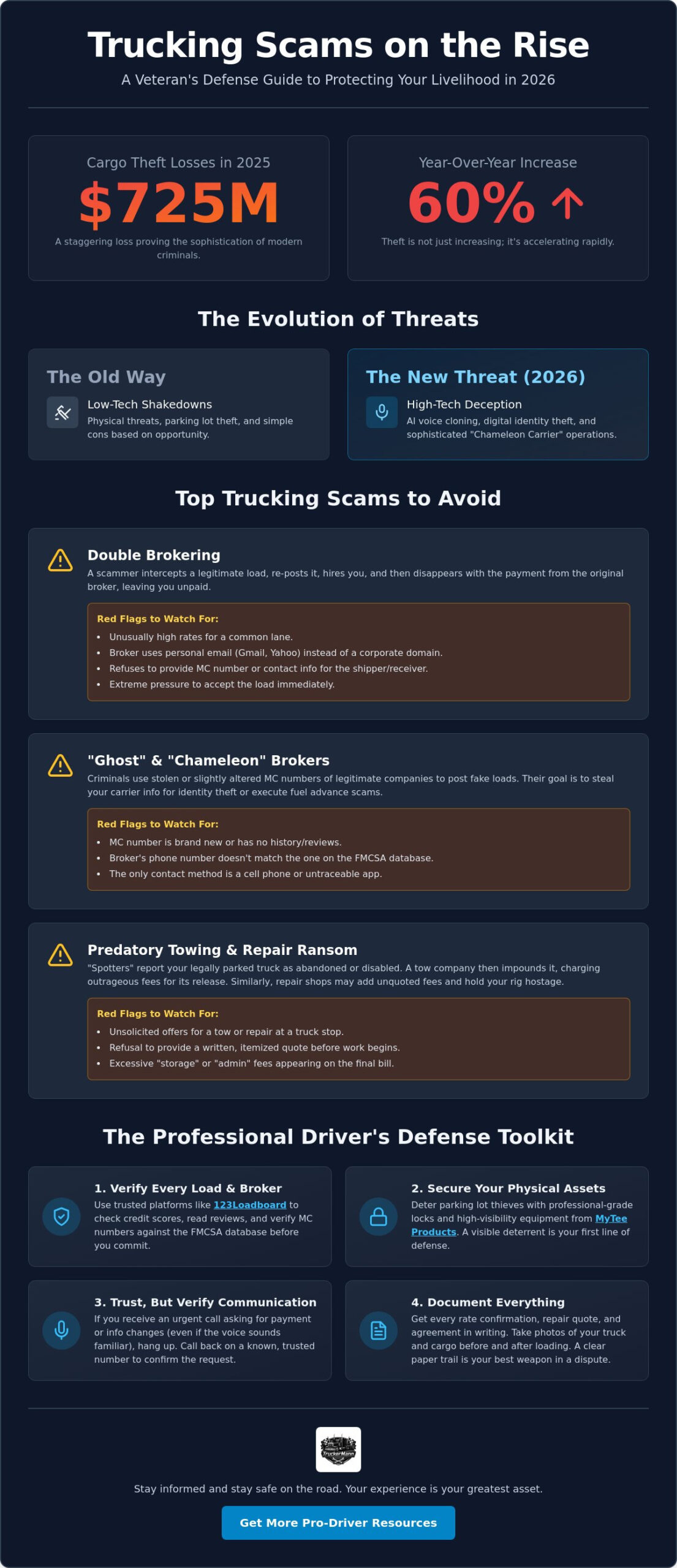
In 2025 alone, cargo theft losses across the U.S. and Canada skyrocketed to nearly $725 million, proving that the modern highway robber doesn’t need a mask when they have a fake load board posting and an AI-generated voice. You’ve spent years honing your craft and keeping your rig between the lines, but the threats you’re facing today aren’t just about road hazards or tight deadlines. It’s the gut-punch realization that a week’s worth of hard-earned pay can vanish in a single fraudulent transaction. Knowing the specific trucking scams to avoid on the road has become just as vital as checking your air lines before a steep grade.
Key Takeaways
- Recognize the shift from low-tech shakedowns to high-tech digital identity theft and AI-driven deepfakes used by modern cyber-criminals to impersonate brokers.
- Identify the immediate red flags of double brokering and “ghost” brokers to ensure you never lose a week’s pay to the most common trucking scams to avoid on the road.
- Deter parking lot thieves and “white van” scammers by securing your cargo with professional-grade locks and high-visibility equipment from MyTee Products.
- Learn the tactical steps to defeat predatory towing “spotter” scams and repair shop ransoms that attempt to hold your rig hostage for unquoted fees.
- Utilize essential verification tools like 123Loadboard to vet every broker and load before you commit your time and fuel to a shipment.
Why Trucking Scams Are More Sophisticated in 2026
The road has changed. It’s no longer just about dodging reckless four-wheelers or navigating mountain passes in a blizzard; the predators have evolved. In 2025, Cargo theft losses surged by 60%, totaling nearly $725 million. This isn’t just bad luck; it’s a coordinated assault. Modern criminals have traded the crowbar for a keyboard, shifting from low-tech parking lot shakedowns to sophisticated digital identity theft. They aren’t just looking for your wallet. They’re looking to steal your entire professional identity to run “chameleon carrier” operations that leave you holding the bag for their crimes.
The volatility of the 2026 freight market has created a perfect storm. When rates are tight, a “too good to be true” offer on a load board looks like a lifeline rather than a trap. Scammers know you’re feeling the squeeze. They use social media to scout your routes, watching your check-ins on Facebook or TikTok to time their attacks perfectly. By the time you realize the broker doesn’t exist, your rig is empty and your paycheck is gone. This is why knowing the specific trucking scams to avoid on the road is your most important pre-trip inspection.
The Psychology of the Modern Scammer
Scammers are masters of the “hurry up and wait” game. They thrive on manufactured urgency, pressuring you to sign a rate con or share banking details “right now” before someone else takes the load. They exploit the universal fear of a deadhead or a low-paying week, dangling high-paying freight as bait to bypass your common sense. Often, they’ll adopt a “driver in need” persona, using industry slang and shared pains to build a false sense of camaraderie. They want you to think you’re helping a brother out, when they’re actually lining their pockets with your fuel money.
New Tech Threats: AI and Voice Cloning
The most chilling advancement in 2026 is the use of AI-driven voice cloning. Scammers can now record a few seconds of a dispatcher’s or family member’s voice from a social media video and use it to create a deepfake phone call. You might think you’re talking to your home office about an “emergency” payment, but it’s a computer-generated trap. Never trust a phone number or a familiar voice alone. Always use a secondary verification protocol, like calling the office back on a known line or using a trusted platform like 123Loadboard to verify broker credentials. Protecting your digital footprint is no longer optional. If you wouldn’t leave your cab unlocked at a rest stop, don’t leave your load details open on a public forum. Using high-quality security gear from MyTee Products is the physical side of the coin, but digital vigilance is the other. Staying one step ahead of these trucking scams to avoid on the road requires a veteran’s eye for detail and a healthy dose of skepticism.
Detecting Load Board Fraud and Double Brokering Red Flags
Load boards are the lifeblood of the independent carrier, but they’ve also become a hunting ground for digital predators. Double brokering is perhaps the most pervasive of the trucking scams to avoid on the road. In this scenario, a legitimate broker gives a load to a second “broker” who is actually a scammer. This middleman then re-posts the load and hires you. The original broker pays the scammer, the scammer vanishes, and you’re left holding a signed Bill of Lading with no one to pay your invoice. It’s a theft of your time, your fuel, and your profit that can cripple a small fleet in a single week.
The “Ghost Broker” phenomenon is equally dangerous. These criminals use stolen or “chameleon” MC numbers to post high-paying loads that don’t exist. Their goal is to harvest your carrier packet information or trick you into a fuel advance scam. Before you ever sign a rate confirmation, you must vet the source. Using a professional, vetted platform like 123Loadboard is your first line of defense; it allows you to see real-time credit data and user reviews that expose these ghosts before they can haunt your bank account. Don’t let the lure of a high-paying lane blind you to the reality of the person on the other end of the phone.
The Fuel Advance Trap
Scammers often lead with a carrot: the promise of a quick fuel advance. They’ll send a falsified Bill of Lading to make it look like a load is ready for pickup, then ask for a small “processing fee” or use your banking details to drain your account. If a rate confirmation has vague pickup details or an unusually high rate for the lane, your radar should be up. Never provide a fuel advance to a broker you haven’t thoroughly vetted through official channels. You can cross-reference suspicious behavior with FMCSA’s red flags of moving fraud to see if the tactics match known criminal patterns that target professional drivers.
Double Brokering: The Silent Profit Killer
Identifying a re-brokered load requires a sharp eye. If the name on the pickup order doesn’t match the broker who hired you, or if the dispatcher becomes defensive when you ask for the original rate confirmation, you’re likely in the middle of a scam. When the middleman disappears, the legal nightmare begins. The shipper may have already paid the first broker, leaving you in a battle for payment that can last months. Protect your business by using 123Loadboard to verify broker credit scores and payment history before you pull the first mile. It’s a good idea to check every new broker’s rating to ensure you aren’t falling for the latest trucking scams to avoid on the road.
Truck Stop Traps: From Shakedowns to Physical Security
The truck stop used to be a sanctuary, a place to grab a hot meal and swap stories with the only people who truly understand the lifestyle. While that brotherhood is still alive, the parking lot has become a stage for some of the most persistent trucking scams to avoid on the road. You’ve likely seen the “White Van” pull up while you’re finishing a pre-trip. These guys claim to have “leftover” high-end power tools or electronics from a delivery, offering them at a massive discount because they “don’t want to take them back to the warehouse.” Don’t bite. It’s either stolen property that will land you in a legal mess or cheap knock-offs that’ll fail before you hit the state line.
The “Parking Lot Mechanic” is even more insidious because it targets your truck’s operation. A stranger might approach you, pointing frantically at your wheel seal or a “leaking” air line they claim to have spotted while you were pulling in. They offer to fix it right there for a “fair price” to keep you from getting an OOS violation. In many cases, these predators actually cause the damage while you’re inside the building, or they use high-pressure tactics to charge you hundreds for a non-repair. If you didn’t see the issue during your own inspection, walk away. Protecting your rig means trusting your own eyes and your professional maintenance schedule over a stranger’s unsolicited advice.
Cargo Security and Equipment Integrity
Thieves are like water; they look for the path of least resistance. If your load is secured with frayed straps or rusted chains, you’re sending a signal that you aren’t vigilant. Scammers and cargo thieves often target trucks with visible equipment failures because they assume the driver isn’t paying attention to the details. Investing in high-quality securement from MyTee Products does more than just hold the freight; it acts as a visual deterrent. When a predator sees the clean, professional-grade gear from MyTee Products, they know they’re dealing with a veteran who doesn’t cut corners. For a full breakdown on the essentials you should be carrying, check out The Best Flatbed Trucking Gear for Logistics & Securement in 2026. Using reliable gear from MyTee Products ensures your load stays where it belongs.
The Driver in Need Truck Stop Scam
The most effective scammers exploit your heart, not just your wallet. They loiter near the fuel island, listening for company names or dispatcher details. They’ll approach you using your company’s name to build instant trust, spinning a tale about a lost wallet or an “emergency” repair they need cash for to get home. It’s a tough spot because we all want to help a fellow driver. However, if they’re asking for cash or a digital transfer, it’s almost certainly a trap. If you want to help, offer to buy them a meal or call their dispatcher for them. Real drivers in a bind will appreciate the gesture; scammers will disappear as soon as they realize there’s no cash coming. Staying sharp about these trucking scams to avoid on the road is how you keep your hard-earned money in your pocket.
Defending Against Predatory Towing and Repair Shop Ransoms
Predatory towing has evolved into a high-stakes shakedown in 2026. These outfits use “spotters” in private lots to find any minor infraction, like a tire slightly over a line or an expired parking permit, and hook your rig before you can even finish your coffee. It’s a calculated attack on your clock and your wallet. Once they have your truck, the “Ransom” tactic begins. They’ll haul your equipment to a remote yard and demand thousands in cash or wire transfers for “administrative fees” and “specialized labor” that were never disclosed. This is one of the most stressful trucking scams to avoid on the road because it physically separates you from your livelihood.
The nightmare doesn’t stop at the tow yard. Unscrupulous repair shops use similar tactics, often refusing to release your truck until you pay unquoted fees for “discovered” issues. Never sign a blank work order at an unfamiliar shop. It’s essentially giving them a blank check to charge whatever they want. Your best defense is a paper trail and a clean record. Keeping your truck in compliance with a DOT inspection level 1 checklist proves you aren’t a “low-hanging fruit” target for these predators. When you can show a history of rigorous maintenance, you have the leverage to fight back against fraudulent claims of mechanical failure.
Steps to Take During a Predatory Tow
If you find yourself in the middle of a shakedown, documentation is your only shield. Take photos of where your truck was parked, the signage in the lot, and the tow truck itself. Get the names of everyone involved and record time stamps for every interaction. While you might be tempted to call the police immediately, know your local laws first. In some jurisdictions, this is considered a civil matter, and you may need to contact the FMCSA or a specialized attorney. Understanding your “Right to Repair” and your rights as a commercial driver is crucial for keeping your rig out of a scammer’s hands.
Vetting Roadside Assistance and Repair Shops
Don’t just call the first number that pops up on a Google search when you’re broken down on the shoulder. Use verified networks or your company’s approved list of vendors. Maintaining your own equipment with high-quality tools and parts from MyTee Products significantly reduces your roadside vulnerability. The less you rely on unknown shops for minor securement or maintenance needs, the safer you are. Before you even head out, review our CDL Pre Trip Inspection Checklist to spot mechanical issues before they become “scam opportunities.” Stay ahead of the predators by mastering your pre-trip routine today.
The Professional Driver’s Toolkit for Scam Prevention
Being a professional isn’t just about how you handle a 53-foot trailer in a crosswind; it’s about how you protect the business behind the wheel. A veteran driver knows that technology is a double-edged sword. While scammers use it to hide, you must use it to shine a light on their tactics. Utilizing 123Loadboard isn’t just a way to find freight; it’s your primary intelligence tool for vetting broker legitimacy in real time. Before you commit your fuel and time, you need to see the data that only a vetted platform can provide. It’s the difference between a profitable week and a legal nightmare.
Daily Habits of the Un-Scammable Driver
The best defense is a bulletproof routine. Start by verifying every rate confirmation through independent channels; don’t just call the number listed on the document. Keep your cargo securement tools from MyTee Products locked in your headache rack and inspect them at every stop. Finally, implement a “Two-Factor” rule for all financial transactions. If a broker asks for a change in payment or a fuel advance, call the office’s verified main line to confirm the request. These small habits are the most effective way to neutralize trucking scams to avoid on the road before they can touch your bank account.
Resources for Fraud Recourse
If you’re targeted, don’t stay silent. Filing a report with the National Consumer Complaint Database (NCCDB) helps the government track and shut down fraudulent operations. You should also use the 123Loadboard community features to flag suspicious brokers, protecting your fellow drivers from the same traps. Vigilance also means staying updated on ELD compliance, as scammers often use “log book” threats to pressure drivers into illegal or unsafe shipments. Staying informed through 123Loadboard and maintaining your rig with gear from MyTee Products ensures you remain a hard target in a volatile industry.
Take Command of Your Rig and Your Revenue
Mastering the complex landscape of trucking scams to avoid on the road requires more than just a sharp eye; it demands a proactive defense strategy. We’ve discussed how digital identity theft and predatory towing can derail even the most successful week, but you don’t have to face these threats alone. By recognizing the psychology of the modern scammer and maintaining high-quality securement equipment from MyTee Products, you position yourself as a hard target for predators. Your career is a lifestyle, not just a job, and protecting your professional reputation is the most important load you’ll ever haul. Staying informed is your best pre-trip inspection for the financial road ahead.
Don’t leave your settlement to chance or trust a broker without seeing the data first. Trusted by thousands of professional drivers, 123Loadboard provides real-time broker credit scores and payment history alongside verified load postings to eliminate the threat of double-brokering. Stay vigilant, keep your gear from MyTee Products locked down, and keep your wheels turning toward a profitable future. The Truckermann is always watching the horizon to keep you safe and successful. Take control of your trucking career and protect your livelihood today.
Frequently Asked Questions
How can I tell if a load board posting is a scam?
Look for unusually high rates for the lane, vague pickup details, or a broker with no established credit history. Scammers often use “ghost” phone numbers that aren’t tied to the brokerage’s official FMCSA record. Using a platform like 123Loadboard allows you to check real-time credit scores and community reviews to filter out these fraudulent postings before you commit your fuel and time.
What should I do if a broker refuses to pay me for a delivered load?
Immediately contact the shipper and consignee to inform them of the non-payment; they are often legally responsible for the freight charges if the broker fails to pay. You should also file a claim against the broker’s bond or trust fund and document every phone call and email. Vetting every new partner through 123Loadboard is the best way to avoid these payment battles before they start.
Is double brokering illegal in 2026?
Yes, unauthorized double brokering is a violation of federal regulations and can lead to heavy fines or the revocation of operating authority. The FMCSA has increased enforcement in 2026 to shut down these “chameleon” operations that steal freight and disappear. It’s one of the primary trucking scams to avoid on the road because it leaves the carrier without legal recourse when the middleman vanishes with the settlement.
How do I report a predatory towing company?
File a formal complaint with the National Consumer Complaint Database (NCCDB) and your state’s Attorney General’s office. If the tow happened on private property, check local municipal codes for “drop fee” laws that may allow you to pay a smaller amount to have the truck released on the spot. Keeping your rig in top shape with professional gear from MyTee Products ensures you aren’t viewed as an easy target for these shakedowns.
What are the red flags of a “Driver in Need” truck stop scam?
Watch for individuals who use your specific company name or dispatcher’s details to build instant trust before asking for cash or a digital transfer. They often loiter near fuel islands to overhear load details from your radio or phone conversations. A real driver in trouble will usually ask for a phone call to their home office or a meal, not a direct cash payment for an “emergency” repair.
Can scammers hack my ELD or GPS to divert my load?
Cyber-criminals can use phishing emails or compromised public Wi-Fi to gain access to your fleet management software and alter routing data. Always verify suspicious route changes or new delivery instructions directly with your dispatcher through a known, secure phone line. Staying updated on the latest security protocols is essential for neutralizing high-tech trucking scams to avoid on the road that target your digital infrastructure.
Why is a fuel advance considered a high-risk transaction?
Fuel advances are frequently used as bait in phishing schemes to harvest your banking details or sensitive carrier packet information. Scammers may offer an advance on a high-paying load that doesn’t actually exist, then disappear once they have your data. Only accept advances from brokers you have thoroughly vetted using the credit history tools and payment ratings found on 123Loadboard.
How do I verify a broker MC number quickly on the road?
Use the FMCSA’s SAFER system or a mobile-optimized platform like 123Loadboard to check the broker’s current authority status and bond information. Ensure the phone number and email address provided match the official records on file exactly. Protecting your business means never taking a “handshake” deal without digital verification of the broker’s credentials and ensuring your equipment securement standards from MyTee Products are always met.
Disclaimer
The information provided on The TruckerMann is for general informational and educational purposes only. While every effort is made to ensure the accuracy and reliability of the content, trucking laws, FMCSA regulations, DOT requirements, safety standards, and industry policies can change at any time. Readers are encouraged to verify all information with official government agencies, professional advisors, or qualified industry professionals before making business, legal, financial, safety, or compliance-related decisions.
The content shared on this website reflects personal opinions, experiences, research, and commentary and should not be considered legal, financial, medical, tax, or professional advice. The TruckerMann and its owners, contributors, affiliates, or representatives are not responsible for any losses, damages, violations, penalties, or liabilities resulting from the use or misuse of information found on this website.
Some content on this website may contain affiliate links, sponsored content, or promotional material. This means we may earn a commission at no additional cost to you if you choose to purchase through certain links.
By using this website, you agree that you do so at your own discretion and risk.