Last Tuesday, a driver with 15 years of clean miles found himself sidelined during a routine carrier audit because a simple clerical error from 2024 turned into a major violation on his state mvr report. Hey Friend, I know how it feels to have your livelihood hanging by a thread because of a piece of paper you haven’t looked at in months. It’s a common fear that a single mistake or a confusing state report could end a career, especially when you’re trying to keep the wheels turning and the bills paid.
You’ve likely felt the frustration of trying to figure out where your CSA score ends and your state record begins. Mastering your record is the only way to protect your CDL, maximize your take-home pay, and stay compliant with the FMCSA 12-month review rule. This guide provides the tools you need to spot errors before they cost you a job and ensures you’re ready for every inspection. The Truckermann is here to help you clear the path for a successful 2026 because the road runs through us.
Key Takeaways
- Understand why the FMCSA mandates an annual review of your driving record and how to keep your DQ file in perfect standing.
- Discover how maintaining a clean mvr can open doors to high-paying specialized hauls and keep insurance companies on your side.
- Master the step-by-step process for pulling your own report to spot and fix costly errors before a recruiter ever sees them.
- Implement a proactive defense strategy starting with your pre-trip to prevent the violations that threaten your livelihood.
What is a Motor Vehicle Record (MVR) in Trucking?
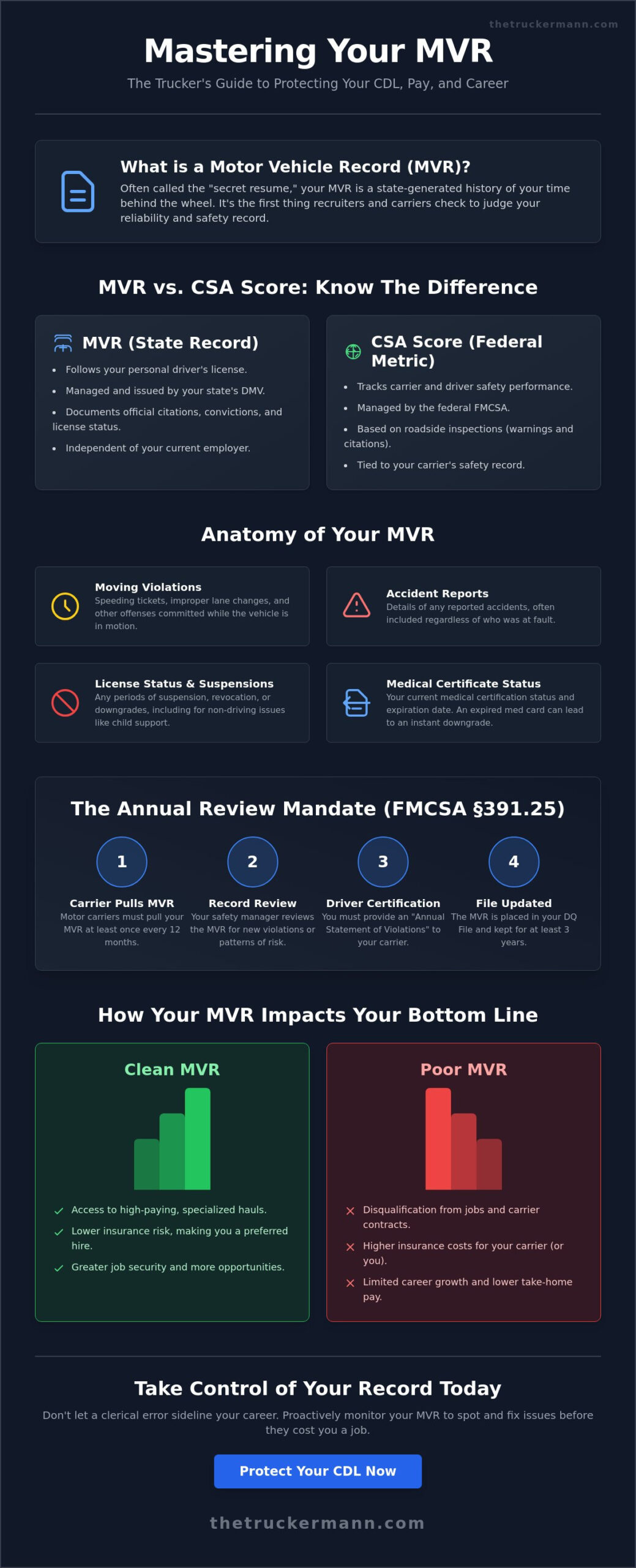
Hey Friend, let’s talk about the most important document in your wallet besides your CDL. Your Motor Vehicle Record, or mvr, is much more than just a list of past mistakes. It is a state-generated report that serves as a chronological history of your time behind the wheel, detailing every ticket, accident, and license status change you have encountered. Recruiter’s often call it the “secret resume.” Before a fleet manager even shakes your hand or offers you a seat, they have already dissected your record to judge your reliability.
In the trucking industry, your reputation is built on miles, but it is documented on this report. Carriers typically request a 3-year or 7-year history to satisfy insurance requirements. Some specialized hauling contracts or high-security fleets may even pull a lifetime report to verify long-term safety trends. This data is often cross-referenced with the National Driver Register (NDR), which is a federal database that ensures drivers with revoked or suspended licenses in one state cannot simply hop across a border to get a fresh start. If you want to keep watching miles roll without a hitch, you need to know exactly what this document says about you.
MVR vs. CSA Scores: Clearing the Confusion
Drivers often confuse these two metrics, but they serve different masters. Your mvr is a state-level record that follows your personal driver’s license regardless of who you work for. In contrast, CSA scores are federal FMCSA metrics used to track carrier safety. A single roadside inspection can hit your CSA score without ever appearing on your record, provided the officer didn’t issue a formal citation. You must monitor both systems to stay “Trucker Mann” ready for 2026, as regulatory shifts continue to favor drivers with spotless data across both state and federal platforms.
What Exactly Appears on Your MVR?
Your report lists standard items like moving violations, DUI or DWI convictions, and periods of license suspension. Since the federal mandate in 2014, most states have integrated your medical certificate status directly into the report. If your med card expires, your CDL status can drop to “downgraded” on your record within 24 hours. This can lead to an immediate job loss if you are caught under a load with an invalid status.
- Speeding tickets and lane change violations.
- Accident reports, regardless of who was at fault.
- Administrative actions like child support suspensions or failure to appear in court.
- Medical examiner certificate expiration dates and Tier 1-4 self-certification status.
Major carriers generally define a “Moving Violation” as any traffic offense committed while the vehicle is in motion, excluding equipment failures or parking tickets. Keeping this record clean is how you ensure The Road Runs Through Us stays a promise of opportunity rather than a history of hurdles.
Federal Requirements: DQ Files and the Annual MVR Review
Hey Friend, if you have spent any time behind that wheel, you know the DOT doesn’t leave much to chance. One of the most critical pieces of your professional life is the Driver Qualification File, or the DQ File. This isn’t just a folder in a dusty cabinet; it’s the legal proof that you are fit to haul. At the very center of this file sits your mvr. Under FMCSA Part 391.25, every motor carrier has a strict legal obligation to pull and review your driving record at least once every 12 months. This Annual MVR Review ensures that you still meet the minimum requirements for safe operation. Carriers are required by law to keep these records for at least 3 years, creating a documented history of your performance on the open road.
The Annual Review Process
When your 12-month window closes, your safety manager will sit down to scrutinize your record. They aren’t just looking for tickets; they are looking for patterns that might put the fleet at risk. During this time, you will likely be asked to provide an “Annual Statement of Violations.” This is where you list any moving violations from the past year. If your mvr shows a hit you didn’t report, it creates a trust gap that is hard to close. Failing to provide this information or having an expired record in your file can lead to immediate disqualification, effectively grounding you until the paperwork is fixed. Being proactive about your status is how you protect your seat; you can find the right gear to stay organized at The Truckermann where we keep the brotherhood moving.
New Entrant Requirements
If you are switching to a new interstate carrier or just starting your journey, the rules are even tighter. Federal law dictates that a carrier must pull your driving record within 30 days of the date your employment begins. This is known as the “Initial MVR.” It serves as the baseline for your DQ File. There is a big difference between this initial check and the yearly one. The initial check looks back at your entire history to qualify you for the job, while the yearly review focuses on your performance since your last check. If a carrier misses that 30-day window, they are in violation of DOT standards, which can lead to heavy fines during a roadside inspection or a full-blown audit.
How Your MVR Impacts Your Trucking Career and Pay
Hey Friend, let’s get real about what determines the weight of your wallet at the end of the month. While your years behind the wheel matter, your mvr acts as the ultimate gatekeeper for the industry’s most lucrative opportunities. If you’re eyeing those specialized flatbed hauls or oversized loads that pay premium rates, a spotless record is your ticket in. Carriers running high-value freight can’t afford the risk of a driver with a spotted history because their clients demand excellence. The Truckermann knows that a single mistake on paper can be the difference between a top-tier salary and scraping by on entry-level freight.
Insurance Premiums and Hiring Decisions
Safety managers don’t always have the final say in who gets the keys. Insurance companies often dictate hiring standards based on their risk assessment models. When a carrier maintains a fleet of drivers with clean records, their annual insurance premiums stay significantly lower. This savings often translates directly into higher driver pay and better equipment. Most major carriers enforce a strict “Three-Year Rule” where a single serious violation, such as speeding 15 mph over the limit, makes you a liability for 36 months. Having a clean mvr gives you the upper hand during salary negotiations. You aren’t just another body in a seat; you’re a low-risk asset that saves the company money.
CDL rankings and internal carrier “scorecards” often depend on the length of your clean driving streak. A driver with five years of clean inspections and zero violations sits at the top of the dispatch list for the best runs. If you hit the “uninsurable” threshold, which is typically three moving violations or two at-fault accidents within a three-year period, most insurance providers will refuse to cover you. At that point, your truck is parked for good until those points fall off.
MVR Impact on Lease-Purchase and Owner-Operators
If you’ve decided to stop pulling for the man and start your own business, your driving record becomes even more critical. Owner-operators must secure their own primary liability insurance, and the price tag is tied directly to those driving stats. A driver with a couple of recent tickets might see insurance quotes jump by $5,000 to $10,000 per year compared to a clean operator. This overhead can eat your entire profit margin before you even fuel up. For those in a lease-purchase program, a sudden dip in your driving score can lead to a contract termination, leaving you without a truck and without a job. You can learn more about protecting your livelihood by Understanding MVR Reports and Your Driving Career. Staying vigilant about your record is the only way to keep your wheels turning and your profits high. Remember, the road runs through us, but only if we keep it clean.
How to Check Your Own MVR and Fix Costly Errors
Hey Friend, sitting behind that wheel gives you plenty of time to think, but don’t let your driving record be a mystery that keeps you up at night. You need to see exactly what a recruiter sees before you ever sign an application. Pulling your own report is the only way to ensure your career stays on the right track. Most jurisdictions make this easy through an online portal. You’ll generally visit your official motor vehicle department website, enter your CDL number, and pay a small fee. While specific fees vary by jurisdiction, expect to pay a small amount, typically ranging from $10 to $20 for a certified 3-year history. These small investments prevent massive headaches later.
The Truckermann recommends checking your mvr at least 60 days before you plan to switch companies. Bureaucracy moves slow. If you find a “ghost violation”-a ticket that should have fallen off after three years but is still hanging around-you’ll need those eight weeks to force the motor vehicle department to update their database. Check for incorrect conviction dates too. A ticket from June 2021 that is wrongly listed as June 2022 could be the difference between getting hired and being told to wait another year.
Disputing Inaccuracies on Your Record
National MVR Services vs. Official Motor Vehicle Department
You might see third-party sites offering a “nationwide” check, but be careful. While these aggregators are fast, they often rely on databases that aren’t updated in real-time. The official jurisdiction-issued report is the gold standard for DOT compliance and insurance underwriting. If you’ve held a license in multiple jurisdictions, you must pull a report from each individual jurisdiction. Recruiters will look at every jurisdiction where you’ve held a CDL to ensure no hidden violations are lurking across lines. Trust the official source to keep your professional reputation solid.
Ready to keep your business running as smooth as your engine? Grab the right supplies from our trucking tools and gear collection to stay organized on the road.
Proactive Protection: Keeping Your Driving Record Clean
Hey Friend, let’s talk about the shield that keeps your career moving. Your mvr isn’t just a digital file; it’s your reputation recorded in 1s and 0s. The Truckermann strategy for avoiding career-ending violations is simple: never give an officer a reason to walk toward your cab with a ticket book in hand. It starts with the pre-trip inspection. If you’re cutting corners on your walkaround to save ten minutes, you’re gambling with your entire livelihood. A single light out or an audible air leak is a neon sign inviting a roadside inspection that could tarnish your record for three years or more.
Gear and Maintenance as MVR Insurance
In the flatbed world, your gear is your best defense. Maintaining your straps, chains, and binders prevents the securement violations that often lead to heavy mvr points. When you roll through a scale and your equipment looks pristine, you send a message of professionalism before you even roll down the window. High-quality gear acts as a form of insurance. It reduces the mechanical failures that trigger DOT interventions.
The “Trucker Mann” approach to roadside interactions is built on professionalism as a shield. If you’re pulled over, your demeanor and the state of your truck determine the outcome. Using a systematic tool like The Ultimate DOT Inspection Level 1 Checklist ensures you’ve checked the 37 critical points that inspectors target. When an officer sees you’ve done the work, they’re more likely to let you roll with a warning rather than a violation that hits your permanent record.
Staying Ahead of the 2026 Regulations
The landscape is shifting beneath our tires. By November 2024 and heading into 2026, the FMCSA Clearinghouse and state licensing agencies will communicate with unprecedented speed. New regulations mean that any “prohibited” status in the drug and alcohol clearinghouse will trigger an automatic downgrade of your CDL by state agencies. This real-time monitoring is becoming the industry standard. Carriers are no longer checking your record once a year; they’re subscribing to services that alert them the moment a new citation hits your file.
Staying ahead means being proactive rather than reactive. You need to be the master of your own data. Watch your miles roll with the confidence that your equipment won’t let you down. Ready to level up? Check out the best flatbed gear to keep your record clean.
The road runs through us, but a clean record is what keeps us on that road. Treat your pre-trip like a ritual and your gear like your life depends on it, because in this industry, it truly does. Stay safe, stay legal, and keep those wheels turning.
Master Your Record and Own the Road in 2026
Hey Friend, your driving record is the most valuable tool in your kit. As the 2026 FMCSA and DOT compliance standards take full effect, keeping a clean mvr is the only way to protect your seat and your paycheck. We’ve looked at how annual reviews impact your DQ file and why catching errors early prevents long-term career damage. This guide was built from the real road experience of a professional driver who knows that one mistake on paper can be as dangerous as a blowout at sixty miles per hour. You don’t have to navigate these regulatory shifts alone. By staying proactive and checking your records regularly, you ensure that your reputation remains as solid as the freight you haul. It’s about more than just rules; it’s about respect for the craft and the brotherhood we share. Keep your gear tight and your record tighter because the road runs through us.
Keep your record clean with the best flatbed gear and tools.
Stay safe out there and keep those wheels turning.
Frequently Asked Questions
How long does a violation stay on my MVR for a CDL holder?
Most minor traffic violations stay on your mvr for 3 to 7 years depending on your specific state laws. Serious offenses like a DUI or leaving the scene of an accident can haunt your record for 10 years or even permanently in some jurisdictions. The FMCSA also keeps a separate 3 year history on your PSP record which recruiters check alongside your state driving history.
Can I get a trucking job with a DUI on my MVR from five years ago?
You can find work with a five year old DUI, but your options will be limited to smaller carriers or second chance companies. Most top tier fleets and fuel haulers require a clean mvr for at least 7 to 10 years following a major alcohol related offense. Insurance providers often set these hard limits, so expect to pay your dues with a smaller outfit before moving up to those high paying line haul roles.
Does a “Warning” from a DOT officer show up on my MVR?
A written warning does not appear on your state issued driving record because it is not a legal conviction. However, that warning will definitely show up on your FMCSA PSP report for 3 years. These warnings still impact a carrier’s CSA score, so safety managers see them during the hiring process even if your license technically looks clean. Hey friend, don’t let a warning slide; it still tells a story to your future boss.
How many points can I have on my MVR before I lose my CDL?
Most states will suspend your license if you rack up 12 points within a 12 month or 24 month window. Under FMCSA regulations, you will face a 60 day disqualification if you are convicted of two serious traffic violations within 3 years. These serious violations include speeding 15 mph over the limit or following too closely. Keep those points low to keep your career moving forward.
What is the difference between a certified and non-certified MVR?
A certified report carries an official state seal and is the only version accepted for court proceedings or official employment background checks. A non-certified report is just a digital printout for your personal records. While the information is usually identical, employers need the certified version to prove they have met DOT hiring standards during an audit. The Truckermann recommends keeping a certified copy in your files at all times.
How do I check my MVR if I have lived in multiple states?
You must request a separate report from the DMV of every state where you held a license in the last 10 years. There is not one single national database that combines every state record into one document for drivers. If you have moved between 3 states, you will need to pay 3 separate fees to ensure you see everything a potential recruiter sees during your application process.
Will a personal vehicle speeding ticket affect my commercial MVR?
Every ticket you get in your personal pickup truck counts against your commercial driving status. Points earned in a four wheeler transfer directly to your record and can lead to a CDL suspension. If you get a 10 mph over ticket on a Sunday in your personal car, your company’s insurance provider will see it and might raise your rates or pull your eligibility. The road runs through us, so stay professional even when you are off the clock.
How often should I pull my own MVR as an owner-operator?
You should pull your own report at least once every 12 months to catch errors before they cause problems. Mistakes happen at the DMV more often than you think. Catching an old ticket that should have dropped off after 3 years can save you thousands in insurance premiums. Stay vigilant and keep your paperwork as clean as your rig to protect your bottom line.
Disclaimer
The information provided on The TruckerMann is for general informational and educational purposes only. While every effort is made to ensure the accuracy and reliability of the content, trucking laws, FMCSA regulations, DOT requirements, safety standards, and industry policies can change at any time. Readers are encouraged to verify all information with official government agencies, professional advisors, or qualified industry professionals before making business, legal, financial, safety, or compliance-related decisions.
The content shared on this website reflects personal opinions, experiences, research, and commentary and should not be considered legal, financial, medical, tax, or professional advice. The TruckerMann and its owners, contributors, affiliates, or representatives are not responsible for any losses, damages, violations, penalties, or liabilities resulting from the use or misuse of information found on this website.
Some content on this website may contain affiliate links, sponsored content, or promotional material. This means we may earn a commission at no additional cost to you if you choose to purchase through certain links.
By using this website, you agree that you do so at your own discretion and risk.