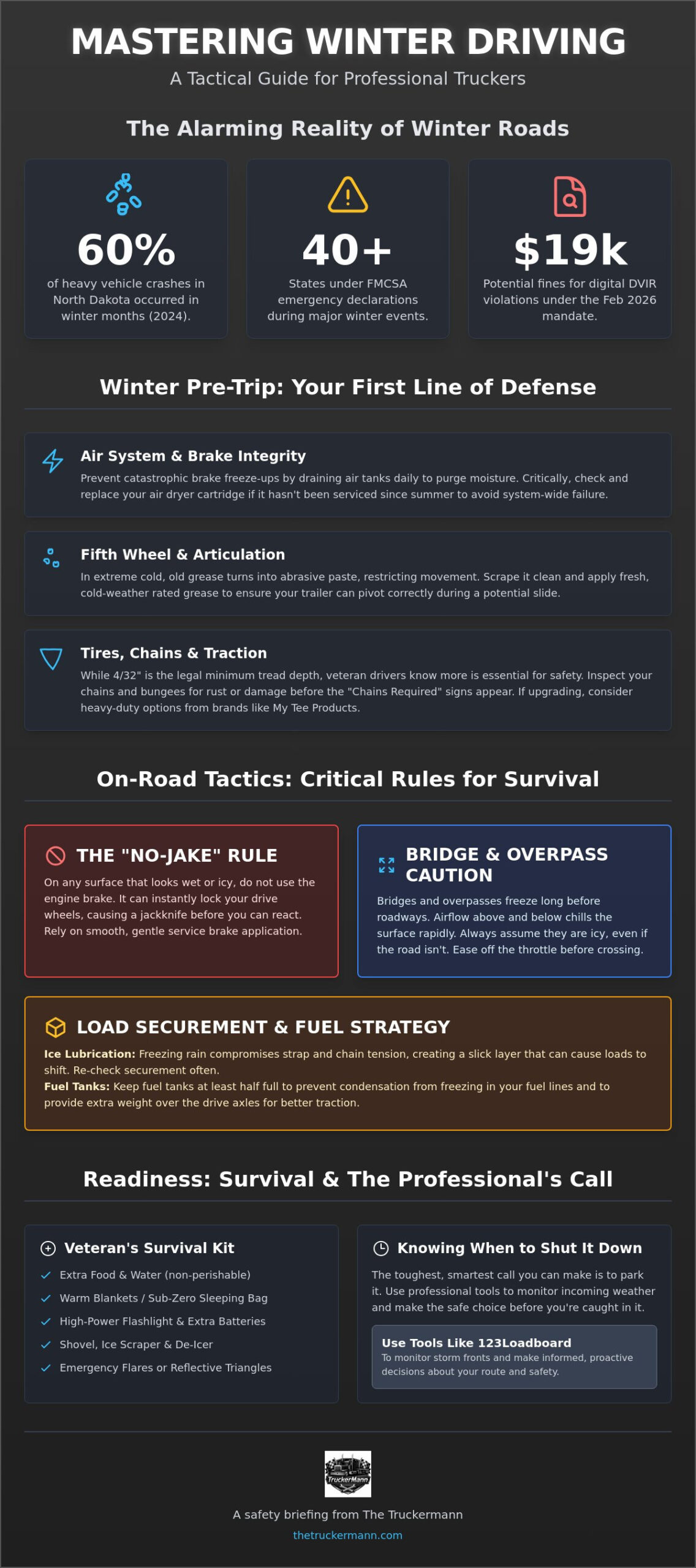
Did you know that 60% of heavy vehicle crashes in North Dakota happened during the winter months of 2024? That is a staggering number that proves the white stuff is more than just a nuisance; it is a direct threat to your livelihood. We all know that sinking feeling in the gut when the trailer starts to kick out on black ice, or when the wind starts howling across a rural two-lane. It is exactly why mastering winter driving safety tips for semi trucks is about more than just checking a box for compliance. It is about protecting your record, your rig, and your life.
I know the pressure you feel to hit those deadlines, especially when the FMCSA is issuing emergency declarations for 40 states like they did in early 2026. You want to keep your record clean and avoid those massive $19,000 fines for digital DVIR violations that hit the books this February. This guide is your tactical briefing for the 2026 season. We will dive into the load physics that prevent jackknifing, the gear needed to pass a Colorado chain law inspection, and the veteran instincts that tell you when it is time to park it. You are going to gain the skills needed to stay upright and profitable until the spring thaw.
Key Takeaways
- Upgrade your pre-trip routine to include air dryer cartridge maintenance to prevent catastrophic brake freeze-ups before you hit the mountain grades.
- Learn why the ‘No-Jake’ rule is critical on black ice and how to safely navigate bridges that freeze long before the main roadway.
- Master the physics of ice lubrication to keep flatbed loads secure when freezing rain compromises your strap and chain tension.
- Implement essential winter driving safety tips for semi trucks like maintaining a half-tank fuel minimum and building a veteran’s survival kit for emergency shutdowns.
- Use professional tools like 123Loadboard to monitor incoming storm fronts and make the tough call on when it’s time to park the rig.
The Winter Pre-Trip: Beyond the Standard DOT Inspection
When the temperature falls below 32 degrees, your standard CDL pre-trip becomes a survival ritual. A routine walk-around won’t catch the frozen moisture in your lines that causes a brake lock-up on a 6% grade. With the FMCSA’s February 2026 mandate for stricter digital DVIR trails, your inspection needs to be more than just compliant; it needs to be bulletproof to avoid those $19,000 fines for falsified or illegible records. You aren’t just checking boxes for the DOT anymore; you’re ensuring your equipment can withstand the physical toll of sub-zero operation.
You’ve probably seen winter service vehicles out there dumping salt and brine, but they can’t save you if your equipment fails from the inside out. One of the most overlooked winter driving safety tips for semi trucks involves your air dryer cartridge. If that desiccant is saturated, moisture will travel through your system and freeze at the lowest point, which is usually your brake chambers. If you haven’t swapped that cartridge since the leaves were green, you’re rolling the dice on a freeze-up.
To visualize these critical inspections, watch this veteran’s perspective on winter preparation:
Old, contaminated grease on your fifth wheel is another hidden liability. In extreme cold, that gunk turns into a stiff, abrasive paste that resists movement. This prevents the fifth wheel from pivoting smoothly as you navigate turns, which can actually steer your trailer during a slide on slick pavement. Take the time to scrape off the old, gray sludge and apply fresh, cold-weather rated grease to ensure your rig stays articulated properly when the road gets dicey.
Managing Your Air System and Glad Hands
Moisture is the silent killer of air systems in the high country. You need to drain your air tanks daily to purge any condensation before it has the chance to settle and freeze. If you see white “mayo” or water spitting out of the valves, your dryer is already compromised. Use air line antifreeze sparingly as a last resort, because overusing it can degrade the rubber seals in your valves over time. Check your glad hand seals for any signs of dry rot or cracking. Cold weather makes rubber brittle, and a small leak at the trailer connection can lead to a significant pressure drop when you need your service brakes most.
Tires, Chains, and Traction Control
Traction is a game of physics. Your tires need deep grooves to clear slush and bite into the hard pack. While the law might require 4/32 of an inch of tread depth, a seasoned veteran knows that is the bare minimum for safety. Follow the CDL Pre Trip Inspection Checklist to ensure your foundation is solid before the first flake falls. Don’t wait for the “Chains Required” sign on I-70 to discover your links are rusted or your bungees are missing. If you need to upgrade your gear, brands like My Tee Products offer the heavy-duty chains and securement tools needed to handle the harshest mountain passes of the 2026 season.
On-Road Tactics: Navigating Black Ice and Winter Grades
Once you’re out of the yard and on the main line, the tactical game begins. The most important rule for any veteran is the “No-Jake” rule. If you’re rolling down a grade and the pavement looks even slightly wet, your hand should be nowhere near that engine brake switch. Using your jake brake on slick surfaces can cause your drive wheels to lose traction and lock up, which is the fastest way to trigger a jackknife. When the engine tries to slow the tractor but the trailer keeps pushing, the physics of a 40-ton rig will always find the path of least resistance, and that path is usually sideways.
Bridges and overpasses are your next major hurdle. Because air flows both above and below the road surface, these structures lose heat much faster than the ground-insulated highway. They can freeze over while the rest of the road is still just damp. You should always ease off the throttle before you hit the bridge deck. It’s also wise to cross-reference your own observations with official NHTSA winter driving tips to stay ahead of changing conditions. If you’re looking for more advanced training on handling these high-stakes scenarios, check out the courses at the DLA Academy to sharpen your professional edge.
Identifying black ice is a skill that separates the pros from the statistics. Keep a close eye on your mirrors; if the tires of the vehicles in front of you are throwing up spray, the road is wet. If that spray suddenly stops but the pavement still looks dark and “wet,” you are likely driving on a sheet of ice. At this point, your following distance needs to expand. While a 7-second gap is standard, you should double that to at least 14 seconds when visibility or traction is compromised. This gives you the space to react without slamming the service brakes.
Steering and Braking in Low-Traction Scenarios
If you feel the trailer start to step out, don’t panic and overcorrect. You need to stay off the brakes and steer into the slide. Modern ABS is designed to handle the heavy lifting, so forget the old-school “stab braking” advice. If you have to slow down, apply steady, firm pressure and let the computer do its job. Keep a relaxed but firm grip on the wheel; if you’re white-knuckling it, you won’t be able to feel the subtle feedback the chassis is giving you about the road surface.
The Dangers of Team Trucking in Winter
Team trucking adds a layer of risk during the winter months. Sleeping in the bunk while your partner navigates a blizzard is inherently dangerous because you have no way to react if the rig loses control. Establish a protocol where both drivers stay awake during severe weather events. If the conditions are bad enough that one driver is uncomfortable, it’s time to pull over. No load is worth a life, and you can always find better ways to manage your schedule at thetruckermann.com when the weather finally clears.
Flatbed Securement: Tarping and Chaining in Freezing Temps
Flatbedding is a different beast in the winter. You’re out in the elements, fighting stiff straps and frozen winches while the door-swingers stay warm in their cabs. One of the most dangerous phenomena you’ll face is “ice lubrication.” If you load a piece of machinery or steel onto a deck that hasn’t been cleared of snow and ice, you’ve essentially put your cargo on skates. As the trailer flexes and vibrates, that thin layer of ice acts as a lubricant, significantly reducing the friction that keeps your load centered. It is one of those critical winter driving safety tips for semi trucks that could save you from a catastrophic load shift on a mountain pass.
You need to be aggressive about clearing your deck before the first piece of cargo touches it. Use a stiff broom or even a portable propane torch to ensure the wood or aluminum is dry. If you’re hauling steel, the risk is even higher because the smooth surfaces provide zero natural grip. Always use friction mats, but make sure they aren’t frozen solid before you lay them down. A frozen friction mat is just another layer of ice.
Managing Straps and Chains in Sub-Zero Weather
Cold weather changes the physical properties of your securement gear. Synthetic straps lose their elasticity when the mercury drops below zero, meaning they don’t “give” as well when the load settles. You’ll find yourself stopping every 50 miles to crank down winches that were tight when you left the shipper. Chains aren’t immune either; freezing rain can coat links in ice, making it difficult to get a proper bite with your binders. Using heavy-duty gear from My Tee Products ensures your equipment stays pliable and reliable when the wind-chill is biting. Always refer to FMCSA safe driving guidelines to understand how road vibrations at different speeds impact securement integrity during storms. For a deep dive into the right tools for the job, check out our guide on The Best Flatbed Trucking Gear.
Tarping Tactics for High Winds and Snow
Tarping in a January gale is a recipe for disaster if you aren’t careful. A 100-pound lumber tarp becomes a massive sail the moment the wind catches it. You can be pulled right off the deck if you’re holding on when a gust hits. Try to park so the wind hits the back of your trailer, or better yet, tarp inside a bay if the shipper allows it. To prevent ice from bonding your tarps to the load, use moving blankets as a buffer. Adding edge protection from Truck n Tow helps prevent the sharp corners of your load from slicing through frozen, brittle vinyl. Staying proactive with your gear is what keeps you in the game while others are stuck on the shoulder.
Emergency Survival and DOT Compliance Readiness
Survival in the high country isn’t just about staying on the road; it’s about what you do when the road shuts down. A veteran’s rule of thumb is that a half-tank of diesel is functionally empty. If you get caught in a multi-day closure on I-80, that fuel is your only source of heat. Running out of fuel in sub-zero temps is a life-threatening emergency. Beyond personal safety, winter grime is a major compliance risk. Road salt cakes onto your tail lights and reflective tape within miles of driving. If an inspector can’t see your conspicuity tape, it will negatively impact your DOT Inspection Level 1 results. Keep a squeegee and extra de-icer fluid handy for every fuel stop. Cleaning your lights is one of the most practical winter driving safety tips for semi trucks for keeping your record clean and avoiding unnecessary roadside stops.
The Essential Winter Survival Gear List
You shouldn’t rely on the truck’s heater as your only line of defense. You need a “go-bag” that stays in the cab, not buried in the side box where it might be inaccessible in a drift. This kit should include at least three days of non-perishable, high-calorie food and several gallons of water. A sleeping bag rated for -20 degrees is essential for those nights when the APU fails or you’re out of fuel. Cold weather is notorious for killing batteries. A dedicated backup power bank for your phone and ELD is non-negotiable. If you lose truck power, you still need a way to call for help. While My Tee Products provides the industrial gear to keep your load safe, your survival kit is what keeps you alive during an unplanned mountain shutdown.
ELD and Hours of Service (HOS) in Emergencies
The FMCSA allows for an “Adverse Driving Conditions” exception, but you have to use it correctly to stay legal. This rule can grant you up to two extra hours of driving time to reach a safe location, but only if the conditions were not apparent at the time of dispatch. You must document the situation thoroughly in your ELD. Note the specific highway, the visibility issues, and the lack of safe parking. Transparency is your best defense against an HOS violation during a blizzard. If the weather forces a shutdown, communicate with your dispatcher and broker immediately. Being proactive about delays shows professionalism and protects your reputation. You can also use tools like 123Loadboard to monitor how weather is impacting lanes ahead of you, allowing you to shut down before you’re trapped in the middle of nowhere.
Make sure you’re ready for the scale house by reviewing our complete DOT inspection checklist.
The Professional’s Choice: Knowing When to Shut It Down
The hardest part of the job isn’t navigating a 6% grade in a whiteout; it’s the mental battle between your professional pride and the physical reality of the road. You’ve got a broker breathing down your neck and a clock that never stops ticking, but the most important of all winter driving safety tips for semi trucks is knowing when to call it a day. A true veteran doesn’t prove their worth by driving through a blizzard that has already claimed three rigs in the ditch. They prove it by having the discipline to find a safe haven before the situation turns terminal. This is the core of the Truckermann’s Creed: no load is worth a life, a career-ending wreck, or a permanent stain on your CSA score.
Fatigue hits differently in the winter. The constant tension of micro-adjusting for wind gusts and scanning for black ice drains your mental battery twice as fast as a clear summer run. If you find yourself staring at the white lines until they start to blur, or if your reaction time feels sluggish, you’re already in the danger zone. High-stress winter driving requires a level of focus that can’t be sustained for a full 11-hour shift when the weather is working against you. Recognizing these early signs of exhaustion is just as critical as checking your tire pressure.
Trip Planning and Weather Monitoring
Successful winter runs start before you even pre-trip. You need to move beyond standard weather forecasts and use specialized trucking apps that offer road-level detail. Proactive planning allows you to identify safe havens, like reputable truck stops or designated rest areas, long before the snow starts to accumulate. When you’re looking for your next haul, use 123Loadboard to analyze freight lanes and plan routes that steer clear of incoming storm fronts. If a route looks too risky, have that conversation with your broker early. Most professionals respect a driver who prioritizes the safety of the equipment and the cargo over a reckless gamble. By using 123Loadboard to stay ahead of the weather, you’re acting as a strategist rather than just a steering wheel holder.
The Economic Reality of Winter Safety
Master the Tactical Road Ahead
Surviving the 2026 winter season is about more than just slowing down; it’s about the tactical preparation of your equipment and the discipline of your mindset. We’ve walked through the essential evolution of the pre-trip inspection and the high-stakes reality of navigating black ice on mountain grades. By integrating these winter driving safety tips for semi trucks into your daily routine, you’re moving beyond basic compliance and into the realm of professional mastery. This guidance is built on the hard-earned experience of professional drivers, focusing on real-world survival and DOT-compliant practices that keep your record clean and your rig upright.
Your gear is your first line of defense when the mercury drops. You can upgrade your winter securement gear with My Tee Products to ensure your flatbed loads are locked down tight against the ice. For more veteran insights and strategic advice that protects your career, join the community at The Truckermann. Stay vigilant, stay prepared, and remember that your safety is the most valuable cargo on the trailer. We’ll see you out there on the high line.
Frequently Asked Questions
Is it safe to use my cruise control in winter weather?
No, you should never use cruise control on icy or wet roads. The system is unable to detect a loss of traction before it is too late. If your drive wheels hit a patch of black ice and start to spin, the cruise control will actually increase power to maintain your set speed. This can instantly trigger a jackknife or a spin-out. You need your foot on the pedal to feel exactly how the truck is responding to the surface.
When should I use the ‘Adverse Driving Conditions’ exception on my ELD?
You can use this exception when you encounter unexpected weather or road conditions that were not known at the time of dispatch. This rule adds two hours to your driving window, allowing you to reach a safe location. It is a vital part of your winter driving safety tips for semi trucks when a storm shuts down the highway. Just remember to document the specific cause of the delay in your ELD remarks to stay compliant.
How often should I check my load securement in freezing conditions?
Check your securement every 50 miles during severe weather. Synthetic straps can become brittle and lose their tension in sub-zero temperatures as the load settles. While using heavy-duty equipment from My Tee Products gives you a professional edge, physics still requires you to verify that tension manually. Frequent stops to tighten winches are a small price to pay for keeping your cargo on the deck and avoiding a catastrophic shift.
What is the best way to thaw frozen air brakes on a semi truck?
The safest way to thaw frozen brakes is to gently tap the brake drums with a hammer to break the ice bond between the shoe and the drum. If that doesn’t work, you can use a portable heater or a torch, but you must be extremely careful around air lines and tires. Always verify that every wheel is turning freely before you pull out. Dragging a frozen wheel will flat-spot a tire in just a few hundred feet.
Should I keep my fuel tanks full during a winter storm?
Yes, keeping your tanks full is a major safety advantage in the high country. The extra weight over your drive axles provides much-needed traction on slick grades. More importantly, if you get stranded in a blizzard, you’ll need that fuel to keep the engine or APU running for heat. A full tank is your primary lifeline when the road closes and you’re stuck in the bunk for 24 hours.
How do I prevent my diesel fuel from gelling in sub-zero temps?
Use a high-quality winter fuel additive and try to fill up with winter-blend diesel found in northern states. Additives lower the cold filter plugging point of the fuel, which prevents paraffin wax from clogging your filters. If you’re heading North from a warmer climate, don’t wait until you’re in the sub-zero temps to add your treatment. Get it in the tanks while the fuel is still warm to ensure it mixes properly.
What should I do if I start to jackknife on black ice?
If the trailer starts to step out, get off the brakes immediately and steer into the direction of the slide. You need the wheels to keep turning to regain directional control. Don’t overcorrect or slam the service brakes, as this will only lock the wheels and worsen the pivot. Keep your eyes on where you want the truck to go, not on the ditch. Regaining traction requires a calm hand and steady steering.
Is it legal to drive if my lights are covered in snow but still ‘on’?
No, it’s not legal to drive if your lights are obscured. FMCSA regulations mandate that all required lamps and reflective tape must be clearly visible to other motorists. Even if your bulbs are burning bright, a layer of road salt or snow can hide your rig from someone following too closely. Part of your winter driving safety tips for semi trucks should involve a quick wipe-down of all lenses at every fuel stop.
Disclaimer
The information provided on The TruckerMann is for general informational and educational purposes only. While every effort is made to ensure the accuracy and reliability of the content, trucking laws, FMCSA regulations, DOT requirements, safety standards, and industry policies can change at any time. Readers are encouraged to verify all information with official government agencies, professional advisors, or qualified industry professionals before making business, legal, financial, safety, or compliance-related decisions.
The content shared on this website reflects personal opinions, experiences, research, and commentary and should not be considered legal, financial, medical, tax, or professional advice. The TruckerMann and its owners, contributors, affiliates, or representatives are not responsible for any losses, damages, violations, penalties, or liabilities resulting from the use or misuse of information found on this website.
Some content on this website may contain affiliate links, sponsored content, or promotional material. This means we may earn a commission at no additional cost to you if you choose to purchase through certain links.
By using this website, you agree that you do so at your own discretion and risk.