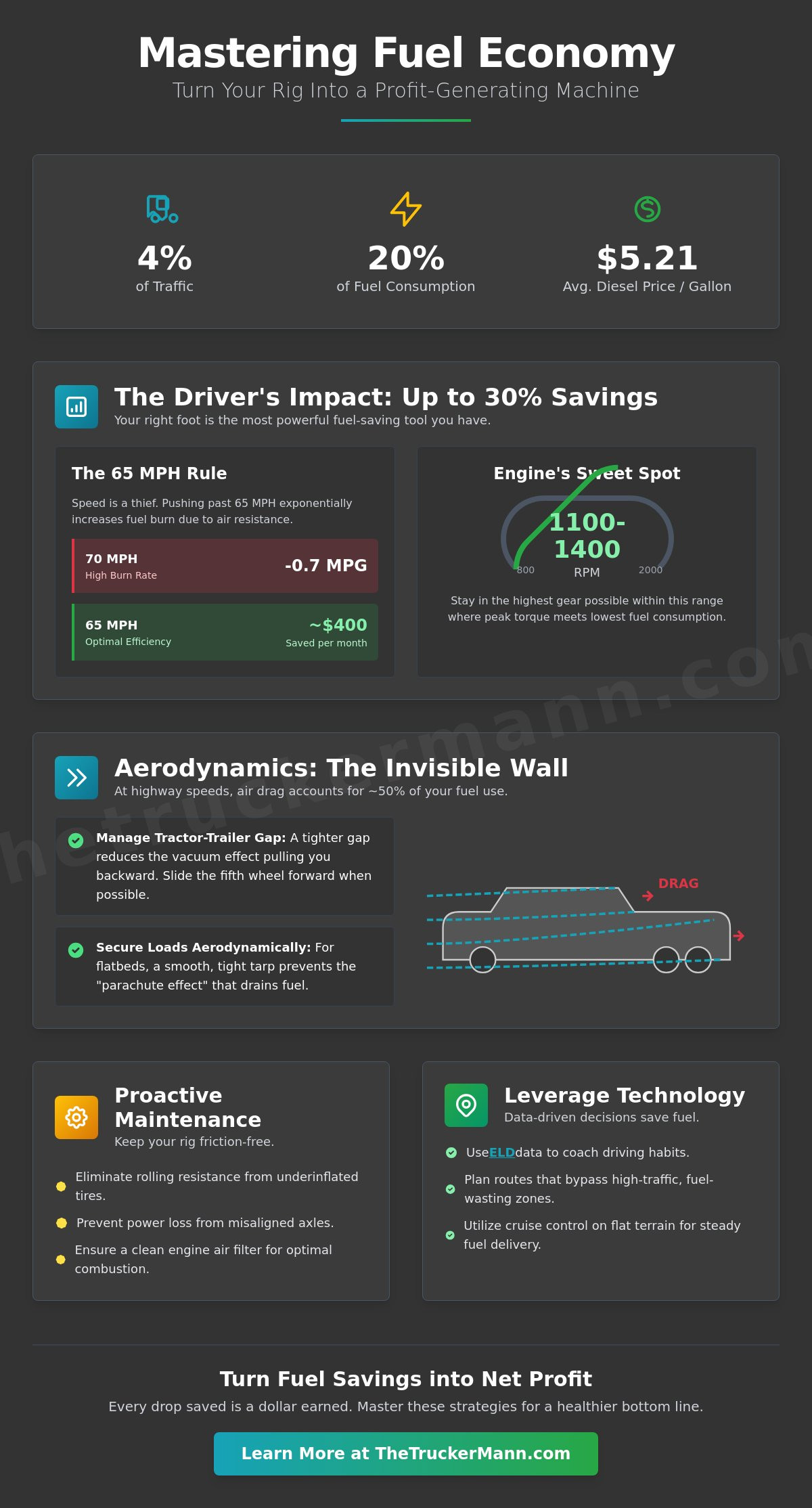
Did you know that heavy duty vehicles account for 20% of all domestic fuel consumption despite making up only 4% of the traffic? With diesel prices sitting at an average of $5.21 per gallon this June, that statistic isn’t just a number; it is a direct hit to your weekly settlement. You’ve likely seen the confusing marketing for fuel saving gadgets and felt the pressure of tight windows forcing your foot down, but chasing speed usually means burning through your hard earned margins. We both know that in this industry, survival depends on mastering the small gains and implementing proven tips for better fuel economy in a commercial truck to protect your bottom line.
I understand the frustration of watching your profit evaporate at the pump while navigating new 2026 ELD mandate updates and stricter emissions standards. This guide is designed to cut through the noise and provide you with veteran tested strategies that actually move the needle. You will learn how to optimize your driving behavior to save up to 30% at highway speeds, understand the real impact of aerodynamic drag, and identify which gear delivers a genuine return on investment. Let’s look at how you can turn your rig into a more efficient, profit generating machine for the long haul ahead.
Key Takeaways
- Identify your engine’s RPM sweet spot where torque peaks and fuel consumption drops to maximize every gallon.
- Minimize the air drag penalty at highway speeds by mastering tractor-trailer gap management and aerodynamic load securement.
- Discover maintenance-focused tips for better fuel economy in a commercial truck, including how to eliminate rolling resistance and power loss from misaligned axles.
- Use ELD data to coach your own driving habits and plan routes that bypass high-traffic, fuel-trapping zones.
- Learn the financial math behind fuel surcharges to turn your increased MPG into pure net profit on every settlement.
Mastering the Driver’s ‘Sweet Spot’ for Maximum MPG
Every pro knows the sensation of the engine finding its rhythm; that point where the vibration smooths out and the rig seems to pull with less effort. This isn’t just about driver comfort. It is about finding the engine’s sweet spot where your tractor operates at its highest thermal efficiency. When you are out on the open road, especially with diesel prices hitting an average of $5.21 per gallon this June, every extra RPM outside this range is just money blowing out of your exhaust pipe. Mastering these tips for better fuel economy in a commercial truck starts with understanding that your right foot is the most powerful tool in your cab.
Air resistance is a thief that doesn’t work in a straight line. It increases exponentially, meaning that fighting the wind at 75 MPH requires vastly more energy than at 65 MPH. By adopting energy-efficient driving techniques, like using the truck’s mass to carry you over rolling hills rather than mashing the throttle at the bottom of every grade, you keep your fuel rail pressure steady. Momentum is free energy. Don’t waste it by braking at the top of a hill only to accelerate at the bottom.
It is a mental game. We are trained to think that more miles per hour equals more money. But if those extra miles cost you 15% more in fuel, your net profit per hour actually drops. You aren’t just a driver. You are the manager of a mobile business, and businesses thrive on margins. Every RPM counts toward your survival in a volatile market.
To better understand how these habits impact your daily run, watch this breakdown of the most effective ways to save fuel:
The 65 MPH Rule and Your Bottom Line
Speed is a thief. Every 1 MPH you push over 65 usually costs you about 0.14 MPG in a standard tractor-trailer setup. If you are running a 2,500-mile week, dropping from 70 to 65 MPH can save you nearly $100 in diesel costs alone. That is $400 a month back in your pocket. Cruise control is your best friend here because it manages fuel rail pressure much more precisely than a human foot can. Don’t let a tight window trick you into hammering down. Often, the extra fuel burned to save twenty minutes costs more than the detention pay you might miss out on.
Finding and Staying in Your Engine’s Sweet Spot
Most modern diesel engines are designed to live in the 1100 to 1400 RPM range. This is where the magic happens. Use progressive shifting to get through the lower gears without redlining, which keeps your consumption low during those thirsty acceleration phases. You want to stay in the highest gear possible for the longest time possible. The sweet spot is the intersection of peak torque and lowest brake-specific fuel consumption.
Aerodynamic Upgrades and Load Securement Strategy
Air is a wall. At highway speeds, aerodynamic drag accounts for roughly 50% of your fuel consumption. While we often focus on the engine under the hood, the way your rig cuts through the wind is just as important for your weekly settlement. One of the most overlooked tips for better fuel economy in a commercial truck involves managing the gap between your tractor and trailer. If that space is too wide, air becomes turbulent and creates a low pressure vacuum that literally pulls your truck backward. Keeping your fifth wheel slid forward as far as weight limits allow is a free way to boost your MPG.
The Run on Less Regional fuel-economy demonstration proved that even small aerodynamic adjustments lead to massive savings over thousands of miles. It isn’t just about the truck’s shape; it is about how you handle the load itself. Whether you are pulling a dry van or a flatbed, managing airflow is a discipline that requires the right gear and a sharp eye during every stop.
Tarping for Aerodynamics, Not Just Protection
Flatbedders face a unique challenge because every load has a different profile. A loose, flapping tarp creates a parachute effect that can destroy your fuel mileage in a single headwind. Using heavy duty, tight fitting tarps from My Tee Products ensures that air moves smoothly over your cargo instead of getting trapped in the folds. When you secure your load with high quality gear from My Tee Products, you are protecting your freight and your profit margin simultaneously. For a deeper dive into the right equipment, check out our guide on the best flatbed trucking gear for 2026.
Chassis and Trailer Add-ons That Pay for Themselves
If you own your trailer, side skirts and trailer tails are among the most effective investments you can make. Side skirts prevent air from swirling under the trailer and getting caught on the rear axles. Similarly, flow through mudflaps and wheel covers reduce the spray and turbulence created by rotating tires. During your pre-trip inspection, always look for cracks in your fairings or loose brackets on your skirts. A broken fairing isn’t just a DOT concern; it is a leak in your wallet. Investing in a streamlined setup ensures you aren’t fighting the wind every mile of the way.
Preventive Maintenance: Keeping Your Rig Friction-Free
Friction is the silent thief that lives in every moving part of your rig. While we often focus on the wind hitting the windshield, mechanical friction inside your engine and at the wheel ends can be just as devastating to your cost per mile. Staying on top of your maintenance schedule is about more than just avoiding a roadside service call; it is a core strategy for staying profitable in a tight market. Even with the shifting regulatory landscape, including the updates found in the EPA’s Clean Trucks Plan, keeping your equipment in peak physical condition remains your best defense against rising overhead.
Tire Pressure and Rolling Resistance
Tires are your only contact with the pavement, and they are responsible for a massive chunk of your rolling resistance. A 10 PSI drop in tire pressure can cost you roughly 1% in fuel economy. If you are running on soft tires, you are essentially trying to drive through sand all day. Automatic Tire Inflation Systems (ATIS) are excellent for trailers, but for the tractor, you need to be hands on. I recommend keeping a professional grade gauge from Truck n Tow in your side box and checking your pressures every single morning. When you invest in your own inflation tools from Truck n Tow, you are taking control of the single easiest “free” fuel hack in the industry.
The Hidden Cost of Misalignment
If your axles aren’t perfectly square, your truck is “dog-tracking.” This means your tires are scrubbed against the road surface, creating mechanical drag and destroying your tread life. It is like trying to walk with your feet pointed inward; it takes more energy to go the same distance. Beyond the mechanical loss, a misaligned truck presents a larger, crooked profile to the wind, which increases the aerodynamic drag we discussed earlier. One of the most effective tips for better fuel economy in a commercial truck is to get a professional laser alignment every 50,000 miles. It is a small upfront cost that prevents your wheels from fighting each other and keeps your MPG where it belongs.
Leveraging Tech: Route Optimization and ELD Data
Technology in the cab used to be a dirty word for many of us. We often viewed the ELD mandate as just another layer of government oversight designed to keep us under a thumb. But in 2026, these devices have evolved into powerful profit centers that can help you master the best tips for better fuel economy in a commercial truck. They don’t just track your hours; they track your right foot, your idle time, and your engine load. If you want to survive the current economic squeeze, you need to stop looking at your tablet as a snitch and start looking at it as a high performance coach.
Beyond the cab, your choice of freight plays a massive role in your consumption. Using a platform like 123Loadboard allows you to be selective about the lanes you run so you aren’t fighting a losing battle against geography. If you are chasing high MPG, you don’t just look at the rate per mile. You look at the topography and the likely weather patterns on that route. A heavy load through the Rockies will always burn more than a similar weight on the flats of the Midwest. Smart load selection is a fundamental part of a modern fuel strategy. Find high-paying, fuel-efficient loads here to start maximizing your margins today.
Using ELD Data to Gamify Your Driving
Most modern telematics systems allow you to pull reports on “hard braking” and “excessive acceleration.” Every time you slam on the brakes, you are throwing away the kinetic energy you spent fuel to create. By reviewing these reports, you can identify patterns where you might be driving too aggressively in city traffic. High idle times are another profit killer. In 2026, with diesel at an average of $5.21 per gallon, an hour of idling is essentially burning a five dollar bill. Use your data to prove your efficiency to carriers, which can often lead to better fuel surcharge negotiations or performance bonuses.
Smart Planning: Avoiding the Stop-and-Go
A heavy diesel engine is at its least efficient when it has to move 80,000 pounds from a dead stop. Stop-and-go traffic is a fuel trap that can drop your average MPG into the low single digits. Smart route planning means timing your arrivals to bypass major metros like Chicago or Atlanta during peak congestion. Use weather apps to check for significant headwinds before you trip plan. If a 30 MPH gust is hitting you head-on, it might be worth delaying your departure or taking a slightly longer, sheltered route to save on the fuel bill. Pre-planning your fuel stops also ensures you aren’t racking up out-of-route miles just to find a cheaper pump.
The Financial Payoff: Turning Fuel Savings into Profit
Saving fuel isn’t just about being green; it’s about staying in the black. When you combine the driving habits, aerodynamic tweaks, and maintenance routines we’ve discussed, the cumulative effect on your bank account is massive. In this industry, we often focus on the gross revenue of a load, but the veterans know that profit is what you keep after the wheels stop turning. By consistently applying these tips for better fuel economy in a commercial truck, you transform your rig from a cost center into a profit machine.
The real magic happens with the fuel surcharge. Most carriers calculate surcharges based on a fleet average, often around 6.0 or 6.5 MPG. If you can push your efficiency to 7.5 or 8.0 MPG through discipline and better gear, that extra surcharge money doesn’t go toward diesel; it goes directly into your pocket as pure profit. It is essentially a performance bonus you pay yourself every single mile. Investing those gains back into high quality equipment, like premium tarps from My Tee Products, ensures you keep those aerodynamic gains for the long haul. When you choose My Tee Products, you are choosing gear that works as hard as you do to protect your margins.
Calculating Your Cost Per Mile (CPM)
You can’t manage what you don’t measure. To find your fuel CPM, divide your total fuel spend for the week by the number of miles you ran. It’s a simple formula that keeps you honest. With diesel prices averaging $5.21 per gallon as of June 2026, even a tiny 0.5 MPG improvement can save you over $6,600 annually if you run 100,000 miles. Seeing that profit per load increase week over week provides a psychological boost that makes the discipline of slowing down much easier to swallow.
Investing in Long-Term Efficiency
Cheap gear is a false economy. A bargain bin tarp that flaps in the wind or a low grade lubricant that increases internal friction will cost you far more in wasted fuel and early replacements than the “savings” at the checkout counter. Professionalism extends beyond the equipment to your own business education. Programs like DLA Academy help you master the operational side of trucking so you can navigate these economic shifts with confidence. Joining DLA Academy gives you the tools to analyze your numbers like a CEO rather than just a driver. Treat your truck like a business, and it will pay you like one. Mastering these tips for better fuel economy in a commercial truck isn’t just a set of chores; it is the mark of a true professional who values their craft and their future.
Master the Miles and Claim Your Profit
Navigating the 2026 market requires more than just a CDL; it demands a business owner’s mindset. We’ve looked at how finding your engine’s sweet spot and tightening up your maintenance routine can save you thousands of dollars at the pump. These aren’t just suggestions. They are essential tips for better fuel economy in a commercial truck that help you stay competitive as diesel prices and regulations shift. By using ELD data to coach your own habits and investing in aerodynamic gear, you’re not just surviving. You’re mastering the road.
As a veteran-driver owned and operated resource, we only recommend what actually works on the asphalt. Don’t let your hard-earned settlement disappear into the wind because of poor aerodynamics or a heavy right foot. Gear up for efficiency with the best flatbed tools from My Tee Products! For more industry-leading advice updated for current conditions, stay connected with the community at The Trucker Mann. Keep your wheels square, your tarps tight, and your eyes on the horizon. We’ll see you out there on the high side.
Frequently Asked Questions
How much fuel does a semi-truck burn while idling?
A typical semi-truck burns between 0.6 and 1.0 gallons of diesel for every hour it idles. While it might seem like a small amount, idling for an entire 10-hour reset can waste up to 10 gallons of fuel. At June 2026 prices, that’s over $50 gone for no reason. Minimizing idle time is one of the most immediate tips for better fuel economy in a commercial truck that you can implement today.
Does using cruise control actually save fuel in a commercial truck?
Cruise control generally saves fuel by maintaining a steady fuel rail pressure and avoiding the “foot-tapping” acceleration that wastes diesel. It’s most effective on flat or gently rolling terrain where the computer can manage the throttle more precisely than a human. However, in heavy mountains, you’re better off taking over to use momentum. It’s about letting the tech handle the steady work so you can focus on the grade.
What is the best speed for fuel economy in a heavy-duty truck?
The sweet spot for most modern heavy-duty trucks is between 60 and 65 MPH. Once you cross the 65 MPH threshold, aerodynamic drag increases so sharply that your engine has to work significantly harder just to push through the air. Keeping your speed in this range is a proven way to keep your MPG high without sacrificing too much time on your delivery window.
How often should I check my tire pressure for optimal MPG?
You should check your tire pressure every single morning during your pre-trip inspection. Temperature changes and slow leaks can drop your PSI overnight, and running even 10 PSI low can hurt your fuel economy by 1%. Don’t rely on the “thump” test. Use a calibrated gauge from a reliable source like Truck n Tow to ensure every tire is at the manufacturer’s recommended pressure.
Do aerodynamic trailer tails really work?
Aerodynamic trailer tails definitely work by reducing the low-pressure vacuum behind the trailer that creates rear-end drag. Studies show they can improve fuel efficiency by 1% to 5% at highway speeds. While they require a bit of extra work to deploy, the fuel savings over a long-haul run make them a smart investment. You can find high-quality aerodynamic aids and securement gear at My Tee Products to help streamline your rig.
Can a dirty air filter significantly impact my truck’s fuel economy?
A restricted air filter forces your turbocharger to work harder to pull in oxygen, which can definitely tank your MPG. While modern engine computers can adjust the fuel mix to keep emissions in check, the extra work required to breathe still wastes energy. Replacing a clogged filter is a low-cost maintenance step that ensures your engine isn’t fighting itself just to stay running and converting fuel into power.
What is an auxiliary power unit (APU) and how does it save fuel?
An auxiliary power unit (APU) is a small, separate engine that provides climate control and electricity for the cab without running the main tractor engine. Since an APU only burns about 0.1 to 0.2 gallons per hour, it is much more efficient than idling the big block. It’s a key piece of tech for drivers looking for the best tips for better fuel economy in a commercial truck during mandatory rest periods.
How do I calculate my truck’s average MPG correctly?
To calculate your average MPG correctly, divide the total miles driven between fill-ups by the number of gallons it took to top off the tank. Don’t just trust the dash display; those are often optimistic. Keep a log of your odometer readings and fuel receipts over several weeks to get a true picture of your performance. Accurate tracking is the only way to see if your changes are actually paying off on your settlement.
Disclaimer
The information provided on The TruckerMann is for general informational and educational purposes only. While every effort is made to ensure the accuracy and reliability of the content, trucking laws, FMCSA regulations, DOT requirements, safety standards, and industry policies can change at any time. Readers are encouraged to verify all information with official government agencies, professional advisors, or qualified industry professionals before making business, legal, financial, safety, or compliance-related decisions.
The content shared on this website reflects personal opinions, experiences, research, and commentary and should not be considered legal, financial, medical, tax, or professional advice. The TruckerMann and its owners, contributors, affiliates, or representatives are not responsible for any losses, damages, violations, penalties, or liabilities resulting from the use or misuse of information found on this website.
Some content on this website may contain affiliate links, sponsored content, or promotional material. This means we may earn a commission at no additional cost to you if you choose to purchase through certain links.
By using this website, you agree that you do so at your own discretion and risk.