Imagine sitting in a dusty weigh station lot during the 2026 International Roadcheck, staring at a Driver Vehicle Examination Report that just sidelined your rig. That sinking feeling in your gut isn’t just about the immediate fine; it’s the fear of what that “Out of Service” sticker does to your CSA score and your future behind the wheel. Knowing exactly what to do if you fail a dot inspection is the difference between a temporary setback and a career-ending disaster. With fines for general violations now reaching up to $16,550 and ELD tampering carrying even heavier penalties, you can’t afford to guess your way through the aftermath.
We understand the frustration of watching an estimated $264 in revenue vanish for every day you’re stuck in a shop instead of on the asphalt. You’ve worked too hard to let one bad day at the scales tank your reputation or your bank account, especially with the FMCSA’s 2026 focus on ELD integrity and cargo securement. This guide is your survival manual for the modern regulatory landscape. We’ll show you how to navigate the 15-day certification window, protect your PSP record, and use the DataQ system to fight back against inaccurate marks. Here is the step-by-step roadmap to getting your truck moving and keeping your career on track.
Key Takeaways
- Master the 15-day certification window to ensure your repairs are documented and filed before the FMCSA escalates your violations.
- Learn how to decode the specific FMCSR regulations on your Driver Vehicle Examination Report to identify exactly where your compliance fell short.
- Protect your long-term hireability by understanding what to do if you fail a dot inspection and how severity weights impact your 24-month rolling CSA score.
- Implement a 15-minute “Pre-Pre-Trip” routine and a targeted roadside repair kit to transition from avoiding inspections to being ready for them every day.
Immediate Steps After Failing a DOT Inspection
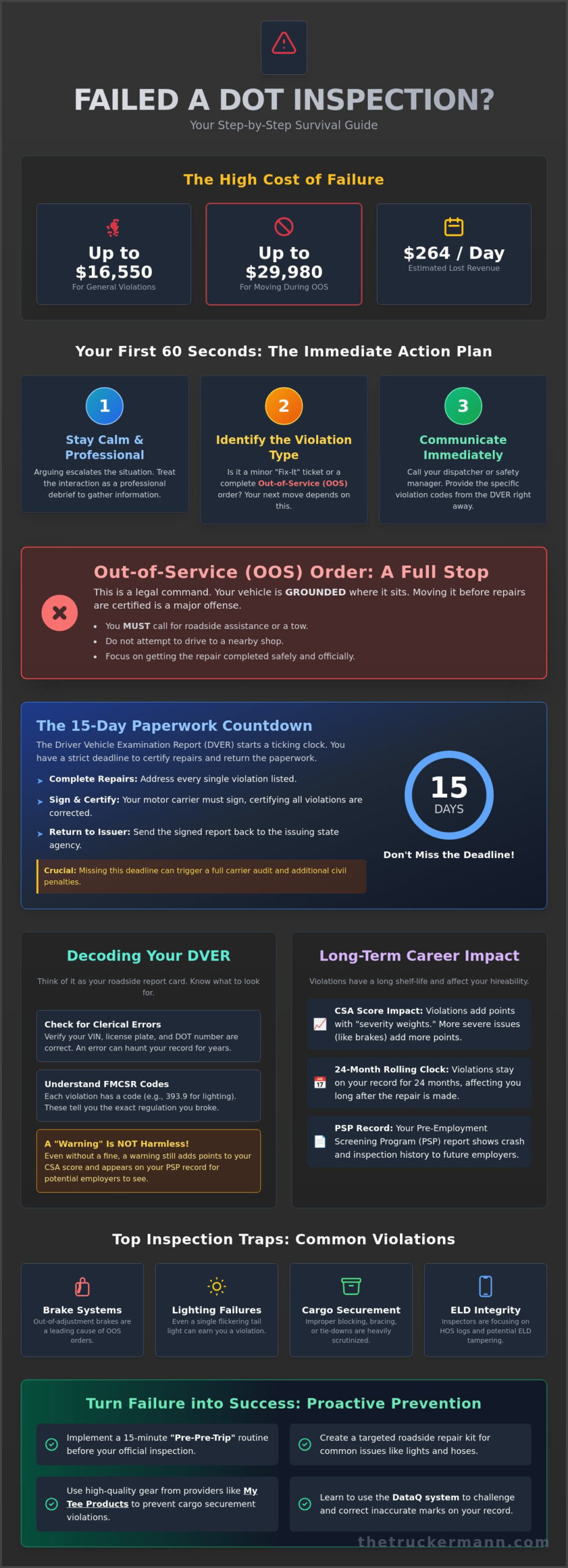
When that officer hands you a violation notice, your blood pressure probably spikes. It’s a natural reaction, but how you handle the next sixty seconds dictates how the rest of your month goes. First, keep your cool. Being argumentative with an inspector only invites a deeper dive into your logs or equipment. Treat it like a professional debrief. You need to quickly identify if you’ve been slapped with an Out-of-Service (OOS) order or just a list of “Fix-it” violations. The Federal Motor Carrier Safety Administration (FMCSA) sets these standards to keep the roads safe. While it feels personal, it’s just part of the regulatory grind.
To better understand how this process unfolds at the scale house, watch this helpful video:
Once you have the Driver Vehicle Examination Report (DVER) in hand, get on the phone with your dispatcher or safety manager. Don’t wait. They need the specific violation codes to start the clock on repairs and potentially reroute freight. Knowing exactly what to do if you fail a dot inspection starts with clear communication. If it’s a minor lighting issue, you might be allowed to roll to a nearby shop. If it’s an OOS order, you’re staying put until the problem is solved.
Handling the Out-of-Service (OOS) Order
An OOS order is a legal stop-work command. Your truck is grounded exactly where it sits. If you move that vehicle before the repairs are certified, you’re looking at fines that can reach up to $29,980. That is a career-ending number. You’ll need to call a mobile mechanic or arrange a tow to a repair facility. Using high-quality securement from My Tee Products can prevent many cargo-related OOS orders, but if you’re already sidelined, focus on getting the repair done safely on the shoulder or in the lot.
The 15-Day Paperwork Countdown
The DVER isn’t just a receipt; it’s a ticking clock. You have exactly 15 days to get the repairs completed, sign the report, and return it to the state agency that issued it. Your motor carrier must certify that every violation has been addressed. If you miss this deadline, you’re inviting a secondary audit or additional civil penalties. It’s a simple administrative task, but in the chaos of the road, it’s the one most drivers forget. Keep a copy for your records to prove you took the necessary steps if the system fails to update correctly.
Decoding the Driver Vehicle Examination Report (DVER)
The DVER is basically your roadside report card, and it doesn’t grade on a curve. This document is split into three main buckets: Driver, Vehicle, and Hazardous Materials. Each line item corresponds to a specific Federal Motor Carrier Safety Regulation (FMCSR) code. If you see a code like 393.9, that is a lighting violation. Understanding these codes is the first real step in what to do if you fail a dot inspection, as it allows you to verify if the officer’s assessment matches the reality of your equipment. Check your VIN, license number, and DOT number for typos immediately. A simple clerical error by an inspector can haunt your record for years if you don’t catch it on the spot.
There’s a common myth that a “Warning” doesn’t count. That is dead wrong. While a warning might not carry a fine, it still hits your CSA score and shows up on your Pre-Employment Screening Program (PSP) record. Potential employers see these warnings as red flags. Knowing what to do if you fail a dot inspection involves treating every mark on that paper, whether it’s a warning or a violation, as a threat to your professional reputation. If the data is wrong, you need to know it before you leave the scale house.
Common Violations Found on the DVER
Brake systems and lighting failures remain the heavy hitters in 2026. If a single brake is out of adjustment or a tail light is flickering, you’re looking at a mark. Cargo securement is another trap. If your blocking, bracing, or tie-downs aren’t up to snuff, you’ll see it here. Using professional-grade gear from My Tee Products can help you avoid these citations. With the 2026 focus on ELD integrity, expect inspectors to scrutinize your HOS logs for even minor clerical slips, like missing annotations or incorrect duty status changes.
Ensuring Repair Certification
After the repair is done, someone has to sign off. If it was an Out-of-Service issue, a qualified mechanic usually needs to sign the DVER to certify the work was completed. For minor “Fix-It” violations, your carrier’s safety officer can often provide the signature. Never just take their word for it. Keep every receipt, work order, and parts invoice as secondary proof. These paper trails are your best defense during a future audit. To stay ahead of the game, refer to The Ultimate DOT Inspection Level 1 Checklist for prevention. For more tips on staying compliant, visit thetruckermann.com.
How a Failed Inspection Impacts Your CSA Score and Career
Let’s talk about the elephant in the room: your career. A failed inspection isn’t just a bad day at the office; it’s a mark on your permanent record that potential employers and insurance companies will scrutinize for the next two years. Your CSA score follows a 24-month rolling window. This means a heavy violation today will weigh you down until 2028. Many drivers think a clean Motor Vehicle Record (MVR) protects them, but the MVR only tracks tickets and accidents. Your Pre-Employment Screening Program (PSP) report is where the real story lives. It’s the first thing a recruiter looks at to decide if you’re a liability or a professional.
The math behind these points is brutal. The FMCSA uses “Severity Weights” from 1 to 10, plus an extra 2 points for any Out-of-Service violation. Then, they apply “Time Weights.” In the first six months, your points are tripled. From six to twelve months, they’re doubled. If you’re wondering what to do if you fail a dot inspection to save your job, the answer is to understand this weight system. One bad brake light might be a severity of 2, but if you’re OOS, that’s a 4, which triples to 12 points immediately. Is your career over after one failure? No. But your “hireability” takes a hit, and your current seat might get a lot warmer.
The DataQ Challenge Process
If the inspector got it wrong, don’t just take it lying down. The DataQ system is your way to fight back. This is where you challenge inaccurate data to get points scrubbed from your record. Success here requires more than just your word; you need evidence. This is why you should always take high-resolution photos of your equipment, cargo, and even the officer’s measurements at the roadside. If you can prove that your load was secured with top-tier straps from My Tee Products and the inspector misapplied the regulation, a successful DataQ challenge can wipe those points clean.
Insurance and Employer Consequences
For owner-operators, a spike in CSA points leads directly to higher insurance premiums. Carriers with prioritized BASICs can see rates jump by 15% to 40% almost overnight. Even if you’re a company driver, fleet managers are watching. They need to know they can trust you with their equipment and their reputation. Being transparent about the failure is better than letting them find it during a random audit. If you show them you’ve already implemented a plan for what to do if you fail a dot inspection, including better pre-trips and using reliable gear like that found at My Tee Products, you’re building a bridge of trust instead of burning one.
Correcting Violations Fast: Gear and Resources You Need
A failed inspection is a race against the clock. Once you’re sitting in that lot, the only thing that matters is how fast you can turn a violation into a correction. You need a roadside repair kit that goes beyond a rusty screwdriver and a roll of duct tape. At a minimum, keep a complete set of spare bulbs and fuses for every circuit on your rig. Light failures are low-hanging fruit for inspectors; don’t let a five-dollar bulb keep you from a five-thousand-dollar load. Basic hand tools, including a set of wrenches and a multimeter, are mandatory for chasing down those electrical gremlins that always seem to pop up during the International Roadcheck.
If you’re wondering what to do if you fail a dot inspection due to insecurement, the answer is to upgrade your kit immediately. Knowing what to do if you fail a dot inspection involves being prepared before the officer even steps on your running board. Utilizing high-quality gear from My Tee Products ensures you aren’t just meeting the bare minimum, but exceeding it. The value of having a backup My Tee Products tarp or strap set in your toolbox cannot be overstated. When an inspector finds a fray in your primary line, having a fresh, tagged replacement ready to go can save you from an OOS order.
Cargo Securement Solutions
Cheap straps fail inspections because they stretch, fray, and lose their Working Load Limit (WLL) tags. My Tee Products provides the durability needed to withstand the grit of the road without falling apart. If you’re cited for edge protector violations, My Tee Products offers heavy-duty solutions that prevent strap wear and keep you compliant. For a deeper dive into the right tools for the job, check out The Best Flatbed Trucking Gear for Logistics & Securement in 2026. Having a spare My Tee Products strap set is the cheapest insurance you can buy.
Finding Loads After a Delay
Downtime is the silent killer of profitability. Each day a driver is out of service costs an estimated $264 in lost revenue. To bounce back, you need to be aggressive. Using 123Loadboard allows you to recover lost revenue after OOS downtime by finding the highest-paying freight in your immediate area. You can filter for quick pay loads on 123Loadboard to quickly cover the costs of any roadside repairs or fines you just incurred. This platform is essential for owner-operators who need to stay profitable despite regulatory setbacks. To keep your business running smoothly, visit thetruckermann.com for more expert advice on staying compliant.
Mastering the Clean Inspection: Turning Failure into a Professional Standard
A failed inspection feels like a punch in the gut, but it’s also a wake-up call that every seasoned veteran has heard at least once. The shift from dreading the scale house to being ready for it is what separates the steering wheel holders from the true professionals. Instead of crossing your fingers and hoping for the best, you need to walk into that booth with the confidence of a driver who knows their rig is tight. Knowing what to do if you fail a dot inspection is a defensive skill, but mastering the clean inspection is an offensive strategy that protects your livelihood and keeps you profitable.
Don’t keep your failure stories to yourself. Sharing advice on what to do if you fail a dot inspection builds a stronger community and helps younger drivers avoid the same traps. When you tell a brother about a specific inspector’s focus on ELD annotations or a hidden air leak, you’re helping everyone stay on the road. It’s about camaraderie and mutual respect. We’re all in this together, and a lesson learned by one should be a lesson shared with all. This fraternal bond is what keeps the industry moving forward despite the weight of new regulations.
The Ultimate Pre-Trip Routine
Implementing a 15-minute “Pre-Pre-Trip” routine every single morning is your best defense against the 2026 CVSA focus areas. You need to zero in on the “Big 3”: Tires, Brakes, and Lights. Check your tread depth and look for uneven wear that could signal a suspension issue. Test your brake stroke and listen for audible air leaks that could lead to an immediate OOS order. Ensure every single bulb, from your headlights to your license plate lamp, is burning bright. Focusing on these details while using high-quality gear from My Tee Products ensures you’re always ready for a surprise Level 1. To get your process down to a science, check out our CDL Pre Trip Inspection Checklist: The 2026 Master Guide. Consistency is the only way to ensure nothing is missed before you hit the scales.
Staying Ahead of 2026 Regulations
The 2026 International Roadcheck, scheduled for May 12-14, will place a heavy emphasis on ELD integrity and cargo securement. Your ELD isn’t an enemy; it’s your best friend during a roadside audit if you use it correctly. Inspectors are looking for tampering and falsification, so ensure your annotations are clear and your duty statuses are accurate. For a full breakdown of the latest requirements, read our ELD Compliance in 2026 guide. Professional growth in this industry means mastering the paperwork just as much as the driving. Using reliable equipment from My Tee Products for your securement needs ensures that when you do get pulled in, you’re rolling back out with a clean report and your head held high.
Take Control of Your Career and Your Compliance
A failed inspection is a high-stakes hurdle, but it doesn’t have to be the end of the road. By mastering the 15-day certification window and understanding how to challenge errors through the DataQ system, you keep the power in your hands. This guide, written by a professional driver and based on the latest 2026 FMCSA and CVSA standards, provides the blueprint for protecting your livelihood. You now know exactly what to do if you fail a dot inspection to mitigate the damage to your CSA score and keep your insurance premiums from skyrocketing.
Success in this industry is built on preparedness and the quality of your equipment. Having practical gear recommendations for real-world fixes means you spend less time on the shoulder and more time earning. Don’t let a failed inspection stop your momentum. Upgrade your securement gear at My Tee Products today and stay compliant. For more veteran advice on mastering the grit of the field, visit thetruckermann.com. You’ve got the miles behind you and a bright career ahead; keep that rig moving and stay safe out there.
Frequently Asked Questions
How long does a failed DOT inspection stay on my record?
A failed inspection remains on your carrier’s CSA record for 24 months. If you’re looking at your individual Pre-Employment Screening Program (PSP) report, those violations stick around for three years. It’s a long time for a single mistake to follow you. Focus on getting clean inspections to dilute the impact of those older points over time.
Can I drive my truck if I have a violation but was not placed Out-of-Service?
Yes, you can keep rolling if the violation isn’t an Out-of-Service (OOS) order. However, you are legally required to have the defect repaired and the signed inspection report returned to the issuing agency within 15 days. Ignoring a “Fix-It” violation is a fast track to a much larger fine or a full audit during your next encounter with the law.
Who is responsible for paying the fine after a failed inspection: the driver or the company?
Fines are generally issued to the motor carrier for equipment failures and to the driver for behavioral or HOS violations. Most companies will cover the cost of a mechanical failure, but if the inspector cites you for a logbook error, that cash is usually coming out of your pocket. Always clarify your company’s safety policy before you hit the road to avoid surprises.
What happens if I refuse to sign the DOT inspection report?
Refusing to sign doesn’t make the violations go away. The inspector will simply mark the report as “Refused to Sign” and the data will still be uploaded to the FMCSA. It usually backfires by making you look unprofessional, which can lead to more frequent “random” inspections. Just sign it and use the DataQ process if you need to fight the results later.
How many CSA points do I get for a failed brake inspection?
Brake violations carry a severity weight of 4 points. If the issue is serious enough to land you an Out-of-Service order, you get an additional 2 points, bringing the total to 6. Remember that these points are tripled during the first six months. Knowing what to do if you fail a dot inspection is a high-priority concern for your career longevity.
Can a failed DOT inspection lead to a CDL suspension?
Equipment failures usually won’t cost you your license directly, but driver-related Out-of-Service orders can. If you’re caught with serious HOS violations or major safety issues, the FMCSA has the authority to disqualify you. Accumulating multiple OOS orders for the same recurring issue in a short period can also lead to a suspension of your driving privileges.
What is the DataQ system and how do I use it?
DataQ is the official FMCSA portal where you can challenge incorrect inspection data. You’ll need to create an account and file a Request for Data Review (RDR) with supporting evidence like photos or mechanic receipts. If you can prove your gear from My Tee Products was compliant, the state can remove the points. Understanding what to do if you fail a dot inspection includes knowing how to use this system.
Is a ‘warning’ on a DOT inspection the same as a ‘violation’ for my CSA score?
Yes, a warning hits your CSA score with the exact same weight as a formal citation. Don’t let the word “warning” fool you into thinking your record is safe. Every mark on that DVER impacts your carrier’s percentile ranking and your future hireability. Treat every inspection with the same level of seriousness to keep your professional reputation intact.
Disclaimer
The information provided on The TruckerMann is for general informational and educational purposes only. While every effort is made to ensure the accuracy and reliability of the content, trucking laws, FMCSA regulations, DOT requirements, safety standards, and industry policies can change at any time. Readers are encouraged to verify all information with official government agencies, professional advisors, or qualified industry professionals before making business, legal, financial, safety, or compliance-related decisions.
The content shared on this website reflects personal opinions, experiences, research, and commentary and should not be considered legal, financial, medical, tax, or professional advice. The TruckerMann and its owners, contributors, affiliates, or representatives are not responsible for any losses, damages, violations, penalties, or liabilities resulting from the use or misuse of information found on this website.
Some content on this website may contain affiliate links, sponsored content, or promotional material. This means we may earn a commission at no additional cost to you if you choose to purchase through certain links.
By using this website, you agree that you do so at your own discretion and risk.