Hey Friend, the high-mileage paycheck you’re chasing across state lines might actually be worth less than the local route that gets you home for dinner every night. It’s a tough call that every driver faces. You want the big money, but you also want to avoid the 33 percent of roadside violations that stem from simple paperwork errors or improper authority. The Truckermann knows the pressure of staring at the FMCSA handbook and wondering if you’re operating in a legal grey area regarding interstate vs intrastate hauling.
We agree that your livelihood shouldn’t be a guessing game. You deserve to know exactly how this choice impacts your bottom line and your time off. This 2026 guide provides the master framework you need to navigate these regulatory differences with total confidence. We will break down the latest legal requirements, compare financial outcomes for both models, and show you how to maintain 2026 compliance while building a career that actually works for you. The road runs through us, and we’re here to make sure you’re on the right side of it.
Key Takeaways
- Learn to navigate the complex “Continuous Flow” doctrine to ensure your local loads aren’t accidentally putting your operating authority at risk.
- Master the interstate vs intrastate financial divide by comparing IFTA obligations and insurance minimums that can range from $750k to over $5M.
- Use the “Protective Mentor” perspective to weigh the freedom of long-haul truck stop culture against the stability of staying close to home for your family.
- Discover how to choose the right path for your specific career stage based on projected 2026 market capacity and emerging economic shifts.
- Get clear on exactly when you need an MC number versus state-specific permits to keep the DOT off your back and your wheels turning profitably.
Defining the Divide: What is Interstate vs. Intrastate Commerce?
Hey Friend, let’s break down the most fundamental choice you’ll make behind the wheel. Choosing between interstate vs intrastate hauling isn’t just about how many miles you put on the odometer; it’s about which rulebook you live by every day. If you’re moving goods across state lines or even international borders like Canada or Mexico, you’re in the world of interstate commerce. If your route stays strictly within the borders of a single state with no intent for the freight to leave that state, you’re running intrastate. This distinction dictates your CDL medical requirements, your potential earnings, and your legal standing during a roadside inspection. The Truckermann knows that understanding these definitions is the first step toward protecting your livelihood and staying compliant with the DOT.
To get a clearer picture of how these definitions impact your daily operations, watch this breakdown:
The Core Definition of Interstate Trucking
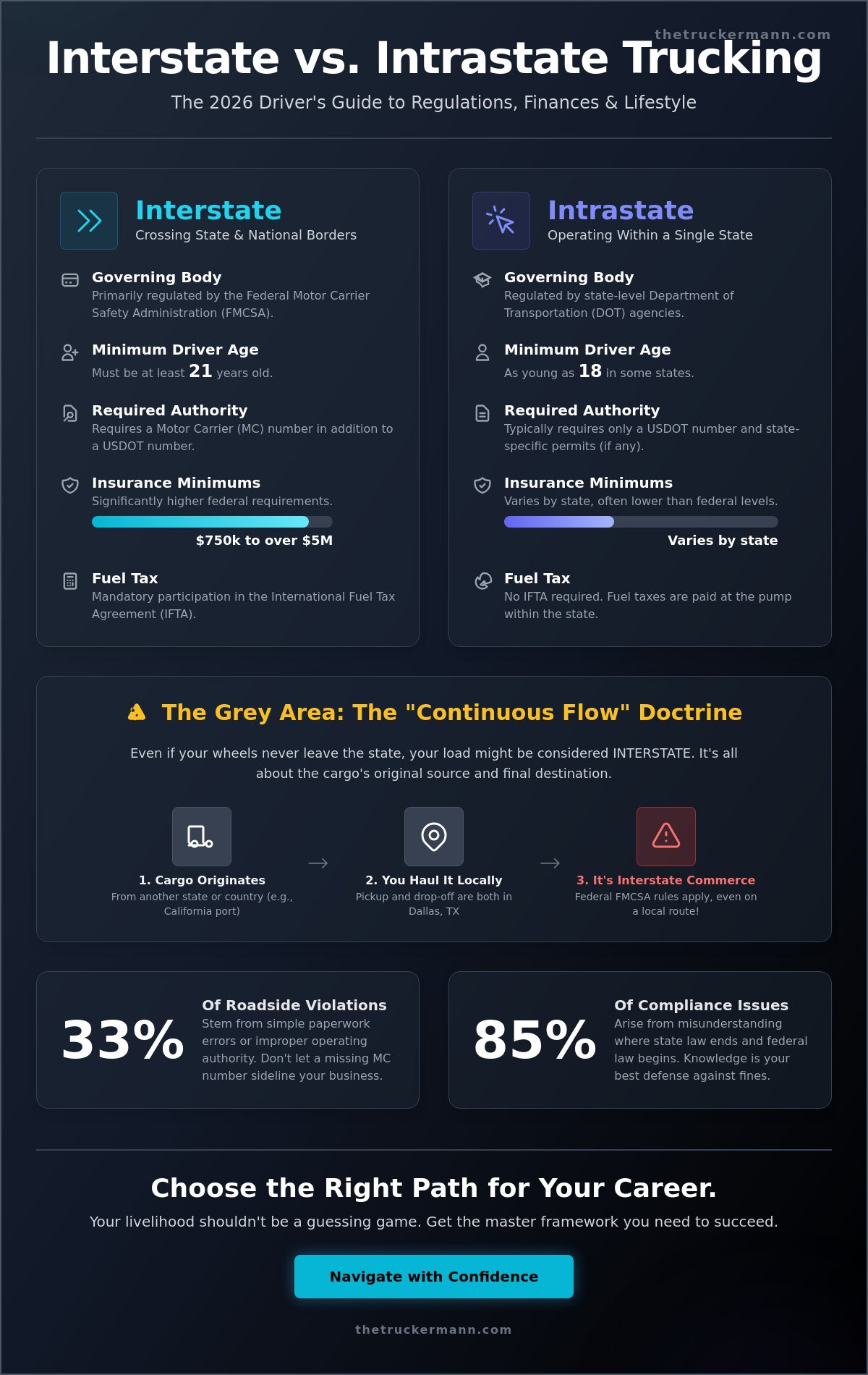
Interstate trucking involves hauling freight that crosses state lines or international borders. Even if you pick up and drop off a load within the same state, it’s considered interstate if the cargo originated from outside that state or is destined for a different one. The FMCSA governs these long-haul operations to ensure safety across the national highway system. This federal oversight traces its roots back to the Interstate Commerce Act of 1887, which established the precedent for federal regulation of the transport industry. Today, running interstate means you must comply with federal Hours of Service (HOS) regulations and maintain a higher level of insurance coverage. It’s the path for those who love watching the miles roll across the horizon and don’t mind the rigors of federal oversight.
The Local Hustle: What Qualifies as Intrastate?
Intrastate operations happen when your truck, the driver, and the freight stay entirely within one state’s borders. You aren’t crossing lines, and the cargo doesn’t have an “out-of-state” intent. While the FMCSA sets the baseline, state-level DOT agencies often have their own specific rules for local drivers. For example, some states allow drivers as young as 18 to operate commercially, whereas federal law requires you to be 21 for interstate routes. Common examples include:
- Local construction delivery and gravel hauling.
- Regional food distribution for grocery chains.
- Last-mile logistics and residential delivery services.
In 2023, the American Trucking Associations reported that local and regional hauls accounted for over 50% of all freight tonnage. This path offers more home time, but it requires a sharp eye on state-specific regulations that can change the moment you hit a new county line. Whether you’re running local or long-haul, the road runs through us all.
The FMCSA Rulebook: Compliance, Authority, and the ‘Grey Areas’
Hey Friend, the lines on the road are clear, but the lines in the FMCSA rulebook often blur into a grey fog. When you’re weighing the choice of interstate vs intrastate, you aren’t just picking a route; you’re picking which set of masters you serve. The Truckermann knows that roughly 85% of compliance violations stem from a simple misunderstanding of where state law ends and federal law begins. It’s a high-stakes game where the wrong box checked on a form can lead to a roadside nightmare.
Interstate intent is the legal standard used by DOT inspectors in 2026 to classify a shipment based on its ultimate destination rather than its current leg of travel. This means your “local” day could suddenly be under the federal microscope. Understanding the nuance between federal and state trucking regulations is the only way to protect your CDL and your wallet from aggressive enforcement tactics. For a complete breakdown of the 2026 updates — including the $15,900 maximum penalty for ELD violations — review the full interstate vs intrastate trucking FMCSA rules and compliance guide to make sure your operation is bulletproof before your next haul.
When Does Your Local Haul Become Interstate?
The “Continuous Flow” doctrine is the trap most local drivers fall into. If you pick up a load in Dallas that originated in a California port, that freight is in interstate commerce even if you only drive it twenty miles to a Fort Worth warehouse. The shipper’s intent, documented on the bill of lading, dictates the rules. Because of this, keeping a clean CDL pre-trip inspection checklist is vital. A DOT officer won’t care if your haul is short once they classify the load as interstate; they’ll expect every federal safety standard to be met perfectly. That includes strict adherence to the 11-hour driving limit and 14-hour duty window — get the full breakdown of how these clocks work in our guide to FMCSA hours of service rules explained so you’re never caught off guard during a roadside inspection.
DOT Numbers and Operating Authority
By 2026, the digital paper trail has made “flying under the radar” impossible. Almost every commercial vehicle requires a USDOT number, but the MC Number is the true divider. If you cross state lines or handle freight with interstate intent, that MC Number is mandatory. Intrastate-only carriers often face a patchwork of state-specific registrations that can be just as rigorous. If you’re looking for real-road opportunities to expand, getting your federal authority early is usually the smarter play for long-term growth.
- Federal HOS: Strict 11-hour driving limits and 14-hour duty windows apply to all interstate moves.
- State Exemptions: Some states allow for extended hours or different rest requirements for drivers staying within a 150 air-mile radius.
- The Pivot: The moment your wheels touch freight bound for another state, those local exemptions evaporate instantly.
The Road Runs Through Us, and staying on the right side of the FMCSA is how we keep those wheels turning. Don’t let a “local” mindset leave you vulnerable to federal-sized fines.
The Business of Hauling: Insurance, IFTA, and Tax Obligations
Hey Friend, let’s talk about the money that leaves your pocket before you even hit the highway. When you’re deciding on interstate vs intrastate work, the back-office costs are often what make or break a small fleet. The Truckermann has seen plenty of drivers jump into the long-haul game only to get blindsided by the compliance price tag. Running across state lines opens up more freight, but it also opens your wallet to federal regulators.
Insurance Requirements: Federal vs. State
Federal law under FMCSA Part 387 requires a minimum of $750,000 in primary liability for general freight crossing state lines. If you’re hauling hazardous materials, that requirement surges to $5 million. Staying within state lines can sometimes lower these premiums. Some states allow intrastate carriers to operate with $500,000 in coverage for specific weight classes. While lower premiums keep more cash in your pocket, they often lock you out of the best load boards. Most premium brokers won’t look at your authority unless you carry at least $1 million in liability and $100,000 in cargo insurance.
IFTA and the Paperwork Burden
If you cross state lines, the International Fuel Tax Agreement (IFTA) becomes your new shadow. You’ve got to track every mile driven and every gallon pumped in every single jurisdiction. By 2026, manual logs are a recipe for an audit headache. Most pros use ELDs to automate these quarterly filings, ensuring they don’t overpay or face state penalties. To stay ahead of the latest device requirements, review our complete guide to ELD compliance in 2026 so you’re never caught running a revoked device during a weigh station check. Intrastate drivers generally skip this burden, paying fuel tax directly at the pump without the need for complex multi-state reporting.
Beyond fuel taxes, you have to account for the Unified Carrier Registration (UCR) fees. These fees scale based on your fleet size. For a 1-2 vehicle operation, the cost is manageable, but it’s another annual hurdle that interstate carriers can’t dodge. When evaluating interstate vs intrastate paths, consider these fixed costs:
- UCR Fees: Annual payments based on the number of commercial motor vehicles in your fleet.
- IRP Plates: Apportioned registration that distributes license fees among the states where you operate.
- BOC-3 Filing: The requirement to designate a process agent in every state where you have authority.
- Heavy Highway Vehicle Use Tax (Form 2290): A federal tax for vehicles weighing 55,000 pounds or more.
The hidden costs of interstate compliance can add up to thousands of dollars extra per year. You’ve got to weigh that against the higher volume and better rates the national market offers. The road runs through us, but it’s the paperwork that keeps us legal and profitable in a shifting 2026 economy.
Life on the Road: Gear, Lifestyle, and Route Planning
Hey Friend, choosing between interstate vs intrastate routes is more than a career move; it’s a decision about the life you live when you step out of the cab. If you’re running OTR, your truck is your sanctuary. You’ll learn the rhythm of the truck stops and the quiet peace of a 2 AM stretch of highway in Nebraska. It’s a mental game that requires a certain level of solitude. However, it takes a toll on the home front. If you have a family, those weeks away are a heavy sacrifice. Local drivers get the “home every night” prize, but they pay for it with the stress of tight city corners and aggressive four-wheelers in 5 PM traffic. Your health and your sanity depend on knowing which grind you’re built for.
Equipping Your Rig for the Long Haul
Running long-haul means you need the best flatbed trucking gear to handle shifting climates and varied terrain. When you’re crossing the Rockies in winter, your chains and straps better be top-tier. Inside the cab, don’t skimp on a high-quality mattress or a reliable portable power station. Your health depends on that sleep. Navigation tech is a must, but always keep a paper atlas for when the signal drops in the middle of nowhere. Durable, weather-resistant gear isn’t just a suggestion; it’s your lifeline when you’re three states away from a familiar shop.
The Local Driver’s Toolkit
Efficiency is the name of the game for the intrastate professional. You’re likely climbing in and out of that cab 20 times a day. You need boots with real grip and gloves that won’t shred after one week of handling pallets or quick-release securement. City-level enforcement is no joke. DOT officers in urban zones are often looking for quick wins during a roadside inspection. Your pre-trip routine must be bulletproof to avoid those city-level citations that eat your profit. Use urban navigation tools that account for low bridges and weight-restricted residential zones to stay out of trouble.
Protect your livelihood and your rig by staying prepared for any route. Find the tools you need at The Truckermann to keep the rubber side down and the money coming in.
The Final Verdict: Which Path Should You Haul in 2026?
Hey Friend, sitting behind that wheel involves more than just steering. It is about choosing a lifestyle that pays the bills without robbing your soul. Deciding between interstate vs intrastate trucking in 2026 comes down to your current season of life. If you are a rookie looking to stack miles and gain rapid experience, the open road of interstate hauling offers the fastest classroom. Veterans often look toward intrastate routes to reclaim their weekends and sleep in their own beds. The Truckermann’s advice is simple: start where the road calls you, but stay where the money makes sense.
Market trends for 2026 show a distinct shift. FMCSA projections from early 2025 indicate a 4.2 percent increase in regional freight demand as e-commerce hubs move closer to consumers. This shift creates a surge in intrastate capacity. Meanwhile, long-haul interstate capacity is expected to tighten by Q3 of 2026. This tightening usually pushes per-mile rates higher for those willing to cross state borders. You have to watch the numbers. If the rates don’t cover the rising cost of diesel and maintenance, that long-haul variety isn’t worth the stress.
Pros and Cons of Going Interstate
Going interstate means you are the backbone of the national economy. The 2026 freight market favors OTR drivers who can handle specialized loads; rates for these runs are often 15 percent higher than local work. You get the “The Road Runs Through Us” lifestyle, watching the miles roll by across different time zones. However, it is regulation heavy. You deal with more frequent DOT interactions and higher maintenance costs. In 2026, parts and labor for Class 8 trucks have risen 7 percent, making every extra mile a calculated risk for your bottom line. Staying sharp on the FMCSA hours of service rules explained for 2026 is essential when those tighter capacity windows mean you can’t afford a single logging violation to derail a high-paying load.
Pros and Cons of Staying Intrastate
Staying intrastate offers a predictable rhythm that many drivers crave. You avoid the complex tax filings like IFTA that complicate interstate operations. The downside is the grind. City congestion in 2026 has increased delay times in major metros by 11 percent. You also face a different kind of pressure. The May 2026 Roadside Inspection Blitz will specifically target brake systems and ELD compliance for all commercial vehicles to ensure no driver is running a revoked or non-compliant device. If you stay local, you are a frequent target for these checks. You must keep your equipment sharp to avoid the fines that eat your profits.
Master Your Route and Protect Your Bottom Line
Choosing your path in the interstate vs intrastate landscape requires more than just a CDL; it demands a total grasp of FMCSA authority and the tax shifts coming in 2026. You’ve seen how the divide impacts everything from your IFTA filings to your daily route planning. Staying local might offer more home time, but crossing state lines opens up the high-volume commerce that fuels the nation’s logistics hubs. Whatever you decide, your compliance record is your most valuable asset during every roadside check.
The Truckermann stands with you as a seasoned veteran who knows the grit of the highway. We provide real-world advice from drivers who have faced the 72-hour Roadcheck blitzes and come out on top. We’ve expertly vetted our selection to ensure you’re carrying gear that meets the strict 2026 safety standards. Don’t wait for a roadside violation to realize your equipment isn’t up to par. Keeping your truck ready is the only way to keep your business profitable.
Upgrade your gear for the long haul with our top-rated flatbed tools and secure your future on the road. We’re dedicated to helping you navigate these regulatory changes with confidence and professional pride. The road runs through us, and we’ll see you at the next mile marker.
Frequently Asked Questions
Do I need a USDOT number for intrastate trucking in 2026?
Hey Friend, you’ll need a USDOT number for intrastate operations in 37 states, including Texas, Florida, and Georgia. While federal law doesn’t mandate it for every local hauler, most state agencies use these numbers to track your safety scores and compliance. If your rig weighs over 10,001 pounds or you’re hauling hazmat, check your specific state’s DOT website to avoid a $500 fine during a roadside check.
Can an intrastate driver cross state lines for a personal trip in their rig?
You cannot legally cross state lines in a commercial vehicle if you only hold intrastate authority, even for a personal trip. The moment that bumper crosses a state boundary, the FMCSA classifies the movement as interstate commerce under 49 CFR Part 390.5. If you’re caught in another state without the proper authority, you risk having your vehicle placed out of service immediately by enforcement officers.
What happens if I haul an interstate load with only intrastate authority?
Hauling an interstate load with only intrastate authority is a major violation that leads to immediate out-of-service orders and fines often exceeding $2,000 per occurrence. When comparing interstate vs intrastate, remember that authority is about the cargo’s origin and destination, not just your truck’s path. If that freight started in another state, you’re playing with fire and risking your carrier’s safety rating before you even get paid.
Is IFTA required if I only drive in my home state?
You don’t need an IFTA license if you strictly operate within your home state’s borders. The International Fuel Tax Agreement only applies to motor carriers traveling in two or more member jurisdictions with a vehicle over 26,000 pounds. Keep your fuel receipts organized anyway; if you ever decide to expand, you’ll need that data to calculate your base state’s tax liabilities accurately.
How do I change my CDL medical self-certification from intrastate to interstate?
To change your certification, you must submit a new self-certification form and a valid Medical Examiner’s Certificate (Form MCSA-5876) to your local State Driver Licensing Agency. Most states allow you to do this online or via mail in under 15 minutes. This shift is vital when weighing interstate vs intrastate options, as it moves you into the Non-Excepted Interstate category, opening up all 48 lower states for your career.
Does ‘interstate’ apply if I’m only hauling empty pallets across state lines?
Yes, hauling empty pallets across state lines still counts as interstate commerce. The FMCSA doesn’t care if your trailer is full of gold or empty wood; the movement of the commercial vehicle itself across state boundaries triggers federal regulations. If you’re behind that wheel and crossing from Ohio into Indiana, you must comply with all federal hours of service and equipment standards regardless of your cargo.
Which type of trucking is more likely to be targeted in a DOT Level 1 inspection?
Interstate carriers are statistically more likely to face a DOT Level 1 inspection, especially during the CVSA International Roadcheck which typically occurs every May. Inspectors focus on long-haul rigs because they accumulate more miles and face higher wear and tear on brakes and tires. The Truckermann suggests keeping your pre-trip inspections tight, as 20 percent of vehicles inspected during these blitzes are placed out of service for mechanical failures.
Disclaimer
The information provided on The TruckerMann is for general informational and educational purposes only. While every effort is made to ensure the accuracy and reliability of the content, trucking laws, FMCSA regulations, DOT requirements, safety standards, and industry policies can change at any time. Readers are encouraged to verify all information with official government agencies, professional advisors, or qualified industry professionals before making business, legal, financial, safety, or compliance-related decisions.
The content shared on this website reflects personal opinions, experiences, research, and commentary and should not be considered legal, financial, medical, tax, or professional advice. The TruckerMann and its owners, contributors, affiliates, or representatives are not responsible for any losses, damages, violations, penalties, or liabilities resulting from the use or misuse of information found on this website.
Some content on this website may contain affiliate links, sponsored content, or promotional material. This means we may earn a commission at no additional cost to you if you choose to purchase through certain links.
By using this website, you agree that you do so at your own discretion and risk.