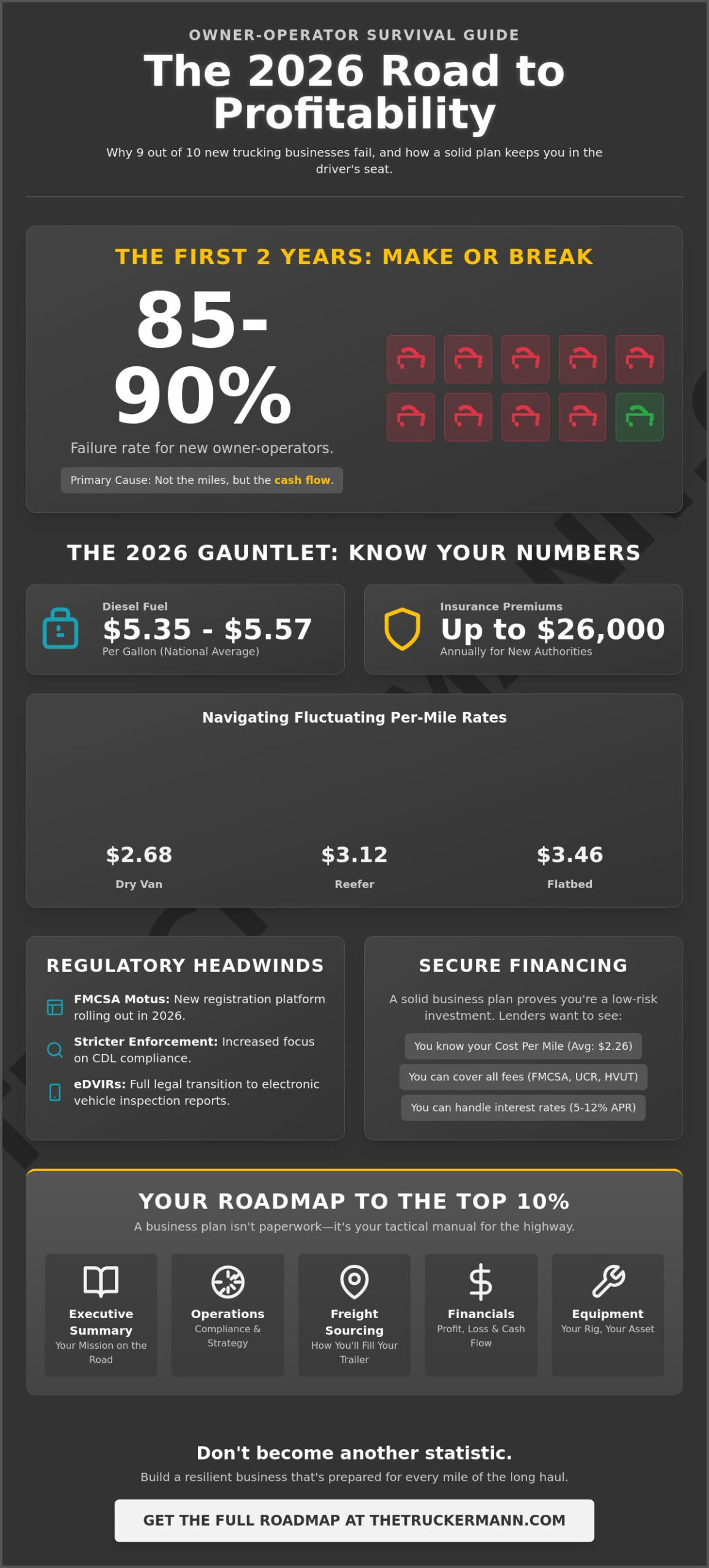
Hey Friend. Did you know that 85% to 90% of new owner-operator businesses fail within their first two years? Most of the time, it isn’t because the driver couldn’t handle the miles; it’s because they didn’t have a solid owner operator trucking business plan to navigate the cash-flow desert. You’re out there watching the miles roll, but with diesel averaging $5.35 a gallon and insurance premiums for new authorities hitting as high as $26,000, grit alone won’t keep your lights on. You know the road is getting tighter with the FMCSA’s new Motus registration system and stricter enforcement on CDL compliance.
I understand the pressure of keeping that rig moving while rates fluctuate. That’s why I’ve put together a boots-on-the-ground roadmap to build a profitable business that survives market shifts and regulatory blitzes. In this guide, we will break down your exact startup costs, provide a template to secure equipment financing, and show you how to find freight that pays better than the $2.68 per mile national van average. The road runs through us, so let’s make sure you’re prepared for every mile of the long haul.
Key Takeaways
- Master the core components of an owner operator trucking business plan to build a resilient operation that anticipates market shifts and 2026 regulatory blitzes.
- Compare the real financial impact of running your own authority versus leasing on, including a deep dive into hidden costs like percentage takes and forced dispatch.
- Calculate your true break-even point by identifying every startup expense and establishing a “Survival Reserve” to protect your cash flow during the first 90 days.
- Shift from the office to the cab with a boots-on-the-ground execution strategy that ensures you remain the most prepared driver on the lot.
Why Every Owner-Operator Needs a Business Plan in 2026
Hey Friend, driving is the easy part; running the business is where most guys wash out. You can back a 53-foot trailer into a tight dock in a blizzard, but if you can’t manage your cash flow, you’ll be out of a job before the season turns. An owner operator trucking business plan isn’t just some boring paperwork for a bank manager. It’s a living document that helps you anticipate the 2026 freight cycles and protects your livelihood when the market gets volatile. In an industry where 85% to 90% of new carriers fail within 24 months, having a strategy is the only way to stay in the 10% that actually makes money.
To better understand the financial side of starting out, watch this helpful video:
Think of your plan as a buffer against sudden DOT regulatory shifts. With the FMCSA rolling out the Motus registration platform in 2026 and tightening enforcement on non-domiciled CDLs, you need a roadmap that accounts for compliance costs before they hit your bank account. There’s a massive difference between having a “driving job” and running a trucking business. A business owner knows their numbers, anticipates the next roadside inspection blitz, and treats every mile like a line item on a profit and loss statement.
The 2026 Freight Market Reality Check
The grit is real this year. National average diesel prices are hovering between $5.35 and $5.57 per gallon, meaning your fuel surcharge better be accurate. While flatbed spot rates are showing strength at $3.46 per mile, van rates are tighter at $2.68. Watching the miles roll isn’t enough when your insurance for a new authority can cost up to $26,000 annually. Success in 2026 requires more agility than ever because technology shifts, like the full legal transition to eDVIRs, mean you have to be tech-savvy to stay compliant and profitable.
Securing Financing in a Tight Credit Environment
Banks in 2026 are skeptical. They’re looking for more than just a clean MVR; they want to see that you understand your Cost Per Mile (CPM). Since the average cost to operate a truck was $2.26 per mile in 2024, lenders want proof that you can handle interest rates ranging from 5% to 12% APR. A professional owner operator trucking business plan proves you’re a low-risk investment. When you can show a lender exactly how you’ll cover your $300 FMCSA filing fee, your UCR fees, and your Heavy Vehicle Use Tax while still netting a profit, you’re in a much stronger position to negotiate better rates on equipment leases.
The Core Components of Your Trucking Business Plan Template
Your business plan shouldn’t look like a corporate textbook. The Truckermann knows you don’t have time for fluff, so we’re stripping this down to a lean, 5-section tactical manual. This document serves two masters: the banker who holds your equipment note and the mirror you look into every morning. It needs to be transparent, honest, and grounded in the grit of the highway. While most templates focus on fancy marketing goals, a real owner operator trucking business plan prioritizes the gears that keep the wheels turning.
I recommend structuring your plan into these five pillars: Executive Summary, Operations, Freight Sourcing, Financials, and Equipment. We’re moving away from “marketing” because, let’s be honest, you aren’t running ad campaigns. You’re building a freight sourcing strategy. Whether you’re chasing the $3.46 per mile flatbed rates or securing steady contract freight, your plan must detail how you’ll keep your trailer full. If you’re looking for more ways to professionalize your setup, check out the latest tools and things for your rig.
Executive Summary: Your Mission on the Road
This is your elevator pitch. In a single sentence, define your niche. For example: “I operate a solo flatbed service specializing in over-dimensional machinery across the Southeast.” Clearly state your “why.” Are you chasing high revenue in the reefer market, which sat at $3.12 per mile in April 2026, or are you prioritizing home time with dedicated regional dry van runs? Keep it punchy. Banks and brokers should understand your value and your area of operation in 30 seconds or less.
Operations and Compliance Strategy
Operations is the heart of your document. If you can’t stay compliant, you can’t stay on the road. Detail your plan for maintaining a clean CDL pre trip inspection checklist to ensure you’re always ready for a surprise roadside inspection. With the FMCSA focusing heavily on English proficiency and CDL validity in 2026, your plan should outline how you’ll stay ahead of these regulatory blitzes.
Include your specific strategy for DOT Level 1 readiness. List your ELD provider and your schedule for preventative maintenance. Don’t just say you’ll fix things when they break. Specify your maintenance intervals to prove to lenders that you won’t let a $500 part turn into a $10,000 tow bill. The road runs through us, and that means being the most prepared professional at the scale house.
Deciding Your Operating Model: Own Authority vs. Leasing On
Hey Friend, let’s talk straight. The number one objection I hear from drivers looking to make the jump is that the paperwork for their own authority will bury them. It’s a valid concern. The DOT doesn’t make things easy, and the FMCSA’s move toward the Motus platform in 2026 adds another layer of digital red tape. However, your owner operator trucking business plan should reflect your actual capacity for administration. If you hate spreadsheets and compliance more than you love freedom, leasing on might be your lane. But if you want to keep every cent of your revenue, you need to understand the trade-offs.
Leasing on often hides costs that don’t show up on a settlement sheet. You might get a fuel card, but you’re often paying back a percentage of your gross, sometimes 25% or more, just for the privilege of using their MC number. You also have to decide early on if you’re chasing freight across the country or staying local. Understanding the nuances of interstate vs intrastate trucking is a critical first step in your plan because it dictates your insurance requirements and filing fees.
Running Under Your Own Authority
The Truckermann sees this as the path to total freedom, but it comes with total responsibility. When you run your own numbers, you are the sentinel for your own safety record. You’ll need to cover the $300 non-refundable FMCSA filing fee for your operating authority and stay current on 2026 UCR fees, which are $46 for fleets of two vehicles or fewer. You’ll also be responsible for the Heavy Vehicle Use Tax, which caps at $550 for those 75,000 lb rigs. The hustle is real here. You aren’t just driving; you’re working load boards and building direct shipper relationships to beat the national spot averages.
The Leased-On Owner-Operator Path
This is often the “training wheels” phase for new entrepreneurs. It’s a solid way to learn the business side without the $26,000 annual insurance premium for a new authority. You get access to company fuel discounts and pre-negotiated rates that a solo guy can’t get on his own. The downside is clear. You’re still behind that wheel for someone else’s brand. You might face forced dispatch or limited freight choices, meaning you’re trading a significant chunk of your profit for a lighter administrative load. Decide based on your risk tolerance. If you want to master the road before you master the back office, leasing on is a respectable start.
Calculating Your Trucking Startup Costs and Break-Even Point
Hey Friend, math is the silent partner sitting in your passenger seat. If the numbers don’t add up on your owner operator trucking business plan, they certainly won’t add up when you’re staring at a $1,200 fuel bill at a lonely truck stop. Startup costs for a new operation typically range from $50,000 to $75,000. This includes your truck down payment, a 20% to 33% upfront insurance deposit, and your initial permits. You’ve got to be cold-blooded about these figures. Every dollar you spend before your first load is a weight on your back, so track everything from that $300 FMCSA filing fee to the $46 UCR registration.
Cash flow is the biggest killer of new carriers. It often takes 30 to 45 days to receive payment for your first load, but your expenses like fuel and insurance are immediate. The Truckermann recommends a “Survival Reserve” of three to six months of operating cash before you even think about hitting the road. This isn’t just a safety net; it’s the capital that allows you to wait for high-paying freight instead of taking cheap loads out of desperation. If you’re feeling overwhelmed by the math, head over to The Truckermann for more financial survival tips.
Fixed vs. Variable Costs: The Driver’s Perspective
Your fixed costs are the ones that hit your bank account even if the wheels don’t turn. This includes truck payments, insurance premiums, and annual permits. Variable costs scale with your mileage, such as fuel, tires, and maintenance. You also need to budget for the best flatbed trucking gear so you aren’t forced to pay retail prices for chains and straps at a travel center. Always account for “deadhead” miles in your projections. If you drive 150 miles empty to pick up a load paying $3.46 per mile, your actual revenue per mile drops significantly. Use the break-even formula: Fixed Costs divided by (Rate Per Mile minus Variable Costs) to see exactly how many miles you need to roll each month to stay in the black.
2026 Insurance and Tax Realities
Commercial auto liability premiums are surging in 2026, with new authorities often facing annual costs between $12,000 and $26,000. Then there’s the IFTA quarterly headache. The International Fuel Tax Agreement requires precise record-keeping, so automate this through your ELD to avoid the nightmare of manual receipt counting. Don’t forget the Heavy Highway Vehicle Use Tax (Form 2290). This tax caps at $550 for vehicles over 75,000 lbs and is a non-negotiable requirement for staying legal. The road runs through us, and that means staying on top of the IRS and DOT before they come looking for you.
Turning the Plan Into Miles: Execution and Gear Prep
Once the ink is dry on your owner operator trucking business plan, the real work starts in the cab. The first 90 days are a gauntlet that will test every projection you made. Transitioning from the office to the highway means shifting your focus from spreadsheets to the physical reality of the road. The Road Runs Through Us is not just a slogan; it’s a badge of identity that requires you to be the most prepared professional on the lot. A rigorous pre-trip mindset is your primary risk-mitigation strategy. When you treat every inspection like a business audit, you protect your profit from $1,000 roadside repairs and the downtime that kills new carriers.
Success behind the wheel is tied directly to your physical readiness and the quality of your equipment. You can’t run a million-dollar business if you’re neglecting the very tools that generate revenue. Professionalism starts with your gear. If you look like a pro and act like a pro, brokers and shippers will treat you like one. This execution phase is where your paper strategy meets the pavement, and your ability to adapt to 2026 market volatility will define your longevity in this industry.
The Gear That Protects Your Profit
Skimping on securement gear is a fast track to cargo claims and a tarnished authority. High-quality chains, straps, and safety vests are the essential tools of our trade. In 2026, cargo claims can exceed $100,000 for specialized loads, and a single failed strap can lead to a lost contract. Investing in a robust toolkit reduces your anxiety during a Roadside Inspection Blitz. When a DOT officer sees well-maintained, professional-grade securement, it signals that you’re a safe operator. This often leads to shorter inspection times and fewer violations, keeping your CSA score clean and your insurance premiums manageable.
Building Your Roadside Support Network
You need to identify reliable shops and mobile mechanics along your frequent routes before you actually break down. Searching for a mechanic while you’re stranded on the shoulder is a recipe for getting overcharged. Your owner operator trucking business plan should include a list of vetted service providers who understand the urgency of an independent driver’s schedule. Additionally, consider the value of specialized factoring companies. Since it can take up to 45 days to get paid by some brokers, a good factoring partner provides the immediate cash flow needed to cover $5.35 per gallon diesel and immediate maintenance needs. Hey Friend, a plan is just paper until you put it in gear. Now, let’s get rolling.
Master the Miles Ahead
Hey Friend, the difference between a driver who survives and a business owner who thrives is the willingness to do the homework before the wheels turn. By now, you understand that your owner operator trucking business plan is a living shield against the 85% to 90% failure rate that haunts this industry. We’ve mapped out the 2026 FMCSA Motus registration shifts and the reality of the $2.26 average cost per mile. This isn’t corporate theory; it’s a roadmap built on real road stories and veteran experience to ensure your profitability stays as high as those $3.46 flatbed spot rates.
Success requires the right mindset and the right tools to protect your cargo and your authority. This guide was built to keep you vigilant and prepared for every DOT blitz and market surge that 2026 throws your way. Ready to gear up? Check out the best flatbed trucking equipment for your new business. The road runs through us, so keep your head up and your rig ready. I’ll see you out there on the high side.
Frequently Asked Questions
How much does it cost to start a trucking business in 2026?
It typically costs between $50,000 and $75,000 to get your operation off the ground in 2026. This total includes your truck down payment, the $300 FMCSA filing fee, and initial insurance deposits that often range from $3,000 to $7,000. You must also account for your $46 UCR registration and the Heavy Vehicle Use Tax before you ever pick up your first load.
Do I really need a business plan if I’m just a one-truck operation?
Yes, an owner operator trucking business plan is essential because it serves as your survival roadmap in a market where 90% of new carriers fail. Even for a solo operation, you need to track your $2.26 per mile operating cost to ensure you aren’t losing money while you’re behind that wheel. It’s the only way to separate your personal pockets from your business revenue.
What is the most profitable type of freight for owner-operators right now?
Flatbed freight is currently the most profitable niche, with national spot rates averaging $3.46 per mile as of April 2026. Reefer loads follow at $3.12, while dry van rates remain the tightest at $2.68 per mile. While flatbed pays more, remember that it requires specialized securement gear and more physical labor during the loading and tarping process.
Can I get a truck loan with a new authority and a business plan?
You can secure equipment financing with a new authority, but lenders will scrutinize your plan to see if you truly understand your cost per mile. Expect interest rates to range from 5% to 12% APR depending on your credit profile and the age of the equipment. A professional plan proves to the bank that you have the 45 days of cash reserves needed to survive until your first invoices are paid.
How do I calculate my cost per mile (CPM) accurately?
Calculate your CPM by adding your total fixed costs to your variable costs and dividing that sum by your total miles driven, including deadhead. If your fixed costs are $4,000 a month and your variable costs are $1.50 per mile, you must know exactly how many miles you need to roll to stay profitable. Most successful operators found their average cost per mile was around $2.26 in 2024.
What are the biggest mistakes new owner-operators make in their first year?
The biggest mistake is underestimating the cash flow desert and failing to keep a three to six month survival reserve. Many drivers also ignore their deadhead mileage or fail to account for the 3% rise in annual insurance costs. Without a solid owner operator trucking business plan, it is easy to mistake a large settlement check for actual profit before the $5.35 per gallon fuel bills hit.
Is it better to buy or lease a truck in 2026?
Buying is generally better for long term profitability because truck and trailer payments surged 8.3% recently, making lease purchase programs riskier than ever. When you own the equipment, you have the freedom to choose your freight without being tied to a specific carrier’s forced dispatch. If you have the $50,000 for a down payment and reserves, owning your rig outright protects your margins when rates soften.
How does a business plan help with DOT compliance?
A business plan helps by formalizing your maintenance and inspection schedules, which keeps your CSA score clean and your insurance premiums lower. It forces you to budget for the new Motus registration platform and ensures you are ready for the FMCSA focus on non domiciled CDL validity. By treating compliance as a line item in your plan, you avoid the $10,000 fines that wash out unprepared drivers during a roadside inspection blitz.
Disclaimer
The information provided on The TruckerMann is for general informational and educational purposes only. While every effort is made to ensure the accuracy and reliability of the content, trucking laws, FMCSA regulations, DOT requirements, safety standards, and industry policies can change at any time. Readers are encouraged to verify all information with official government agencies, professional advisors, or qualified industry professionals before making business, legal, financial, safety, or compliance-related decisions.
The content shared on this website reflects personal opinions, experiences, research, and commentary and should not be considered legal, financial, medical, tax, or professional advice. The TruckerMann and its owners, contributors, affiliates, or representatives are not responsible for any losses, damages, violations, penalties, or liabilities resulting from the use or misuse of information found on this website.
Some content on this website may contain affiliate links, sponsored content, or promotional material. This means we may earn a commission at no additional cost to you if you choose to purchase through certain links.
By using this website, you agree that you do so at your own discretion and risk.