Hey Friend. Did you know that 72% of Out-of-Service orders in 2026 stem from preventable issues that you could have caught during a standard pre-trip walkaround? It is a staggering number, especially when you consider that a single Hours-of-Service violation can now cost a motor carrier up to $19,246. I know the anxiety that kicks in when those blue lights appear in the mirror, but your roadside inspection prep should not be a frantic 10 minute scramble. It is a daily discipline of “Cab Command” that starts long before you ever turn the key in the ignition.
The Truckermann understands that your time is your money, and sitting on the shoulder for hours while an inspector picks apart your ELD logs is the last thing you need. We agree that the constant shift in FMCSA regulations and the new “Vehicle Maintenance: Driver Observed” violation category feel like a target on your back. That is why we are going to master the technical checklists and digital protocols that ensure you pass every time. In this guide, we will preview the upcoming International Roadcheck focus on ELD tampering, break down the 2026 penalty structures, and give you the exact habits needed for a clean report. Because out here, the road runs through us, and we stay moving by staying prepared.
Key Takeaways
- Learn why treating a DOT stop as a proactive safety audit instead of a penalty phase protects your CSA score and keeps your carrier ranking high.
- Achieve “Zero-Friction” compliance by mastering your ELD audit mode and having digital paperwork ready before the officer even approaches your window.
- Identify the “Low-Hanging Fruit” like lighting and tires that trigger stops, while securing the brake and steering components that lead to immediate Out-of-Service orders.
- Discover how professional courtesy and a clean cab environment set the tone for a faster, smoother inspection process from the moment you pull over.
- Build a bulletproof routine of daily roadside inspection prep through diligent pre-trip and post-trip inspections that catch defects before they turn into costly violations.
The 2026 Roadside Inspection Landscape: What’s at Stake?
Think of a DOT stop as a professional safety audit rather than a roadside interrogation. While it feels like a disruption to your clock, a clean inspection is a badge of honor that directly boosts your CSA score and keeps your carrier in the green. In the high-stakes environment of 2026, the FMCSA has shifted toward data-driven enforcement, making your knowledge of U.S. vehicle inspection programs more critical than ever. When you approach a scale house or see the lights flash, your roadside inspection prep determines whether you’re back on the asphalt in twenty minutes or parked for the weekend.
To see exactly how a pro handles the technical side of a walkaround, watch this breakdown of a standard semi inspection:
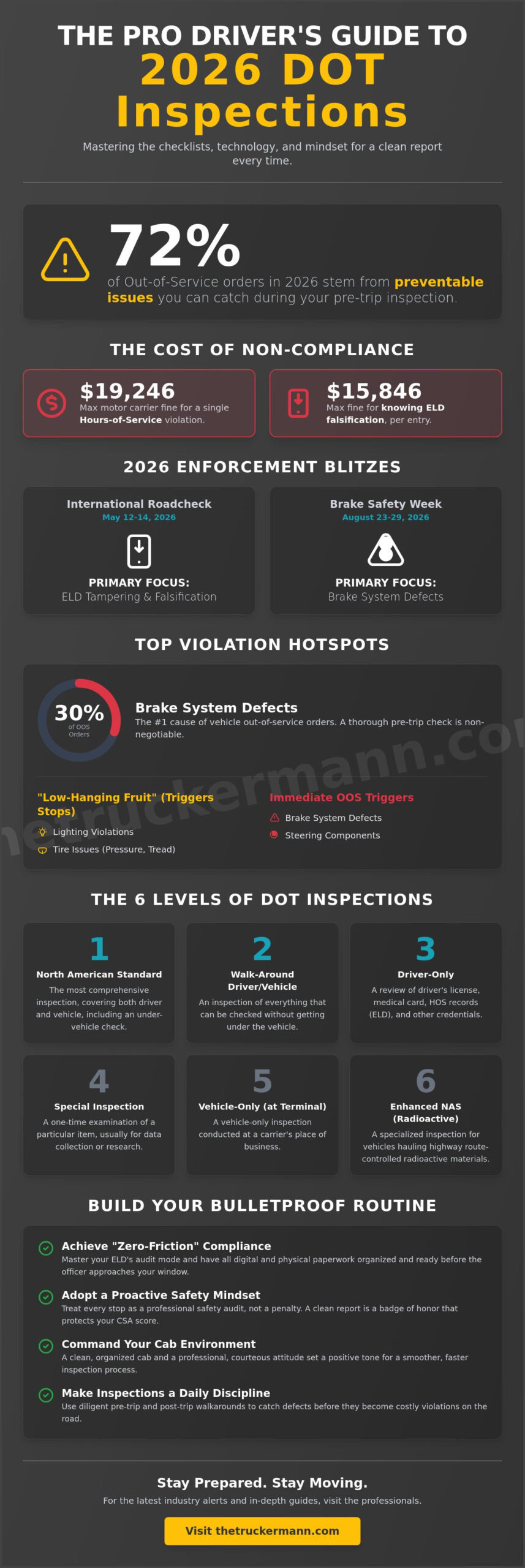
For 2026, the CVSA has set its sights on specific targets. The International Roadcheck, scheduled for May 12-14, 2026, will place a heavy emphasis on ELD tampering and falsification. With fines for knowing falsification reaching up to $15,846 per entry, the stakes have never been higher for those behind the wheel. These blitzes aren’t just about collecting revenue; they are about maintaining a level playing field where every professional driver operates safely. Brake system defects still account for 30% of vehicle out-of-service orders, which is why Brake Safety Week from August 23-29, 2026, remains a critical date on your calendar. Proper roadside inspection prep isn’t just about passing a test, it’s about ensuring every driver makes it home to their family. Before you hit the road this season, it pays to separate fact from fiction by reviewing the most common truck inspections DOT myths that could be costing you a clean report.
Understanding the 6 Levels of DOT Inspections
Not every stop is created equal. You’ll most likely face a Level 1 North American Standard Inspection, which is a full deep dive into both the driver and the machine. Level 2 is a walk-around vehicle inspection where the officer won’t get under the rig, while Level 3 focuses strictly on your credentials and logs. Specialized stops like Level 4 (one-time study), Level 5 (terminal-based), and Level 6 (radioactive materials) are less common but require the same level of readiness from a seasoned veteran.
Why Your Driver-Vehicle Examination Report (DVER) Matters
Your DVER is essentially your report card. If an officer finds a defect, it’s recorded here with a specific violation code that impacts your carrier’s Safety Measurement System ranking. You must deliver this report to your carrier within 24 hours of the inspection. Understanding these codes is vital because a “Vehicle Maintenance: Driver Observed” violation means the inspector believes you should’ve caught the issue during your pre-trip. To fully understand how this document follows your CDL and affects your long-term record, it’s worth reading our complete breakdown of the driver vehicle examination report and what every line means for your 2026 compliance. Don’t let a preventable $2,364 fine for violating an out-of-service order be the reason your season goes off the rails.
Mastering the Digital and Physical Paperwork
When an officer approaches your cab, the first thirty seconds set the tone for the entire encounter. If you are digging through a cluttered glove box or struggling to find your login, you are already signaling that your operation might be disorganized. Your goal is “Zero-Friction” compliance. This means having every document ready before the inspector even asks for it. In 2026, your roadside inspection prep must prioritize digital readiness because the ELD is the very first thing an officer will scrutinize. With motor carrier fines for HOS violations reaching up to $19,246, there is no room for technical glitches or missing paperwork.
Your permit book should be a well-oiled machine. It is not just a place to stuff receipts; it is your legal shield. An organized folder allows for rapid retrieval, which keeps the inspector moving through their checklist quickly. If you want to stay ahead of the curve, consider checking out more of the latest industry alerts at The Truckermann to keep your “Cab Command” sharp.
ELD Compliance: Pixels and Transfer Protocols
In 2026, simply having an ELD is not enough. You must be an expert at the roadside audit mode. Inspectors now expect you to execute a data transfer via Web Services or Email within minutes. If you fumble this, you’re inviting a deeper dive into your logs. You must also carry the ELD instruction card and a supply of blank paper logs. Missing that single instruction card is a common, avoidable violation that flags you for further scrutiny. Before you hit the scale, always clear your “Unidentified Driving Time.” If an inspector sees unassigned miles, they’ll assume you’re trying to hide hours, which can lead to a $15,846 penalty for willful falsification.
The In-Cab “Ready Folder” Checklist
Beyond the screen, your physical folder must be current and complete. Every driver should have a “Ready Folder” within arm’s reach containing:
- Current vehicle registration and IFTA credentials.
- Proof of insurance and any necessary hazardous materials permits.
- A valid DOT Medical Card and your CDL.
Depending on whether you are crossing state lines or staying local, your permit requirements will vary. You can find a detailed breakdown of these differences in our interstate vs intrastate guide. Keeping these documents updated is especially vital during high-enforcement periods like the CVSA International Roadcheck, where inspectors are looking for any reason to issue a citation. Verify that your medical certificate is linked to your CDL in the state system, as a “not-certified” status will result in an immediate out-of-service order and a $2,364 fine.
Mechanical Mastery: Targeting the Top 10 Violations
Hey Friend. If the paperwork is your shield, the mechanical state of your rig is your fortress. You can have the cleanest logs in the country, but if a brake light is out or a tire is balding, you are giving an officer a formal invitation to dig deeper. Roadside inspection prep on the mechanical side is about eliminating the “Low-Hanging Fruit” that triggers a stop in the first place. Statistics from the CVSA show that brake system defects account for roughly 30% of all vehicle out-of-service orders. That is a massive chunk of potential downtime that you can avoid with a simple, disciplined walk-around before you ever put the truck in gear.
Inspectors also look for the “Clean Air” check. If they smell exhaust in the cab or see soot streaks on the stack, they will flag you for an exhaust leak. These are the small, sensory details that separate the pros from the rookies. According to CVSA’s official inspection levels, even a Level 2 walk-around will catch these obvious defects. Don’t let a simple missing mudflap or a cracked mirror be the reason your day goes off the rails. The Truckermann knows that a rig that looks sharp usually runs sharp, and inspectors feel that same vibe when you roll onto the scale.
Lighting and Tires: The Visible Violations
Your lights are the first thing an inspector sees, often from a mile away. You must make the “Walk-Around” a ritual every time you stop for coffee or fuel. Check every bulb. One flickering marker light can turn a routine scale bypass into a two-hour ordeal. Tires are the next target. You need 4/32 inch of tread depth on your steer tires and 2/32 inch on your drives and trailers. Look for sidewall integrity too. Any bulge, cut, or exposed cord is an automatic OOS order. During the 2025 CVSA International Roadcheck, 18.1% of trucks were placed out of service, and tire issues were a leading cause of those failures.
Brakes and Securement Essentials
Brakes are the ultimate OOS killers. You should perform an applied pressure test daily to listen for air leaks. If you lose more than 3 psi in one minute on a single unit, or 4 psi for a combination, you have a problem that an inspector will find. For my brothers and sisters pulling flatbeds, cargo securement is where the real scrutiny happens. Inspectors will look for frayed straps, nicked chains, or loose binders. Using the best flatbed trucking gear ensures your load stays put and your inspection report stays clean. Remember, a driver who violates an OOS order faces a penalty of up to $2,364, so it is always cheaper to fix the strap before you hit the highway.
The Driver Factor: Attitude and Cab Command
Hey Friend. While the wrenches and the ELD pixels are critical, the person sitting in the driver’s seat often dictates the rhythm and outcome of a DOT stop. You are the captain of your vessel, and your roadside inspection prep is not complete until you have mastered the psychological side of the encounter. When an officer walks up to your door, they are looking for clues about your professional competence. If you look like a pro and act like a pro, the inspector is more likely to treat the stop as a routine check rather than a hunt for violations.
Think of your cab as your office. If an inspector sees a dash cluttered with loose papers, old receipts, and trash, they immediately wonder if your maintenance logs are just as messy. This is where the “Cab Command” philosophy comes into play. By keeping your workspace organized, you signal that you are a disciplined operator who takes safety seriously. Professionalism is a tool you can use to protect your CDL and your carrier’s reputation. Join our community at The Truckermann to stay updated on how seasoned veterans manage the mental game of the road.
The “Clean Cab” Strategy
Your cockpit should be reset every single morning as part of your pre-trip routine. Clear the dashboard of anything that could be considered a “distraction” or a safety hazard. This includes loose electronics, food wrappers, and piles of mail. Ensure your ELD is mounted securely in a bracket as required by 2026 standards; having a tablet sliding around on the passenger seat is a quick way to earn a “Vehicle Maintenance: Driver Observed” violation. A tidy interior suggests that the hidden parts of the truck, like the brake chambers and steering linkages, are likely well-maintained too. Inspectors are human, and they are far less likely to crawl under a truck if the driver clearly takes pride in their equipment.
Professional Conduct During the Stop
When the lights flash, your conduct starts with the pull-over. Signal early, find a level and safe spot, and position the rig to give the officer plenty of room to walk. Once stopped, follow the “Hands on Wheel” rule. Keep your hands at ten and two on the steering wheel until the officer arrives at the window. This simple gesture signals that you prioritize their safety, which immediately lowers the tension of the stop. Use the “Yes, Sir / No, Ma’am” protocol. It is not about being subservient; it is about using professional courtesy as a strategic tool. Answer questions clearly and honestly, but do not volunteer unnecessary information that could open a new line of questioning. Remember, a driver can be fined up to $4,812 for HOS violations in 2026, so let your organized paperwork do the heavy lifting while you remain the calm, professional face of the industry.
Building a Culture of Daily Readiness
Hey Friend. We have covered the paperwork, the mechanical “OOS killers,” and the psychological edge of a professional attitude. Now it is time to talk about the glue that holds it all together: your daily culture. Roadside inspection prep is not a reaction to a flashing light; it is the steady rhythm of a professional who knows that the best way to handle a DOT officer is to never give them a reason to pull out the creeper in the first place. When you make readiness a habit, the high-stakes pressure of a 72-hour blitz becomes just another Tuesday on the job.
The 2026 FMCSA Safety Measurement System (SMS) overhaul introduced the “Vehicle Maintenance: Driver Observed” violation category for a reason. They are looking for defects that you should have reasonably caught during a walk-around. If an inspector finds a flat tire or a cracked mirror that has been there for three days, they aren’t just citing the truck; they are flagging your lack of diligence. By catching these issues in the yard, you save yourself from the average $16,000 cost associated with a CSA violation and the potential $4,812 fine for HOS negligence. Many drivers also fall victim to widespread misconceptions about how enforcement actually works, so it is worth understanding the real facts behind truck inspections DOT enforcement and the myths that trip up even experienced operators.
The Non-Negotiable Pre-Trip Routine
Your best defense is a thorough, unhurried start to your day. We advocate for the “15-Minute Rule.” Rushing your pre-trip to gain a few extra miles often leads to missing the small defects that trigger a full Level 1 inspection. If you want the full breakdown of every nut and bolt you need to inspect, check out our CDL pre trip inspection checklist. Always document your findings in your Driver-Vehicle Inspection Report (DVIR). This creates a legal paper trail showing you are proactive about maintenance, which can be a lifesaver if an inspector questions your commitment to safety.
Investing in Your Compliance Gear
A seasoned veteran does not guess; they measure. Investing in high-quality tools like a calibrated tire pressure gauge and a tread depth tool pays for itself the first time you avoid an out-of-service order. Keep a side-box stocked with spare bulbs, fuses, and even a few extra glad-hand seals for on-the-spot fixes. If an inspector points out a light that just went out, being able to swap it on the spot can sometimes turn a violation into a “warning” or a clean pass. Stay vigilant, keep the shiny side up, and remember that excellence is not an act, it is our identity. Because out here, the road runs through us.
Take Command of Your Compliance and Your Career
Passing a DOT stop in 2026 is not about luck; it is about the discipline you show every morning before the sun even hits the horizon. By mastering your ELD transfer protocols and maintaining a clean cockpit, you transform a high-stakes event into a routine professional handshake. We have explored how the vast majority of out-of-service orders come from preventable mechanical issues and how a professional attitude can significantly shorten your time on the shoulder. This guide provides practical, real-world advice based on current 2026 FMCSA standards to ensure your record stays as clean as your rig.
Your roadside inspection prep is a daily commitment to the brotherhood of the road. When you treat every pre-trip like a final exam, the actual inspection becomes a simple formality. Hey Friend, don’t get caught off guard; check out our top-rated securement gear to keep your load legal and your record clean. This advice comes straight from those who have spent years behind the wheel, ensuring you have the tools to succeed. Stay vigilant, stay safe, and keep that shiny side up. Because out here, the road runs through us.
Frequently Asked Questions
What is the most common violation during a roadside inspection?
Brake system defects are the most frequent violations found during stops, accounting for roughly 30% of all vehicle out-of-service orders. This is followed closely by lighting issues and tire defects. Keeping up with your roadside inspection prep by catching these visible problems during a pre-trip can save you from becoming part of that statistic and facing costly downtime.
Can I refuse a roadside inspection if I am on a tight delivery schedule?
No, you cannot refuse a roadside inspection regardless of your delivery deadline. Refusing to cooperate with a DOT officer is a major violation that will result in an immediate out-of-service order and potential civil penalties. It’s always better to remain professional and provide the requested documentation to get back on the asphalt as quickly as possible without adding extra fines to your day.
How long does a Level 1 DOT inspection typically take?
A Level 1 North American Standard Inspection typically takes between 45 and 60 minutes to complete. This is a comprehensive deep dive that covers both the driver’s credentials and the entire vehicle’s mechanical condition. Level 2 walk-arounds usually take about 30 minutes, while a Level 3 driver-only check can be finished in about 15 minutes if your paperwork is organized and ready.
What happens if I am placed Out-of-Service (OOS)?
If you are placed out-of-service, you are legally prohibited from operating the vehicle until the specified violations are corrected. Violating an OOS order is a serious offense that carries a penalty of up to $2,364 for the driver in 2026. You will need to arrange for on-site repairs or have the vehicle towed to a shop before you can legally return to service and continue your haul.
Does a clean inspection report help my company’s safety rating?
Yes, a clean inspection report significantly improves your company’s CSA score and overall safety ranking. These “clean” inspections act as positive data points that offset previous violations in the FMCSA Safety Measurement System. Maintaining a history of no violations helps your carrier secure better insurance rates and more lucrative freight contracts, proving that the road runs through prepared professionals who value safety.
What documents must I have in the cab for a 2026 inspection?
You must have your CDL, a valid DOT Medical Card, and current vehicle registration ready for the officer. Additionally, 2026 regulations require you to carry IFTA credentials, proof of insurance, and the specific ELD instruction card for your device. Don’t forget to keep at least eight days of blank paper logs in the cab to avoid a technical violation if your digital system fails during a roadside inspection prep check.
How often can the DOT inspect my truck?
There is no legal limit on how often a DOT officer can inspect your truck. However, inspectors often use data-driven tools to target carriers with high CSA scores or visible defects. If you maintain a clean record and keep your rig looking sharp, you are statistically less likely to be pulled in for frequent inspections compared to an operator with a visible history of non-compliance and poor maintenance.
Can an officer inspect my personal sleeper berth area?
An officer can only enter your sleeper berth to check for specific safety items, such as the presence of a proper exit or required bedding. They are generally not permitted to conduct a full search of your personal belongings without probable cause or a warrant. Keeping this area tidy still helps project a professional image, which can influence the overall tone of the inspection and get you back on the road faster.
Disclaimer
The information provided on The TruckerMann is for general informational and educational purposes only. While every effort is made to ensure the accuracy and reliability of the content, trucking laws, FMCSA regulations, DOT requirements, safety standards, and industry policies can change at any time. Readers are encouraged to verify all information with official government agencies, professional advisors, or qualified industry professionals before making business, legal, financial, safety, or compliance-related decisions.
The content shared on this website reflects personal opinions, experiences, research, and commentary and should not be considered legal, financial, medical, tax, or professional advice. The TruckerMann and its owners, contributors, affiliates, or representatives are not responsible for any losses, damages, violations, penalties, or liabilities resulting from the use or misuse of information found on this website.
Some content on this website may contain affiliate links, sponsored content, or promotional material. This means we may earn a commission at no additional cost to you if you choose to purchase through certain links.
By using this website, you agree that you do so at your own discretion and risk.