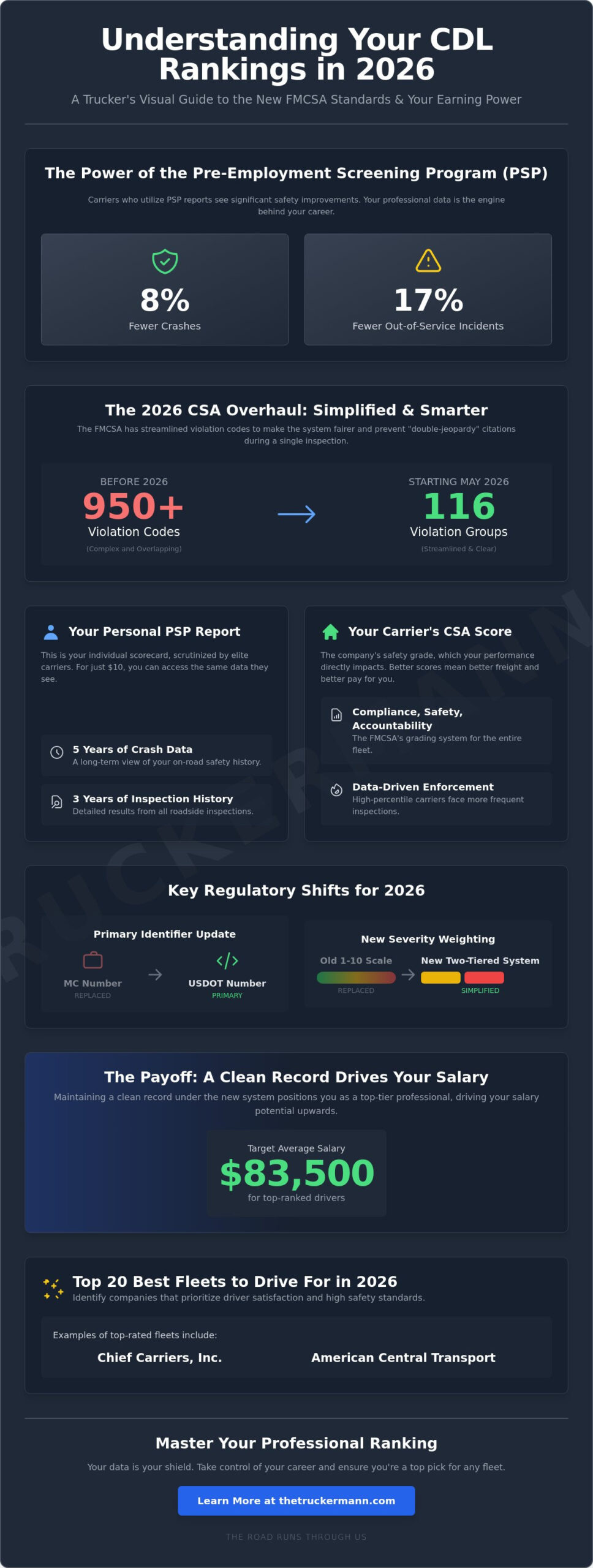
Hey Friend. Did you know that carriers utilizing the Pre-Employment Screening Program see 8% fewer crashes and 17% fewer out-of-service incidents than those who don’t? It’s a staggering number that proves your professional data is more than just a file in a government office; it’s the engine behind your earning power. With the FMCSA recently slashing violation codes from 950 down to just 116 groups, keeping track of cdl rankings has become a whole new ballgame as of May 2026.
I know it feels like the DOT is constantly looking for a reason to pull you over, and the anxiety of a single Level 2 violation hanging over your head is real. You’ve worked hard for that license, and you deserve to know exactly how the industry is grading your performance. This guide will pull back the curtain on the new CSA compliance categories and the $10 PSP reports that determine your worth to a carrier. We will also look at the 2026 Top 20 Best Fleets to Drive For, including names like Chief Carriers, Inc. and American Central Transport, so you can find a home that respects your record. The road runs through us, so let’s make sure your reputation is as solid as the rig you’re driving.
Key Takeaways
- Navigate the 2026 CSA overhaul by understanding how the FMCSA now groups violations into 116 categories to prevent double-jeopardy citations during a single roadside inspection.
- Take control of your earning potential by pulling your own $10 PSP report to verify the five years of crash data and three years of inspection history that elite carriers scrutinize.
- Master the professional cdl rankings that drive your salary toward the $83,500 mark by maintaining a clean record under the new two-tiered severity weighting system.
- Adapt to the 2026 regulatory shift where the USDOT number has officially replaced the MC number as the primary identifier for tracking your professional standing and carrier history.
- Identify the “Top 20 Best Fleets to Drive For” in 2026 to ensure you are hauling for companies that prioritize driver satisfaction and high safety standards.
Defining CDL Rankings: The Professional Pivot for 2026
Hey Friend, let’s clear the air right away. If you spend any time searching the web, you’ve probably noticed that looking for cdl rankings often brings up a storm of esports news and gaming standings. While those guys are fighting for digital trophies, you and I know that the real rankings are happening on the scales and at the roadside inspection points. In the trucking world, these scores are your professional lifeblood. They aren’t just numbers on a screen. They are the safety, compliance, and performance markers assigned to you and your carrier by the FMCSA. This data determines if you’re a top-tier professional or a liability in the eyes of a safety manager.
As we move through 2026, data transparency has reached a fever pitch in the logistics sector. The industry has moved toward a reality where every inspection is logged and every violation is grouped into the new, streamlined compliance categories. If you’re looking for the top-tier real-life opportunities in specialized hauling, your ranking is the first thing a recruiter sees. It’s the difference between pulling high-value freight or being stuck with the leftovers. The road runs through us, and in 2026, that road is paved with data points that define your reputation before you even climb into the cab.
To better understand why the search results for this term are so cluttered with gaming content, watch this helpful video:
The Difference Between Driver Records and Carrier Scores
It’s vital to know that your professional standing is built on two different pillars. First, you have your individual Pre-Employment Screening Program (PSP) report. This is your personal scorecard that follows you from cab to cab, regardless of who you’re hauling for. It contains five years of crash data and three years of roadside inspection results. On the other side, you have the carrier’s CSA scores. These Compliance, Safety, Accountability scores are the FMCSA’s way of grading the company. While you don’t own the carrier’s score, your performance directly feeds into it. A high-ranking carrier attracts better insurance rates and better freight, which ultimately means more money for the driver. Holding a Commercial Driver’s License (CDL) in 2026 means being a data manager as much as it means being a driver.
Why Gaming Results Dominate the Search (and Why You Should Care)
The overlap between the “Call of Duty League” and our industry is a headache for any driver trying to find real info. However, you can’t afford to ignore your professional stats just because the search engines are confused. In this data-driven market, a single violation can drop your ranking and void your chances at a premium seat. A CDL Professional Ranking is the aggregate of your safety compliance and operational history that proves you’re a safe bet for any fleet. The Truckermann knows that the road is unforgiving. Your data should be your shield, not your weakness. Keep your eyes on your cdl rankings to ensure you stay in the top percentile of the workforce.
The CSA Ranking System: How the FMCSA Grades Your Carrier
The Road Runs Through Us, and that road is paved with data points from the FMCSA’s Safety Measurement System (SMS). While your individual performance matters, the company you pull for has its own set of cdl rankings that dictate your daily life behind the wheel. If your carrier has a high percentile in the compliance categories, you’re going to spend a lot more time sitting at the scale house while the DOT goes through your rig with a fine-tooth comb. Data-driven enforcement is the name of the game in 2026, and investigators are looking for patterns across a fleet rather than isolated incidents.
As of the 2026 overhaul, the FMCSA simplified things by consolidating violation codes into 116 groups. They also ditched the old 1-10 severity scale for a much cleaner two-tiered system. Level 1 covers your standard violations; Level 2 is reserved for out-of-service or disqualifying issues. These scores aren’t just for show. When a carrier crosses the intervention threshold, which usually sits between 65% and 90% depending on the category, the FMCSA starts sending warning letters and scheduling audits. It’s a vigilant system designed to target the high-risk players before a crash happens.
The 7 BASICs of Carrier Rankings
The seven categories, formerly known as BASICs and now called compliance categories, are the heart of how the government grades a fleet. Unsafe Driving is often the most visible factor because it’s based on what officers see on the road, like speeding or lane deviations. The Crash Indicator is another heavy hitter. It uses history to predict future risks. Since percentiles are now calculated based on violations within the last 12 months, recent mistakes carry a lot of weight. Finally, the Controlled Substances and Alcohol category remains the ultimate ranking killer. It’s a zero-tolerance zone where a single failure can tank a carrier’s reputation and your own professional standing.
How to Check a Company’s Ranking Before You Sign On
Before you sign that lease or join a new fleet, you need to do your homework. Use the FMCSA Portal to look up a carrier’s USDOT number, which became the primary identifier for all tracking on January 1, 2026. Look for those warning letters. If a company is trending toward the 90% threshold in Vehicle Maintenance, you can bet you’ll be dealing with more roadside inspection headaches. A carrier with solid cdl rankings usually enjoys lower insurance premiums and can afford to pass those savings on to you through safety bonuses. It is also a good idea to check your own PSP Score to see how your personal data aligns with a potential employer’s standards. Top-tier fleets like those on the 2026 Best Fleets to Drive For list are picky about who they hire because they want to protect their scores. If you want to stay ahead of these regulatory shifts and keep your career on the right track, you can get the latest industry alerts from The Truckermann to stay prepared for whatever the DOT throws your way next.
The Personal Ranking: Master Your PSP Score to Boost Pay
Hey Friend, let’s talk about your personal scoreboard. Think of your PSP score as your professional batting average. In the 2026 market, top carriers don’t just look at your experience; they look at your federal record before they even shake your hand. This report is the backbone of your individual cdl rankings. It contains a deep dive into your last five years of crash history and three years of roadside inspection results. If you’re looking to jump into heavy hauling or specialized flatbed work where the pay is higher, a clean PSP is your golden ticket. It proves you’re a safe bet behind that wheel.
Statistics from May 2026 show that carriers using the Pre-Employment Screening Program have seen 8% fewer crashes and 17% fewer out-of-service incidents. Because of this, fleets are willing to pay a premium for drivers who keep their data clean. When you have a stack of clean inspections, you aren’t just another driver; you’re a high-value asset. You can use that “ranking” to negotiate a better cents-per-mile rate or a higher sign-on bonus. Top earners in the 90th percentile are making around $83,500 annually, and they didn’t get there by ignoring their stats. It’s the entrepreneurial way to play the game in a data-driven industry.
The Anatomy of a PSP Report
Your report isn’t just a list of dates. It’s a weighted document. While the FMCSA simplified the severity scale to two levels in early 2026, the impact on your record remains significant. A Level 2 violation for an out-of-service issue is a much heavier anchor than a standard Level 1 citation. Conversely, every time you roll through a scale and get a “clean” inspection with no violations, it acts as a multiplier for your professional value. It proves to the DOT and your employer that you’re vigilant. You can request your own report for a $10 fee through the official FMCSA portal to see exactly what recruiters are seeing during the hiring process.
Improving Your Driver Ranking After a Violation
We all have bad days on the road. If a violation hits your record, don’t panic, but do get proactive. Most inspection data stays on your PSP for three years, while crashes linger for five. The best way to stop the bleeding is to prevent the next hit. Using a detailed CDL pre-trip inspection checklist is the most effective way to catch maintenance issues before the DOT does. If you find an error on your report, use the DataQ system to challenge it. The Truckermann has seen many drivers successfully void incorrect data by being persistent and providing proper documentation. Keeping your cdl rankings high requires constant maintenance, just like your rig. The road runs through us, and keeping your record clean is how you stay in the fast lane to better pay.
2026 Carrier Rankings: The Best Companies to Drive For
Hey Friend, we’ve talked about how the DOT grades you, but now it’s time to grade the companies. In the 2026 market, cdl rankings for carriers have shifted toward a “Driver-First” mentality. It’s no longer just about who has the most trucks on the interstate. It’s about who offers the best work environment and the lowest out-of-service (OOS) rates. Large players like J.B. Hunt continue to lead in capacity, but their safety trends are constantly under the microscope of data-driven enforcement. Whether you’re looking at a mega-carrier or a regional outfit, understanding how interstate vs. intrastate status changes their regulatory oversight is a key step in choosing your path. The Road Runs Through Us, and choosing the right partner is how you keep your own record clean.
The Truckermann has observed that the most successful drivers in 2026 are those who vet their employers as strictly as the FMCSA vets a driver’s PSP. High-ranking carriers don’t just happen by accident. They are built on a foundation of rigorous maintenance and a culture that values the person behind the wheel. As capacity rates fluctuate, these top-tier companies maintain their standing by keeping their trucks out of the “red zone” of the compliance categories. This vigilance protects their insurance rates and, more importantly, your livelihood.
Top 5 Carriers by Safety Ranking (2026 Data)
The 2026 list of the Top 20 Best Fleets to Drive For, released by CarriersEdge, proves that safety and driver satisfaction go hand-in-hand. Companies like American Central Transport and Chief Carriers, Inc. consistently outrank the competition by maintaining rigorous maintenance standards. Mega-carriers often struggle with their “rank” because managing thousands of drivers makes it harder to keep OOS rates low across the board. Below is a look at how some of the 2026 leaders compare in terms of their professional standing and estimated pay scales.
| Carrier Name | Safety Ranking (2026) | Avg. Annual Pay (Est.) |
|---|---|---|
| Chief Carriers, Inc. | Top 20 Best Fleet | $68,500 |
| American Central Transport | Top 20 Best Fleet | $66,000 |
| J.B. Hunt | High-Capacity Leader | $56,348 |
Niche Rankings: Best Flatbed and Specialized Carriers
If you want the top dollar, you look toward the specialized cdl rankings. Flatbed and tanker fleets often offer higher pay because the job requires more technical skill and tighter securement standards. This is where your investment in the best flatbed trucking gear pays off. Regional carriers often dominate these niche lists, providing a “High-Rank” experience that many drivers miss because they only look at the national names. You can check the full list of 2026 high-paying carriers here to find your next career move and ensure you’re hauling for the best in the business.
Mastering Your Professional Ranking with The Truckermann
Hey Friend. We’ve walked through the data, the carrier scores, and the $10 PSP reports that define your worth in this industry. Now, let’s talk about the mindset of a winner. In the trucking world of 2026, you have to treat every roadside inspection like a championship match. The DOT isn’t just looking for a reason to write a ticket; they’re looking to see if you’re a professional who takes pride in your rig. A seasoned veteran knows that a clean record isn’t just luck. It’s the result of being vigilant and prepared every single morning before those wheels even turn. Your reputation is your most valuable asset, and it’s built one mile at a time.
The Truckermann has seen it all. I’ve watched drivers with twenty years of experience lose their “rank” because they got complacent with their paperwork or their gear. In a data-driven market, you can’t afford to be a “good enough” driver. You have to be an elite operator. This means understanding that the FMCSA’s move to the USDOT number as the primary identifier on January 1, 2026, was a signal for more transparency. Every move you make is being watched by the algorithms. If you want to stay in the top 1% of earners, you have to master the cdl rankings by being more prepared than the guy in the next lane.
Tools for the High-Ranked Driver
Your gear is your first line of defense against a tanking score. If you roll into a scale with frayed straps or a leaking air line, you’re asking for an out-of-service order that will haunt your cdl rankings for years. Investing in high-quality logistics gear is the smartest move an entrepreneurial driver can make. When you use top-tier securement equipment, you’re telling the inspector you don’t cut corners. This level of professionalism is what keeps your vehicle maintenance score in the green. It’s how you secure those premium seats in fleets that pay the top 90th-percentile salaries of $83,500. Education and gear aren’t expenses; they are the path to the top.
Your Next Mission: Stay Vigilant
The rules are always moving. Just look at the April 14, 2026, deadline for replacing decertified ELDs. If you weren’t watching the news, that single oversight could have crushed your compliance score. Stay embedded in the brotherhood. Share your road stories and your “near-misses” with the DOT so others can avoid the same pitfalls. The Truckermann is here to act as your sentinel, filtering complex government mandates into real-life opportunities. Check your gear, pull your record, and keep those miles rolling. The road runs through us, and your data is the fuel that keeps your career moving forward.
Secure Your Future in the 2026 Logistics Landscape
Hey Friend. The road ahead is changing, but your ability to master it remains the same. We’ve seen how the May 2026 overhaul of the SMS system consolidated violation codes into 116 groups, making it easier to track your standing but harder to hide from mistakes. Whether you’re pulling for a Top 20 fleet like American Central Transport or running regional routes, your cdl rankings are the digital fingerprint of your professionalism. By keeping your PSP report clean of those Level 2 out-of-service violations and staying updated on the USDOT number transition, you position yourself for the top-tier $83,500 annual earnings.
The Truckermann is here to ensure you never walk into a roadside inspection blitz unprepared. You’ve got the expert insights and the 2026 regulatory updates needed to dominate the highway. Now, it’s time to take action. You can upgrade your gear and protect your ranking with The Truckermann to ensure every piece of securement equipment meets the highest DOT standards. Keep your head up, your rig tight, and your record spotless. The road runs through us, and I’ll see you out there on the next haul.
Frequently Asked Questions
What is the most important CDL ranking for a new driver?
The PSP report is the most critical document for your early career because it contains your individual three-year roadside inspection history and five-year crash record. While you don’t own a carrier’s CSA score, your personal performance directly influences the cdl rankings that recruiters use to filter new hires. Keeping this record clean from day one is the fastest way to jump from entry-level positions into high-paying specialized roles.
Can a single DOT violation ruin my professional ranking?
A single violation won’t destroy your career, but a Level 2 out-of-service violation acts as a heavy anchor on your record for three years. Under the 2026 simplified severity system, these disqualifying events are prioritized by FMCSA investigators looking for patterns of negligence. One mistake is a learning opportunity; however, two or three within a 12-month window will trigger interventions that can make you unhireable for top-tier fleets.
How do CDL rankings in trucking differ from the Call of Duty League?
Professional cdl rankings in the logistics industry are data-driven safety scores managed by the FMCSA, whereas the Call of Duty League is an esports competition based on gaming match wins. While the search results often overlap, your professional ranking determines your ability to clear scale houses and earn a living behind the wheel. The Truckermann focuses on the grit of the highway, where a high rank means fewer inspections and better insurance rates.
How often is the FMCSA CSA ranking updated for carriers?
The FMCSA updates its Safety Measurement System data once every month, usually during the first or second week. This monthly refresh calculates new percentiles for carriers based on any violations or clean inspections logged within the previous 30 days. Because percentiles are now heavily weighted toward violations occurring in the last 12 months, a single month of poor performance can rapidly shift a carrier’s standing from safe to high-risk.
Does my personal MVR affect my federal CDL ranking?
Your Motor Vehicle Record and your federal PSP report are separate documents, but they tell the same story to recruiters. While the PSP tracks DOT inspections and crashes, your MVR logs state-level moving violations like speeding in your personal vehicle. In 2026, elite carriers cross-reference both to ensure their drivers maintain high standards, as any blemish on either record suggests a lack of professional vigilance on the road.
What is a ‘good’ PSP score for a professional truck driver in 2026?
A perfect score is a clean sheet with zero violations and zero crashes over the reported period. However, the industry also highly values “clean inspections,” which are instances where you were stopped by the DOT and passed without any citations. Having a high number of clean inspections on your report acts as a positive multiplier that proves you are proactive about maintenance, making you a prime candidate for top-tier pay.
Can I dispute a violation that is negatively ranking my record?
You can challenge any incorrect or unfair data on your record through the FMCSA’s DataQ system. This is the official channel for drivers and carriers to request a review of inspection results or crash data that they believe is inaccurate. If you have documentation proving a violation was issued in error, filing a DataQ can successfully remove that mark from your record and restore your professional standing in the eyes of recruiters.
Which carriers have the best safety rankings for flatbed drivers this year?
Chief Carriers, Inc. and American Central Transport are currently leading the 2026 rankings for safety and driver satisfaction in the flatbed sector. These companies are recognized as part of the Top 20 Best Fleets to Drive For because they prioritize rigorous maintenance and driver support. Hauling for these high-ranked carriers often leads to better equipment and more consistent home time, as their clean safety records allow them to bypass many common roadside inspection headaches.
Disclaimer
The information provided on The TruckerMann is for general informational and educational purposes only. While every effort is made to ensure the accuracy and reliability of the content, trucking laws, FMCSA regulations, DOT requirements, safety standards, and industry policies can change at any time. Readers are encouraged to verify all information with official government agencies, professional advisors, or qualified industry professionals before making business, legal, financial, safety, or compliance-related decisions.
The content shared on this website reflects personal opinions, experiences, research, and commentary and should not be considered legal, financial, medical, tax, or professional advice. The TruckerMann and its owners, contributors, affiliates, or representatives are not responsible for any losses, damages, violations, penalties, or liabilities resulting from the use or misuse of information found on this website.
Some content on this website may contain affiliate links, sponsored content, or promotional material. This means we may earn a commission at no additional cost to you if you choose to purchase through certain links.
By using this website, you agree that you do so at your own discretion and risk.