In 2025, hours-of-service violations triggered nearly 39% of all driver-related out-of-service orders. It’s a frustrating reality for anyone behind the wheel; you’re out there grinding to move freight, yet the very rules meant to keep you safe often feel like a trap designed to hit your CSA score. We know the stress of staring at a ticking 14-hour clock while stuck at a shipper, wondering if a split-sleeper calculation is going to hold up during a roadside inspection. This veteran-led guide has the FMCSA hours of service rules explained so you can stop guessing and start driving with total confidence.
You’ve got enough on your plate without worrying about a $19,246 fine for a simple logging mistake or a revoked ELD model. We’re going to master the 11, 14, and 70-hour clocks together, including how to use the 34-hour restart to your maximum advantage. You’ll get a clear look at the 2026 compliance standards and the latest pilot programs for sleeper berth flexibility. By the time we’re done, you’ll have the technical “know-how” to handle any DOT officer with the poise of a seasoned pro. Let’s get to work.
Key Takeaways
- Learn how the HOS framework protects your CDL and your safety by prioritizing strategic rest over raw miles.
- Get the FMCSA hours of service rules explained clearly, including how to maximize your 11-hour driving limit within the strict 14-hour on-duty window.
- Master the math behind the 34-hour restart and split-sleeper provisions to keep your clock fresh and your revenue moving.
- Identify the specific scenarios where you can legally extend your shift using the short-haul and adverse driving conditions exceptions.
- Stay ahead of 2026 ELD enforcement trends to avoid costly out-of-service orders and protect your CSA score during roadside inspections.
Understanding the FMCSA Hours of Service (HOS) Framework
The clock is more than just a timer on your dash; it’s a legal boundary that keeps you and everyone else on the asphalt alive. At its core, the HOS framework is a federal mandate that dictates the maximum time you can work and the minimum time you must rest. The government’s mission here is straightforward: reducing fatigue-related accidents. We’ve all felt that heavy-eyed fog after a long haul, and these rules are the guardrails meant to stop a tired driver from making a fatal mistake. When you have the FMCSA hours of service rules explained by a veteran, you realize these aren’t just hurdles; they’re the professional standards of our trade.
Most commercial drivers must comply with these regulations if they operate a vehicle weighing 10,001 pounds or more. While the rules are federal, they primarily target interstate commerce. If you’re crossing state lines, you’re under the FMCSA’s thumb. Intrastate drivers often follow similar state-specific rules, but the 10,001-pound threshold is the universal “welcome to the big leagues” marker. Understanding the Hours of Service (HOS) regulations is your first step in protecting your livelihood from the regulatory volatility of the industry.
To better understand this concept, watch this helpful video:
Compliance impacts more than just your daily schedule. Every violation you pick up at a scale house or during a roadside stop bleeds into your carrier’s CSA score. Those points stay on the record, making your truck a magnet for DOT officers and driving up insurance premiums for the whole fleet. A high safety rating is a badge of honor that keeps the best freight coming your way, while a poor one can lead to audits that shut down operations entirely.
The Legal Meaning of Compliance for Truckers
For a professional driver, compliance is a daily discipline. It’s the difference between a smooth day and a nightmare at the inspection station. You need to distinguish between a “violation,” which is the act of breaking the rule, and a “citation,” which is the actual piece of paper that costs you money. Staying legal is a prerequisite for success, just like having the best flatbed trucking gear for your securement needs. If your logs aren’t right, the best straps and chains in the world won’t keep you from being placed out-of-service.
Property-Carrying vs. Passenger-Carrying Differences
The FMCSA splits the world into property-carrying and passenger-carrying roles. If you’re hauling freight, you’re allowed an 11-hour driving limit within a 14-hour window after 10 consecutive hours off. Bus drivers, however, face a stricter 10-hour driving limit. The logic is simple; the risk profile changes when you’re responsible for dozens of lives in the back rather than a load of dry goods. Always verify which rule set applies to your specific CDL class before you log that first mile of the day.
The Core 4: Breaking Down the Property-Carrying Rules
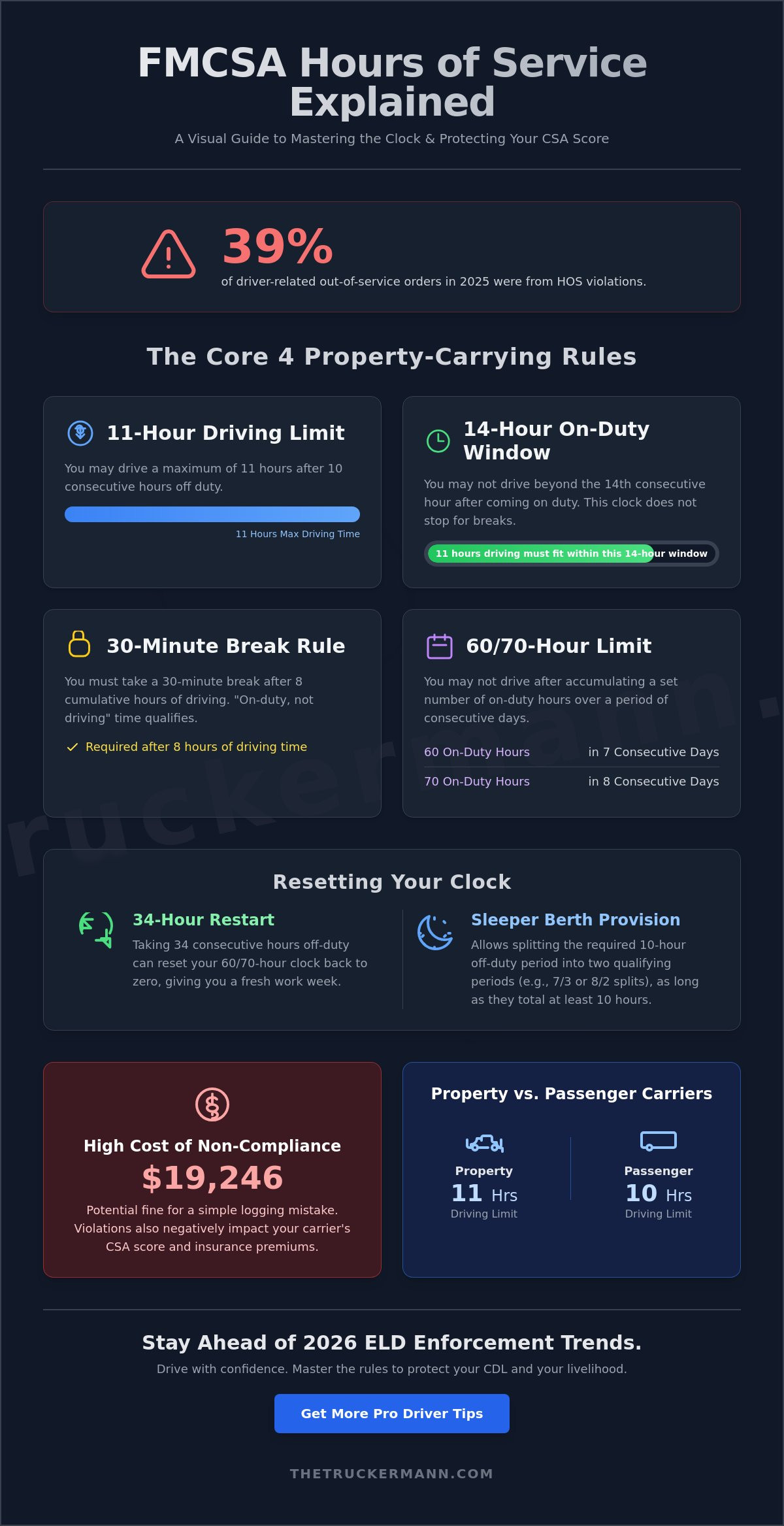
Success on the road isn’t just about how fast you can turn a mile. It’s about how well you manage your clocks. When we look at FMCSA hours of service rules explained for the modern driver, everything rests on four pillars. These aren’t suggestions; they are the legal framework that keeps your CDL clean. You’ve got 11 hours of driving time and a 14-hour on-duty window. Then there’s the mandatory 30-minute break and the long-haul 60/70-hour limits. If you don’t respect these boundaries, the DOT will find a way to make you respect them at the next scale house.
Your 11-hour driving limit is the actual time you spend behind the wheel. Once you’ve spent 10 consecutive hours off duty, your 11-hour tank is full. However, that fuel only lasts as long as the 14-hour window allows. You must also remember the 30-minute break rule. After 8 cumulative hours of driving without at least a 30-minute interruption, you have to pull over. The good news is that since the 2020 update, this break can be satisfied by “on-duty not driving” time. This means you can count your fuel stop or a quick load check toward that requirement. For a quick refresher on the specifics, check the official Summary of HOS Regulations.
Managing the 14-Hour Window
The 14-hour clock is where most drivers feel the squeeze. This clock starts the second you log into any on-duty status. It doesn’t stop for lunch, it doesn’t stop for traffic, and it doesn’t stop while you’re waiting three hours for a lumper to finish. Activities like pre-trip inspections, fueling, and loading all eat into this time. Think of it this way: the 14-hour clock is a wall you cannot climb over. Once that 14th hour hits, you cannot drive another inch until you’ve had your 10 hours of rest. You can find more tips on staying efficient within these windows at The Trucker Mann.
The 60/70-Hour Rolling Cycle
Managing your week requires looking at the big picture. Most long-haulers operate on the 70-hour/8-day rule, meaning you can’t drive after being on duty for 70 hours in any 8 consecutive days. Every morning, you have to calculate your “recap” hours to see what’s falling off from eight days ago. It’s a constant rolling math problem. Modern ELD technology handles this recap math automatically, showing you exactly how much time you’ve gained back at midnight. Understanding whether your carrier uses a 7-day or 8-day schedule is vital for planning your route and ensuring you don’t run out of hours halfway through a cross-country run.
Mastering the 34-Hour Restart and Sleeper Berth Splits
Navigating the 11 and 14-hour clocks is the baseline for staying on the road, but mastering the restart and the split is where you separate the rookies from the road warriors. Having the FMCSA hours of service rules explained means more than just knowing when to stop. It means knowing how to strategically reset your time so you aren’t sitting idle when the good loads are moving. In 2026, the 34-hour restart remains your most powerful tool for clearing your weekly 60 or 70-hour cycle, while the sleeper berth provisions offer the flexibility needed to handle the unpredictable nature of the docks.
The sleeper berth split is often where drivers get tripped up, yet it’s a lifesaver when you’re facing a long delay. Under the current rules, you can split your required 10-hour off-duty period into two chunks. The most common are the 8/2 or 7/3 splits. One period must be at least 7 consecutive hours in the sleeper berth, while the other can be at least 2 hours either off-duty or in the berth. When you use these correctly, neither period counts against your 14-hour driving window. This “pauses” your clock, allowing you to finish a shift that would have otherwise expired while you were backed into a door.
A common mistake is forgetting that these two periods must total at least 10 hours. If you take a 3-hour break, you must follow it up with at least 7 hours in the sleeper later to complete the requirement. You also can’t drive past your 11-hour limit between these periods. It’s a rolling calculation that requires a sharp eye on your ELD. If you mess up the math, you’re looking at a “false log” or “driving over hours” violation that can result in a fine of up to $4,812 for the driver.
The 34-Hour Restart Strategy
The 34-hour restart is your get-out-of-jail-free card. When you’ve been running hard for six days and your recap hours look like a skeleton crew, taking that full day and a half off breathes new life into your paycheck. However, it isn’t always the best move. If you have 10 hours falling off every day for the next three days, running on recaps might keep you moving more consistently than sitting for 34 hours. If your ELD fails, you must manually document this restart on your paper logs, ensuring you clearly mark the 34-hour consecutive off-duty block to avoid any confusion during a Level I inspection.
Splitting the Log: 7/3 and 8/2 Scenarios
Imagine you arrive at a receiver with only 2 hours left on your 14-hour clock, but the lumper tells you it’s a 5-hour wait. Instead of burning your clock, you go into the sleeper for 3 hours. That 3-hour block pauses your 14-hour window. After you’re loaded, you still have those 2 hours to find a safe place to park for your remaining 7-hour sleeper period. This is the most complex part of interstate vs intrastate trucking compliance, as state rules can sometimes vary, but for most of us on the long haul, these splits are the key to surviving the “hurry up and wait” game.
HOS Exceptions: Short-Haul, Adverse Conditions, and Emergency Relief
The road doesn’t always care about your logs. Sometimes a blizzard rolls in out of nowhere, or a shipper keeps you at the dock until your clock is a ghost of its former self. While the regulations are rigid, the FMCSA provides specific relief valves for the real-world grit of the field. Having the FMCSA hours of service rules explained correctly means knowing when you can legally push back against the clock without risking your CDL. These exceptions are your safety net, but they require precise documentation to survive a DOT audit.
The short-haul exception is a massive benefit for drivers who stay close to home. If you operate within a 150 air-mile radius of your normal work reporting location and return there within 14 hours, you aren’t required to use an ELD or keep detailed records of duty status. This “150-mile bubble” allows for a straightforward 14-hour work shift. However, if you step outside that radius or exceed the 14-hour limit even once, you must use an ELD for that day. If you’re looking to stay ahead of the curve with your compliance, check out the latest industry updates at The Trucker Mann.
Qualifying for the Short-Haul Exception
To stay legal under the short-haul rule, you must start and end your day at the same location. You’re limited to a 14-hour shift, and you still have to follow the 11-hour driving limit. The biggest trap here is transitioning. If you spend Monday through Wednesday as a local driver but pick up a long-haul load on Thursday, you must have an ELD installed and active for that long-haul day. You also need to be able to show your time records for the previous seven days if an officer asks for them at the scale. Local operators who want a deeper understanding of how intrastate trucking regulations and state-specific HOS rules apply to their operation should review the requirements carefully before assuming federal exemptions cover every situation.
Adverse Conditions and Emergency Use
The Adverse Driving Conditions exception is often misunderstood. It allows you to extend both your 11-hour driving limit and your 14-hour window by up to 2 hours when you encounter unexpected delays. The keyword is “unexpected.” If you knew about a snowstorm before you left the terminal, you can’t claim this exception. It’s meant for things like a sudden road closure due to an accident or a flash flood that wasn’t on the radar. When you use this, you must annotate your ELD immediately. Write a clear note explaining the situation, such as “2-hour extension used due to unexpected multi-vehicle accident at MM 142 on I-80.”
Emergency relief is a different beast entirely. This only applies when a federal or state official declares a formal emergency. In these cases, the HOS rules are often suspended for drivers providing direct assistance to the emergency area. Finally, don’t confuse this with Personal Conveyance (PC). PC is for moving your truck while off-duty for personal reasons, like finding food or a motel. It cannot be used to advance a load or “get closer” to your next pickup. If you use PC to bypass HOS limits, it’s a fast track to a “false log” violation.
Compliance Tools: Managing Your Clock with ELDs and Tech
In the current regulatory environment, your Electronic Logging Device (ELD) is your primary defense during a roadside inspection. It is the gold standard for compliance. However, as of May 4, 2026, the FMCSA has taken a harder line on non-compliant hardware. If you are caught using a revoked ELD model, you will be cited for having no record of duty status and placed immediately out-of-service. This isn’t just a minor paperwork error. It’s a high-stakes situation that can lead to fines of up to $4,812 for the driver and $19,246 for the carrier. Having the FMCSA hours of service rules explained is only half the battle; you need hardware that won’t let you down when the blue lights start flashing.
Your cab setup needs to be as professional as your driving. A secure dash mount and a heavy-duty charger are essential to keep your device from dying mid-shift. Even more critical is your backup plan. You are legally required to carry a supply of blank paper logs. If your ELD malfunctions, you must immediately notify your carrier and begin manual logging. You generally have eight days to get that device repaired or replaced before you’re in violation. It’s also worth noting that the FMCSA provides a 60-day window specifically for carriers replacing models that were recently revoked from the approved list in March 2026.
Smart drivers also use technology to find safe parking before their 11 or 14-hour clocks hit zero. Apps that show real-time parking availability help you avoid the parking lot shuffle that often leads to HOS violations or unsafe parking on highway shoulders. When you plan your stops using tech, you protect your CSA score and your peace of mind.
Choosing the Right ELD for Your Operation
Look for an interface that simplifies recap math and offers robust technical support. A clean log is just as important as a clean CDL pre-trip inspection checklist. Both show the DOT that you are a professional who takes safety seriously. For a deeper look at hardware options and technical requirements, check out our ELD compliance guide. Your choice of tech determines how much time you spend talking to inspectors and how much time you spend making money.
The Sentinel’s Final Word on Safety
In the age of data, trying to cheat the clock is a losing game. The industry is moving toward Level VIII wireless inspections where your data is checked while you are moving at highway speed. Your knowledge of HOS rules is your best shield against predatory dispatchers who might push you to drive beyond your legal limits. Stand your ground. Your CDL is your livelihood, and your safety is the only thing that ensures you keep it. Drive safe, stay legal, and get home to your family.
Protecting Your CDL and Your Future
Mastering your clock is the difference between a successful career and an out-of-service order that sidelines your earnings. We’ve gone through this veteran-led breakdown to ensure you have the FMCSA hours of service rules explained with the most current 2026 compliant data available. Remember that the 14-hour clock is a hard wall, but using the 8/2 or 7/3 sleeper splits strategically can give you the flexibility you need when shippers and receivers get in the way of your schedule. Staying ahead of ELD revocations and keeping a clean logbook is your best defense against the rising fines that target our community.
This guide comes from a place of direct industry experience; we’ve been in that cab and we know the pressure you face every single day. Don’t let complex regulations intimidate you. Use these tools to stay legal, keep your CSA score spotless, and focus on what you do best: moving the world’s freight. Before you head out on your next run, make sure you’re equipped for the long haul. Check out the best gear for your next haul at Mytee Products. Keep the rubber side down, watch your clocks, and get home safe to the people who matter most.
Frequently Asked Questions
What is the 14-hour rule in trucking?
The 14-hour rule is a strict window that limits how long you can drive after coming on duty following 10 hours off. Once you start your day, you have 14 consecutive hours to complete all your driving. This clock doesn’t stop for fuel, lunch, or loading delays. It’s a wall you can’t climb over; once that 14th hour hits, you must stop driving until you get another 10 hours of rest.
How does the 34-hour restart work in 2026?
A 34-hour restart resets your weekly 60/70-hour clocks to zero and is the fastest way to get back on the road. By taking 34 consecutive hours off duty or in the sleeper berth, you gain back your full 70 hours for the next 8 days. In 2026, this rule remains the most effective way to clear your recap math. It’s your best tool when you’ve run hard and need a fresh start for a haul.
Can I extend my driving time during bad weather?
You can extend your driving time by up to 2 hours using the Adverse Driving Conditions exception when the weather turns unexpectedly. This applies if you encounter snow, ice, or road closures that weren’t known before you started your trip. It pushes your 11-hour driving limit to 13 hours and your 14-hour window to 16 hours. Just make sure to annotate your ELD with the specific reason to satisfy any DOT officer.
What is the difference between on-duty and driving time?
Driving time is specifically the minutes you spend behind the wheel of a moving vehicle, while on-duty time includes all work-related tasks like inspections. Fueling, pre-trips, and waiting at a shipper are all on-duty, not-driving activities. Both count toward your 14-hour window, but only actual wheel time eats your 11-hour limit. Understanding this distinction is key to having the FMCSA hours of service rules explained correctly for your daily log management and compliance.
Do I need an ELD for short-haul trucking?
You don’t need an ELD if you stay within a 150 air-mile radius of your reporting location and return home within 14 hours. This “short-haul exception” allows you to use simple time cards instead of electronic logs. However, if you drive outside that 150-mile bubble or work longer than 14 hours on any given day, you must use an ELD for that specific shift. It’s a critical rule for local drivers who occasionally take longer runs.
What happens if I violate HOS rules?
Violating HOS rules can result in heavy fines, out-of-service orders, and serious hits to your carrier’s CSA score. In 2026, a driver can be fined up to $4,812 per violation, while motor carriers face penalties reaching $19,246. Most importantly, an inspector can place you out-of-service for 10 hours or more on the spot. This stops your revenue cold and leaves a permanent mark on your professional driving record that’s hard to erase.
How do I use the 8/2 sleeper berth split?
You use the 8/2 sleeper berth split by breaking your 10-hour rest into one 8-hour block in the sleeper and one 2-hour block off duty. These two periods must total at least 10 hours to satisfy the requirement. When paired correctly, the shorter break pauses your 14-hour clock. This is a vital part of FMCSA hours of service rules explained for drivers who need to navigate long loading delays without burning their limited driving window.
Is personal conveyance counted as on-duty time?
Personal conveyance is recorded as off-duty time because it is for personal use while you are completely relieved from work. You can use it to find food or a safe place to sleep when you’re out of hours. However, you cannot use it to advance a load or perform any task that benefits the carrier. If you use it to “cheat” the clock or get closer to a shipper, it’s considered a false log entry.
Disclaimer
The information provided on The TruckerMann is for general informational and educational purposes only. While every effort is made to ensure the accuracy and reliability of the content, trucking laws, FMCSA regulations, DOT requirements, safety standards, and industry policies can change at any time. Readers are encouraged to verify all information with official government agencies, professional advisors, or qualified industry professionals before making business, legal, financial, safety, or compliance-related decisions.
The content shared on this website reflects personal opinions, experiences, research, and commentary and should not be considered legal, financial, medical, tax, or professional advice. The TruckerMann and its owners, contributors, affiliates, or representatives are not responsible for any losses, damages, violations, penalties, or liabilities resulting from the use or misuse of information found on this website.
Some content on this website may contain affiliate links, sponsored content, or promotional material. This means we may earn a commission at no additional cost to you if you choose to purchase through certain links.
By using this website, you agree that you do so at your own discretion and risk.