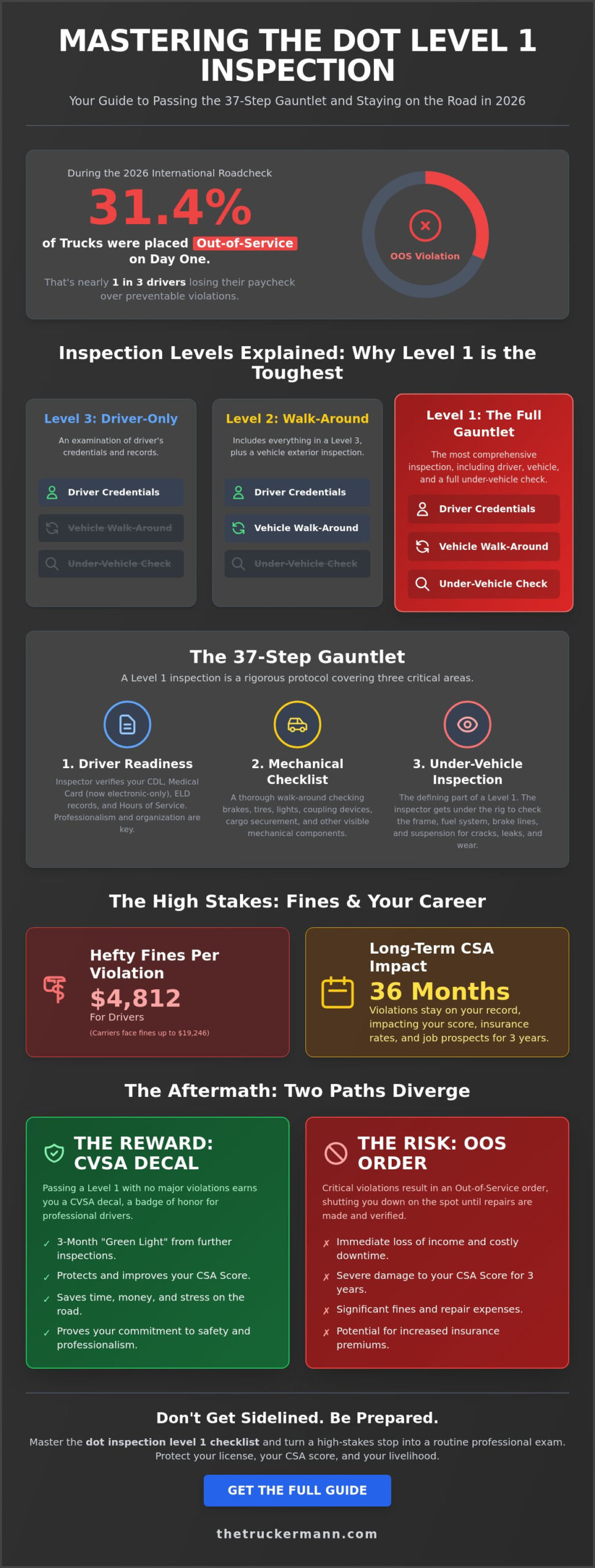
Did you know that on the first day of the 2026 International Roadcheck, a staggering 31.4% of rigs were pulled off the road with out-of-service orders? That’s nearly one in three drivers losing their paycheck because of violations that could’ve been caught by using a proper dot inspection level 1 checklist before hitting the pavement. It’s a gut-punch every time you see those flashing lights, especially with the FMCSA’s heavy focus on ELD tampering and the strict English proficiency rules that kicked in last June. You’re out there to move freight and provide for your family, not to sit idle while your CSA score takes a hit and fines for driver violations climb as high as $4,812.
We’ve been in your boots and we know the Level 1 Inspection isn’t a roadside ambush; it’s a professional exam where the answers are already in your pre-trip routine. We’ve built this veteran-led guide to help you master every stage of the 37-step North American Standard Inspection and keep your rig rolling. We’ll break down the 17 recent updates to the out-of-service criteria, covering everything from the new one-inch brake hose chafing rule to ELD record reconstruction, so you can earn that CVSA decal and protect your career.
Key Takeaways
- Transform high-stakes roadside stops into routine professional exams by mastering the 37-step dot inspection level 1 checklist used by North American inspectors.
- Stay ahead of the 2026 regulatory shift toward electronic-only medical card verification to ensure your driver credentials remain ironclad and compliant.
- Identify critical mechanical red flags in your brake system and cargo securement that frequently trigger out-of-service orders during the under-vehicle review.
- Learn how to secure the coveted CVSA decal, providing a three-month “green light” that protects your schedule and keeps your CSA score spotless.
What is a Level 1 DOT Inspection and Why Does It Matter in 2026?
The Level 1 Inspection is the heavyweight champion of roadside stops, and it’s the one that keeps most drivers up at night. Formally known as the North American Standard Inspection, this 37-step review is the most thorough examination an officer can perform on your rig. While a Level 2 is just a walk-around and a Level 3 focuses on your paperwork, the Level 1 goes deep into the guts of your machine. In 2026, the stakes have never been higher. With the first day of the 2026 International Roadcheck on May 12 showing a brutal 31.4% out-of-service rate, it’s clear that inspectors aren’t playing games. They’ve sharpened their focus on ELD data integrity and advanced brake system technology, making a solid dot inspection level 1 checklist your best friend when you’re pulled over. To understand how enforcement trends have evolved, reviewing the CVSA Roadcheck 2024 dates and results provides critical context for what inspectors are prioritizing this year.
To better understand what happens during this comprehensive review and how to prepare your equipment, watch this helpful video:
Passing this inspection isn’t just about avoiding a ticket today; it’s about protecting your career for the next three years. A clean Level 1 report is a badge of honor that can lead to lower insurance premiums and makes you a top-tier candidate for the best-paying fleets. Conversely, a string of violations can sink your CSA score and lead to massive financial hits. Current 2026 regulations allow for fines up to $19,246 for carriers and $4,812 for drivers per violation. You’re out there to make money, not to hand it over to the government because of a chafed brake hose or a paperwork glitch.
The 37-Step Gauntlet: An Overview
This isn’t a five-minute check. A proper Level 1 usually takes between 30 and 90 minutes because the inspector is following a rigorous protocol established by the Commercial Vehicle Safety Alliance (CVSA). What separates this from every other stop is the “under-vehicle” portion. The inspector will literally get on a creeper or climb into a pit to check your frame, fuel system, and every inch of your brake lines. They’re looking for cracks, leaks, and illegal welds that you can’t see from the driver’s seat. It’s a high-pressure environment, but being prepared means you can walk away with a clean bill of health.
CSA Scores and Your Bottom Line
Every violation found during a Level 1 is weighted based on its severity and stays on your record for 36 months. It’s a long time to carry a mistake. However, there’s a massive upside to being prepared. Passing a Level 1 often earns you a “Clean Inspection” bonus from many carriers and, more importantly, a CVSA decal. This sticker is a signal to other officers that your rig is tight, often sparing you from additional stops for the next three months. Staying diligent with your dot inspection level 1 checklist ensures you keep those points off your record. If you’re still worried about what’s fact and what’s fiction, take a look at these Truck Inspections DOT Myths to clear up the confusion before your next dispatch.
The Driver Readiness Checklist: Credentials and Documentation
The inspector usually starts the clock the moment they approach your cab. Before they ever crawl under your trailer, they’re looking at you. This initial phase of the dot inspection level 1 checklist is a test of your professionalism and your “fit for duty” status. They’ll check your CDL to ensure your endorsements are current and match the specific load you’re hauling. If you’re pulling hazmat or a tanker without the right letters on your license, the inspection ends early with a ride to the curb. Organization is your secret weapon here. A driver who hands over a clean, tabbed binder suggests a compliant, detail-oriented professional, while someone digging through a glovebox full of old receipts invites the inspector to look much closer at everything else.
One of the biggest shifts you need to account for in 2026 is the electronic-only medical card rule. As of June 25, 2025, the requirement to carry a physical Medical Examiner’s Certificate (MEC) effectively ended for most CDL holders. Inspectors now rely on the Commercial Driver’s License Information System (CDLIS) to verify your medical status. If your physical has expired or the system hasn’t been updated, a piece of paper in your wallet won’t save you. You’ll be placed out-of-service immediately. It is your responsibility to ensure your state’s DMV has your current results on file before you pre-trip. This is a critical part of the North American Standard Inspection protocol that catches many veterans off guard.
ELD Compliance and Log Integrity
In 2025, falsification of records of duty status was the second most-cited driver violation, with 58,382 total incidents recorded. In 2026, inspectors are specifically hunting for ELD tampering and “unidentified driving time” on your device. If you have gaps in your timeline that you can’t explain, you’re looking at fines that can reach $15,846 for knowing falsification. Make sure you know how to transfer your data via web services or email instantly. If you need a refresher on the latest tech requirements, check out our guide on ELD Compliance in 2026 to stay ahead of the curve.
The ‘Attitude’ Factor: Interacting with the Inspector
Your demeanor is a tool just like your tire gauge. Be polite, be brief, and be honest. The “Driver-only” portion of the 37 steps includes an assessment of your English proficiency, a rule that became a strictly enforced out-of-service condition on June 25, 2025. If you can’t communicate clearly with the officer, they’ll shut you down. Answer the questions asked, don’t volunteer extra information, and let your equipment do the talking. For more tips on mastering the road, visit The Trucker Mann to keep your career on the high side of the law.
The Mechanical Checklist: Brakes, Tires, and Cargo Securement
Once you clear the cab, the inspector moves to the heavy iron. This is where the dot inspection level 1 checklist gets truly physical. Brakes remain the most common reason for a red tag, accounting for a massive chunk of that 31.4% out-of-service rate we saw during the 2026 Roadcheck. Inspectors are looking for more than just stopping power; they’re hunting for audible air leaks, thinning brake pads, and compromised drums. A major update for April 2026 focuses on brake hose chafing. If an inspector finds a hose with chafing that exposes the reinforcement material over a length of more than one inch, you’re officially out of service. It’s a precise measurement that requires you to be just as meticulous during your morning walk-around as the officer is during the North American Standard Inspection.
Tires don’t just carry the load; they carry your reputation for safety. You need at least 4/32-inch tread depth on your steer tires and 2/32-inch on all others. We recommend a “no-regrets” replacement rule. If a tire is hovering near the limit, swap it out before the road chooses for you. While you’re looking at the rubber, check your lighting. Bulbs and signals are the “low-hanging fruit” of the industry. A single flickering marker light or a dead turn signal is often the only invitation an officer needs to pull you in for a full Level 1. It’s a simple fix that saves you an hour of scrutiny and a potential hit to your record.
Flatbedders and specialized haulers have a higher hill to climb when it comes to cargo securement. In 2025, inspectors issued over 34,000 violations for poorly secured loads. Whether it’s a shifted coil or a loose strap, if the cargo isn’t tight, you aren’t moving. The 2026 Roadcheck has placed a specific spotlight on this category, meaning every tie-down point will be tested for tension and integrity. Don’t let a frayed strap be the reason your profit for the week disappears into a fine. Looking back at how the CVSA Roadcheck 2024 dates and enforcement focus areas shaped current inspection priorities can help you anticipate exactly what officers are trained to target.
Brake and Suspension Deep Dive
Inspectors will listen for the telltale hiss of air leaks while you’re in the cab pumping the pedal. They’ll also crawl under to check your suspension components, including U-bolts, spring hangers, and the condition of your air bags. For a standard Type 30 clamp-type brake chamber, the pushrod stroke must not exceed 2 inches to remain compliant under 2026 CVSA criteria. If you’re running long-stroke versions, that limit extends to 2.5 inches, but anything beyond that is an automatic violation.
Securement and Logistics Gear
Your chains and binders are your lifeline on the road. Inspect every link for stretching or nicks and check your straps for any edge cuts or UV damage. Investing in high-quality trucking gear from Mytee Products ensures your equipment can handle the rigors of heavy hauling without failing under pressure. If you want to dive deeper into the specific tools that keep your load stationary, take a look at our breakdown of The Best Flatbed Trucking Gear for 2026.
Surviving the Under-Vehicle Inspection: What the Inspector Sees
The under-vehicle portion of the dot inspection level 1 checklist is where the true grit of the job happens. While you’re in the driver’s seat following instructions to pump the brakes or hit the lights, the inspector is down in the dirt, often on a creeper, looking for the things you can’t see from the mirror. They follow a specific path from the front steering axle all the way to the rear of the trailer, and they aren’t just looking for road grime. They’re hunting for stress cracks in the frame, illegal welds that suggest a patch job rather than a real repair, and fuel tanks that aren’t properly secured. In 2026, with the CVSA’s renewed focus on technical integrity, even a small leak in your DEF system or a loose exhaust hanger can be enough to trigger an out-of-service order.
Your steering mechanism is a high-priority zone during this phase. The inspector will check for excessive play or lash in the steering wheel; if it exceeds the specific limits for your gear box size, you’re shut down on the spot. They’ll also examine the driveline, looking for worn U-joints or loose yokes that could lead to a catastrophic failure on the highway. Exhaust leaks are another major red flag, especially if they’re near the cab or fuel lines, as these are considered immediate fire hazards. It’s about more than just compliance. It’s about making sure you and every other driver on the road get home in one piece.
The Creeper Phase: Step-by-Step
During the first step, the inspector focuses on the front steering axle and suspension, checking for cracked leaves or worn bushings. Next, they move to the mid-section to verify the integrity of the fuel tanks and the DEF system, ensuring no hazardous leaks are present. Finally, they reach the critical connection point: the fifth wheel. They’ll check for proper lubrication, secure mounting to the frame, and ensure the kingpin is locked tight without excessive slack. This methodical dot inspection level 1 checklist ensures nothing is missed from front to back.
Preparation Tips for the Under-Rig Check
Don’t make the inspector’s job harder than it needs to be. A rig caked in road grime and grease makes it difficult to spot genuine issues, but it also signals a lack of maintenance to the officer. We recommend cleaning your undercarriage regularly. A clean truck often passes faster because it shows you’re a professional who stays on top of your equipment. Take the time once a week to do your own creeper check with a flashlight to spot leaks or cracks before the DOT does. For a deeper dive into staying ready for the scales, read our guide on Roadside Inspection Prep. If you want to keep your career moving forward without the weight of OOS orders holding you back, head over to The Trucker Mann for more veteran-led advice.
The Aftermath: CVSA Decals, OOS Orders, and Next Steps
The officer finally steps back from your rig and closes their notebook. This is the moment of truth. If you’ve followed your dot inspection level 1 checklist to the letter, you’re likely looking at the best possible outcome: the CVSA decal. Earning this sticker is like getting a “pass” for the next three months. It signals to other inspectors that your equipment was tight as of its last major review. This is especially critical during high-pressure events like the CVSA Roadcheck 2026 schedule, where a decal can often save you from being pulled into the bay for a repeat performance.
But the road isn’t always smooth. If you’re hit with an Out-of-Service (OOS) order, the wheels stop turning immediately. You aren’t moving that truck until the specific safety violation is repaired and verified. Whether it’s a mobile mechanic or a tow to the nearest shop, the costs add up fast. Whatever you do, don’t even think about “limping” it to the next stop. In 2026, a driver violating an OOS order faces fines up to $2,364, while the carrier can be slammed with a penalty as high as $23,647. It’s a risk that can end your career and bankrupt a small fleet in a single afternoon.
Every stop concludes with the Driver Vehicle Examination Report (DVER). You’re legally required to get this paperwork to your motor carrier within 15 days. Even if the violations weren’t enough to shut you down, they still need to be corrected, and the report must be signed and returned to the issuing agency to prove compliance. Use these clean reports as leverage. A driver with a history of passing the dot inspection level 1 checklist with zero violations is a valuable asset. You can use that spotless record to negotiate better freight rates or secure a seat in the most prestigious fleets in the country.
The CVSA Decal: Your Professional Badge
A decal is only awarded if you pass a Level 1 or Level 5 inspection with zero critical violations in the checked categories. It’s usually placed on the lower right corner of the windshield. During major enforcement blitzes, this sticker is the ultimate time-saver. It tells the scale master you’ve already run the gauntlet and come out clean, which often lets you bypass the long lines of trucks waiting for their turn in the inspection pit.
Contesting a Violation: DataQs and Your Rights
Officers are human and they do make mistakes. If you believe a violation on your report is factually incorrect, you have the right to challenge it through the FMCSA DataQs system. This is why you should never sign a report that you believe contains false information without clearly noting your disagreement. Protect your record like your livelihood depends on it, because it does. Stay vigilant, stay prepared, and keep the shiny side up. That’s the final word from The Truckermann on staying safe and profitable on the open road.
Master the Road and Protect Your Livelihood
Navigating the asphalt in 2026 requires more than just driving skills; it demands a veteran’s eye for detail and a proactive stance against shifting regulations. By staying sharp on your dot inspection level 1 checklist, you’re doing more than avoiding fines; you’re ensuring that your career stays on the high side of the law. One in three rigs failed the 2026 Roadcheck. With your electronic medical card verified and your brake hoses meeting the new one-inch chafing standard, you don’t have to be part of that statistic.
We provide these veteran-verified checklists and real-time 2026 regulatory updates because we know what’s at stake for the 50,000+ professional drivers who trust our community. It’s time to take control of your next stop before you ever see the flashing lights. Gear up for your next inspection with pro-grade securement tools at Truck n Tow and keep your rig moving toward the next paycheck. Stay safe out there. Keep your equipment tight and remember that every clean inspection is a win for the whole brotherhood.
Frequently Asked Questions
How long does a Level 1 DOT inspection typically take?
A Level 1 DOT inspection typically takes between 30 and 90 minutes to complete properly. The time varies based on the inspector’s experience and how well you’ve maintained your rig. Because this is a full 37-step review that includes the under-vehicle portion, you should expect to be parked for at least an hour if the officer is being thorough.
What is the difference between a Level 1 and a Level 2 inspection?
The primary difference is the under-vehicle examination. A Level 1 is the most comprehensive check, requiring the inspector to crawl under the truck to inspect the frame, fuel system, and brake components. A Level 2 is known as a “walk-around” inspection, where the officer only checks items that can be seen without getting under the vehicle.
Can a Level 1 inspection count as my annual DOT inspection?
Yes, a roadside Level 1 inspection meets the federal requirements for a periodic annual inspection under 49 CFR 396.17. You must ensure you receive a copy of the Driver Vehicle Examination Report (DVER) and keep it in your cab. Many drivers prefer this because it proves the truck is compliant without requiring a separate trip to a maintenance shop.
What are the most common reasons for a truck to be placed out-of-service?
Brake system defects and tire issues are the most frequent causes of out-of-service orders. Specifically, the “20% rule” for defective brakes and tread depth falling below 2/32-inch on drive tires will shut you down immediately. In 2025, cargo securement violations and falsified ELD records were also top reasons for drivers being pulled off the road.
Do I still need to carry a physical DOT medical card in 2026?
No, you don’t need to carry a physical medical card in 2026. As of June 25, 2025, the FMCSA transitioned to a fully electronic system where inspectors verify your medical status through the CDLIS database. While the officer will check the system, it’s still a good idea to have a digital copy on your phone just in case there’s a technical glitch at the scale.
What happens if I refuse a roadside DOT inspection?
Refusing an inspection is considered an automatic out-of-service violation and often leads to immediate legal consequences or arrest. It’s treated as a failure to comply with federal safety regulations, and it will result in a massive hit to your carrier’s CSA score. Most fleets will terminate a driver immediately for refusing an inspection because of the long-term damage it causes.
How long does a DOT violation stay on my CSA score?
Violations stay on a carrier’s Compliance, Safety, Accountability (CSA) record for 36 months. For your personal Pre-Employment Screening Program (PSP) record, the data follows you for three years. Consistently passing your dot inspection level 1 checklist is the only way to keep your record clean and ensure you remain eligible for the best-paying jobs in the industry.
Does every truck get a CVSA decal after a Level 1 inspection?
No, decals are only awarded to trucks that pass the dot inspection level 1 checklist with zero critical violations in the inspected categories. If the inspector finds even a minor issue that isn’t serious enough for an out-of-service order, you still won’t receive the decal. The sticker is a reward for maintaining a truly spotless rig and is valid for three months.
Disclaimer
The information provided on The TruckerMann is for general informational and educational purposes only. While every effort is made to ensure the accuracy and reliability of the content, trucking laws, FMCSA regulations, DOT requirements, safety standards, and industry policies can change at any time. Readers are encouraged to verify all information with official government agencies, professional advisors, or qualified industry professionals before making business, legal, financial, safety, or compliance-related decisions.
The content shared on this website reflects personal opinions, experiences, research, and commentary and should not be considered legal, financial, medical, tax, or professional advice. The TruckerMann and its owners, contributors, affiliates, or representatives are not responsible for any losses, damages, violations, penalties, or liabilities resulting from the use or misuse of information found on this website.
Some content on this website may contain affiliate links, sponsored content, or promotional material. This means we may earn a commission at no additional cost to you if you choose to purchase through certain links.
By using this website, you agree that you do so at your own discretion and risk.