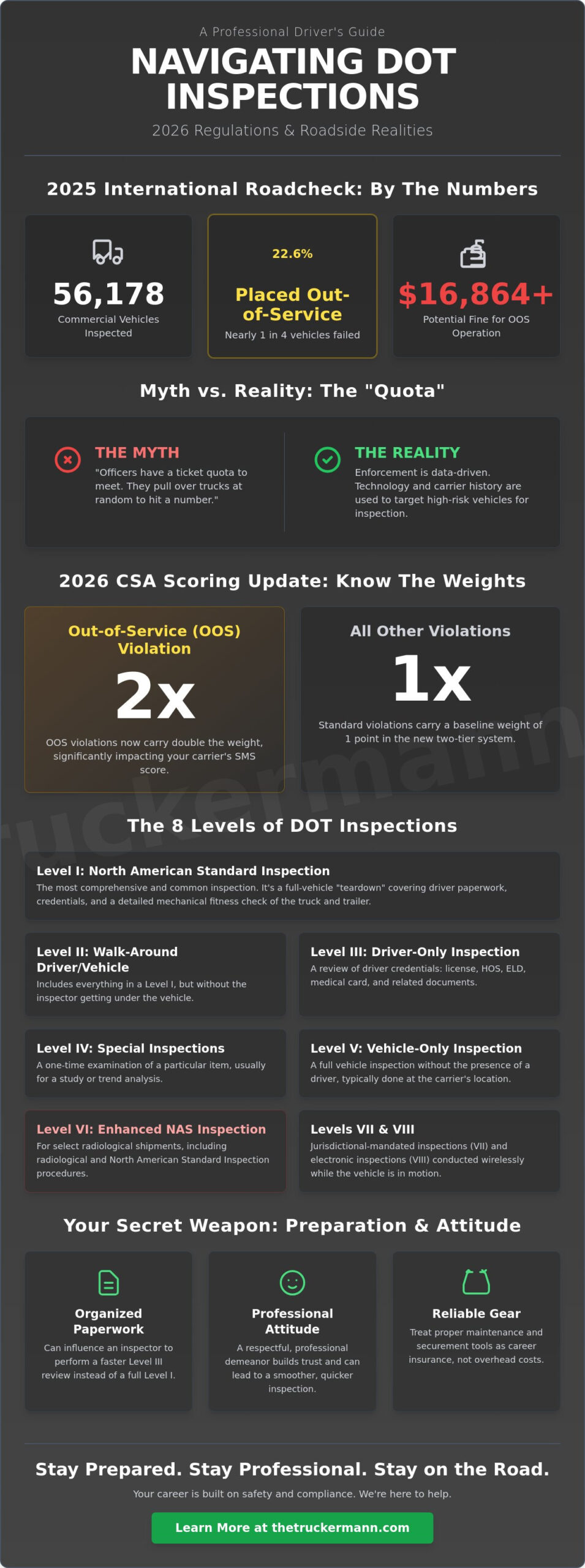
Hey Friend, did you know that during the 2025 International Roadcheck, 22.6% of the 56,178 commercial vehicles inspected were slapped with an out-of-service order? It’s a number that keeps many of us awake in the sleeper berth, especially with the 2026 Blitz Week scheduled for May 12 through May 14. Whether you are a seasoned veteran or just starting out, truck inspections dot the landscape of your career, and the rumors flying around the truck stop make it feel like you’ve got a target on your back. You’ve likely heard the tall tales about secret quotas, yet the reality of modern enforcement is much more predictable than the CB radio gossip suggests.
We understand the gut-punch feeling of seeing those flashing lights and worrying about your CSA score or a $16,864 fine. That’s why The Truckermann is going to clear the air by debunking the most dangerous fiction and showing you how to navigate the 2026 regulations. You’ll learn the truth about the FMCSA’s updated two-tier scoring system and why you no longer need to carry physical ELD manuals or spare fuses in your cab. We are breaking down the real criteria inspectors use so you can pull away with a clean inspection and your career on track. Because at the end of the day, the road runs through us.
Key Takeaways
- Stop letting the “quota” myth dictate your stress levels and start viewing the roadside stop as a professional hurdle you’re fully prepared to clear.
- Identify all eight distinct inspection levels to understand exactly what an officer is looking for when they step onto your running board or crawl under your trailer.
- Master the 2026 focus on ELD unassigned driving time and cargo securement to ensure truck inspections dot your professional record with clean results.
- Discover how a professional attitude and organized paperwork can influence an inspector to perform a faster Level III review instead of a full Level I vehicle teardown.
- Treat your securement gear and maintenance tools as career insurance rather than overhead costs to keep your wheels rolling and your CSA score protected.
The DOT Inspection Mindset: Debunking the “Quota” Myth
Hey Friend, let’s clear the air right now. When an officer motions you into the scale house or pulls you over on the shoulder, it isn’t a personal attack on your character or your livelihood. It’s a professional hurdle, plain and simple. Many drivers sit in the breakroom spinning yarns about “quotas” and how the DOT needs to hit a certain number of tickets by the end of the month. The Truckermann has seen it all, and the truth is far more calculated than a simple numbers game.
The reality is that truck inspections dot the highway because they are part of a massive, data-driven machine. In 2025, during the International Roadcheck, inspectors placed 22.6% of the 56,178 vehicles inspected out of service. That isn’t because they had a quota to fill; it’s because nearly a quarter of the rigs on the road had serious safety defects. Inspectors don’t just pick trucks at random anymore. They use technology and history to target high-risk carriers. A clean inspection is a massive win for you. It boosts your carrier’s safety rating and keeps your wallet heavy by avoiding fines that can reach $19,277 for operating an out-of-service vehicle.
To better understand how a real-world stop can go south quickly and what inspectors are actually looking for, watch this driver’s experience:
The Purpose of the FMCSA Inspection Program
The whole system is built on FMCSA Part 396.17, which mandates periodic inspections to ensure every rig on the road is safe for the public. This Commercial vehicle inspection overview shows that the North American Standard Inspection program aims to create a level playing field. It ensures that the guy cutting corners on maintenance doesn’t have an unfair advantage over the professional who does things right. We believe that high standards protect the brotherhood. When we all follow the same rules, the road is safer for everyone. The Road Runs Through Us, and that means we hold ourselves to the highest bar of excellence.
CSA Scores and Why They Matter to You
The Compliance, Safety, Accountability (CSA) system is basically a scorecard for your professional life. While the carrier technically holds the score, those violations follow your CDL from one job to the next. In February 2026, the FMCSA updated the scoring methodology to a two-tier system where Out-of-Service (OOS) violations carry a weight of 2, while all others are weighted at 1. The Safety Measurement System (SMS) is the primary tool the FMCSA uses to rank carriers by comparing their recent data to that of similar fleets. If you’re hauling for a carrier with a high SMS score, expect more truck inspections dotting your route. You can protect your career by using quality gear from Mytee Products to keep your cargo secure and your record clean.
The 8 Levels of DOT Inspections You Need to Know
Hey Friend, let’s talk about the gauntlet. Most drivers think there are only three types of inspections because those are the most common sights at the scales. But if you want to be a true master of the road, you need to know that the CVSA actually recognizes eight distinct levels. Knowing exactly which one you’re facing can be the difference between a 15-minute paperwork check and a three-hour roadside interrogation where an officer is literally crawling through your grease. These truck inspections dot our routes not to slow us down, but to ensure every rig sharing the lane is as safe as yours.
The FMCSA Roadside Inspection Program is the backbone of highway safety, and it’s getting more sophisticated every year. In 2026, we are seeing a massive shift toward data-driven enforcement. If you understand the levels, you can stay one step ahead of the curve. If you find yourself needing to upgrade your gear before the next blitz, you can always check out the latest securement tools to keep your trailer in top shape.
Level I Through Level V: The Roadside Staples
Level I is the “North American Standard,” and it’s the most thorough check in the book. The inspector looks at everything from your brakes and fuel system to your seatbelt and cargo securement. Level II is essentially a walk-around where the officer checks everything they can see without getting under the truck. Then there’s the Level III, which is strictly about you and your paperwork. As of January 10, 2026, your medical certificate must be verified exclusively through your Motor Vehicle Record (MVR), so don’t expect a paper card to save you. Level IV is a special one-time check for research, and Level V is a vehicle-only inspection usually conducted at a carrier’s terminal. To make sure you’re fully prepared for the most comprehensive stop on the road, review our complete DOT inspection level 1 checklist before your next haul.
Levels VI, VII, and VIII: The Specialized Checks
Level VI is specifically for those hauling transuranic waste or Highway Route Controlled Quantities (HRCQ) of radioactive material. If you pass this, you get a special Level VI decal that is only valid for one trip. Level VII covers jurisdictional mandates, which are often state-specific checks like those for school buses or shuttles. Finally, we have the Level VIII, the “Electronic Inspection.” This is the future. It happens wirelessly while you are still moving, checking your ELD data, CDL status, and medical certification via telematics. It’s a reminder that even when you aren’t stopped, the road runs through us and the data keeps flowing. You can stay updated on these tech shifts by visiting The Truckermann for the latest road alerts.
Myth vs. Reality: Common Roadside Violations
Hey Friend, the truck stop is full of “legal experts” who’ve never seen the inside of a scale house. One of the most dangerous myths floating around is that as long as your ELD screen is green, you’re untouchable. That’s a fast track to a violation. In 2026, inspectors aren’t just glancing at your clocks. They’re digging into unassigned driving time and checking if your device can actually transfer data to the roadside officer. If you have miles on that truck that aren’t accounted for, it doesn’t matter how perfect your log looks; you’re looking at a serious HOS violation.
Another myth is that a tiny hiss from an air line is just “character” for an old rig. Don’t believe it. Brake systems accounted for a massive portion of the vehicle out-of-service orders during the 2025 International Roadcheck. A small leak might seem minor to you, but to an inspector, it’s a sign of a neglected system. These truck inspections dot the country specifically to catch these “minor” issues before they cause a pileup. When an officer hears air escaping, they stop looking for reasons to let you go and start looking for reasons to shut you down.
The Lighting and Tire Trap
One headlight out or a flickering marker light is basically a neon invitation for a Level I inspection. It tells the officer that if you didn’t check your lights, you probably didn’t check your slack adjusters either. Tire tread depth is another area where “close enough” isn’t good enough. If you’re under 4/32 of an inch on your steers, you aren’t just getting a warning; you’re getting parked. You can find the technical standards for these checks in The 8 Levels of DOT Inspections documentation. For a full checklist to keep your rig compliant, you should read our Roadside Inspection Prep guide.
Cargo Securement and Flatbed Realities
For my flatbed brothers, the myth that you can slack on securement for a “short hop” across town is a career killer. Inspectors are trained to spot frayed webbing and cracked chain links from 20 feet away. In 2026, cargo securement remains a top focus area for the CVSA, and they have zero patience for “good enough.” To keep your loads tight and your record clean, it’s worth investing in professional grade gear from Mytee Products. Their heavy-duty straps and chains are built to withstand the scrutiny of even the toughest inspector. Remember, the road runs through us, and a secured load is the signature of a professional driver who values safety over speed.
The Driver’s Secret Weapon: Preparation and Attitude
Hey Friend, let’s talk about the one tool in your kit that doesn’t require a wrench: your mindset. When you pull into that inspection bay, your attitude often dictates whether you’re looking at a 15-minute Level III paperwork shuffle or a two-hour Level I vehicle teardown. If you’re defensive or combative, you’re practically asking the officer to find a reason to keep you there. A clean, organized cab is your first line of defense. The “Clean Cab” theory is real. If your dashboard is cluttered with old receipts and trash, an inspector assumes your maintenance habits are just as messy. Truck inspections dot the landscape of our careers, but showing up as a professional makes you a much smaller target.
A messy dashboard is a red flag. When an officer sees empty soda cans and loose papers rolling around your floorboards, they assume your brake chambers look just as neglected. Using a solid CDL Pre Trip Inspection Checklist is your best defense against surprises. It ensures you’ve caught the frayed belt or the leaking wheel seal before the DOT does. Preparation isn’t just about the truck; it’s about being the master of your space and showing the world you take this life seriously.
Organizing Your Credentials
Keep your professional life in a dedicated binder. While the FMCSA finalized a rule in February 2026 that eliminated the requirement to carry a physical ELD user manual in the cab, you still must be able to show the officer how to receive your logs. If you fumble around trying to find the “Transfer” button, you’re signaling incompetence. Since January 10, 2026, motor carriers have been required to verify medical certifications exclusively through MVRs, but keeping a copy of your SPE certificate or other waivers in a clear sleeve shows you’re prepared for anything. Don’t forget that you must still carry blank paper logs. It’s a violation if your ELD fails and you can’t produce a backup immediately. Understanding exactly what gets recorded after a stop is just as critical, which is why every driver should know how to read their driver vehicle examination report and what that permanent digital record means for your CDL.
The Interaction: Professionalism Over Protest
When the officer approaches, stay in the cab until instructed otherwise. When you do step down, use the “Three-Point Contact” rule. This isn’t just for your safety; it shows the inspector you follow the same professional standards they’re looking for on the truck. Speak clearly and answer only what is asked. You don’t need to admit guilt to be polite. If you make it through without a single violation, don’t be afraid to ask for a CVSA decal. It’s a badge of honor that can help you bypass future scales for up to three months. To stay sharp on your professional game and protect your livelihood, subscribe to The Truckermann for weekly road alerts and industry updates.
Mastering the Road: Gear and Next Steps
Hey Friend, we’ve stripped away the truck stop myths and looked at the eight levels of enforcement you might face. Now we need to focus on the hardware that keeps you on the right side of the law. When truck inspections dot the horizon during the International Roadcheck from May 12 to May 14, 2026, your equipment will be your best witness. Inspectors are human; they look for patterns. If they see a clean rig with high-quality securement gear, they often move faster through the checklist. On the other hand, if they spot a frayed strap or a cracked lens, they’re going to dig deeper until they find something that costs you money. In 2025, brakes, tires, and lights accounted for over 75% of all vehicle out-of-service orders. Don’t let a $10 bulb turn into an $11,000 fine.
Investing in top-tier gear isn’t just an expense; it’s career insurance. The Truckermann knows that the difference between a “pass” and a “parked” often comes down to the small things you catch during your pre-trip. While the FMCSA finalized deregulatory changes in February 2026 that removed the requirement to carry spare fuses and liquid-burning flares, you still need to be vigilant about your active safety systems. Keep your flatbed gear in top shape to avoid being targeted for “visible defects” that trigger a more invasive Level I inspection. Every roadside stop also generates a driver vehicle examination report that becomes part of your permanent compliance record, so knowing what that document contains before you leave the inspection bay can save you from costly surprises down the road.
Essential Gear for Passing Every Time
Professionalism starts with your personal presentation and the tools you keep in the side box. Wearing a high-visibility safety vest and durable work gloves during a walk-around shows the officer you’re a safety-conscious professional. You should browse Truck n Tow for essential safety gear and inspection-ready tools that help you stay compliant. Check your straps daily and replace anything with a visible cut, burn, or frayed edge immediately. With the 2026 focus on cargo securement, inspectors will be looking for any excuse to flag your load. Having a fresh set of straps and chains ready to go is the mark of a driver who is looking to master the road, not just survive it.
Joining the Truckermann Community
Staying updated on the latest regulatory shifts is vital for your survival in this industry. Whether it’s the shift to electronic DVIRs confirmed on February 19, 2026, or the new medical certificate verification mandates, the rules are always moving. You can stay ahead of the game by keeping track of the CVSA Roadcheck dates and focus areas. We believe you’ve got the grit to handle whatever the DOT throws your way; we’re just here to provide the info and the fraternal support to help you do it. The road runs through us, and together, we keep the wheels rolling. Before your next haul, make sure you gear up for your next inspection at Truck n Tow to ensure you’re ready for the scale house.
Take Command of Your Compliance Journey
Mastering the road means moving past the truck stop rumors and facing the data head-on. We have covered how truck inspections dot the landscape of your daily route, but they don’t have to be a source of anxiety. By understanding that the 2026 focus areas center on cargo securement and ELD compliance, you are already ahead of the 46% of drivers who fail their initial CDL road tests. You now have the expert perspective of a seasoned veteran to guide your pre-trip routine and your roadside interactions.
Staying compliant is a choice you make every time you check your straps or organize your binder. High-quality gear is your best defense against the $19,277 fines that can sideline your career. If you are ready to professionalize your operation and stay updated on the latest regulatory shifts, we are here to help. You can find the best flatbed securement gear to pass your next inspection and access real-world tools for the modern driver. Keep your head up and your eyes on the horizon. The road runs through us; we’ll see you at the next stop.
Frequently Asked Questions
What is the most common DOT inspection violation?
Brakes, tires, and lights are the most frequent violations, accounting for over 75% of all vehicle out-of-service orders during the 2025 International Roadcheck. These truck inspections dot the highway specifically to catch maintenance lapses that lead to accidents. Keeping your lighting systems and tread depths above 4/32 of an inch on steers is your best defense against a shutdown.
How long does a Level 1 DOT inspection take?
A standard Level I inspection usually takes between 45 and 60 minutes to complete if the driver is prepared. This comprehensive “North American Standard” check involves a deep dive into both your paperwork and a mechanical examination of the entire vehicle, including the underside. Having your binder organized and your cab clean can help the officer move through the checklist efficiently. You can walk into every stop with confidence by working through a thorough DOT inspection level 1 checklist before you leave the yard.
Can a DOT inspector search my sleeper berth without a warrant?
An inspector generally cannot search your sleeper berth for personal items without a warrant or probable cause, but they can enter to check for safety compliance. They are authorized to ensure the berth meets FMCSA requirements, such as having proper restraints or unobstructed exits. It is a good rule of thumb to keep this area professional and tidy to avoid raising any red flags.
What happens if I fail a DOT roadside inspection?
Failing an inspection typically results in an Out-of-Service (OOS) order, which prevents you from moving the vehicle until the defects are repaired. You may face fines ranging from $1,099 for recordkeeping errors up to $19,277 for operating a vehicle already placed out of service. Additionally, these violations will impact your carrier’s CSA score under the 2026 two-tier weighting system.
Do I need a DOT inspection every year for my truck?
Yes, all commercial motor vehicles must undergo a formal inspection at least once every 12 months according to FMCSA Part 396.17. While roadside truck inspections dot your route unexpectedly, they do not replace the mandatory annual requirement. Operating without a current annual inspection can lead to fines between $1,099 and $11,000 depending on the jurisdiction and carrier history.
How do I get a CVSA decal after an inspection?
You receive a CVSA decal only after passing a Level I or Level V inspection with zero critical vehicle inspection items found. This decal acts as a professional badge of honor and typically exempts your rig from another vehicle inspection for a period of three months. It tells every officer down the road that you are a driver who takes maintenance seriously.
Is a Level 3 inspection only about my ELD logs?
No, a Level 3 inspection is a “Driver-Only” check that covers your ELD logs, CDL status, and medical certification. As of the January 10, 2026 mandate, officers must verify your medical certificate exclusively through your State Motor Vehicle Record (MVR). They will also check for seatbelt usage and any signs of illness or fatigue that could impair your ability to drive safely.
Can I refuse a DOT inspection at a weigh station?
You cannot refuse a DOT inspection without facing an immediate Out-of-Service order and potential legal action. Refusal is considered a major violation that can lead to heavy fines, arrest, and the disqualification of your CDL. The most professional path is to cooperate fully, stay polite, and use your preparation to ensure the inspection goes as smoothly as possible.
Disclaimer
The information provided on The TruckerMann is for general informational and educational purposes only. While every effort is made to ensure the accuracy and reliability of the content, trucking laws, FMCSA regulations, DOT requirements, safety standards, and industry policies can change at any time. Readers are encouraged to verify all information with official government agencies, professional advisors, or qualified industry professionals before making business, legal, financial, safety, or compliance-related decisions.
The content shared on this website reflects personal opinions, experiences, research, and commentary and should not be considered legal, financial, medical, tax, or professional advice. The TruckerMann and its owners, contributors, affiliates, or representatives are not responsible for any losses, damages, violations, penalties, or liabilities resulting from the use or misuse of information found on this website.
Some content on this website may contain affiliate links, sponsored content, or promotional material. This means we may earn a commission at no additional cost to you if you choose to purchase through certain links.
By using this website, you agree that you do so at your own discretion and risk.