Hey there, driver. That six-figure “guaranteed” pay on the side of a trailer is often just smoke and mirrors designed to get your boots in the door before you realize the CPM barely covers your bills. You know the drill; the recruiter promises the moon, but then you’re stuck with unpaid detention time and a 2026 cost of living that makes a standard truck driver salary feel smaller by the day. It’s frustrating to feel like a number in a corporate ledger rather than a respected professional behind the wheel.
We’re here to help you take back control of your earnings with a straight-shooter’s guide to the 2026 landscape. We’ll dig into why the new 72.5 cent IRS mileage rate is a game changer for your bottom line, which specialized niches like flatbed are paying 25% premiums, and how to protect your paycheck against the stricter broker financial responsibility rules that went live on January 16. From maximizing your $80 daily per diem to mastering high-paying hazmat hauls, this is how you stop just surviving the road and start mastering it through practical, growth-oriented moves.
Key Takeaways
- Learn why a clean MVR is the ultimate bargaining chip for securing a top-tier truck driver salary in 2026.
- Move beyond the “cents per mile” trap by understanding how percentage-based pay in heavy-haul can significantly outpace dry van rates.
- Discover how to transition into high-paying flatbed niches by equipping yourself with professional-grade gear from My Tee Products.
- Turn every DOT inspection into a payday by mastering the “Clean Inspection” bonus and maximizing your fuel surcharge efficiency.
- Avoid the 2026 lease-purchase debt traps by learning the veteran’s strategy for building seniority without getting stuck at a dead-end carrier.
The State of Truck Driver Pay in 2026
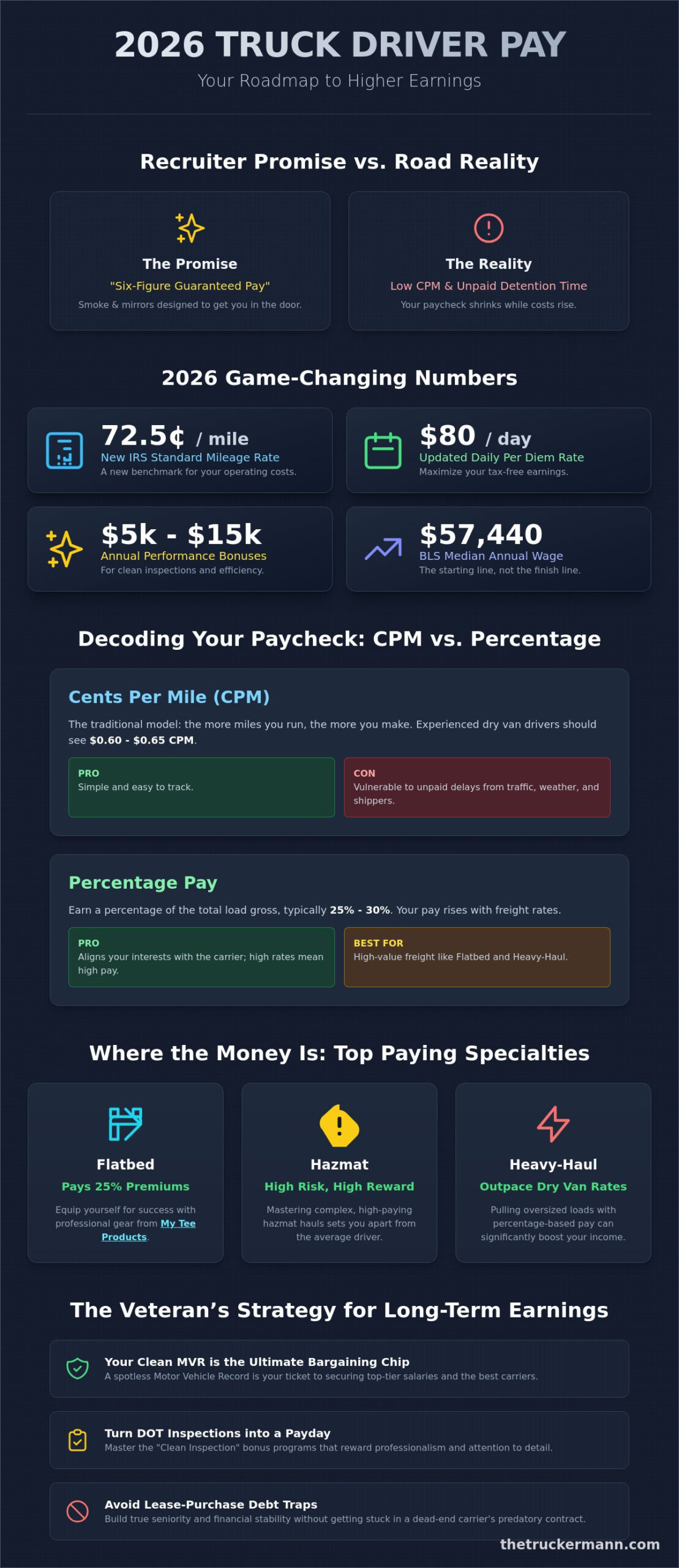
Let’s talk straight. The $57,440 median annual wage reported by the BLS is a safe starting point, but it doesn’t tell the whole story for a driver looking to maximize their truck driver salary in 2026. The market has shifted significantly. It’s no longer just about who can hold a wheel; it’s about who can maintain a spotless MVR and handle complex, specialized freight. With the January 16, 2026, enforcement of stricter broker financial responsibility, the floor for reliable carriers is finally stabilizing, offering more protection against non-payment and fraudulent activities that used to gut a driver’s bottom line.
To truly grasp The State of Truck Driver Pay in 2026, you have to look past the base CPM. A veteran’s total compensation package now includes the updated $80 daily per diem rate and performance bonuses that frequently add $5,000 to $15,000 to your yearly take-home. If you’re hauling specialized loads using high-quality securement gear from My Tee Products, you’re already positioning yourself for the upper tier of the pay scale where expertise meets the grit of the field.
To better understand how to climb the earnings ladder, watch this helpful video:
“Average” is a dangerous word in this business. It lumps the rookie doing local dry van drops in with the heavy-haul specialist pulling oversized loads through the Rockies. In 2026, if you aren’t seeing at least $0.60 to $0.65 CPM for dry van as an experienced driver, you’re underpaid. The 2026 IRS standard mileage rate of 72.5 cents per mile also sets a new benchmark for what it actually costs to keep a rig moving. This is a critical number for anyone considering the jump to owner-operator or trying to negotiate a fair fuel surcharge.
National Averages vs. Regional Reality
National data ignores the fact that a paycheck in the Midwest stretches much further than the same amount on the coast. Regional freight volumes are shifting rapidly. Drivers in manufacturing hubs are seeing steady gains as companies shorten supply chains and focus on domestic production. You need to know the specific value of your lane. Cost-of-living adjustments are finally being baked into regional contracts, meaning your home base is now a primary factor in your annual earnings potential.
The Rise of Guaranteed Minimum Pay
Breaking Down 2026 Pay Structures: CPM, Percentage, and Salary
How you get paid is often more important than the number on your offer letter. While the industry frequently talks about a median truck driver salary, the reality is that your take-home pay depends on which mathematical model your carrier uses. Most OTR drivers still live and die by Cents Per Mile (CPM). In 2026, experienced dry van drivers are seeing rates between $0.60 and $0.65 per mile. It’s a simple system; the more you roll, the more you make. However, it leaves you vulnerable to traffic, weather, and warehouse delays that don’t add a dime to your check.
When you’re looking at a Breaking Down 2026 Pay Structures: CPM, Percentage, and Salary report, you’ll see the national medians, but those figures don’t always account for accessorial pay. This is the “hidden” money that protects your time. Layovers, stop-offs, and breakdown pay can be the difference between a profitable week and a wasted one. If you’re hauling local or dedicated routes, you might even see an hourly or salary structure. This provides stability, but it often caps your upside compared to the high-mileage grinders on the open road.
The Math Behind Percentage Pay
Percentage pay is the preferred model for many in the flatbed and heavy-haul sectors. Instead of a flat rate per mile, you earn a cut of the total load gross, typically ranging from 25% to 30%. This aligns your interests with the carrier. When freight rates spike, your paycheck spikes too. This is especially lucrative for drivers who use professional-grade securement gear from My Tee Products to handle high-value cargo. Just be vigilant; always ask for the original rate confirmation. If a carrier refuses to show you the gross, they might be skimming off the top before calculating your share.
Detention and Breakdown Pay: Protecting Your Time
Your clock is your most valuable asset. In 2026, savvy drivers are using ELD data to prove exactly how long they’ve been sitting at a shipper’s dock. Don’t settle for “industry standard” detention that only pays after four hours of waiting. Demand compensation that starts after the second hour. If you want to keep your truck driver salary growing, you have to treat your time like the finite resource it is. You can find more tips on negotiating these rates by keeping up with the latest industry shifts at thetruckermann.com.
High-Paying Specialties: Why Flatbed and Hazmat Lead the Pack
If you’re tired of the “steering wheel holder” rates, it’s time to look at where the real money is moving. While dry van freight keeps the country running, it’s the specialized niches that offer a significant boost to a truck driver salary. We call this the “sweat equity” premium. It’s the extra cash you earn because you’re willing to step out of the cab, climb on a trailer, and secure a load in the wind and rain. In 2026, flatbed drivers are seeing national averages between $64,000 and $70,000, which is a solid 15% to 25% jump over standard dry van work.
Flatbedding isn’t just about driving; it’s about the technical skill of securement. To play in this league, you need professional-grade tools that won’t fail when the DOT is watching. Sourcing your chains and binders from My Tee Products ensures you aren’t fighting your equipment when you should be focused on the road. When you invest in a full setup from My Tee Products, you’re telling the world you’re a professional who values safety and efficiency. This expertise is exactly why specialized haulers are currently out-earning the general freight crowd.
Flatbed Securement: Skills That Pay Bills
Mastering the art of the tarp and the science of the winch is a career-long investment. You can’t cut corners here. High-quality gear from Truck n Tow is essential for keeping your load legal and your record clean. Using proper securement gear doesn’t just prevent accidents; it protects your safety bonuses. One shifted load can wipe out a year of hard work, so don’t gamble on cheap hardware when your livelihood is on the line.
Endorsements: The Cheapest Way to Give Yourself a Raise
Endorsements are the most efficient way to boost your truck driver salary without necessarily switching carriers. The Bureau of Labor Statistics highlights that specialized haulers are in high demand through 2034, with roughly 237,600 openings projected annually. Adding a Hazmat (H) or Tanker (N) endorsement opens doors to freight that pays a 15% to 35% premium. In 2026, the average annual pay for a hazmat driver is $57,554, but top earners in specialized chemical transport often clear $110,000.
Be prepared for the 2026 regulatory shift. The background check process for these endorsements is stricter than ever, requiring enhanced identity verification and work eligibility checks for all drivers. It takes more time and a bit of grit to navigate the paperwork, but the payoff is worth it. If you want the real goldmine, look toward LTL linehaul. Pulling doubles and triples (T endorsement) often leads to the highest-paying company driver positions in the industry, where respecting your time is part of the corporate culture.
Maximizing Take-Home Pay: Efficiency and Clean Records
Gross pay is a vanity metric. If you want to see a real increase in your truck driver salary, you have to master the art of keeping what you earn. In 2026, the standard per diem rate for travel expenses within the continental U.S. is $80 per day. Since you’re permitted to deduct 80% of that, which amounts to $64 daily, you’re effectively shielding a massive chunk of your income from the taxman. It’s like giving yourself a raise without driving an extra mile. When you combine this tax strategy with fuel efficiency, you’re squeezing every bit of profit out of the tank.
A major part of this efficiency is proactive maintenance. Using a CDL Pre-Trip Inspection Checklist isn’t just about safety; it’s about avoiding the pay-docking violations that carriers use to trim their overhead. If you’re hauling flatbed with gear from My Tee Products, a quick check of your straps and winches can save you thousands in fines and lost time. High-quality equipment from My Tee Products pays for itself by preventing the gear failures that lead to costly delays.
The Cost of a ‘Dirty’ MVR
Insurance companies are the silent partners in your career. Because of the 2026 insurance reality, carriers simply can’t afford to hire drivers they deem risky. One speeding ticket can instantly drop you into a lower pay bracket or disqualify you from the best-paying fleets. Most top-tier carriers now demand a minimum 3-year clean MVR. Protecting your license is the single most important thing you can do for your long-term truck driver salary. Once that record is stained, the high-paying niches like hazmat or oversized loads become much harder to enter.
Passed Inspections = Direct Cash
Don’t view a DOT officer as an enemy. View them as a potential bonus. Many reputable carriers now pay between $50 and $500 for every clean Level 1 inspection you bring back. If you’re prepared for the Ultimate DOT Inspection, you aren’t just avoiding trouble; you’re actively hunting for extra cash. Safety isn’t a burden. It’s a professional reputation that makes you a preferred choice for high-value loads. You can stay ahead of the inspectors by checking out our latest safety and compliance updates to keep your record spotless.
The Veteran’s Strategy for Long-Term Earnings
You’ve survived the rookie years and mastered the art of the road. You know how to secure a load with your eyes closed using professional gear from My Tee Products. Now, the challenge shifts from just making miles to managing a career. A veteran’s truck driver salary isn’t just a reflection of their time behind the wheel; it’s the result of strategic moves that protect their health, their license, and their bank account. In 2026, the real pros are the ones who know when to stay put and when to jump to a carrier that actually values their expertise.
Building seniority doesn’t mean staying at a dead-end company for a decade. It means building a reputation so solid that the best-paying fleets in the country come looking for you. Whether you’re staying on the road or looking to transition into fleet management or safety roles, your track record is your currency. The industry is changing, and those who invest in their professional development today are the ones who will be calling the shots tomorrow.
Avoiding the Lease Purchase Trap
The Truckermann’s warning on “No Money Down” lease deals is more relevant now than ever. These contracts are often designed as debt traps that benefit the carrier far more than the driver. In a 2026 market defined by economic volatility, the overhead of a lease can quickly evaporate your take-home pay. Before you try “becoming your own boss,” calculate the real costs of insurance, maintenance, and fuel. For many, staying a company driver with a guaranteed minimum is the safer, more profitable bet while the market stabilizes. If you do decide to buy, ensure you’re sourcing your equipment from reliable partners like Truck n Tow to keep your maintenance costs under control.
Investing in Your Future
The road eventually ends for everyone, but your earning potential doesn’t have to. Smart veterans are using resources like DLA Academy to level up their industry knowledge and prepare for life beyond the cab. Whether it’s learning the ropes of brokerage or mastering safety regulations, education is the best way to increase your truck driver salary ceiling. Don’t ignore the power of networking at truck stops and terminals either. The best jobs are often found through a handshake and a shared story rather than a job board.
Your character on the road defines your bank account. Every clean inspection, every on-time delivery, and every professional interaction adds to your value. As you look ahead to the rest of the year, remember that the right strategy is just as important as the right rig. Ready to gear up for a better-paying year? Check out our top gear recommendations to ensure you have the tools you need to succeed.
Master Your Financial Future on the Open Road
The road ahead in 2026 belongs to the driver who treats this profession like a high-stakes business. We’ve broken down why chasing a top-tier truck driver salary requires more than just logging miles; it takes the right endorsements, a spotless record, and a mastery of tax-free per diem strategies. By focusing on specialized freight like flatbed or hazmat and avoiding the lease-purchase traps that snag the unwary, you’re doing more than just surviving the latest industry shifts. You’re positioning yourself as a professional veteran that carriers will fight to keep.
Take this veteran-led advice and apply it to every pre-trip inspection and every load securement. Whether you’re upgrading your equipment at My Tee Products or staying ahead of the 2026 regulatory curve, your commitment to professional excellence is what defines your bank account. Success isn’t just about the truck you drive. It’s about the discipline you bring to the cab every single day. Keep your eyes on the horizon and your record clean.
This commitment to excellence often carries over into personal projects and hobbies. For drivers who enjoy the mechanical side of the industry, restomodacademy.com is a great resource for understanding the costs involved in restoring classic cars during your downtime.
Gear up for the high-paying loads at My Tee Products
Frequently Asked Questions
What is the average truck driver salary in 2026?
The median truck driver salary in 2026 sits at $57,440 annually, based on the latest data from the Bureau of Labor Statistics. This breaks down to a median hourly wage of $27.62. While this is the middle of the road, top earners in specialized sectors often exceed $129,000 by leveraging endorsements and clean driving records. Your specific lane and experience level will ultimately dictate where you fall on this scale.
How much more do hazmat drivers make compared to standard OTR?
Hazmat drivers typically earn a premium of 15% to 35% over standard dry van rates. While the average annual pay for hazmat is approximately $57,554, the typical range extends up to $64,386 or more for specialized chemical transport. The higher pay reflects the stricter 2026 background checks and the increased responsibility of hauling hazardous materials. It is a lucrative path for those who value regulatory discipline.
Is flatbed trucking worth the extra work for the pay?
Flatbedding is definitely worth the effort, as it pays roughly $64,000 to $70,000 per year. This is about 15% to 25% higher than the national average for dry van drivers. The extra income covers the physical labor of tarping and chaining loads. Using professional securement gear from My Tee Products makes the job safer and more efficient, helping you earn that “sweat equity” premium without unnecessary gear failures.
How does detention pay work for company drivers?
Detention pay is an hourly rate meant to compensate you for time spent waiting at a shipper or receiver. Most 2026 contracts trigger this pay after the second hour of waiting. Reputable carriers use ELD data to verify these claims and ensure you aren’t working for free while the warehouse takes its time. It is a vital protection for your paycheck, so always confirm the specific detention rate in your hiring agreement.
Can a new driver make $100k in their first year?
While making $100,000 in your first year is rare, entry-level drivers can realistically earn between $50,000 and $82,000. Reaching the six-figure mark usually requires at least five years of experience and a move into highly specialized niches. New drivers who focus on oil field work or team driving in high-demand lanes have the best shot at pushing toward the upper end of that entry-level range early on.
What are the highest-paying trucking companies in 2026?
Private fleets and LTL linehaul carriers consistently offer the highest compensation packages in the industry. These companies value safety and often provide drivers with top-tier equipment from My Tee Products to maintain their high standards. Look for carriers with low turnover rates and strong safety bonuses. These “destination companies” usually require a clean MVR and several years of verifiable experience before they will consider your application.
How does per diem affect my taxes and take-home pay?
Per diem is a tax-free reimbursement for your travel expenses that significantly increases your actual take-home pay. For 2026, the standard per diem rate is $80 per day, and you can deduct 80% of that, which is $64 daily. By receiving a portion of your check as per diem, you lower your taxable income. This means you owe less to the IRS at the end of the year while keeping more cash in your pocket.
Do owner-operators really make more than company drivers?
Owner-operators gross much more, sometimes over $200,000, but their net truck driver salary is often comparable to a top-tier company driver. After paying for fuel, insurance, and maintenance, most owner-operators net between $70,000 and $120,000. A company driver in a specialized niche like hazmat can earn a similar net income without the massive financial risk or the burden of managing all the overhead costs of the rig.
Disclaimer
The information provided on The TruckerMann is for general informational and educational purposes only. While every effort is made to ensure the accuracy and reliability of the content, trucking laws, FMCSA regulations, DOT requirements, safety standards, and industry policies can change at any time. Readers are encouraged to verify all information with official government agencies, professional advisors, or qualified industry professionals before making business, legal, financial, safety, or compliance-related decisions.
The content shared on this website reflects personal opinions, experiences, research, and commentary and should not be considered legal, financial, medical, tax, or professional advice. The TruckerMann and its owners, contributors, affiliates, or representatives are not responsible for any losses, damages, violations, penalties, or liabilities resulting from the use or misuse of information found on this website.
Some content on this website may contain affiliate links, sponsored content, or promotional material. This means we may earn a commission at no additional cost to you if you choose to purchase through certain links.
By using this website, you agree that you do so at your own discretion and risk.